At a glance
| Patent number | CN208958444U (application CN201720958598) |
| Type | China utility model (实用新型) - protects product shape and structure |
| Original title | Inflatable cervical traction device conforming to the physiological curve of a child’s neck (一种符合儿童颈部生理曲线的充气式颈椎牵引器) |
| Patent owner | Children’s Hospital of Fudan University |
| Inventors | Li Zhiping, Lu Jinmiao, Li Qin |
| Filing date | 2017-08-02 |
| Grant date | 2019-06-11 |
| Status (China) | Lapsed - terminated for non-payment of annual fees (recorded 2025-07-25) |
| Patent family | Chinese filings only - no US, European, Japanese, PCT or other filings listed |
| Cited by | 2 later documents |
| Source | Google Patents (search for CN208958444U) |
What the claims cover, in plain language
Claim 1 - an inflatable cervical traction device with an air collar, an inflation bulb valve, a pair of shoulder supports, a pair of shoulder struts and an inflation tube. The collar has a vent with a sealing plug, is C-shaped and open at the back, and is made of three air rings joined top to bottom and connected inside. The struts are fixed under the collar and carry the shoulder supports, which are U-shaped caps over the shoulders; the struts are telescoping, so the collar can be raised and lowered.
Claim 2 - the rings are rubber wrapped in flannel. Claim 3 - the collar is taller at the front than at the back, so its top is a slope. Claim 4 - an adjusting strap at the open end tightens the collar around the neck. Claim 5 - the bulb valve is an air hose, valve and latex bulb. Claim 6 - rotating joints between struts and shoulder caps.
This is a simplified reading for orientation only. The legal scope is defined by the exact claim wording in the official Chinese document.
What this means for US production
This patent was filed only in China and has lapsed, so it no longer restricts anyone in China either. It has no US or other foreign counterpart.
Two points to settle early:
- Other patents may exist. Inflatable neck traction collars and over-the-door traction devices are an active area for US home-therapy brands, so a freedom-to-operate (FTO) review of the collar shape, strut and shoulder-cap design is needed before tooling.
- Regulatory route first. As a pediatric medical device, the regulatory pathway and labeling decide the project plan more than the tooling does.
Customization and manufacturing
What can be customized
| Area | Options |
|---|---|
| Sizes | Two or three child sizes by neck length and shoulder width |
| Collar material | Rubber or medical-grade TPU rings; flannel, cotton or knit covers, removable for washing |
| Inflation | Latex or latex-free bulb, pressure-relief valve, gauge option |
| Struts | Plastic or aluminum telescoping struts with marked height steps |
| Shoulder caps | Molded caps with foam lining; pivot range |
| Kit | Carry bag, instruction booklet for clinicians and parents |
Things to plan for (US market)
- FDA classification and registration - traction equipment is regulated under 21 CFR Part 890 (physical medicine devices); the product code and whether a 510(k) is needed are confirmed before launch, and the manufacturer registers and lists the device (21 CFR 807).
- Quality system - production follows FDA quality system requirements (21 CFR 820) at an FDA-registered facility.
- Natural rubber latex labeling - a latex bulb requires the latex caution statement under 21 CFR 801.437; a latex-free bulb avoids it.
- Biocompatibility - skin-contact materials are assessed to ISO 10993-1 (cytotoxicity, sensitization, irritation).
- Labeling - indications, contraindications and use under clinical direction, written for both clinicians and parents.
How a project runs
- Inquiry - target ages, sizes, sales channel and regulatory plan.
- Design - collar ring profiles, front-to-back slope, strut range, cap shape.
- Prototype - fit trials on sized head-and-shoulder forms, leak and burst testing.
- Pilot run - biocompatibility samples, labeling, regulatory file.
- Production - ring welding or molding, cover sewing, assembly and packing.
Quantities & timeline
The air rings need RF-welding or dip-molding tools, the struts and shoulder caps need injection molds, and covers are cut and sewn. Most of the timeline is regulatory - classification, testing and labeling - rather than tooling. Send us your size range, materials, regulatory plan, quantity and target price and we will reply with options.
Patent drawings
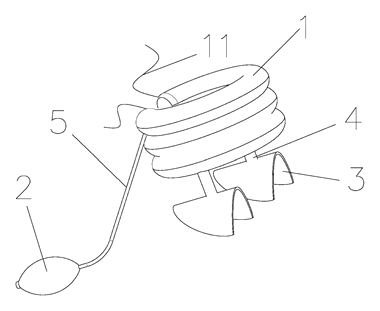
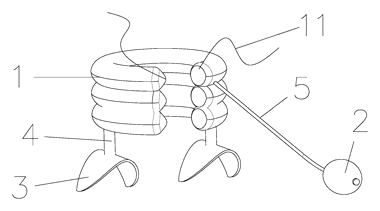
Drawings reproduced from the public patent document for reference.