
Patent CN209399235U
Updated November 6, 2026LED Plant Growth Light with Adjustable Side Wings
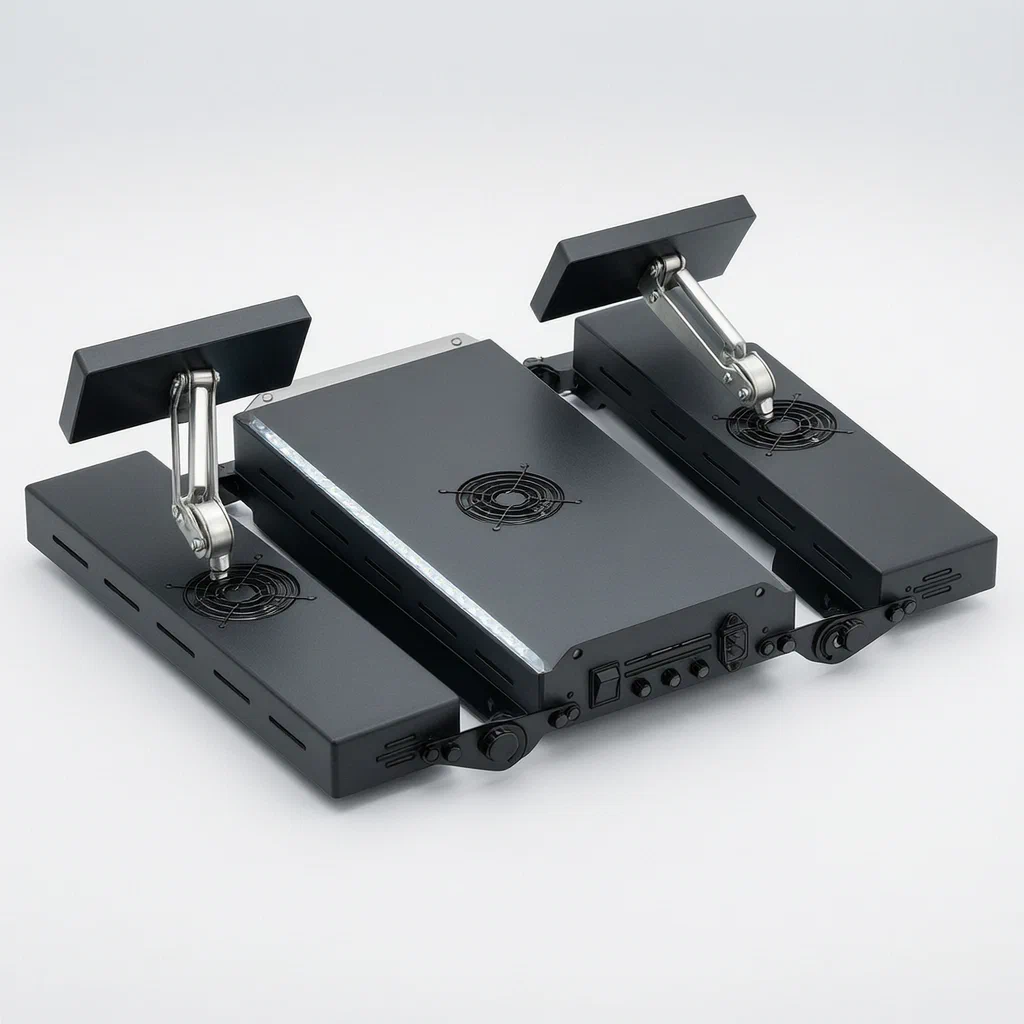
Fixed grow lights force you to choose between wide coverage and high intensity. If plants are tall, the top gets too hot while the bottom stays dark. If plants are short, the light is wasted. This design solves it by adding two 'wings'—auxiliary light bars attached to the main unit via hinged brackets. You can swing these wings up to cast light onto taller foliage or fold them inward to concentrate beams on dense clusters. Each section has its own dimmer, so you can tune the light recipe for different growth stages without moving the entire fixture.
- China utility model - lapsed
- No filings outside China
- Indoor gardening / Horticulture lighting
- Aluminum housings, adjustable brackets, independent dimming
Splat! What let you down?
📐
Adjustable Angle
Side wings hinge on brackets to tilt up or down, changing the light spread.
💡
Dual Dimming
Separate controllers for the main body and side wings allow precise intensity tuning.
❄️
Active Cooling
Heat sinks with parallel fins and fans manage temperature for both sections.
🔧
Modular LEDs
LED beads on the side panels are detachable, simplifying replacement or spectrum swaps.
Bring this product to market
- ✓ Patent review Patent family and legal status reviewed in the relevant jurisdictions.
- 2 Product brief · now How it works, uses and options written up
- 3 Prototype First samples for buyers to review
- 4 Pilot run Small first batch for launch customers
- 5 Volume production Repeat orders at scale
Buyer interest
– of 100 buyers needed to start prototyping
One click, no sign-up. Each vote is one real visitor, and products with the most interest go to prototyping first.
Build team: no members yet. Need a partner, co-funding or skills to build this? Join and we introduce the team once it forms.
Patent Rights & Team Participation
Before joining a development team, participants should ensure they have the necessary rights or authorization to participate in the project.
Participation is generally appropriate where:
- You own the relevant patent rights or have obtained permission or a license from the rights holder.
- The relevant patent rights have expired or have been legally invalidated in the jurisdictions where the planned activities will take place.
- The planned development, manufacturing, and commercialization activities have been independently assessed and do not infringe applicable patent rights in the relevant jurisdictions.
Important: Being located outside a country where a patent is protected does not automatically exempt you from patent infringement risks. Patent rights may apply based on where development, manufacturing, use, sale, or import activities take place.
IP2M does not grant any patent license or authorization through team participation. Joining a project does not provide permission to use, manufacture, or commercialize patented technology.
The problem
Traditional single-panel LED grow lights have a fixed beam angle. When placed over plants of varying heights, they often fail to deliver uniform light. Tall plants receive excessive heat and light at the top, starving the lower leaves, while short plants sit under unused, dispersed light. Adjusting the height of the entire fixture is cumbersome and may not solve the issue if the canopy shape is irregular. Furthermore, standard fixtures usually offer only one level of brightness control, making it difficult to balance light distribution across different parts of the growing area without wasting energy or stressing sensitive plants.
The solution
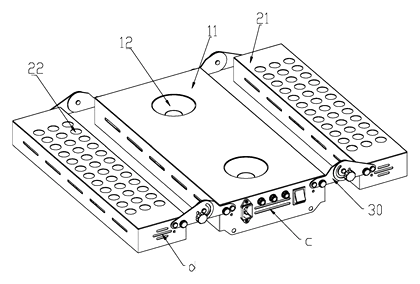
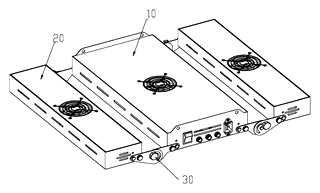
The patent describes a three-part lighting system: a main lamp body (10) flanked by two auxiliary lamp bodies (20). These side units are not rigidly fixed; instead, they attach via adjustable connecting brackets (30).
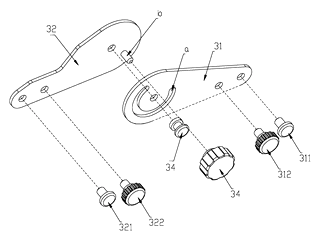
- The brackets use a pivot mechanism with a limit ring groove and shaft, secured by an adjustment knob. This allows the user to rotate the side wings relative to the main body.
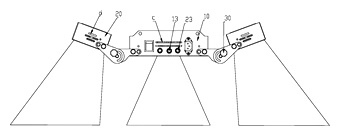
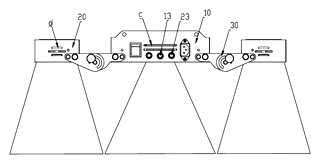
- By tilting the wings upward, the light covers a broader area, suitable for wide, low-growing plants.
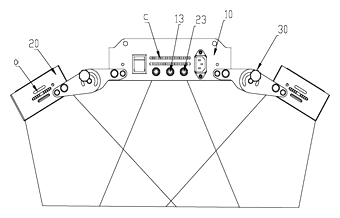
- By tilting the wings inward/downward, the beams overlap with the main light, increasing intensity in a focused zone for dense or tall canopies.
- Each section has its own power supply and dimmer, allowing independent control of the central and side illumination levels.
Who it is for
- Indoor farming startups needing flexible lighting for mixed crop heights without buying multiple fixtures.
- Home gardening enthusiasts who want to optimize light for houseplants or small vegetable patches with irregular shapes.
- Commercial nursery operators managing large trays where edge plants need different light angles than center plants.
- Hydroponic kit manufacturers looking to add a premium feature (angle adjustment) to their existing LED bar designs.
How it works
The main parts
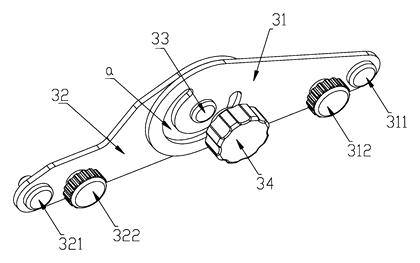
| No. | Part | What it does |
|---|---|---|
| 10 | Main Lamp Body | Central housing with integrated light source and first dimmer. |
| 20 | Auxiliary Lamp Bodies | Two side wings containing LED boards and second/third dimmers. |
| 30 | Adjustable Bracket | Connects side wings to main body; enables angle change. |
| 31/32 | Connecting Plates | First and second plates hinged together by a rotating shaft. |
| 34 | Adjustment Knob | Locks the angle between the plates after setting. |
| 8/9 | Heat Sinks & Fans | Aluminum fins and fans cool the main and side units separately. |
| 6 | LED Boards | Removable panels in side wings holding various color/wavelength beads. |
Operating steps
- Mount the fixture above the plant canopy using the main body’s hanging points.
- Loosen the adjustment knobs on the side brackets.
- Tilt the side wings to the desired angle: outward for broad coverage or inward for concentrated intensity.
- Tighten the knobs to lock the position securely.
- Adjust brightness independently using the separate dimmers for the main and side sections to match plant needs.
Applications
Vertical farming racks
In multi-tier shelving, space is tight. Tilting the side wings downward directs light precisely onto the shelf below, reducing spillage and glare for workers while ensuring lower plants get adequate intensity.
Greenhouse supplemental lighting
Greenhouses often have uneven sunlight patterns due to structural shadows. Growers can angle the side wings to fill dark spots created by beams or pipes, creating a more uniform light environment for crops like tomatoes or peppers.
Home indoor gardens
Houseplants vary in height and leaf density. A user can spread the wings wide for a fern or orchid collection, then narrow them for a tall fiddle-leaf fig, adjusting the daily light integral without moving the heavy fixture.
Nursery propagation tables
Seedlings require gentle, even light. Angling the wings outward creates a soft, diffuse wash over flat trays, preventing hotspots that could scorch delicate sprouts while maintaining efficiency.
Where it is less suitable
- Single-crop monoculture: For vast, flat fields of identical low-height plants, simple fixed-angle floodlights are cheaper and easier to install.
- High-humidity mist rooms: While electronics are potted, the open fan vents in this design may require additional sealing compared to fully enclosed IP65-rated industrial fixtures.
Patent & Production
At a glance
| Patent number | CN209399235U (application CN201920458239) |
| Type | China utility model (实用新型) - protects product shape and structure |
| Original title | A kind of LED plant growth lamp (一种LED植物生长灯) |
| Patent owner | Shenzhen Panxing Da Technology Co Ltd |
| Inventors | Tang Yiming |
| Filing date | 2019-04-03 |
| Grant date | 2019-09-17 |
| Status (China) | Lapsed - terminated for non-payment of annual fees (recorded 2026-03-27) |
| Patent family | Public record shows Chinese filings only - no US, European, Japanese, PCT or other filings listed |
| Cited by | 9 later documents |
| Source | Google Patents (search for CN209399235U) |
What the claims cover, in plain language
Claim 1 - an LED plant growth lamp comprising a main lamp body and two auxiliary lamp bodies distributed on both sides. They are connected by an adjustable connecting bracket used to regulate the irradiation angle of the auxiliary bodies relative to the main body.
Claim 2 - the bracket consists of a first connecting plate, second connecting plate, rotating shaft, and adjustment knob. The plates overlap and hinge on the shaft. A limit ring groove on the first plate and a limit shaft on the second plate interact, with the knob screwing onto the shaft to lock the angle.
Claim 3 - fixing rivets and knobs allow the bracket ends to be hinged and secured to the lamp bodies. Claim 4 - two sets of brackets are used, one at each end of the side wings. Claim 5 - the main body has a housing with an integrated light source and a first dimmer. Claim 6 - the auxiliary bodies have housings with lamp boards holding detachable LED beads of various wavelengths/color temperatures, controlled by a second dimmer. Claims 7-10 - specify rectangular housing shapes, separate heat sinks with parallel fins, ventilation holes, cooling fans for both main and side units, and independent power supplies for the main and side circuits.
This is a simplified reading for orientation only. The legal scope is defined by the exact claim wording in the official Chinese document.
What this means for US production
This patent was filed in China and has lapsed, so it no longer restricts anyone in China either. The public record shows no US or other foreign counterpart.
Two points to settle early:
- Other patents may exist. The horticulture lighting field is active. One company, Jiaxing Shanpu Lighting Appliance Co., Ltd., holds a later international filing (WO2024245209A1) citing this patent. While this does not imply infringement, it indicates ongoing innovation in this niche. A freedom-to-operate (FTO) review is recommended before tooling to check for any valid US patents covering adjustable multi-arm grow lights.
- Electrical Safety. Unlike mechanical furniture, this device involves mains electricity and thermal management. Compliance with UL standards is critical for US market entry.
Customization and manufacturing
What can be customized
| Area | Options |
|---|---|
| Spectrum | Full-spectrum white, red/blue mix, or UV-added beads (replaceable modules) |
| Wattage | Scale LED count per board; adjust driver capacity |
| Housing Size | Length of main and side bars; width ratio (side < half of main per Claim 7) |
| Bracket Range | Limit stop positions to restrict max/min tilt angles |
| Controls | Analog knobs vs. digital PWM dimmers; remote/dimmer integration |
| Finish | Powder-coated aluminum extrusion colors (white/black) |
Things to plan for (US market)
- UL 153 / UL 8750 - Standard for luminaires and LED equipment. Essential for retail sales in the US.
- FCC Part 15 - Electromagnetic compatibility testing for digital drivers and controls.
- Energy Star - Optional certification for commercial buyers seeking efficiency incentives.
- California Title 20 - Appliance efficiency regulations if sold in CA.
How a project runs
- Inquiry - Target wattage, spectrum preference, quantity, and mounting style.
- Design - Thermal simulation, bracket mechanics, PCB layout, and housing extrusion profile.
- Prototype - 3D-printed housings for fit checks; functional samples with real LEDs and drivers.
- Pilot run - Aging tests (thermal stability), drop tests for brackets, electrical safety pre-checks.
- Production - Aluminum extrusion cutting, CNC machining for brackets, injection molding for plastic parts, potting for electronics, final assembly.
Quantities & timeline
Extrusion dies are required for the housing profiles. Injection molds are needed for the bracket knobs and end caps. Thermal testing takes significant time to ensure fan noise and heat dissipation meet specs. Send us your target wattage, spectrum, quantity and timeline and we will reply with options.
Production notes
Tooling and process
Likely requires aluminum extrusion dies for the main and side housings. Plastic components like the adjustment knobs and end caps typically need injection molds. Electronics must be potted to protect against humidity, a common condition in greenhouses.
Cost drivers
UV-stabilized materials are typically essential for outdoor or greenhouse use to prevent yellowing. Corrosion protection on metal brackets adds cost. Packaging volume affects shipping rates significantly due to the bulky shape.
Prototyping path
Typically, start with 3D-printed parts to verify the bracket geometry and fit. Create a coated tube sample for the housing aesthetic. Conduct UV and spray tests on finishes. Build a functional sample with actual LEDs to test thermal performance before tooling.
What we would change before tooling
We would likely refine the thread engagement of the adjustment knob to prevent stripping during frequent use. Hinge boss wear is a risk; adding metal inserts or reinforcing the plastic pivot point is recommended.
Common failure points
Water ingress in electronics is the primary risk if potting is incomplete. Wind load tipping could occur if mounted outdoors without sufficient ballast. Heat path issues may arise if the fan fails or dust blocks the ventilation holes.
Patent drawings
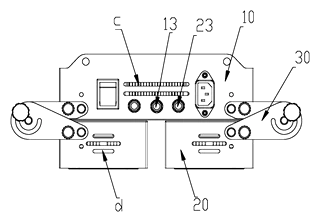
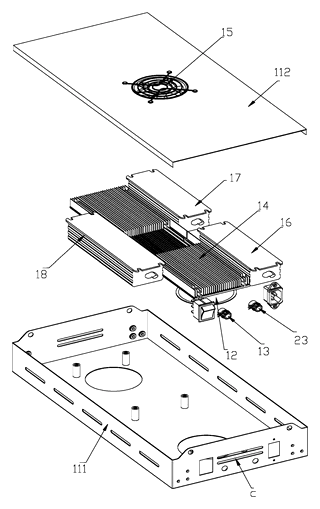
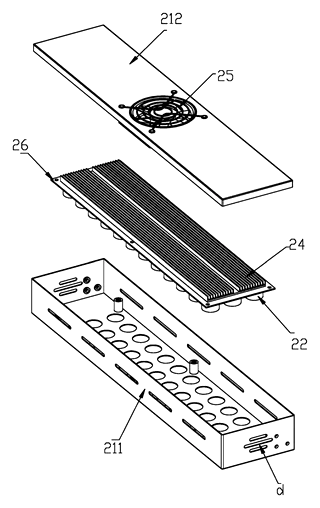
Drawings reproduced from the public patent document for reference.
Frequently asked questions
How do I adjust the light angle?
Each side wing connects to the main body via a bracket with a central pivot. Loosen the adjustment knob, tilt the wing up or down to your desired position, and tighten the knob to lock it in place.
Can I change the light spectrum?
Yes. The patent describes detachable LED beads on the side lamp boards. In production, these can be swapped for different color temperatures or wavelength mixes (e.g., red/blue for flowering, full-spectrum white for veg).
Is the brightness controllable?
It features independent dimmers. One controls the main central light, and another controls the two side wings. This lets you boost the sides for edge plants without over-lighting the center.
Does it get hot?
The design includes dedicated heat sinks with parallel fins and cooling fans for both the main and side units. Ventilation holes allow airflow. Proper installation ensures heat dissipation.
Is it waterproof?
The patent mentions potted electronics and sealed housings. However, it is primarily designed for indoor/greenhouse use. For outdoor rain exposure, confirm the IP rating during the quote stage.
Why are there two side wings?
They extend the coverage area horizontally. By angling them, you can create a “wall” of light around tall plants or spread light wider over low plants, reducing dark spots compared to a single panel.
Can this design be made and sold in the US?
The patent was filed in China and has lapsed, and the public record shows no US counterpart, so it does not restrict the design in the US or in China. Adjustable grow lights may be covered by other US patents - see Patent & Production - so we recommend a freedom-to-operate check before volume production.
Are you affiliated with the patent owner?
No. IP2M is an independent design and manufacturing service working from the public patent document.
Request a quote
Click Request a Quote below to see our email address - copy it, or open your email app with a ready-made message. Please mention patent CN209399235U in the subject.
Helpful details to include:
- Your company and channel (indoor farm, home garden brand, hydroponics supplier)
- Target wattage and total lumens/PPFD requirements
- Spectrum preference (full spectrum, red/blue, custom)
- Quantity and estimated monthly volume
- Certification needs (UL, FCC, Energy Star)
- Timeline - when you would like samples and the first shipment
You can also reach us at (332) 203-9997.
Page editor: Emily Zhang, Product Editor · IP2M
Last updated November 6, 2026. If something on this page looks wrong, email [email protected] and we will check it against the patent.
Interested in building this?
Tell us your target market, quantity and timeline. We reply with options for prototyping, small-batch runs or volume production.
Send your inquiry to
Please put CN209399235U in the subject line and tell us your company, country, estimated quantity and timeline.
Prefer to talk? Call (332) 203-9997.
More product-ready patents
All Garden & Outdoor patents →
Garden & Outdoor
2-in-1 Parent & Child Umbrella
Full-size umbrella with a nested smaller umbrella on top - a rotating decorative layer that detaches into a kid-size umbrella.
Patent CN205611962U
Garden & Outdoor
Wire-Mesh Tree Root & Trunk Guard Against Rodents
Three-part wire-mesh guard that protects the roots and lower trunk of young trees from burrowing and gnawing animals.
Patent CN206808261U
Garden & Outdoor
Adjustable-Angle Tree Support Prop
Tree prop with a pinned base, angle-locking hinge, twist-adjust tube and a locking trunk ring.
Patent CN208370491U
Garden & Outdoor
Self-Renewing Glue-Roller Mosquito Trap
UV insect trap with a glue roller that re-coats itself and scrapes the catch into a tray - no glue boards.
Patent CN217038569U
Garden & Outdoor
Cam-Lock Telescopic Pole for Garden Power Tools
Telescopic pole for garden power tools with cam-lever locks and a spring-button, tear-drop head socket.
Patent CN205812889U
Garden & Outdoor
Mosquito Fan That Listens for Mosquitoes Before It Sprays
Fan with a scanning microphone dish that mists repellent only when it hears mosquitoes.
Patent CN208708542U
Browse by category
- Apparel & Accessories (44)
- Baby & Kids (28)
- Bags & Luggage (16)
- Bath & Personal Care (29)
- Car Accessories (23)
- Furniture, Bedding & Storage (23)
- Garden & Outdoor (31)
- Health & Wellness (13)
- Home, Kitchen & Cleaning (47)
- Lighting (22)
- Packaging & Containers (11)
- Pet Products (11)
- Phone & Camera Accessories (9)
- Retail Display (24)
- School, Office & Art (33)
- Sports & Recreation (43)
- Tools & Workshop (51)
- Toys & Games (21)
This page is based on the public patent document CN209399235U, assigned to Shenzhen Panxing Da Technology Co Ltd. IP2M is an independent manufacturing service and is not affiliated with, endorsed by or licensed by the patent owner. Images marked as concept renderings are illustrations, not photos of an existing product. Patent status information is provided for reference only and is not legal advice; confirm freedom to operate for your market before production. Full disclaimer.