At a glance
| Patent number | CN209436389U (application CN201821511955) |
| Type | China utility model (实用新型) - protects product shape and structure |
| Original title | Button with chamfer (具有倒角的纽扣) |
| Patent owner | Jiashan Fuda Garment Accessories Factory (general Partnership) |
| Inventors | Yu Binxian, Jin Jinming |
| Filing date | 2018-09-14 |
| Grant date | 2019-09-27 |
| Status (China) | Lapsed - terminated for non-payment of annual fees (recorded 2024-07-02) |
| Patent family | Chinese filings only - no US, European, Japanese, PCT or other filings listed |
| Cited by | 3 later documents |
| Source | Google Patents (search for CN209436389U) |
What the claims cover, in plain language
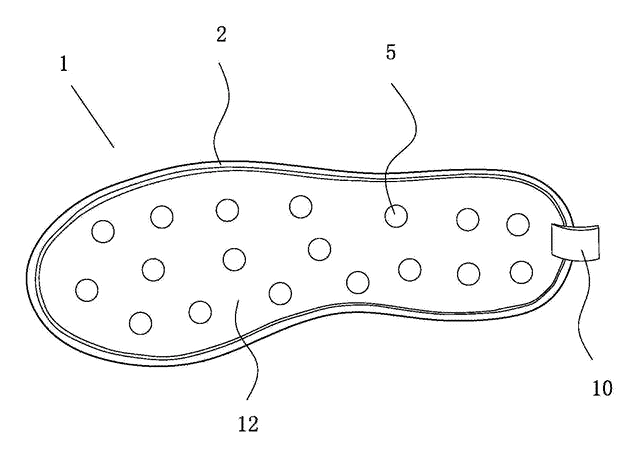
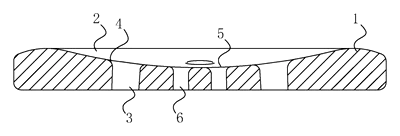
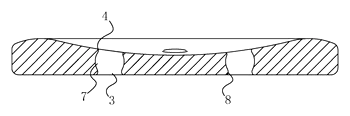
Claim 1 - a button comprising a button body (1) having one side provided with an inwardly recessed thread storage groove (2). The button body is penetrated by multiple threading holes (3). The edge of each threading hole on the side facing the thread storage groove is equipped with an outwardly protruding arc chamfer (4).
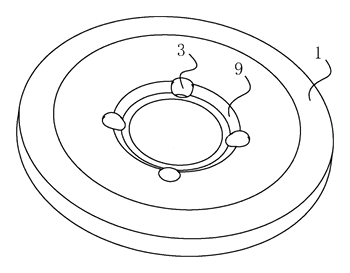
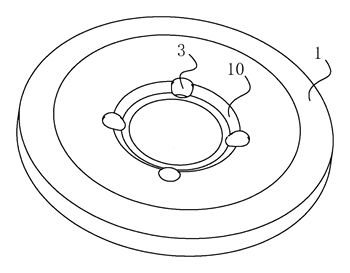
Claim 2 - there are four threading holes, and the part of the button body located between the four threading holes is recessed downward to form a groove (5). Claim 3 - the edge of the groove and the edge of the threading hole are connected by an arc surface transition. Claim 4 - the button body offers a via hole (6) passing through the upper and lower end faces within the groove. Claim 5 - at least two via holes are provided. Claim 6 - the inner wall of the threading hole, facing away from its center position, is concavely formed into an annular groove (7). Claim 7 - the edge of the threading hole on the side deviating from the thread storage groove is equipped with a circular arc corner (8). Claim 8 - the part of the button body between adjacent threading holes is recessed downward to form a gap (9). Claim 9 - the part of the button body between adjacent threading holes projects upward to form a circle support (10).
This is a simplified reading for orientation only. The legal scope is defined by the exact claim wording in the official Chinese document.
What this means for US production
This patent was filed only in China and is lapsed (terminated for non-payment of annual fees, recorded 2024-07-02), so it no longer restricts anyone in China either. It has no US or other foreign counterpart.
Two points to settle early:
- Other patents may exist. Button geometries, particularly those involving specific thread-channel profiles or anti-rotation features, are occasionally patented by major apparel hardware suppliers. While basic four-hole buttons are public domain, a freedom-to-operate (FTO) review of the specific chamfer angle and central groove combination is recommended before committing to dedicated molds.
- Material compatibility. The chamfer and groove geometry must be evaluated against the chosen button material (resin, urea, metal, shell) to ensure the thin edges around the holes do not chip during tumbling or pressing.
Customization and manufacturing
What can be customized
| Area | Options |
|---|---|
| Diameter | Standard shirt sizes (about 10 mm to 15 mm) or custom diameters to be confirmed in design |
| Material | Polyester resin, urea formaldehyde, corozo nut, metal alloy, natural shell |
| Hole count | Two-hole or four-hole variants using the same chamfer principle |
| Chamfer radius | Adjusted based on thread thickness used by the buyer’s sewing factory |
| Color and finish | Solid dyed, pearlescent, laser-engraved logo, matte or polished surface |
| Central groove depth | Set in design to balance thread clearance with overall button strength |
Things to plan for (US market)
- CPSIA (16 CFR 1501) - if the buttons are intended for children’s clothing (sizes up to 12), they must not present a choking hazard and must withstand the small-parts cylinder test; tensile pull testing of the attached button is required.
- California Proposition 65 - resin formulations, dyes, and metal alloys must be screened for listed chemicals such as lead, cadmium, and certain phthalates.
- ASTM D5171 - standard test method for measuring the button attachment strength in garments, commonly specified by US apparel brands to verify that the thread-and-button assembly holds under tension.
- OEKO-TEX Standard 100 - while voluntary, many US brands require garment components to carry this certification to prove the absence of harmful substances.
How a project runs
- Inquiry - button diameter, material, hole count, quantity, and target garment type.
- Design - CAD modeling of the chamfer radius, groove depth, and hole spacing; tooling drawings for the button press mold.
- Prototype - molded samples sent for visual inspection and trial sewing on the buyer’s bartacking machines.
- Pilot run - a short production batch to verify color consistency, dimensional tolerance, and tumble-polishing durability.
- Production - bulk molding, dyeing, finishing, laser engraving if specified, and packaging.
Quantities & timeline
Buttons are produced using multi-cavity compression or injection molds. A single mold set can contain dozens to hundreds of cavities depending on the button diameter. Tooling fabrication and initial sampling take the longest phase of the project, followed by bulk curing and finishing. Send us your diameter, material preference, color requirements, quantity and target price and we will reply with options.
Patent drawings
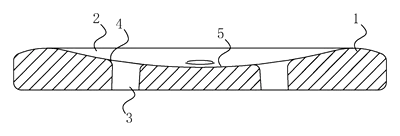
Drawings reproduced from the public patent document for reference.