
Patent CN209564602U
Updated October 25, 2026Ring-Layout Automatic Card Shuffler with Electromagnetic Box Coupling
Shuffling a deck by hand is slow, uneven, and easy to manipulate when players watch closely. This machine solves that by arranging several card-holding boxes in a circle and transferring cards between them automatically. An electromagnet pulls two neighboring boxes together at the right moment, and a central sweeping rod slides a portion of the stack from one box into the next. Support plates inside each box rise or fall through a rotating arm linkage to adjust the card height. Photoelectric sensors detect the rod position. After repeated transfers around the ring, the deck can be shuffled.
- China utility model - lapsed
- No filings outside China
- Games & Puzzles
- Electromagnetic coupling, rotating sweep arm, photoelectric sensors
Splat! What let you down?
🔄
Ring-shaped layout
Multiple card boxes arranged in a circle allow cards to be transferred between adjacent boxes.
🧲
Electromagnetic coupling
Adjacent boxes lock together momentarily via energized magnets, then release when power cuts.
🦾
Sweeping rod mechanism
A central rotating rod with a sweep slot pushes cards from one box into the next during each cycle.
📏
Adjustable support plates
Rotating arms with magnetic blocks raise or lower the plate inside each box to control stack height.
Bring this product to market
- ✓ Patent vetted China-only family and legal status checked
- 2 Product brief · now How it works, uses and options written up
- 3 Prototype First samples for buyers to review
- 4 Pilot run Small first batch for launch customers
- 5 Volume production Repeat orders at scale
Buyer interest
– of 100 buyers needed to start prototyping
One click, no sign-up. Each vote is one real visitor, and products with the most interest go to prototyping first.
Build team: no members yet. Need a partner, co-funding or skills to build this? Join and we introduce the team once it forms.
The problem
When people shuffle playing cards by hand, the result depends heavily on skill. Riffle shuffles can bend or crease cards, overhand shuffles leave clumps together, and anyone watching can sometimes track specific cards through the motion. For families hosting regular game nights, board-game clubs running tournaments, or classrooms teaching probability, a consistent, hands-free shuffle saves time and removes doubt about fairness. According to the patent, the goal is to sweep playing cards among multiple holders to achieve automatic shuffling, making it convenient to randomize the deck according to a set pattern.
The solution
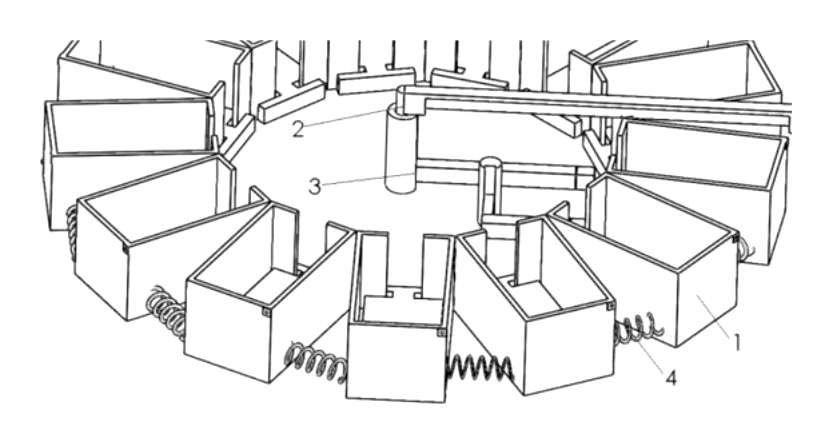
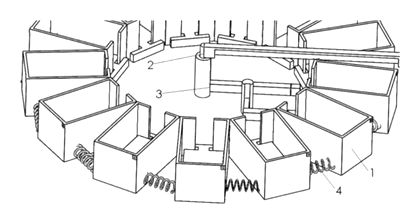
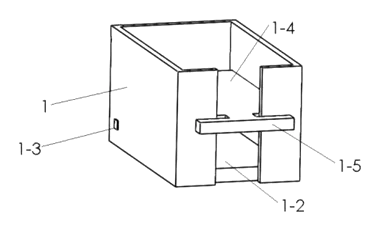
- Several card holders (1) are arranged in a ring. Inside each holder sits a support plate (1-5) whose upper surface holds the cards. Adjusting the plate’s height adjusts the number and height of the cards.
- The facing sides of any two adjacent holders carry an intermittent suction mechanism: a first element and a second element, where at least one is an electromagnetic component. Energizing the magnet pulls the two sides together; cutting power releases them.
- A spring (4) connects the opposite sides of the two adjacent holders. The magnetic attraction force exceeds the spring’s compression force, so the boxes stay locked while the magnet is on. When the magnet turns off, the spring pushes them apart to reset the gap.
- At the center of the ring, a sweeping rod mechanism (2) rotates on a vertical sweeping rod shaft (2-2). The rod itself sits perpendicular to the shaft and features a sweeping slot (2-1).
- While two neighbors are magnetically attracted, the sweeping rod pushes all or part of the cards from one holder into the adjacent one.
- A pallet adjustment mechanism controls the support plates during this transfer. It uses a first rotating arm (3-1), a second rotating arm (3-2), a first boom column (3-3), a second boom lifting column (3-4) and a boom connector (3-5). The first arm links through a boom connector (3-5) to a second boom lifting column (3-4), which also carries the second arm.
- The outer ends of the two rotating arms attach detachably to the support plates of the two neighboring holders. As the sweeping rod moves cards, the arms lift or lower the plates to the preset height.
- Magnetic blocks (3-6, 3-7) at the tips of the rotating arms attract the support plates during adjustment.
- A photoelectric switch (1-1) on each holder detects the rotational position of the sweeping rod.
Who it is for
- Board-game publishers and accessory brands looking to add an electronic shuffler to their product lineup for home tabletop sessions.
- Educational suppliers who sell math and probability kits to schools, where a visible mechanical shuffle helps students understand randomization.
- Social club equipment buyers sourcing reliable table accessories for bridge, poker-style family games, or trading-card meetups where fair dealing matters.
- Toy manufacturers expanding into electronic game-night gadgets aimed at adults and older children.
How it works
The main parts
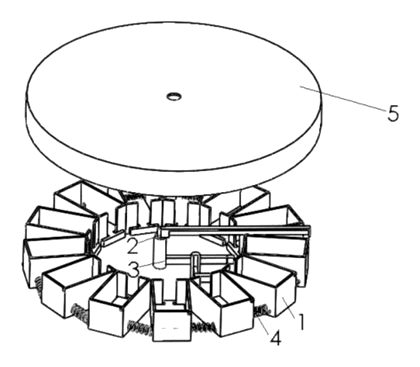
| No. | Part | What it does |
|---|---|---|
| 1 | Card holder | One of several boxes arranged in a ring; receives and holds cards. |
| 1-1 | Photoelectric switch | Detects the rotational position of the sweeping rod. |
| 1-5 | Support plate | Flat surface inside the holder; its height sets the active card count. |
| 2 | Sweeping rod mechanism | Rotates at the ring center to push cards between locked holders. |
| 2-1 | Sweeping slot | A slot on the sweeping rod. |
| 2-2 | Sweeping rod shaft | Vertical axis around which the sweeping rod turns. |
| 3-1, 3-2 | First and second rotating arms | Linkage arms that raise or lower the support plates. |
| 3-3 | First boom column | A column in the arm adjustment mechanism. |
| 3-4 | Second boom lifting column | Secondary column connected via the boom connector. |
| 3-5 | Boom connector | Joins the first rotating arm to the second lifting column. |
| 3-6, 3-7 | Arm magnetic blocks | Magnets at the arm tips that detachably attract the support plates. |
| 4 | Spring | Pushes adjacent holders apart once the electromagnet de-energizes. |
Operating steps
- Load the deck - place the full stack of cards onto the support plate of one designated starting holder.
- Set the plate height - the rotating arms adjust the support plate to set the card height.
- Energize the coupling - the electromagnetic element on the starting holder and its neighbor activates, pulling the two facing sides together against the spring force.
- Verify position - the photoelectric switch detects the rotational position of the sweeping rod.
- Execute the sweep - the sweeping rod moves cards out of the first holder and into the adjacent one.
- Release and advance - power to the electromagnet cuts off, the spring separates the two holders, and the next pair of adjacent holders can be brought into the attraction state.
- Repeat - the cycle continues around the ring until the cards have been transferred enough times to shuffle the deck.
- Collect the cards - the shuffled stack gathers in a holder.
Applications
Family game nights
Households that play card games weekly benefit from a fast, uniform shuffle. Parents simply load the deck, press start, and the machine cycles cards around the ring while everyone else sets up the board or deals snacks, removing arguments about who shuffled fairly last time.
Board-game club tournaments
Clubs running Swiss-style rounds need consistent timing between matches. A ring-layout shuffler standardizes the preparation phase so every table finishes at the same pace, and the transparent mechanical action reassures players that no one manipulated the order during downtime.
Classroom probability lessons
Math teachers demonstrating permutations and random sampling can use the visible sweep action as a live prop. Students watch cards physically move from one compartment to another, making abstract concepts like independent events and uniform distribution easier to grasp than a computer simulation alone.
Trading-card community meetups
Collectors who draft custom decks or play constructed formats often handle cards that resist hand-shuffling. The adjustable support plates accommodate thicker stacks, preserving card condition during repeated events.
Senior center recreation programs
Activity coordinators at senior centers manage large groups with varying dexterity levels. An automatic shuffler removes the physical strain of riffle-shuffling stiff cards, letting participants focus entirely on the social aspect of the game rather than struggling with preparation.
Where it is less suitable
- Single-player solitaire setups - the ring mechanism requires multiple holders and is overbuilt for one person sorting a deck alone.
- Oversized tarot or oracle cards - the sweeping slot and holder dimensions need to match the intended card size; significantly larger or irregularly shaped cards would need redesigned tooling.
- Outdoor picnics - the electromagnetic components and photoelectric switches require stable power and protection from dust and moisture, making indoor tables the intended environment.
Frequently asked questions
How does the ring layout shuffle cards?
Cards sit in several holders arranged in a circle. The machine locks two neighboring holders together with an electromagnet, then a central sweeping rod pushes a portion of the stack from one holder into the next. After releasing, another pair of adjacent holders can be attracted. Repeating this around the entire circle mixes the deck progressively.
Why use electromagnets instead of permanent magnets?
The patent describes an intermittent suction mechanism where at least one element is electromagnetic. Powering the coil creates attraction strong enough to overcome the return spring and lock the boxes; cutting power lets the spring push them apart. This allows the holders to be attracted and separated by energizing and de-energizing the electromagnetic element.
What card sizes fit the holders?
The patent does not list exact card dimensions. Holder width, depth, and the sweeping slot profile are parameters to be confirmed in design based on whether you target bridge-size, poker-size, or sleeved trading cards.
Does the sweeping rod damage card edges?
The rod features a sweeping slot. Material selection for the slot surface, such as polished plastic or coated metal, is determined during prototyping to prevent scuffing. Wear can be evaluated during prototyping.
How is the stack height controlled?
A pallet adjustment mechanism uses two rotating arms linked to boom columns. Magnetic blocks at the arm tips attract the support plate inside each holder. As the sweep occurs, the arms pivot to raise or lower the plate, adjusting the card height for the sweep.
Is the machine noisy during operation?
The patent does not provide decibel ratings. Noise levels depend on the specific implementation. Sound-dampening pads inside the housing are common engineering choices to keep tabletop noise low, finalized during the prototype phase.
Can this design be made and sold in the US?
The patent was filed only in China and has lapsed, so it does not restrict the design in the US or in China. Automatic card shufflers may be covered by other US patents - see Patent & Production - so we recommend a freedom-to-operate check before volume production.
Are you affiliated with the patent owner?
No. IP2M is an independent design and manufacturing service working from the public patent document.
Request a quote
Click Request a Quote below to see our email address - copy it, or open your email app with a ready-made message. Please mention patent CN209564602U in the subject.
Helpful details to include:
- Your company and channel (game accessory brand, educational supplier, toy manufacturer, club equipment buyer)
- Target card dimensions and whether sleeves will be used
- Number of card holders in the ring
- Power preference (AC adapter, rechargeable battery, or dry cells)
- Estimated quantity and target price
- Timeline - when you would like samples and the first shipment
You can also reach us at (332) 203-9997.
Explore this product
Interested in building this?
Tell us your target market, quantity and timeline. We reply with options for prototyping, small-batch runs or volume production.
Send your inquiry to
Please put CN209564602U in the subject line and tell us your company, country, estimated quantity and timeline.
Prefer to talk? Call (332) 203-9997.
More product-ready patents
All Toys & Games patents →
Toys & Games
Stretch-to-Fit Toy Remote with Drone Storage
Toy drone remote with slide-out handles for any hand size, a phone clamp and built-in drone storage.
Patent CN205412243U
Toys & Games
Magnetic Tile Racks for Ultra-Thin Travel Mahjong
Magnetic rack frames that hold ultra-thin mahjong tiles upright and fold into the set's carrying box.
Patent CN207169017U
Toys & Games
X-Braced Square Magnetic Building Tile with Locating-Post Shell
Square magnetic building tile: open X-brace frame, corner-lug magnets, two shells aligned by posts.
Patent CN105963988B
Toys & Games
Card-Thin Magnetic Travel Mahjong and Chess Sets with Magnet Racks
Pocket mahjong and chess sets: thin magnetic-powder tiles, finger magnet picker and fold-out magnetic racks.
Patent CN206896783U
Toys & Games
Inflatable Baby Climbing Mat with a Bumpy Hump and a Ramp Obstacle
Inflatable crawling mat: a bumpy rounded hump and a sloped ramp on a stiffened air base.
Patent CN108905229B
Toys & Games
Transforming Construction Toy with an Extendable Roof Unit and Attic Room
Construction toy with a roof unit that lowers legs to add a smaller attic room above the main floor.
Patent CN219941768U
Browse by category
- Apparel & Accessories (22)
- Baby & Kids (16)
- Bags & Luggage (9)
- Bath & Personal Care (16)
- Car Accessories (10)
- Furniture, Bedding & Storage (12)
- Garden & Outdoor (18)
- Health & Wellness (8)
- Home, Kitchen & Cleaning (24)
- Lighting (12)
- Packaging & Containers (6)
- Pet Products (6)
- Phone & Camera Accessories (4)
- Retail Display (13)
- School, Office & Art (19)
- Sports & Recreation (25)
- Tools & Workshop (27)
- Toys & Games (12)
This page is based on the public patent document CN209564602U, assigned to China Jiliang University. IP2M is an independent manufacturing service and is not affiliated with, endorsed by or licensed by the patent owner. Images marked as concept renderings are illustrations, not photos of an existing product. Patent status information is provided for reference only and is not legal advice; confirm freedom to operate for your market before production. Full disclaimer.