At a glance
| Patent number | CN209564602U (application CN201822131241) |
| Type | China utility model (实用新型) - protects product shape and structure |
| Original title | An automatic card shuffling machine (一种自动洗牌理牌机) |
| Patent owner | China Jiliang University |
| Inventors | Li Mengnan, Zhao Mingyan |
| Filing date | 2018-12-19 |
| Grant date | 2019-11-01 |
| Status (China) | Lapsed - terminated for non-payment of annual fees (recorded 2021-11-26) |
| Patent family | Chinese filings only - no US, European, Japanese, PCT or other filings listed |
| Cited by | 2 later documents |
| Source | Google Patents (search for CN209564602U) |
What the claims cover, in plain language
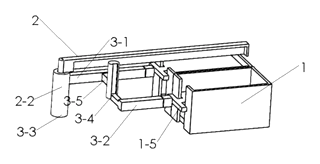
Claim 1 - an automatic card shuffling machine comprising multiple card holders (1) arranged in a ring, each containing a support plate (1-5) whose height adjusts the number and elevation of cards resting on it. Two adjacent holders have facing sides equipped with a cooperating intermittent suction mechanism. A sweeping rod mechanism (2) is rotatably mounted at the center of the ring; when two adjacent holders are magnetically attracted together, the sweeping rod pushes all or part of the cards from one holder into the other.
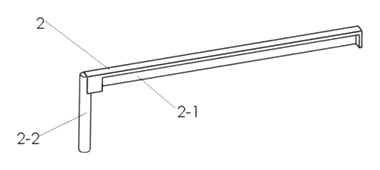
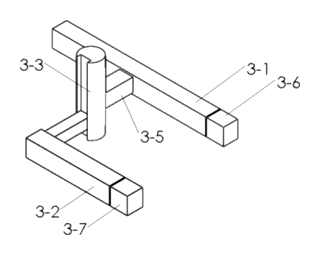
Claim 2 - the intermittent suction mechanism includes a first element and a second element on the opposing sides of two adjacent holders. At least one element is electromagnetic; energizing it creates attraction, and de-energizing it separates the elements. Claim 3 - a spring (4) connects the opposing sides. The magnetic attraction exceeds the spring’s compression force, and after de-energizing, the spring resets the separation. Claim 4 - the sweeping rod mechanism comprises a sweeping rod and a vertical sweeping rod shaft (2-2); the rod is perpendicular to the shaft and features a sweeping slot (2-1). Claim 5 - a pallet adjustment mechanism includes a first rotating arm (3-1), second rotating arm (3-2), first boom column (3-3), second boom lifting column (3-4) and boom connector (3-5). The first arm is connected to the first boom column and, through the boom connector, to the second boom lifting column; the second arm is connected to the second boom lifting column. The arm ends detachably link to the support plates of two adjacent holders to adjust plate height during a sweep. Claim 6 - the first arm end carries a first arm magnetic block (3-6) and the second arm end carries a second arm magnetic block (3-7), which magnetically attract the support plates. Claim 7 - each card holder includes a photoelectric switch (1-1) to detect the rotational position of the sweeping rod.
This is a simplified reading for orientation only. The legal scope is defined by the exact claim wording in the official Chinese document.
What this means for US production
This patent was filed only in China and has lapsed due to non-payment of annual fees, so it no longer restricts anyone in China either. It has no US or other foreign counterpart.
Two points to settle early:
- Other patents may exist. Automatic card shufflers are actively patented in the US by several gaming-accessory companies, covering gravity-fed chutes, roller-based interleaving, and carousel designs, so a freedom-to-operate (FTO) review of the ring layout, electromagnetic coupling, and sweeping rod is needed before tooling.
- Electrical safety. Because the design relies on electromagnets and photoelectric sensors, the finished product must be evaluated for electrical and mechanical safety under applicable US standards.
Customization and manufacturing
What can be customized
| Area | Options |
|---|---|
| Number of holders | Ring size adapted to single-deck or multi-deck configurations |
| Holder dimensions | Internal width and depth tuned for the intended card size |
| Plate adjustment range | Travel distance of the rotating arms to handle different stack thicknesses |
| Housing material | ABS, polycarbonate, or wood-grain finish panels for premium tabletop aesthetics |
| Electromagnet strength | Coil specifications matched to holder mass and required locking force |
| Control interface | Single-button start, programmable cycle count, or app-connected Bluetooth module |
| Power supply | AC adapter, rechargeable lithium pack, or AA battery compartment |
Things to plan for (US market)
- FCC Part 15 - the electromagnetic coils and photoelectric switches generate radio-frequency energy; the assembled unit must comply with FCC limits for unintentional radiators if sold in the US.
- UL 62368-1 - audio/video, information and communication technology equipment safety standard commonly applied to consumer electronic game accessories containing low-voltage circuits.
- ASTM F963 - if the product is marketed for children under 14, toy safety requirements apply, including small-parts warnings, battery compartment security, and mechanical hazard tests.
- California Proposition 65 - plastics, solder, and metal plating used in the housing and internal linkage must be screened for listed chemicals.
How a project runs
- Inquiry - target card size, number of holders, power preference, and estimated volume.
- Design - CAD modeling of the ring chassis, rotating arm geometry, electromagnet placement, and PCB layout for the sensor logic.
- Prototype - 3D-printed housing samples with functional sweeping rods and magnetic couplings to verify card transfer reliability across multiple cycles.
- Pilot run - injection-molded parts assembled in a short batch for FCC pre-scan testing, drop tests, and endurance cycling of the springs and electromagnets.
- Production - tooling release, SMT assembly for control boards, coil winding, final assembly, and quality inspection of the sweep alignment.
Quantities & timeline
The ring chassis and individual card holders require multi-cavity injection molds sized to the chosen card dimensions. The sweeping rod shaft, rotating arms, and boom columns need precision metal stamping or machining dies, while the electromagnets involve custom coil winding fixtures. Photoelectric switches and control PCBs follow standard SMT processes. Certification testing for FCC and UL adds lead time before mass shipment. Send us your card dimensions, holder count, power requirements, quantity and target price and we will reply with options.
Patent drawings
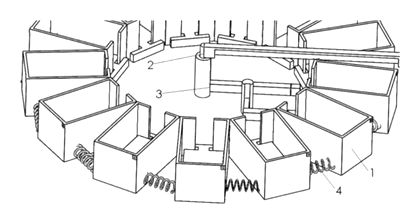
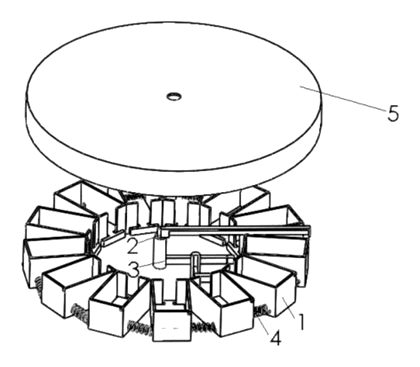
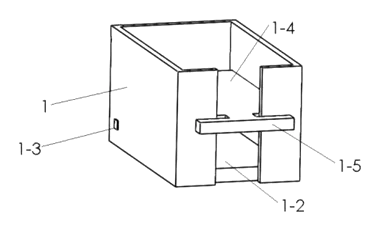
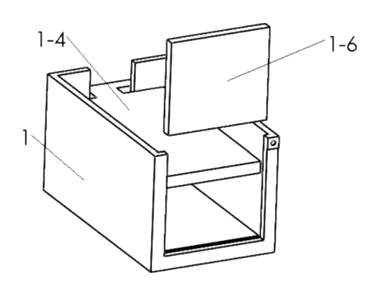
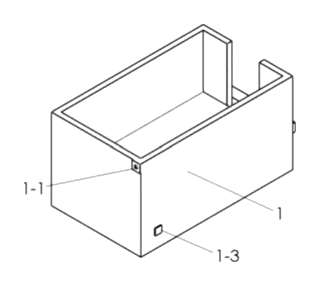
Drawings reproduced from the public patent document for reference.