
Patent CN209566147U
Updated October 25, 2026Ceramic Snap-Off Utility Knife with Round-Notch Cutting Edges
Steel snap-off knives are everywhere in packing rooms and warehouses: cheap, sharp, and quick to dull, rust and leave metal fragments. This knife keeps the familiar slide-and-snap format but makes the blade and the track it runs in from zirconia ceramic, which the patent describes as harder, longer-lasting and resistant to corrosion. The blade is a flat strip about 0.6 to 0.7 mm thick. Its working end is a sharpened semicircular notch rather than a point, and a row of round sharpened holes runs along its length, each crossed by a score line. When the notch dulls, the user snaps the blade at the next score line and a new half-hole becomes the cutting notch.
- China utility model - in force in China until Mar 2029 at most
- No filings outside China
- Box cutters & packing tools
- Zirconia ceramic blade and track, plastic handle
Splat! What let you down?
⚪
Zirconia blade and track
Both the blade and the guide track it slides in are ceramic - no rust and slow wear.
🌙
Notch instead of a point
The working end is a sharpened half-circle that hooks film, tape and straps.
✂️
Snap to a fresh notch
Score lines cross a row of round holes; snap one off and the next half-hole cuts.
✋
Offset finger stops
Staggered bumps on top and bottom of the handle keep fingers from sliding forward.
Bring this product to market
- ✓ Patent vetted China-only family and legal status checked
- 2 Product brief · now How it works, uses and options written up
- 3 Prototype First samples for buyers to review
- 4 Pilot run Small first batch for launch customers
- 5 Volume production Repeat orders at scale
Buyer interest
– of 100 buyers needed to start prototyping
One click, no sign-up. Each vote is one real visitor, and products with the most interest go to prototyping first.
Build team: no members yet. Need a partner, co-funding or skills to build this? Join and we introduce the team once it forms.
The problem
Snap-off utility knives are standard in shipping, retail and crafts, but steel blades dull quickly, rust in damp stockrooms, and their pointed tips can stab into box contents or the user’s hand. According to the patent, handles that become slippery with oil or lubricant also lead to slips and cuts. The patent sets out a ceramic knife that stays sharp longer and is safer to hold.
The solution
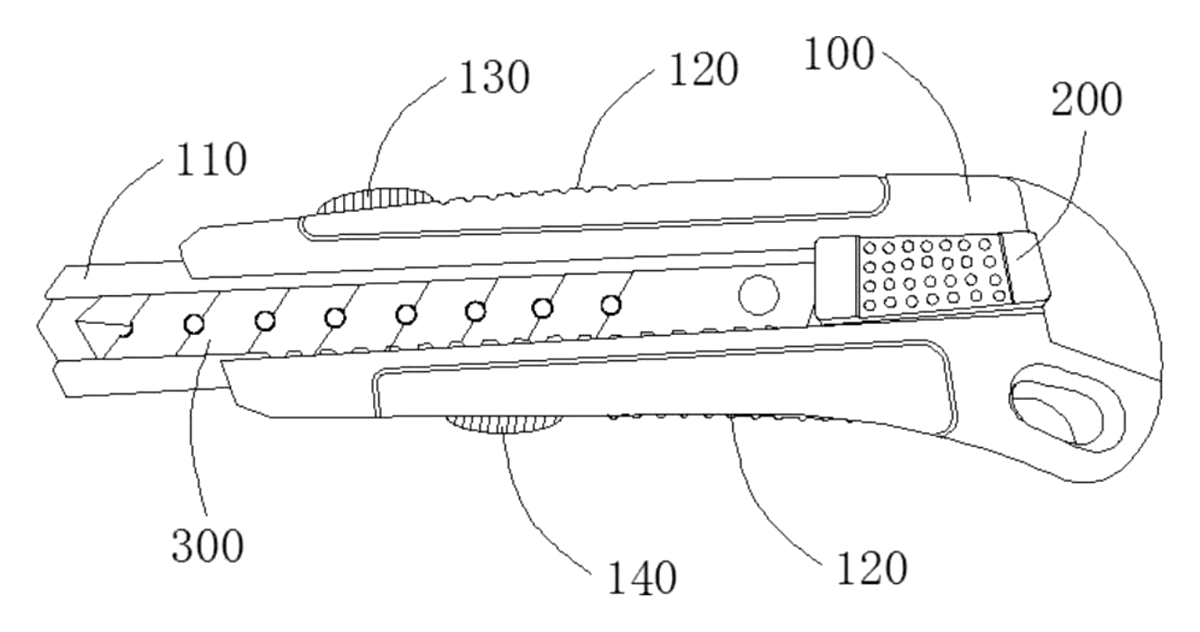
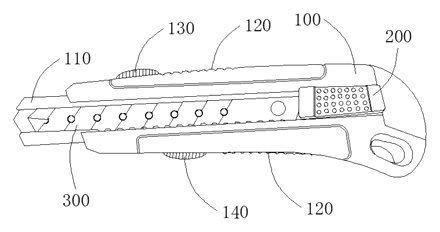
- A handle (100) has a guide track (110) in which a slider (200) runs back and forth; the blade (300) is fixed to the slider and moves with it.
- The guide track and blade are made of ceramic - zirconia in the preferred example - while handle and slider are plastic.
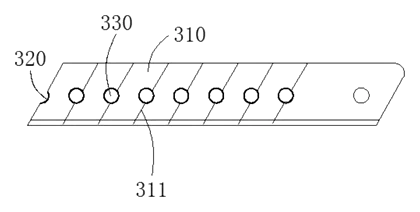
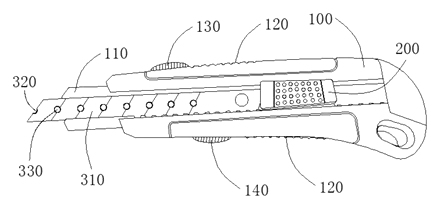
- The blade is a flat strip (310), about 0.6-0.7 mm thick. At the end that sticks out of the track it has a semicircular hole edge (320) - a sharpened half-circle that does the cutting.
- Along its length the blade has several round hole edges (330), evenly spaced. On one face, score lines (311) cross each hole, splitting it into two arcs; the left arc is not shorter than the right one.
- When the notch dulls, the blade is snapped at the next score line, and the remaining half of that round hole becomes a new semicircular cutting notch. The patent gives 3-10 holes and score lines per blade.
- The handle has anti-slip zones (120) on both faces, a first finger stop (130) on top and a second finger stop (140) underneath, offset from each other, with the top stop nearer the blade.
Who it is for
- Tool brands adding a ceramic line next to steel box cutters, for buyers who want rust-free, long-life blades.
- Packaging and warehouse supply distributors selling to e-commerce fulfillment centers that open thousands of cartons a day.
- Retail store supply programs where stock teams cut tape and shrink film without damaging the goods inside.
- Craft and hobby brands that sell knives for paper, film and vinyl and value a blade that does not rust or mark.
How it works
The main parts
| No. | Part | What it does |
|---|---|---|
| 100 | Handle | Plastic body with the track inside. |
| 110 | Guide track | Ceramic channel the blade runs in. |
| 120 | Anti-slip zones | Grip texture on both faces. |
| 130, 140 | Finger stops | Offset bumps on top and bottom of the handle. |
| 200 | Slider | Moves the blade in and out. |
| 300 | Blade | Zirconia strip, about 0.6-0.7 mm thick. |
| 320 | Semicircular notch edge | The working cutting edge at the tip. |
| 330, 311 | Round hole edges and score lines | Spare edges and snap points along the blade. |
Using it
- Push the slider to extend the blade just far enough to expose the notch.
- Hook the notch over tape, film or strapping and pull - the sharpened half-circle cuts as it slides.
- Retract the blade after use.
- When the notch dulls, extend the blade one section and snap it at the score line; the next half-hole becomes the new notch.
Applications
Opening cartons in fulfillment centers
Pickers and receivers slit packing tape with the notch, which runs along the seam instead of plunging into the box.
Retail stockrooms
Stock teams cut shrink wrap and strapping on pallets; a ceramic blade does not rust in damp back rooms.
Food and beverage plants
Ceramic does not corrode in wet areas; if the knife is used near food lines, a detectable version or blade-control program is part of the plan.
Crafts, vinyl and film work
Hobbyists trimming paper, vinyl or window film get a clean cut and a blade that does not rust between projects.
Electronics and lab benches
A non-metallic, non-magnetic blade is useful when trimming insulation, tape and film near sensitive parts.
Where it is less suitable
- Heavy cutting and prying - ceramic is hard but brittle; it is not for prying, scraping or cutting thick carpet and drywall.
- Point cuts - the notch-style tip is made for slitting and hooking, not for starting a cut in the middle of a sheet.
- Food-plant use without a detection plan - ceramic fragments are not caught by metal detectors unless a detectable grade is used.
Frequently asked questions
How does a round notch cut?
The half-circle at the tip is sharpened all around. Hooked over tape, film or a strap and pulled, it slices along the material instead of pushing a point into it.
How do I get a new edge?
Extend the blade one section and snap it at the score line. The score line runs through the next round hole, so the half that stays on the blade becomes a fresh semicircular notch.
Does ceramic last longer than steel?
The patent describes zirconia as wear-resistant, harder than steel and not corroded by moisture. Edge life against your actual materials is measured on samples.
Will the blade break if dropped?
Zirconia is hard but less tough than steel. The blade sits inside a ceramic track in the handle; drop and impact tests are part of the pilot run, and the knife is not meant for prying.
Is it safer than a regular box cutter?
The notch tip is less likely to plunge into box contents, and the offset finger stops keep the hand behind the blade. Safety claims for workplace programs are confirmed with your own testing.
Can it be used in food plants?
Ceramic does not rust, but it is not metal-detectable. For food plants we can quote a detectable ceramic grade and a colored handle for blade-control programs.
Can this design be made and sold in the US?
The patent was filed only in China, so it does not restrict the design in the US. It is in force in China until March 2029 at most, and making or selling it there needs the owner’s permission. Utility knives may be covered by other US patents - see Patent & Production - so we recommend a freedom-to-operate check before volume production.
Are you affiliated with the patent owner?
No. IP2M is an independent design and manufacturing service working from the public patent document.
Request a quote
Click Request a Quote below to see our email address - copy it, or open your email app with a ready-made message. Please mention patent CN209566147U in the subject.
Helpful details to include:
- Your company and channel (tool brand, packaging distributor, retail supply, craft brand)
- Blade size and number of snap sections
- Slider type (manual, auto-retract, locking)
- Handle materials, colors and branding
- Estimated quantity and target price
- Timeline - when you would like samples and the first shipment
You can also reach us at (332) 203-9997.
Explore this product
Interested in building this?
Tell us your target market, quantity and timeline. We reply with options for prototyping, small-batch runs or volume production.
Send your inquiry to
Please put CN209566147U in the subject line and tell us your company, country, estimated quantity and timeline.
Prefer to talk? Call (332) 203-9997.
More product-ready patents
All Tools & Workshop patents →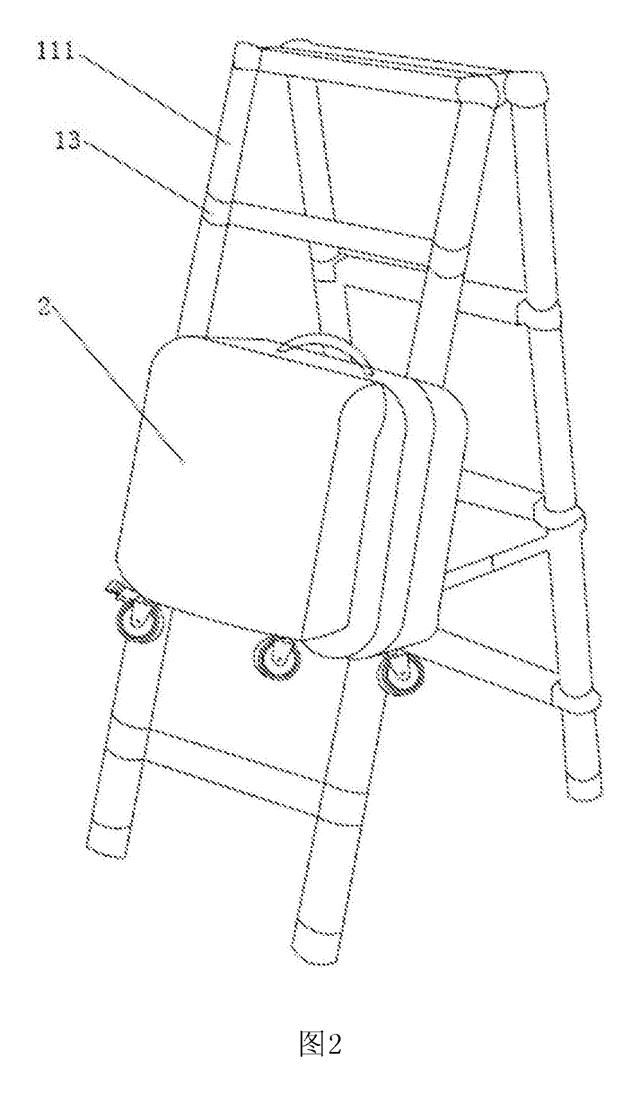
Tools & Workshop
Rolling Tool Box with Telescoping Step Ladder
Telescoping A-frame ladder with an attached rolling tool box that slides to your working height.
Patent CN206290197U
Tools & Workshop
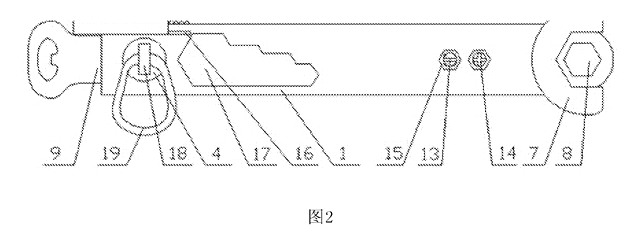
Folding 3-Handle Wrench Multi-Tool
Folding three-handle wrench multi-tool with magnetic screwdriver bits, saw, file and bottle opener.
Patent CN205290875U
Tools & Workshop
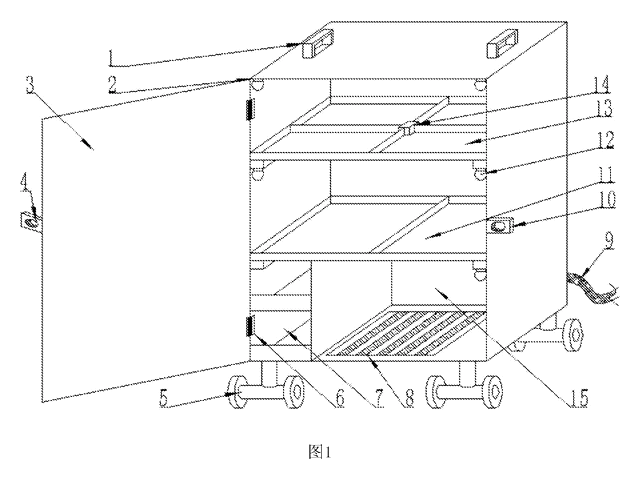
Rolling Auto-Repair Tool Cabinet with Built-In Lights
Lockable rolling tool cabinet for car repair with interior lights, a lubricant tray, parts drawers and a tool bay.
Patent CN205989314U
Tools & Workshop
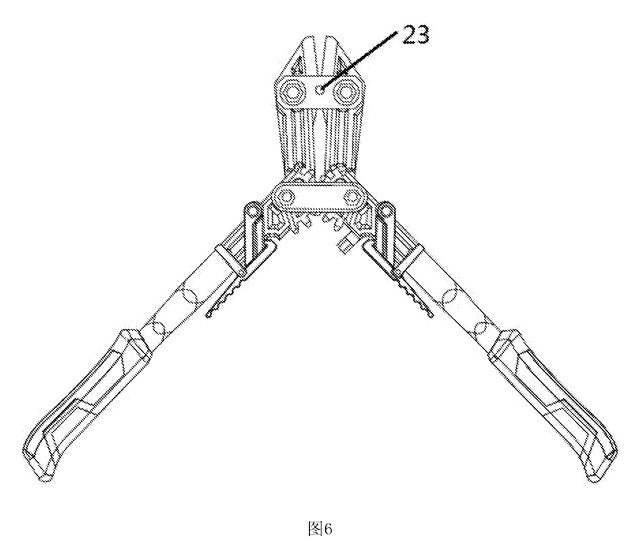
Wide-Opening Folding Bolt Cutter
Bolt cutter with linked, gear-meshing handles that open up to 190° and fold in half for storage.
Patent CN207206226U
Tools & Workshop
Nail-Holding Hammer with Fold-Out Drivers
Hammer with a nail-holding T-slot in the head and fold-out drivers stored in the handle.
Patent CN205254927U
Tools & Workshop
Modular Wrench with Screw-On Heads
Wrench handle with a three-way threaded hub for screw-on adjustable and hex heads, plus a pipe sleeve.
Patent CN206216564U
Browse by category
- Apparel & Accessories (22)
- Baby & Kids (16)
- Bags & Luggage (9)
- Bath & Personal Care (16)
- Car Accessories (10)
- Furniture, Bedding & Storage (12)
- Garden & Outdoor (18)
- Health & Wellness (8)
- Home, Kitchen & Cleaning (24)
- Lighting (12)
- Packaging & Containers (6)
- Pet Products (6)
- Phone & Camera Accessories (4)
- Retail Display (13)
- School, Office & Art (19)
- Sports & Recreation (25)
- Tools & Workshop (27)
- Toys & Games (12)
This page is based on the public patent document CN209566147U, assigned to Xiamen Jialian Technology Development Co., Ltd.. IP2M is an independent manufacturing service and is not affiliated with, endorsed by or licensed by the patent owner. Images marked as concept renderings are illustrations, not photos of an existing product. Patent status information is provided for reference only and is not legal advice; confirm freedom to operate for your market before production. Full disclaimer.