At a glance
| Patent number | CN209574066U (application CN201821722576) |
| Type | China utility model (实用新型) - protects product shape and structure |
| Original title | Baby Blanket with Collapsible Seat Cushion (具有折叠式座垫的婴儿用毯) |
| Patent owner | Freshman Club |
| Inventors | Li Zhihong |
| Filing date | 2018-10-23 |
| Grant date | 2019-11-05 |
| Status (China) | Lapsed - terminated for non-payment of annual fees (recorded 2021-10-01) |
| Patent family | Chinese filings only - no US, European, Japanese, PCT or other filings listed |
| Cited by | 0 later documents |
| Source | Google Patents (search for CN209574066U) |
What the claims cover, in plain language
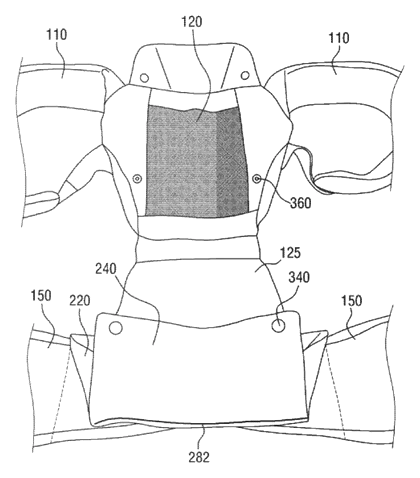
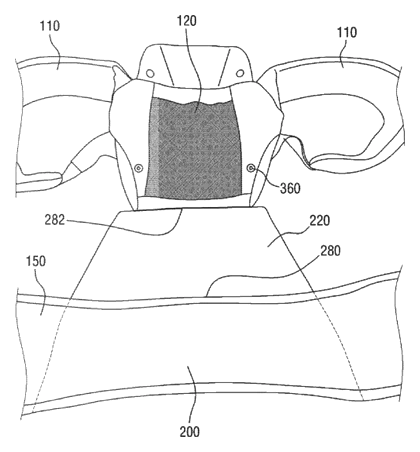
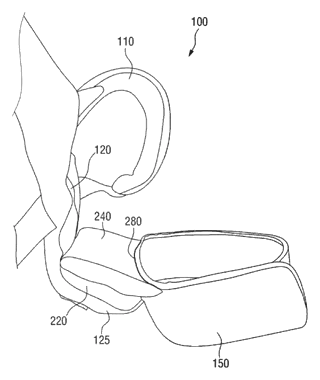
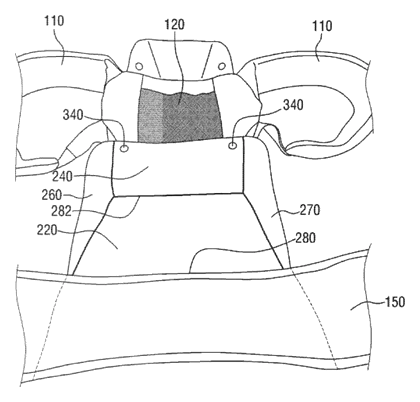
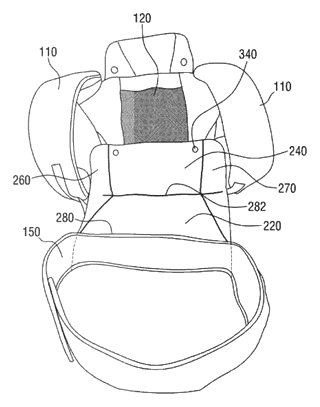
Claim 1 defines a baby blanket comprising a backrest and a seat portion supported by shoulder belts and a waistband. The key feature is the seat construction: an interconnecting piece connects the seat portion to the waistband. Two cushion parts (first and second) are attached to this piece via specific sewing threads. These threads act as hinges, allowing the cushion parts to fold inward.
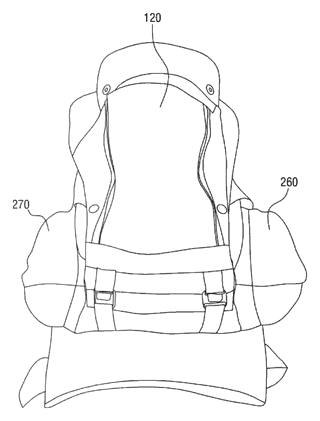
Claim 2 adds a first fixing unit to secure the folded position of the cushions. Claim 3 specifies that the fixing unit consists of buckle straps formed on the respective cushion parts. Claim 4 introduces auxiliary parts on the sides of the cushions, also connected by sewing threads, which assist in the folding process. Claim 5 describes how these auxiliary parts fold between the main cushion parts when collapsed. Claim 6 clarifies the folding direction: the first cushion folds toward the seat portion, and the second folds toward the first cushion. Claim 7 adds a second fixing unit for when the cushions are expanded and folded against the backrest. Claim 8 details that this second fixing unit uses snap-fasteners located on the second cushion and the backrest.
This is a simplified reading for orientation only. The legal scope is defined by the exact claim wording in the official Chinese document.
What this means for US production
This patent was filed only in China and has lapsed due to non-payment of fees. Therefore, it currently imposes no restrictions on manufacturing or selling in China. It has no US or other foreign counterparts.
Two points to settle early:
- Other patents may exist. The baby carrier and wearable blanket market is highly competitive with numerous active patents regarding ergonomic seating, strap systems, and quick-release mechanisms. A freedom-to-operate (FTO) review is essential to ensure your specific implementation of the folding seams and fasteners does not infringe on existing US intellectual property held by major brands.
- Safety Standards Compliance. Unlike hardware patents, baby products are heavily regulated for safety. The structural integrity of the folding seams and the strength of the shoulder/waist straps must meet rigorous drop-test and load-bearing standards before any mass production begins.
Customization and manufacturing
What can be customized
| Area | Options |
|---|---|
| Fabric Material | Cotton blends, bamboo viscose, or synthetic moisture-wicking fabrics; machine washability ratings. |
| Padding Type | Foam density, fiber fill thickness, or removable inserts for different seasons. |
| Fasteners | Type of buckles (side-release vs. snap), strap adjustability range, and material (nylon vs. metal). |
| Dimensions | Overall length, seat width, and strap lengths to accommodate different caregiver sizes. |
| Design/Aesthetics | Colorways, prints, embroidery, and branding placement on the backrest or waistband. |
| Folding Mechanism | Variation in the number of fold lines or auxiliary support panels for different compression levels. |
Things to plan for (US market)
- Soft carrier classification: Assess the finished design against 16 CFR 1226 / ASTM F2236 for soft infant and toddler carriers. If a proposed version instead meets the sling-carrier definition, review 16 CFR 1228 / ASTM F2907. The applicable category depends on the final carrying configuration.
- Carrier testing and instructions: Have the responsible manufacturer confirm the currently incorporated standard edition, load-retention and restraint tests, warnings and intended-use instructions. The patent does not establish a safe weight range or product certification.
- Proposition 65: California requires warnings for chemicals like phthalates or lead in dyes and plastics (buckles/snaps).
- Labeling: Care labels must comply with FTC Textile Act regulations regarding fiber content and country of origin.
How a project runs
- Inquiry - Define fabric preferences, target age group, and desired folding complexity.
- Design - Create technical packs specifying seam allowances, fold-line locations, and fastener placements.
- Prototype - Produce sample units to test the folding mechanics and strap comfort.
- Pilot Run - Small batch production for internal quality checks and preliminary safety testing.
- Production - Full-scale manufacturing with cut-and-sew operations, attaching hardware, and final inspection.
Quantities & timeline
Lead times depend on fabric sourcing and certification testing. Molds are generally not required unless custom plastic buckles are specified; otherwise, standard off-the-shelf hardware is used. Cutting and sewing capacity determines throughput. Send us your fabric choice, target retail price, quantity, and certification requirements and we will reply with options.
Patent drawings
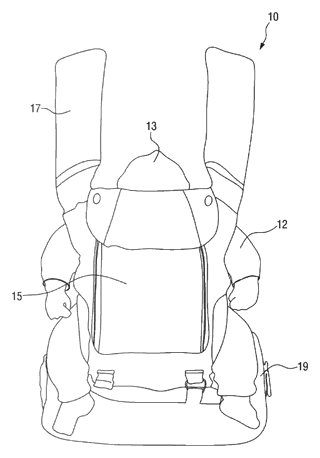
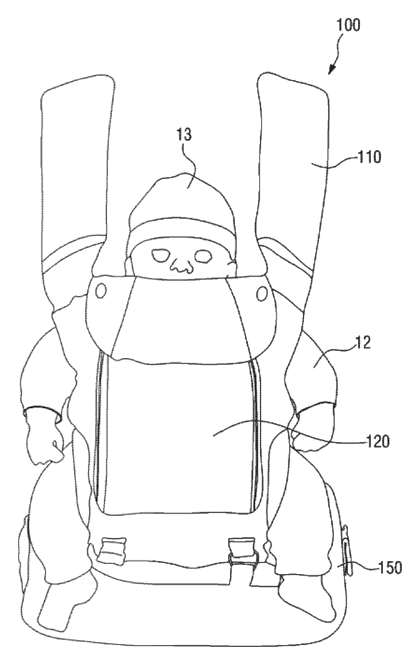
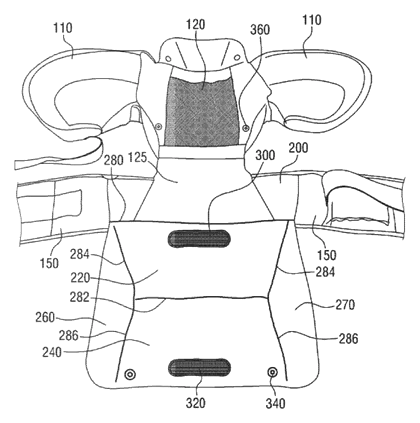
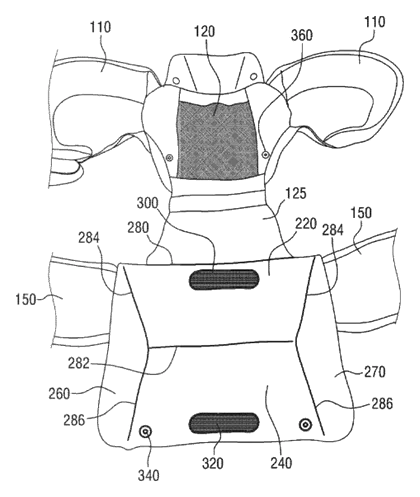
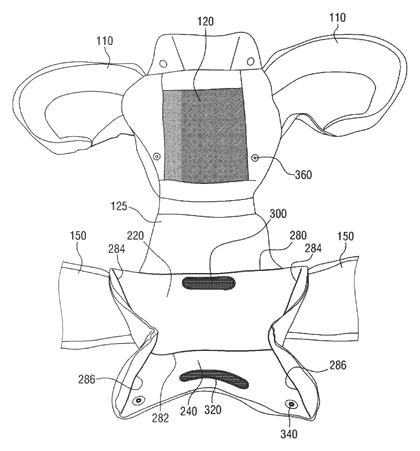
Drawings reproduced from the public patent document for reference.