
Patent CN209600696U
Updated October 29, 2026Bicycle Bottle Cage with Integrated Tire Lever and Screwdriver Tool Set
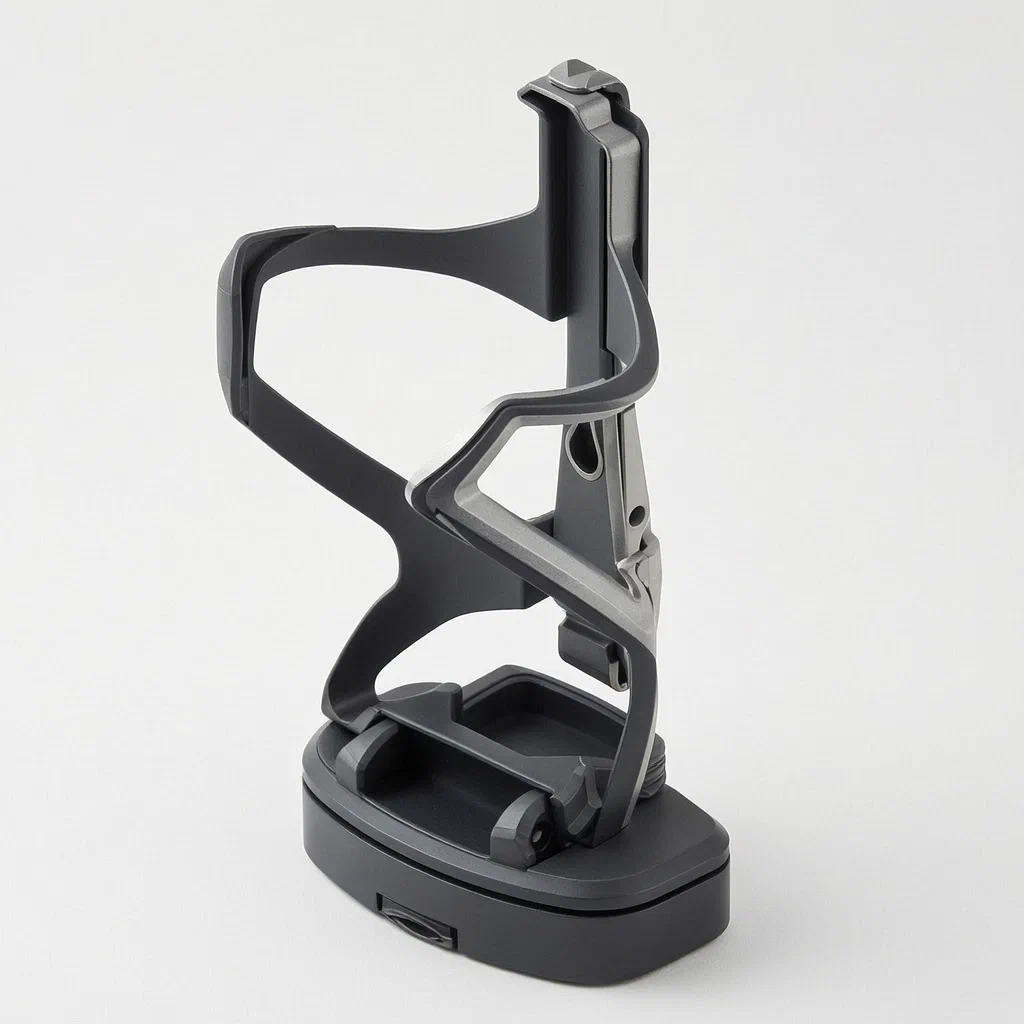
Carrying separate bike tools often means extra bags or loose items rattling in a saddle pack. This design builds the tools directly into the bottle cage footprint. The cage itself mounts to the bicycle frame using standard bolts through a hollow portion and combined holes in the back plate. A tire lever presses into the cage's accommodating space, held by a hook-shaped end over the top supporting portion and a snap-fit recess catching the bolt head. Wrench bars sit inside grooves on the back of that lever. At the bottom, a screwdriver handle clicks into a joining section on the cage's lower edge. When maintenance is needed, the screwdriver handle pulls free, and its pivot group swings out multiple screwdriver heads. Everything stays locked together during the ride, taking up no more room than a standard bottle cage.
- China utility model - in force
- No filings outside China
- Bicycle accessories
- Integrated tire lever and screwdriver storage
Splat! What let you down?
🔧
Built-in screwdriver set
A handle with a pivot group holds multiple screwdriver heads that rotate outward when detached from the cage base.
🚲
Snap-in tire lever
The tire lever presses into the cage's accommodating space, secured by a hook end and a snap-fit recess on the bolt head.
🗜️
Hidden wrench bars
Grooves on the back of the tire lever store at least one wrench tool rod each, kept flat against the cage.
⚙️
Standard mounting
Combined holes in the back plate accept standard bicycle frame bolts, fitting typical bottle cage bosses.
Bring this product to market
- ✓ Patent vetted China-only family and legal status checked
- 2 Product brief · now How it works, uses and options written up
- 3 Prototype First samples for buyers to review
- 4 Pilot run Small first batch for launch customers
- 5 Volume production Repeat orders at scale
Buyer interest
– of 100 buyers needed to start prototyping
One click, no sign-up. Each vote is one real visitor, and products with the most interest go to prototyping first.
Build team: no members yet. Need a partner, co-funding or skills to build this? Join and we introduce the team once it forms.
The problem
Cyclists need basic tools—a tire lever, hex wrenches, and screwdrivers—to fix flats or adjust components during a ride. Carrying these items separately usually requires a saddle bag, a jersey pocket, or a strap-on frame mount. Saddle bags add bulk and can swing or rattle. Jersey pockets hold limited items and shift weight. Loose tools strapped to the frame scratch paint and work themselves loose over rough surfaces. Riders who prefer a minimal setup often leave tools behind, risking a stranded ride if a mechanical issue occurs far from home. Integrating tools into existing frame hardware solves the space and retention issues without adding separate luggage.
The solution
This utility model combines a standard bottle cage with a complete basic tool kit, keeping everything within the cage’s own profile.
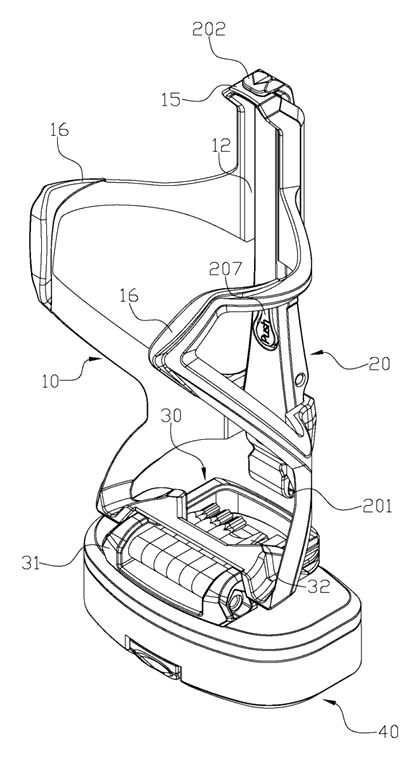
- The bottle cage has a back plate with a hollow portion and combined holes for standard frame bolts. The top edge bends forward into a supporting portion, and two side stop portions curve forward to wrap around a water bottle, forming an indented accommodating space.
- A tire digging rod (tire lever) has a working end and a hook-shaped fixed end. Its back side includes a snap-fit recess, a first containing groove, and a second containing groove.
- At least one wrench tool rod sits inside each containing groove. The tire lever angles into the accommodating space; the hook-shaped end catches the top supporting portion, and the snap-fit recess locks onto the bolt head passing through the combined hole.
- A screwdriver tool set features a handle shaped for gripping. The handle carries a second joining section that mates with a first joining section at the bottom edge where the side stop portions connect.
- A rear pivot group on the screwdriver handle holds multiple screwdriver tool heads that rotate outward when the handle is detached.
- The entire assembly mounts to the bicycle frame exactly like a normal bottle cage, leaving the center open for a water bottle while the tools remain locked in the back and bottom spaces.
Who it is for
- Bicycle accessory brands looking to expand their bottle cage lineup with a multi-function option for commuters and touring riders.
- OEM bicycle manufacturers seeking a value-added component that ships pre-installed on city, gravel, or entry-level mountain bikes.
- Wholesalers and Amazon sellers targeting cyclists who prefer minimal gear and want to avoid separate saddle bags or tool wraps.
- Bike-share and fleet operators needing a standardized, theft-resistant way to keep basic maintenance tools attached to every bicycle in the fleet.
How it works
The main parts
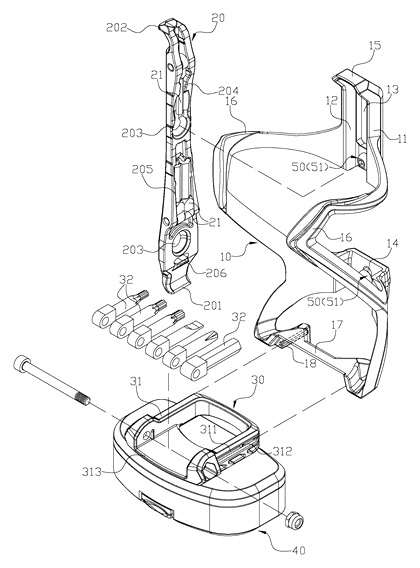
| No. | Part | What it does |
|---|---|---|
| 1 | Back plate | Forms the main body of the cage; contains the hollow portion and combined holes for frame bolts. |
| 2 | Supporting portion | The top edge of the back plate, bent forward to catch the hook-shaped end of the tire lever. |
| 3 | Side stop portions | Two sides connected to the back plate, curving forward to hold the bottle and form the accommodating space. |
| 4 | First joining section | Located at the bottom edge where the side stop portions connect; mates with the screwdriver handle. |
| 5 | Tire digging rod | The tire lever; has a working end for prying tires and a hook-shaped fixed end for hanging on the supporting portion. |
| 6 | Snap-fit recess | On the back of the tire lever; catches the bolt head to lock the lever into the accommodating space. |
| 7 | First / second containing grooves | Recesses on the back of the tire lever that hold the wrench tool rods. |
| 8 | Wrench tool rods | Stored in the containing grooves; used for hex bolts or nuts. |
| 9 | Screwdriver tool set | Includes the handle, the second joining section, and the rear pivot group. |
| 10 | Screwdriver tool heads | Multiple bits held by the pivot group; rotate outward for use. |
Operating steps
- Mount the cage - pass bolts through the combined holes in the back plate and tighten them into the bicycle frame’s bottle cage bosses.
- Insert the wrench rods - slide at least one wrench tool rod into the first containing groove and one into the second containing groove on the back of the tire lever.
- Snap in the tire lever - angle the tire lever so the hook-shaped fixed end rests over the supporting portion at the top of the cage. Press the lever backward into the accommodating space until the snap-fit recess catches the bolt head.
- Attach the screwdriver set - align the second joining section on the screwdriver handle with the first joining section at the bottom edge of the cage and press them together until fixed.
- Use the tools - to remove the screwdriver set, apply force to detach the joining sections, then rotate the required screwdriver tool heads outward from the pivot group. To remove the tire lever, pull it away from the snap-fit recess and lift the hook end off the supporting portion.
- Insert a bottle - the side stop portions still function as a standard cage to hold a water bottle over the stored tools.
Applications
Daily commuting
Commuters ride short distances where a full saddle bag feels excessive. A flat tire or a loose fender bolt requires immediate attention. The integrated cage keeps a tire lever, wrenches, and screwdrivers permanently attached to the frame without rattling or adding bulk under the seat.
Gravel and light touring
Gravel riders encounter varied terrain that loosens bolts and increases puncture risk. Stopping to dig through packed bags delays the ride. Having the tools snap-fitted directly behind the water bottle allows quick access at the roadside while keeping the bottle available for hydration.
Bike-share fleets
Fleet bicycles undergo constant wear and require frequent minor adjustments by field mechanics. Loose tools left in baskets get stolen or lost. Mounting the tool set directly into the bottle cage footprint ensures every bicycle carries its own maintenance kit, locked to the frame by the cage bolts.
Recreational weekend riding
Casual riders often forget to pack tools before a short weekend loop. If a mechanical issue happens, they have no way to fix it. With the tools built into the cage, the equipment is always present whenever the bicycle is ridden, removing the need to remember a separate kit.
Where it is less suitable
- Competitive road racing - racers prioritize aerodynamic profiles and absolute minimum weight; a thicker cage with embedded metal tools adds grams and alters airflow.
- Downhill mountain biking - extreme impacts and mud can compromise snap-fit retention mechanisms; dedicated, heavily protected tool storage is preferred.
- Frames without bottle bosses - bicycles lacking threaded mounting points cannot attach the back plate without aftermarket adapters, which may interfere with the snap-fit recess.
Frequently asked questions
How does the tire lever stay attached to the cage?
The tire lever has a hook-shaped fixed end that rests over the supporting portion at the top edge of the back plate. On its back side, a snap-fit recess catches the head of the bolt passing through the combined hole. This two-point contact holds the lever flat inside the accommodating space.
Where are the wrenches stored?
The back side of the tire lever features a first containing groove and a second containing groove. At least one wrench tool rod fits into each groove. When the tire lever is snapped into the cage, the wrench rods face inward and are hidden between the lever and the back plate.
How does the screwdriver set attach and detach?
The bottom edge of the cage, where the two side stop portions connect, has a first joining section. The screwdriver handle has a matching second joining section. According to the patent, these sections consist of a rail bar and a track slot with a protrusion. The handle presses onto the bottom edge to lock in place and is removed by applying force.
Do the screwdriver bits fold out?
Yes. The handle includes a rear pivot group that holds multiple screwdriver tool heads. Once the handle is detached from the cage, the required tool heads rotate outward from the pivot group for use.
Does this fit standard bicycle frames?
The back plate contains combined holes designed for standard bottle cage bolts. The patent also mentions the combined hole can be a long hole, allowing vertical adjustment to fit different frame boss spacings.
Can the tools fall out on rough roads?
The design relies on the snap-fit recess catching the bolt head and the hook-shaped end resting on the supporting portion to secure the tire lever. The joining sections secure the screwdriver handle. Retention strength depends on the exact dimensions and material stiffness, which are set in design and confirmed on prototypes during vibration testing.
What materials are used?
The patent describes the structural shapes and connections but does not specify materials. Plastics such as nylon or polycarbonate are typical for the cage body, while the tools are usually steel or hardened alloy. Exact materials are chosen based on the buyer’s strength and weight requirements.
Can this design be made and sold in the US?
The patent was filed only in China and is currently in force in China until at most 2029-03-13 (if annual fees are paid). It has no US counterpart, so it does not restrict the design in the US. However, several US design patents citing this document have been granted to other parties. We recommend a freedom-to-operate check before volume production—see Patent & Production.
Are you affiliated with the patent owner?
No. IP2M is an independent design and manufacturing service working from the public patent document.
Request a quote
Click Request a Quote below to see our email address - copy it, or open your email app with a ready-made message. Please mention patent CN209600696U in the subject.
Helpful details to include:
- Your company and channel (bicycle accessory brand, OEM manufacturer, wholesaler, Amazon seller, fleet operator)
- Cage material preference (plastic, metal) and color
- Tool configuration (number and sizes of wrench rods, types of screwdriver heads)
- Mounting hole requirements (standard or adjustable)
- Estimated quantity and target price
- Timeline - when you would like samples and the first shipment
You can also reach us at (332) 203-9997.
Explore this product
Interested in building this?
Tell us your target market, quantity and timeline. We reply with options for prototyping, small-batch runs or volume production.
Send your inquiry to
Please put CN209600696U in the subject line and tell us your company, country, estimated quantity and timeline.
Prefer to talk? Call (332) 203-9997.
More product-ready patents
All Sports & Recreation patents →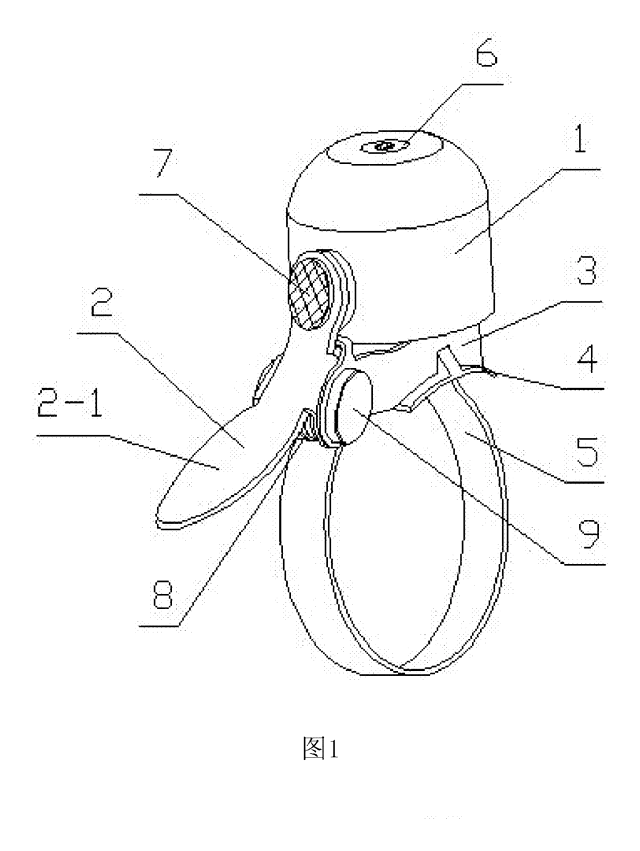
Sports & Recreation
Compact Torsion-Spring Bike Bell
Mini bike bell with a standard torsion spring and a rubber-floated dome - small size, clear tone, quick strap mount.
Patent CN205819384U
Sports & Recreation
Padded Toe-Box Shield for Sneakers
Ventilated, silicone-lined toe-box insert that supports the front of a sneaker and cushions the toes.
Patent CN209473731U
Sports & Recreation
Reversible Fishing Seat-Box Lid with Backrest
Fishing seat-box lid that flips on removable hinge pins: cushion, backrest and storage on one face.
Patent CN208624426U
Sports & Recreation
Swivel-Pin Skateboard Truck with Rubber Sleeve
Skateboard truck with a turning center pin, a tilting axle clamp and a rubber sleeve that centers it.
Patent CN216777880U
Sports & Recreation
Full-Face Bike Helmet with Magnetic Detachable Chin Bar
Full-face cycling helmet whose chin bar clips on and off with magnetic, latching side connectors.
Patent CN206630067U
Sports & Recreation
Bike Phone Holder with Built-In Flashlight Clamp
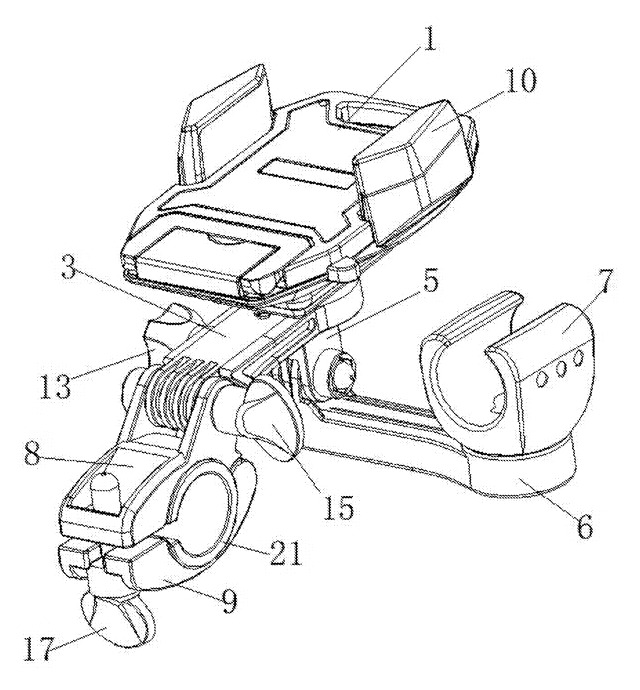
Handlebar mount with a phone cradle on top and a flashlight clamp below, on one arm.
Patent CN206077485U
Browse by category
- Apparel & Accessories (22)
- Baby & Kids (16)
- Bags & Luggage (9)
- Bath & Personal Care (16)
- Car Accessories (10)
- Furniture, Bedding & Storage (12)
- Garden & Outdoor (18)
- Health & Wellness (8)
- Home, Kitchen & Cleaning (24)
- Lighting (12)
- Packaging & Containers (6)
- Pet Products (6)
- Phone & Camera Accessories (4)
- Retail Display (13)
- School, Office & Art (19)
- Sports & Recreation (25)
- Tools & Workshop (27)
- Toys & Games (12)
This page is based on the public patent document CN209600696U, assigned to Naixing Vehicle Material Shenzhen Co ltd, Zhangzhou Anjiayi Industrial Co ltd, Naixing Enterprise Co ltd. IP2M is an independent manufacturing service and is not affiliated with, endorsed by or licensed by the patent owner. Images marked as concept renderings are illustrations, not photos of an existing product. Patent status information is provided for reference only and is not legal advice; confirm freedom to operate for your market before production. Full disclaimer.