
Patent CN209733227U
Updated October 26, 2026Motor-Driven Lifting Chair with Synchronized Frames and Swing Mechanism
Adjustable-height chairs for children often tilt as they rise, making the seat feel unsteady and complicating posture adjustments. This lifting chair design solves that problem by using two lifting frames that move together under a single motor drive. Because both frames raise and lower at the same time, the angle between the seat main body and the installation base stays constant throughout the travel. The drive mechanism converts the motor's rotation into linear motion through a rotating member and a driving member connected off-center, pushing the swinging members that actuate the frames. In addition to vertical movement, a seat body swing mechanism lets the seat shift forward and backward along its length. Limit mechanisms restrict the opening angle of the frames during descent, while limiters on the rotating members prevent side-to-side drift, keeping the chair stable in all positions.
- China utility model - withdrawn
- No filings outside China
- Baby & kids furniture
- Motor-driven synchronized lift
Splat! What let you down?
⚙️
Synchronized lift
Two lifting frames rise and lower together, keeping the seat angle constant relative to the base.
🔄
Swing mechanism
Allows the seat body to shift in the front-back direction for added positioning options.
⚡
Motor drive
A motor turns a rotating member; an off-center driving member actuates the swinging frames.
🛑
Angle limits
A lift limit mechanism controls the opening angle of the frames when the seat lowers.
Bring this product to market
- ✓ Patent vetted China-only family and legal status checked
- 2 Product brief · now How it works, uses and options written up
- 3 Prototype First samples for buyers to review
- 4 Pilot run Small first batch for launch customers
- 5 Volume production Repeat orders at scale
Buyer interest
– of 100 buyers needed to start prototyping
One click, no sign-up. Each vote is one real visitor, and products with the most interest go to prototyping first.
Build team: no members yet. Need a partner, co-funding or skills to build this? Join and we introduce the team once it forms.
The problem
When a child’s chair or adjustable seat needs to change height, simple scissor lifts or single-arm jacks often cause the seat pan to tilt as it rises. That tilt shifts the occupant’s center of gravity, makes the seat feel unstable, and forces the user to readjust their posture every time the height changes. Adding a separate recline or slide function usually requires extra motors or linkages, increasing the part count and the chance of mechanical failure. Parents and caregivers need a seat that moves vertically without changing its angle, while still offering some fore-aft adjustment for feeding or play.
The solution
This lifting chair addresses those issues through a specific linkage arrangement:
- An installation base supports the entire structure on the floor.
- A first lifting frame and a second lifting frame are mounted on the base and carry the seat main body.
- A driving mechanism containing a motor, a rotating member fixed to the motor’s output shaft, and a driving member pivotally connected to the rotating member at a point offset from the shaft center.
- The other end of the driving member connects to a first swinging member and a second swinging member, which actuate the two lifting frames so they rise and lower synchronously.
- A seat body swing mechanism allows the seat body to move along the front-back direction relative to the base.
- A lift limit mechanism restricts the opening angle between the pivotal rods of the frames, particularly when the seat is lowered.
Who it is for
- Children’s furniture brands looking for a motorized high chair or activity seat that adjusts height smoothly without tilting the seat pan.
- Wholesalers of juvenile products sourcing adjustable seating for retail chains where parents value easy height transitions between table and floor levels.
- Amazon sellers in the baby category needing a differentiated product listing with a clear mechanical advantage over manual crank or pneumatic chairs.
- Contract manufacturers building seating for daycares or pediatric therapy rooms where repeatable, stable height settings are required daily.
How it works
The main parts
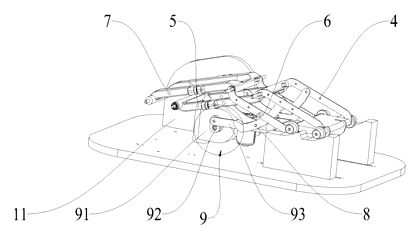
| No. | Part | What it does |
|---|---|---|
| 1 | Seat main body | The platform or shell where the occupant sits. |
| 2 | First lifting frame | One of the two frames supporting the seat, driven to lift synchronously. |
| 3 | Second lifting frame | The other supporting frame, moving in step with the first. |
| 4 | Driving mechanism | Contains the motor, rotating member and driving member that power the lift. |
| 5 | Installation base | The bottom structure resting on the floor, supporting both lifting frames. |
| 6 | Rotating member | Fixed to the motor’s output shaft; transfers rotation to the driving member. |
| 7 | Driving member | Pivotally connected off-center to the rotating member; pushes the swinging members. |
| 8 | First / second swinging members | Link the driving member to the lifting frames to convert rotary motion to lift. |
| 9 | Seat body support seat | Connects the seat main body to the pivot shafts of the lifting frames. |
| 10 | Seat body swing mechanism | Enables front-back displacement of the seat body. |
| 11 | Lift limit mechanism | Limits the opening angle of the frames via protruding parts on pivotal rods. |
| 12 | Limiters | Prevent left-right movement of the seat body relative to the mounting base. |
| 13 | Support seat (on base) | Supports the moving parts with a concave arc surface or high-low slope. |
Operating steps
- Power the motor - the motor’s output shaft turns the rotating member.
- Transfer motion - because the driving member is pivoted at a point offset from the shaft center, rotation pushes the driving member linearly.
- Actuate frames - the driving member moves the first and second swinging members, causing the first and second lifting frames to open or close together.
- Maintain angle - since both frames move synchronously, the seat main body retains a constant angle relative to the installation base throughout the travel.
- Swing the seat - the seat body swing mechanism can be operated independently to shift the seat forward or backward.
- Limit travel - the lift limit mechanism stops the frames from opening past a set angle, and limiters block lateral drift.
Applications
High chairs for dining
Parents adjust the chair height to match different dining tables or kitchen counters. The synchronized frames keep the seat level so the child does not slide forward when raised, while the swing mechanism pulls the seat closer to the table edge.
Activity and play seats
Toddlers use the chair at a low height for floor play and a higher setting for table crafts. The constant seat angle prevents tipping sensations during transitions, and the lift limit mechanism ensures the frames do not over-extend when lowered to the floor position.
Pediatric therapy seating
Therapists require precise, repeatable seat heights for children during sessions. The motor drive provides steady adjustment without manual cranking, and the limiters prevent lateral sway, giving a stable platform for postural exercises.
Daycare multi-use chairs
Staff change seat heights frequently to accommodate different age groups sharing the same room. The robust frame synchronization reduces maintenance compared to independent gas springs, and the support seat’s concave arc surface guides the moving parts smoothly.
Where it is less suitable
- Adult office chairs - the frame geometry and motor sizing described in the patent target lighter loads typical of children’s furniture; adult ergonomic chairs use different lift columns.
- Outdoor patio seating - the exposed motor, pivot points and swing mechanism are designed for indoor environments where weather sealing is not specified.
- Recliners requiring full backrest tilt - this design maintains a constant seat-to-base angle and offers fore-aft swing, but it does not describe a reclining backrest hinge.
Frequently asked questions
How do the two lifting frames stay synchronized?
The motor turns a rotating member, and a driving member is pivoted on it at a point offset from the motor shaft. When the motor runs, the driving member pushes both the first and second swinging members at the same time, forcing the two lifting frames to open or close together. This keeps the seat main body at a constant angle relative to the base.
What does the seat body swing mechanism do?
It allows the seat body to move forward and backward along its length. According to the patent, this is achieved through a seat body swing mechanism that drives the seat in the front-rear direction, adding a sliding function on top of the vertical lift.
Is the motor inside the base?
According to the patent, the motor is arranged at the end of the installation base away from the pivot shafts of the lifting frames. The exact size and voltage are set in design and confirmed on prototypes based on the intended load.
What stops the chair from lowering too far?
A lift limit mechanism controls the opening and closing angle of the lifting frames. The patent describes pivotal rods with protruding parts that define the maximum angle when the seat body is lowered, preventing the frames from collapsing flat.
Does the seat wobble side to side when lifting?
The patent describes limiters on the rotating members that restrict the seat body from moving in the left-right direction relative to the mounting base. Additionally, a support seat on the base with a concave arc surface or high-low slope guides the moving parts.
What age group is this chair designed for?
The patent text does not specify an age or weight rating. These parameters are set in design and confirmed on prototypes depending on the frame thickness, motor torque and seat dimensions chosen for production.
Can this design be made and sold in the US?
The patent was filed only in China and has been withdrawn (the owner actively abandoned the right effective 2025-02-07), so it does not restrict the design in the US or in China. Motorized children’s furniture may be covered by other US patents - see Patent & Production - so we recommend a freedom-to-operate check before volume production.
Are you affiliated with the patent owner?
No. IP2M is an independent design and manufacturing service working from the public patent document.
Request a quote
Click Request a Quote below to see our email address - copy it, or open your email app with a ready-made message. Please mention patent CN209733227U in the subject.
Helpful details to include:
- Your company and channel (children’s furniture brand, Amazon seller, wholesaler, contract manufacturer)
- Target age group and weight capacity
- Height range (lowest to highest seat position)
- Materials preferred for the frame and seat shell
- Control type (buttons, foot pedal, remote)
- Estimated quantity and target price
- Timeline - when you would like samples and the first shipment
You can also reach us at (332) 203-9997.
Explore this product
Interested in building this?
Tell us your target market, quantity and timeline. We reply with options for prototyping, small-batch runs or volume production.
Send your inquiry to
Please put CN209733227U in the subject line and tell us your company, country, estimated quantity and timeline.
Prefer to talk? Call (332) 203-9997.
More product-ready patents
All Baby & Kids patents →
Baby & Kids
Portable Folding Rocking Bassinet Frame
Rocking bassinet frame that folds flat: telescopic hub, folding rails, two-part legs, curved rockers.
Patent CN206910143U
Baby & Kids
Stroller Seat with Linked Fold-Away Armrest
Stroller seat whose armrest unlocks and folds automatically when the backrest is folded forward.
Patent CN206856772U
Baby & Kids
One-Motion Folding Baby Crib with Linked Frame
Portable baby crib whose top rails fold down automatically as the A-frame legs are closed.
Patent CN207202585U
Baby & Kids
Motorized Rocking Stroller That Rocks by Turning Its Wheels
Baby rocker or stroller whose motor turns the wheels back and forth; a clutch switches to pushing.
Patent CN208119238U
Baby & Kids
Bedside Crib Base with Spring-Loaded Telescoping Caster Legs
Bedside crib feet with spring-loaded sliding casters: wide when alone, short to sit flush at the bed.
Patent CN207168269U
Baby & Kids
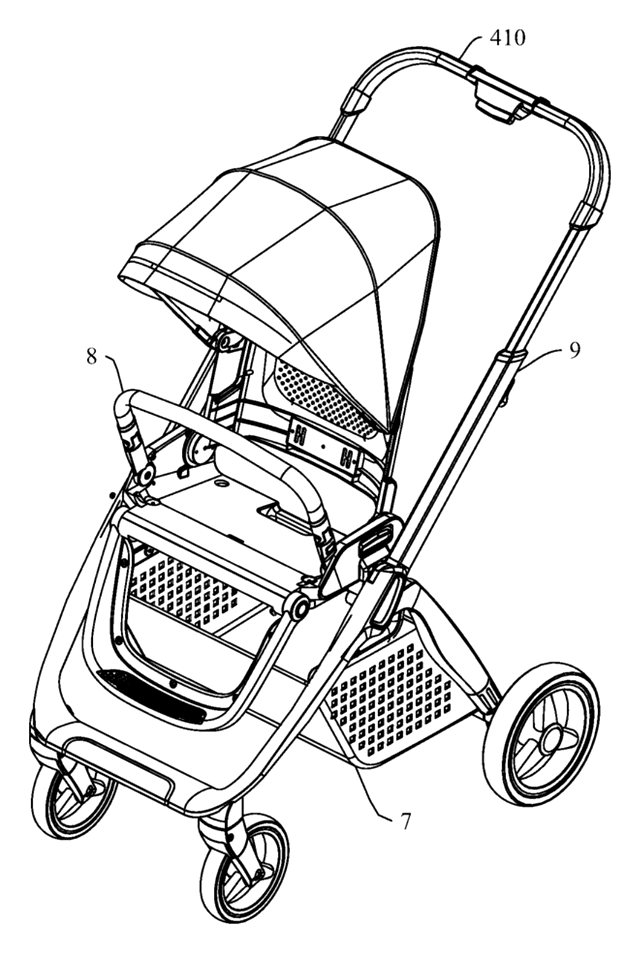
Compact-Fold Stroller with a Four-Bar Side Frame and Telescoping Handle
Stroller with four-bar side frames: handle and rear leg fold onto the front leg, handle telescopes.
Patent CN213799844U
Browse by category
- Apparel & Accessories (22)
- Baby & Kids (16)
- Bags & Luggage (9)
- Bath & Personal Care (16)
- Car Accessories (10)
- Furniture, Bedding & Storage (12)
- Garden & Outdoor (18)
- Health & Wellness (8)
- Home, Kitchen & Cleaning (24)
- Lighting (12)
- Packaging & Containers (6)
- Pet Products (6)
- Phone & Camera Accessories (4)
- Retail Display (13)
- School, Office & Art (19)
- Sports & Recreation (25)
- Tools & Workshop (27)
- Toys & Games (12)
This page is based on the public patent document CN209733227U, assigned to Zhongshan City Togyibaby Co Ltd. IP2M is an independent manufacturing service and is not affiliated with, endorsed by or licensed by the patent owner. Images marked as concept renderings are illustrations, not photos of an existing product. Patent status information is provided for reference only and is not legal advice; confirm freedom to operate for your market before production. Full disclaimer.