At a glance
| Patent number | CN209733227U (application CN201920159138) |
| Type | China utility model (实用新型) - protects product shape and structure |
| Original title | A kind of lifting chair (一种升降椅) |
| Patent owner | Zhongshan City Togyibaby Co Ltd |
| Inventors | Liu Weibing |
| Filing date | 2019-01-29 |
| Grant date | 2019-12-06 |
| Status (China) | Withdrawn - the owner actively abandoned the patent right, effective 2025-02-07 |
| Patent family | Chinese filings only - no US, European, Japanese, PCT or other filings listed |
| Cited by | 10 later documents |
| Source | Google Patents (search for CN209733227U) |
What the claims cover, in plain language
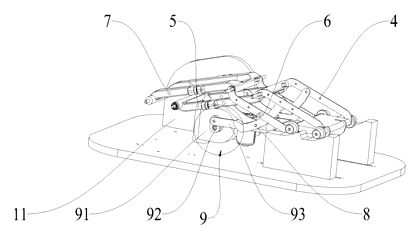
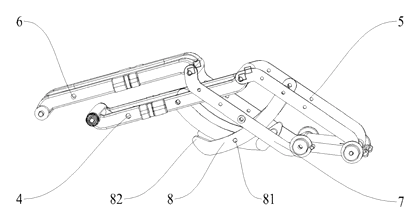
Claim 1 - a lifting chair with a seat main body, a first lifting frame, a second lifting frame, a driving mechanism and an installation base that supports both frames. The seat main body sits on the two lifting frames, and the driving mechanism raises and lowers them synchronously.
Claim 2 - the driving mechanism includes a motor, a rotating member fixed to the motor’s output shaft, and a driving member. One end of the driving member pivots on the rotating member at a point offset from where the rotating member attaches to the shaft. The other end connects to a first swinging member and a second swinging member.
Claim 3 - adds a seat body support seat fixed to the seat main body at one end, with its other end connecting to a first pivot shaft of the first lifting frame and a second pivot shaft of the second lifting frame.
Claim 4 - introduces a seat body swing mechanism that drives the seat body to move along the front and rear directions.
Claim 5 - specifies a swivel seat fixed to the seat body and pivotally connected to a swing base.
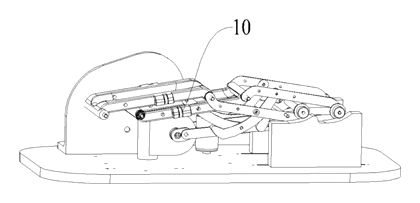
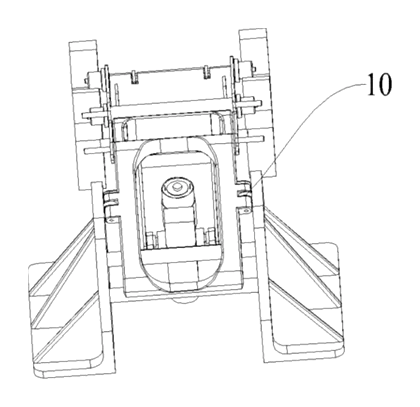
Claim 6 - adds a lift limit mechanism that restricts the opening and closing angle of the first and second lifting frames.
Claim 7 - details that two pivotal rods are pivotally connected, with at least one rod having a protruding part that defines the angle between them when the seat lowers.
Claim 8 - places limiters on the first and/or second rotating members to stop left-right movement of the seat body relative to the mounting base.
Claim 9 - describes a support seat on the installation base for the moving parts, with a support surface shaped as a concave arc or a high-low slope sloping down toward the rotating members.
Claim 10 - locates the motor at the end of the installation base away from the first and second pivot shafts.
This is a simplified reading for orientation only. The legal scope is defined by the exact claim wording in the official Chinese document.
What this means for US production
This patent was filed only in China and has been withdrawn (the owner actively abandoned the right effective 2025-02-07), so it no longer restricts anyone in China. It has no US or other foreign counterpart.
Two points to settle early:
- Other patents may exist. Motorized children’s chairs and lifting mechanisms are covered by various US and international patents held by juvenile product companies, so a freedom-to-operate (FTO) review of the synchronized frame linkage, motor drive geometry and swing mechanism is needed before tooling.
- Motor and electrical safety. The chair relies on an electric motor; selecting a motor class, wiring method and switch type appropriate for juvenile furniture must be settled early, as these choices affect both enclosure design and regulatory testing.
Customization and manufacturing
What can be customized
| Area | Options |
|---|---|
| Seat dimensions | Width, depth and shell contour to fit target age groups |
| Frame material | Steel tubing or stamped steel for the lifting frames and base |
| Motor specification | Voltage, torque and speed to be confirmed in design |
| Swing travel | Range of front-back movement set by the swing mechanism geometry |
| Upholstery | Removable pads, wipe-clean plastics or fabric covers |
| Control interface | Button panel, foot switch or remote control |
| Color and finish | Powder coating or paint colors for metal parts |
Things to plan for (US market)
- CPSC 16 CFR 1231 / ASTM F404 - safety standard for high chairs, covering stability, restraint systems, pinch points and structural integrity; applicable if marketed for feeding.
- UL 962 or equivalent - safety standard for household and commercial motorized furniture, addressing electrical shock, fire risk and motor overload.
- California Proposition 65 - screening of plastics, foams, paints and coatings for listed chemicals.
- FCC Part 15 - if the motor controller or any wireless remote emits radio frequency energy.
How a project runs
- Inquiry - define target age range, weight capacity, height range and control preferences.
- Design - engineer the frame geometry, select the motor, design the rotating and driving members, and model the limit mechanisms.
- Prototype - build working samples to verify synchronous lift, swing travel, noise levels and pinch-point clearances.
- Pilot run - conduct cycle testing, load testing and preliminary compliance checks against relevant ASTM/CPSC standards.
- Production - stamp or weld frames, mold plastic seat shells, assemble drive components, wire the motor, and package.
Quantities & timeline
The lifting frames and installation base require stamping dies or welding jigs, the seat shell needs injection molds sized to the chosen dimensions, and the rotating and driving members need precision machining or molding. Motor sourcing and electrical certification tests add to the schedule. Send us your target age group, weight capacity, height range, preferred materials, quantity and target price and we will reply with options.
Patent drawings
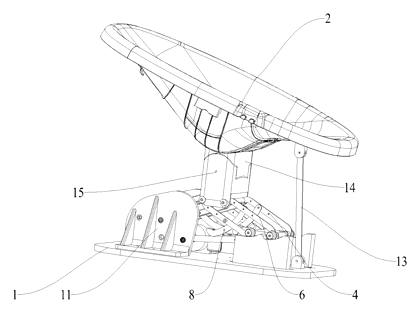
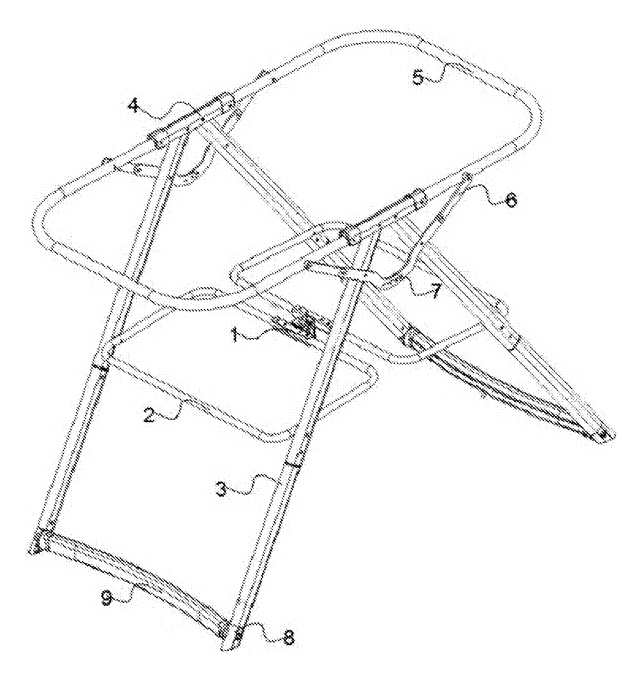
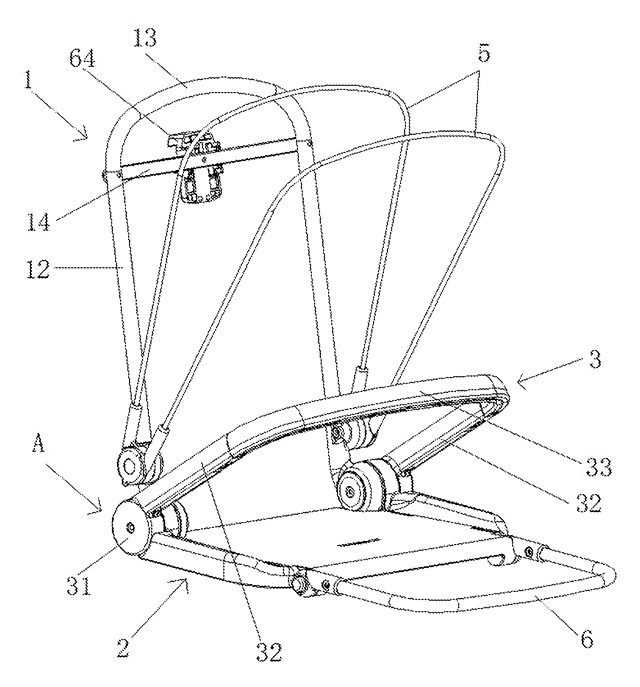
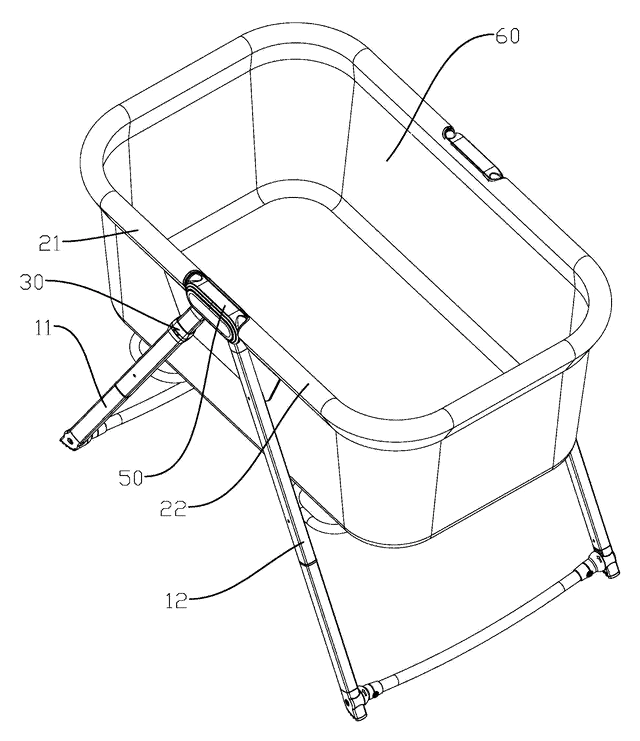
Drawings reproduced from the public patent document for reference.