At a glance
| Patent number | CN209757356U (application CN201920039975) |
| Type | China utility model (实用新型) - protects product shape and structure |
| Original title | Bicycle bottle cage with tool set (具工具组的自行车水壶架) |
| Patent owner | Naixing Vehicle Material Shenzhen Co ltd, Zhangzhou Anjiayi Industrial Co ltd, Naixing Enterprise Co ltd |
| Inventors | Shi Horen, Wang Benli, Yang Xinhuang |
| Filing date | 2019-01-10 |
| Grant date | 2019-12-10 |
| Status (China) | Active - In force in China until at most 2029-01-10 (if annual fees are paid) |
| Patent family | Chinese filings only - no US, European, Japanese, PCT or other filings listed |
| Cited by | 0 later documents |
| Source | Google Patents (search for CN209757356U) |
What the claims cover, in plain language
Claim 1 defines the core structure: a bicycle bottle cage with a back plate containing an inwardly concave storage space. It specifies a tire lever rod with a working end and hooked fixing end, featuring a locking recess and accommodating grooves on its back. Wrench tool rods are placed in these grooves. The assembly is secured when the lever is pressed into the space, clamping the bolt head via the locking recess and fastening the fixed end against the abutting part of the back plate.
Claim 2 adds a “embracing water bottle placing portion” in front of the cage. Claim 3 specifies that the coupling hole on the back plate is a long hole for vertical adjustment. Claim 4 introduces a buckle block protruding from the back of the tire lever to snap onto the bottom edge of the back panel. Claim 5 mentions a pressing portion on the tire lever. Claims 6-8 detail the quantity of wrenches (one in the first groove, two in the second) and their hexagonal cross-section.
This is a simplified reading for orientation only. The legal scope is defined by the exact claim wording in the official Chinese document.
What this means for US production
This patent was filed only in China and is currently active in China. Making or selling this specific structural design in China would require permission from the patent owners. However, since there are no corresponding patents in the US or Europe, the design itself is not restricted by this specific patent number in those markets.
Two points to settle early:
- Other patents may exist. Bicycle accessories are a competitive field with many existing patents regarding tool integration and bottle cage structures. A freedom-to-operate (FTO) review is recommended to ensure no other US patents cover similar integrated tool-cage mechanisms.
- Material Standards. The patent does not specify materials. For US sales, the plastic or metal used must meet general consumer safety standards, particularly if marketed to children or used in extreme weather conditions.
Customization and manufacturing
What can be customized
| Area | Options |
|---|---|
| Material | Nylon composite, aluminum alloy, or steel for the cage and tools. |
| Tool Set | Number and size of wrench rods (hex keys); tire lever material (POM/nylon). |
| Color | Pantone matching for the cage body and tool handles. |
| Finish | Matte, glossy, or textured surfaces for grip and aesthetics. |
| Mounting | Long-hole adjustment range for different frame diameters. |
Things to plan for (US market)
- CPSC General Requirements: While bicycles have specific standards, components should generally avoid sharp edges and toxic materials.
- California Prop 65: If using certain plastics or coatings, screening for listed chemicals is necessary.
- Durability Testing: Cycles of insertion/removal for the tools to ensure locking mechanisms do not wear out prematurely.
How a project runs
- Inquiry - Define material preferences, tool count, and color scheme.
- Design - CAD modeling of the back plate curvature and lever locking geometry.
- Prototype - 3D printed or CNC machined samples to test fit and retention strength.
- Mold Tooling - Create injection molds for the plastic cage and lever; stamping dies for metal wrenches.
- Production - Injection molding, metal fabrication, assembly, and packaging.
Quantities & timeline
Injection molds for the complex back plate and lever shapes require precision engineering. Metal wrenches are typically stamped or cut from bar stock. Assembly involves snapping the tools into the cage. Send us your material choice, tool configuration, color, quantity and target price and we will reply with options.
Patent drawings
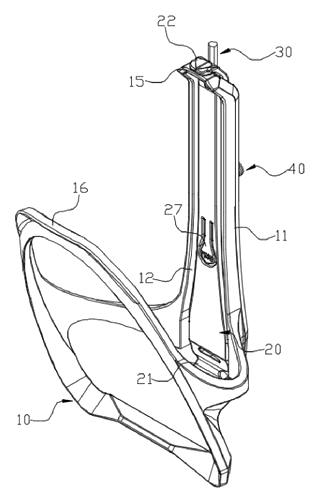
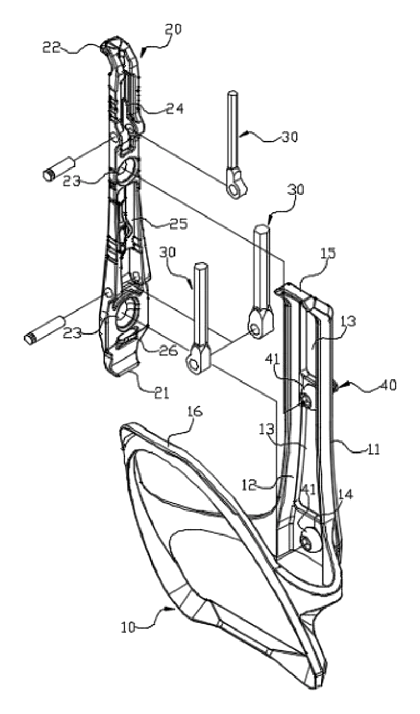
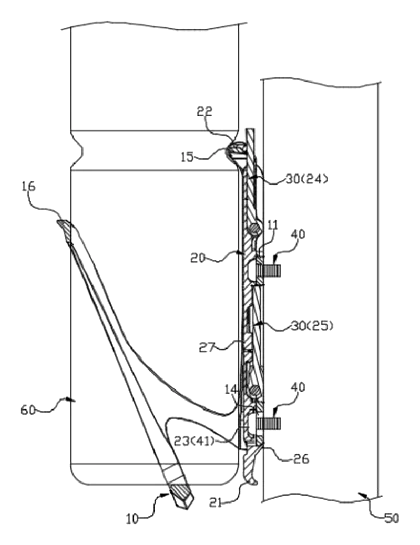
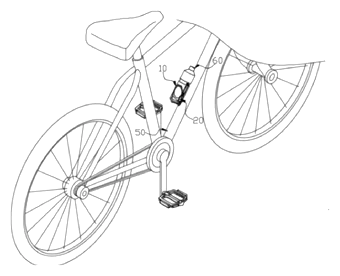
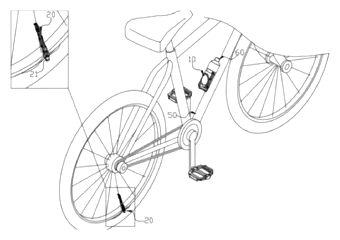
Drawings reproduced from the public patent document for reference.