
Patent CN209915891U
Updated November 3, 2026Layered Cleaning Sponge Head for Mops with PVA and PU Layers
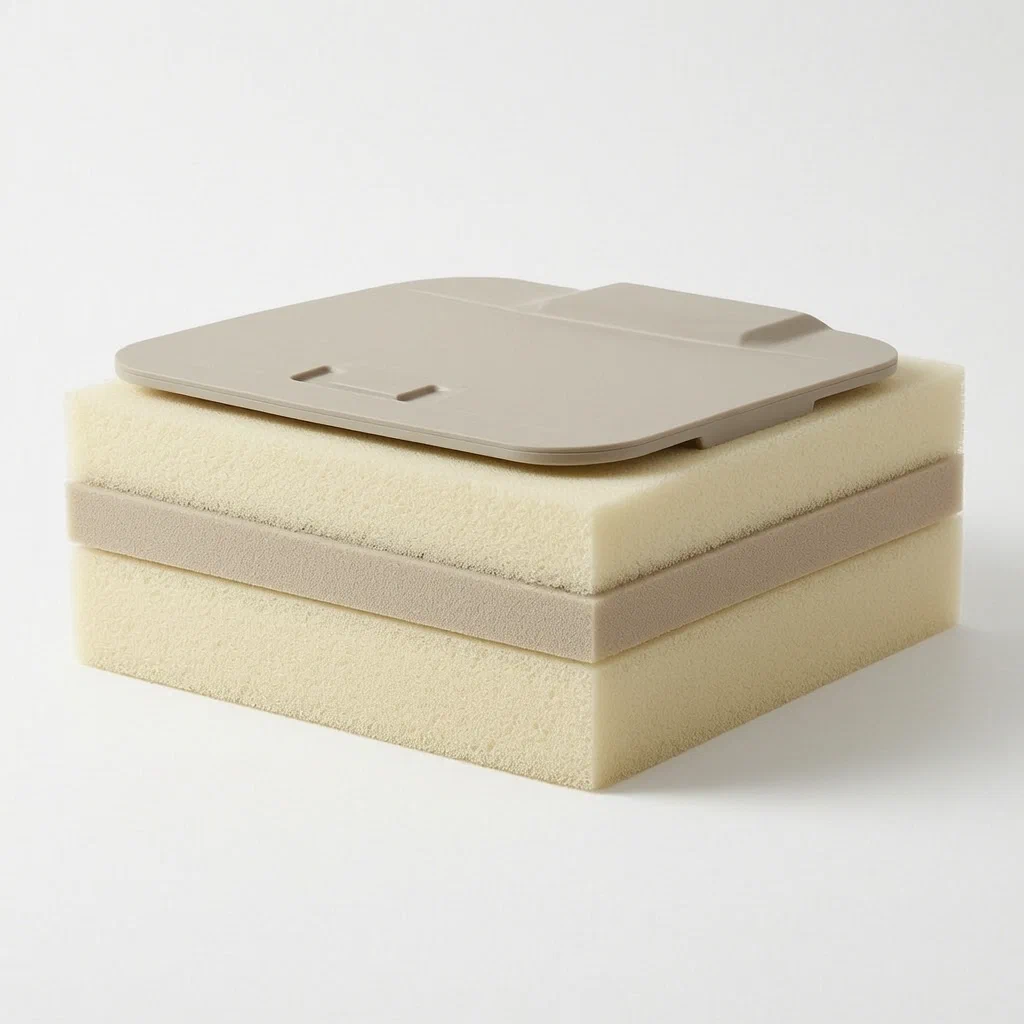
Standard flat mops often suffer from sponge heads that warp, tear, or fail to squeeze out water completely because the absorbent material lacks structural support. When you wring out a simple PVA pad, it can twist or stretch, leaving pockets of dirty water trapped inside. This patent describes a composite sponge head where a rigid support layer sits between a soft PVA absorption layer and a resilient PU backing layer. The support layer keeps the shape stable while the outer layers do the work of picking up dirt and releasing water. The connection to the mop frame is handled by a separate interface layer, making replacement easier and reducing stress on the sponge itself.
- China utility model - lapsed
- No filings outside China
- Floor care & cleaning tools
- PVA, EVA/Plastic, PU sponge layers
Splat! What let you down?
🧽
PVA Contact Layer
The bottom layer touches the floor, providing high water absorption for effective cleaning.
🛡️
Stiff Support Core
A harder middle layer prevents the soft PVA from warping or tearing during use.
💪
PU Resilient Backing
The top layer adds cushion and helps expel water when the mop is squeezed.
🔗
Secure Interface
Connects to the mop handle via a plastic plate or felt cloth for easy attachment.
Bring this product to market
- ✓ Patent vetted China-only family and legal status checked
- 2 Product brief · now How it works, uses and options written up
- 3 Prototype First samples for buyers to review
- 4 Pilot run Small first batch for launch customers
- 5 Volume production Repeat orders at scale
Buyer interest
– of 100 buyers needed to start prototyping
One click, no sign-up. Each vote is one real visitor, and products with the most interest go to prototyping first.
Build team: no members yet. Need a partner, co-funding or skills to build this? Join and we introduce the team once it forms.
The problem
Traditional mop sponge heads often consist of a single piece of absorbent foam or fabric. While these materials pick up water well, they lack structural integrity. During the wringing process, especially in bucket systems or manual squeezing, the soft sponge can deform, twist, or tear. This deformation reduces the surface area in contact with the floor, leading to streaks and leftover puddles. Furthermore, without a rigid backbone, the sponge may not return to its original shape after compression, causing uneven wear over time. Users also find it difficult to extract all the dirty water, as the sponge folds in on itself rather than compressing uniformly.
The solution
- Three-Layer Composition: The sponge head is built from three distinct functional layers bonded together.
- Bottom Layer (PVA): A Polyvinyl Alcohol (PVA) sponge layer forms the base. This material is chosen for its superior absorbency and ability to hold large amounts of water relative to its weight. It directly contacts the cleaned surface.
- Middle Layer (Support): Positioned between the PVA and the top layer is a support layer made of a harder material, such as EVA foam or a thin plastic sheet. Its primary function is to provide rigidity. Because its hardness is greater than both the PVA and the top PU layer, it acts as a skeleton that resists bending and twisting forces.
- Top Layer (PU): A Polyurethane (PU) sponge layer sits above the support core. PU offers good elasticity and resilience. It serves as the mounting point for the mop mechanism and assists in pushing water out through the PVA layer when pressure is applied from the top.
- Interface Connection: The PU layer is connected to the mop’s mechanical part (the frame or handle assembly) via an “articulamentum” or connecting layer. This can be a plastic plate (ABS or PVC) or a felt cloth. This interface ensures that the force from the mop handle is transferred evenly across the sponge head without damaging the porous sponge structure.
- Integrated Formation: The patent specifies that the PVA, support, and PU layers are processed into an integrated formed part. This bonding prevents delamination during wet use and repeated washing cycles.
Who it is for
- Floor Care Brands looking to upgrade their standard flat mop lines with a more durable, non-warping sponge head that commands a higher price point due to perceived quality.
- Commercial Cleaning Suppliers who need mop heads that withstand frequent wringing and industrial use without losing shape, reducing replacement costs for facility managers.
- OEM Manufacturers specializing in household cleaning tools who want a modular sponge design that simplifies assembly using pre-bonded layers.
- Retail Chains seeking private-label products that differentiate themselves from generic sponges by highlighting “structural support” features in packaging.
How it works
The main parts
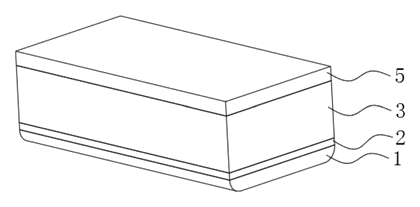
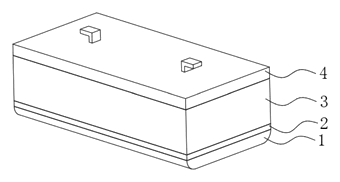
| No. | Part | What it does |
|---|---|---|
| 1 | PVA Sponge Layer | Bottom layer; absorbs water and picks up dirt from the floor. |
| 2 | Support Layer | Middle layer; made of EVA or plastic; prevents warping and provides stiffness. |
| 3 | PU Sponge Layer | Top layer; resilient backing that aids in water expulsion and mounts to the mop. |
| 4 | Plastic Plate | Optional interface; ABS or PVC plate connecting the PU layer to the mop frame. |
| 5 | Felt Cloth | Alternative interface; flexible fabric connector between the sponge and the tool. |
Operating Steps
- Absorption: When the mop is pushed across a wet floor, the PVA layer (1) absorbs water and debris. The support layer (2) keeps the PVA flat against the surface, ensuring maximum contact area.
- Wringing/Squeezing: To clean the mop, pressure is applied to the PU layer (3). The rigid support layer (2) distributes this force evenly across the entire width of the sponge.
- Water Expulsion: Instead of folding or twisting, the sponge compresses vertically. The PU layer pushes water down through the PVA layer, allowing it to be released efficiently. The support layer prevents the sponge from collapsing inwardly, which would trap water.
- Recovery: Once pressure is released, the elasticity of the PU layer and the memory of the support layer help the sponge return to its original rectangular profile, ready for the next pass.
Applications
Flat Mops for Hardwood Floors
Wood floors require a damp, not soaking wet, mop. The PVA layer holds enough water to clean but releases it quickly when squeezed. The support layer ensures the mop head stays flat, preventing streaks caused by uneven pressure distribution on delicate finishes.
Tile and Grout Cleaning
In bathrooms and kitchens, tile grout traps dirt. The rigid support allows the user to apply significant downward pressure without the sponge head buckling. This enables the PVA to scrub deeper into grout lines while maintaining its shape for consistent coverage.
Commercial Office Spaces
Large open areas require efficient mopping. These sponge heads fit onto wide commercial mops. The layered construction withstands the aggressive wringing mechanisms of janitorial carts, reducing the frequency of head replacements compared to single-material sponges.
Home Car Wash Details
While primarily for floors, the absorbent nature makes it suitable for drying cars. The support layer prevents the sponge from tearing when dragged across curved surfaces like hoods and roofs, offering a safer alternative to loose chamois cloths.
Where it is less suitable
- Heavy Industrial Degreasing: For oil-based spills, specialized microfiber or synthetic degreasing pads are preferred over PVA, which may degrade faster with harsh solvents.
- Extreme Cold Environments: PVA can become brittle if frozen. In unheated warehouses, synthetic foams might offer better flexibility at low temperatures.
- Very Small Niche Areas: The bulkiness of the three-layer stack might make it too thick for cleaning tight corners or intricate furniture legs compared to thinner microfiber wraps.
Frequently asked questions
Why use three different sponge materials?
Each layer has a specific job. The PVA (bottom) absorbs the most water. The Support layer (middle) is harder and keeps the sponge from bending or tearing when you squeeze it. The PU (top) is elastic and helps push the water out. Together, they clean better than a single-material sponge that warps easily.
Does the support layer make the mop heavy?
Not significantly. The support layer is typically 0.5-1 cm thick and can be made of lightweight EVA foam or thin plastic. It adds structure without adding excessive weight, keeping the mop easy to maneuver.
Can this sponge head be washed in a machine?
The patent describes the layers as “integrally formed,” meaning they are bonded strongly. However, machine washing depends on the adhesive quality. We recommend hand rinsing or gentle cycle tests during prototyping to confirm durability for your specific brand standards.
How does it connect to the mop handle?
There are two options described in the patent: a plastic plate (ABS or PVC) for snap-in frames, or a felt cloth for strap-and-buckle systems. This interface attaches to the top PU layer, protecting the sponge from direct stress from the handle.
Is PVA better than microfiber?
PVA holds more water than typical microfiber, making it ideal for wet mopping. Microfiber is often better for dry dusting or polishing. This sponge head is designed for wet cleaning tasks where water absorption and controlled release are key.
Can I change the color of the sponge?
Yes. While PVA is naturally yellowish-white, the PU and support layers can be colored to match your brand. The plastic interface plates can also be molded in custom colors.
Can this design be made and sold in the US?
The patent CN209915891U was filed only in China and has lapsed (expired) due to non-payment of fees. It does not restrict manufacturing or sales in the US. However, other active patents may cover similar structures, so a freedom-to-operate review is advised before large-scale launch.
Are you affiliated with the patent owner?
No. IP2M is an independent design and manufacturing service working from the public patent document.
Request a quote
Click Request a Quote below to see our email address - copy it, or open your email app with a ready-made message. Please mention patent CN209915891U in the subject.
Helpful details to include:
- Your company and channel (floor care brand, commercial supplier, retailer)
- Target dimensions (length, width, total thickness)
- Connection type preference (plastic plate vs. felt cloth)
- Material specs (preferred EVA hardness or plastic type)
- Estimated quantity and target price
- Timeline - when you would like samples and the first shipment
You can also reach us at (332) 203-9997.
Explore this product
Interested in building this?
Tell us your target market, quantity and timeline. We reply with options for prototyping, small-batch runs or volume production.
Send your inquiry to
Please put CN209915891U in the subject line and tell us your company, country, estimated quantity and timeline.
Prefer to talk? Call (332) 203-9997.
More product-ready patents
All Home, Kitchen & Cleaning patents →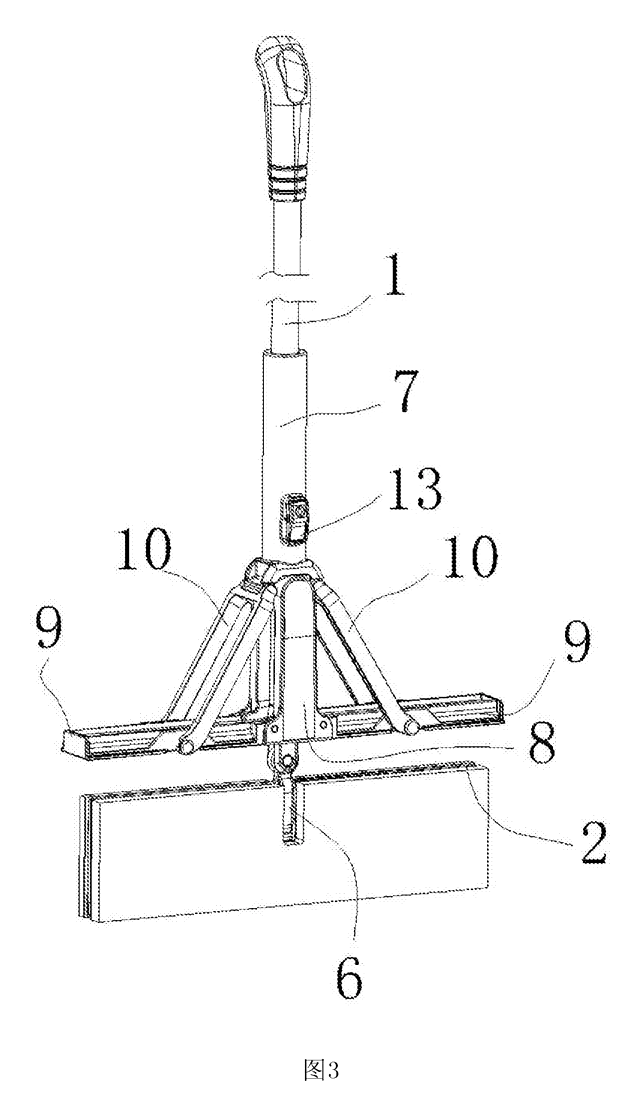
Home, Kitchen & Cleaning
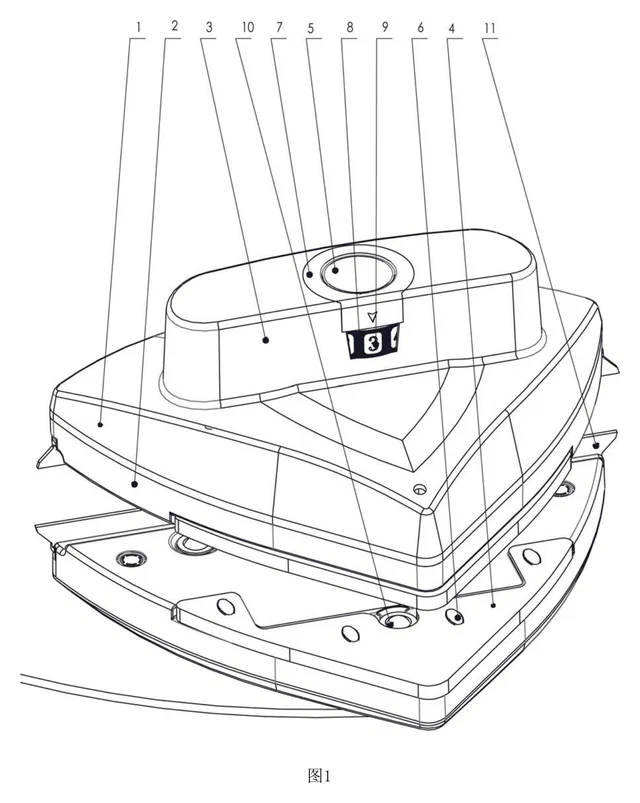
Self-Wringing Flat Mop with Fold-Away Wringer
Flat mop with a built-in wringer that opens only when you wring and folds flat against the pole when you mop.
Patent CN207734114U
Home, Kitchen & Cleaning
Magnetic Double-Sided Window Cleaner with Dial-Set Magnet Strength
Magnetic window cleaner with a sealed, sliding magnet, dial-set strength for different glass thicknesses and a spring-held idle position.
Patent CN209360543U
Home, Kitchen & Cleaning
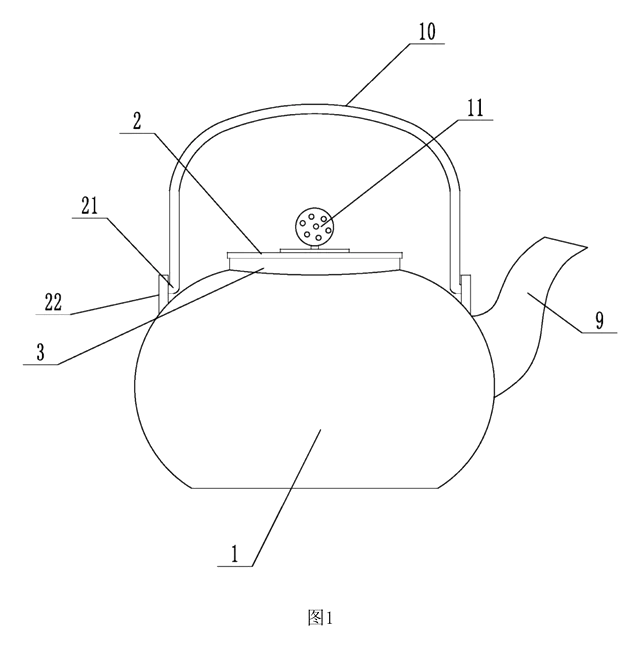
Metal Kettle with Magnetic Lid That Stays On When Pouring
Metal teapot/kettle with a magnet-held lid that does not fall off when pouring, and an insulated, vented lid knob.
Patent CN210540477U
Home, Kitchen & Cleaning
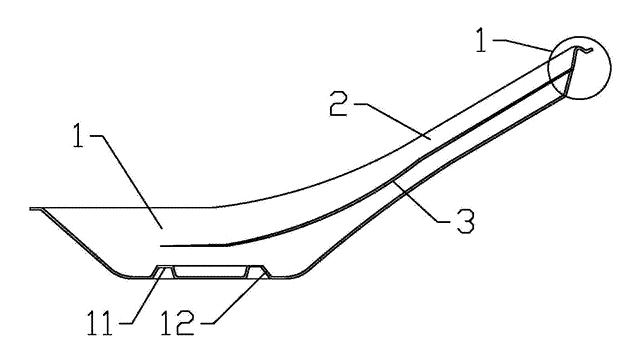
Reinforced Disposable Soup Spoon
Disposable soup spoon with a handle-to-bowl rib, stiffened edges and a ring foot to resist breaking.
Patent CN206964482U
Home, Kitchen & Cleaning
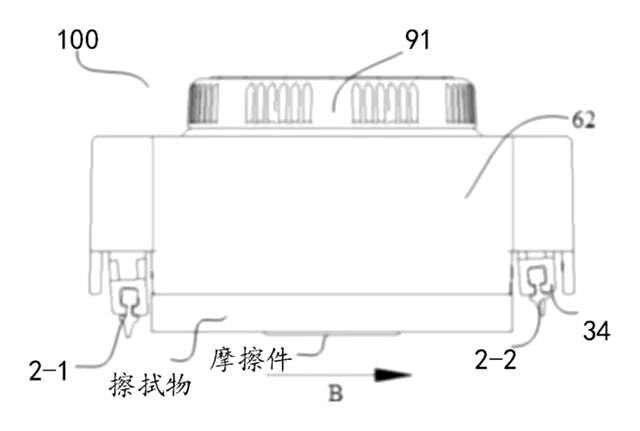
Self-Switching Double-Squeegee Window Cleaner
Cleaning head with two squeegee blades that switch automatically with the direction of movement.
Patent CN212630655U
Home, Kitchen & Cleaning
Self-Rinsing Roller Scrub Brush with Dirty-Water Tank
Powered roller brush that rinses and spins its bristles clean inside the body and stores the dirty water.
Patent CN210076909U
Browse by category
- Apparel & Accessories (31)
- Baby & Kids (23)
- Bags & Luggage (13)
- Bath & Personal Care (22)
- Car Accessories (19)
- Furniture, Bedding & Storage (17)
- Garden & Outdoor (25)
- Health & Wellness (10)
- Home, Kitchen & Cleaning (36)
- Lighting (17)
- Packaging & Containers (9)
- Pet Products (8)
- Phone & Camera Accessories (6)
- Retail Display (18)
- School, Office & Art (25)
- Sports & Recreation (32)
- Tools & Workshop (41)
- Toys & Games (17)
This page is based on the public patent document CN209915891U, assigned to Hebei Shi Jie Bao Daily Plastic Products Co Ltd. IP2M is an independent manufacturing service and is not affiliated with, endorsed by or licensed by the patent owner. Images marked as concept renderings are illustrations, not photos of an existing product. Patent status information is provided for reference only and is not legal advice; confirm freedom to operate for your market before production. Full disclaimer.