At a glance
| Patent number | CN210054901U (application CN201821542690) |
| Type | China utility model (实用新型) - protects product shape and structure |
| Original title | Umbrella frame structure and outdoor equipment (伞架结构和户外设备) |
| Patent owner | Dongjun New Energy Co ltd |
| Inventors | Zhu Kenan |
| Filing date | 2018-09-20 |
| Grant date | 2020-02-14 |
| Status (China) | Lapsed - terminated for non-payment of annual fees (recorded 2024-09-13) |
| Patent family | Chinese filings only - no US, European, Japanese, PCT or other filings listed |
| Cited by | 2 later documents |
| Source | Google Patents (search for CN210054901U) |
What the claims cover, in plain language
Claim 1 defines an umbrella frame structure comprising an umbrella stand body (rod and frameworks), solar chips, an energy storage power supply, and a light source. The key feature is a wire cavity arranged along the extension direction of the body, housing at least part of the connecting wires.
Claims 2-3 specify that the wire cavity can be a first cavity in the frameworks (ribs) and/or a second cavity in the rod. The cavity may be a hollow structure formed by the outer wall or a containing groove.
Claims 4-5 describe the mechanical layout, including upper and lower nest structures for pivoting the ribs, which are divided into branch bones and face bones, each potentially having its own wire cavity.
Claims 6-10 detail the electrical architecture, placing solar chips on the face bones, using concentration circuit boards in the nest structures to manage connections between solar chips, the battery, and lights.
Claims 11-14 extend this to include a second concentration board in the lower nest and distributing light emitting units across various ribs.
Claims 15-17 claim an outdoor unit (solar umbrella or tent) incorporating this frame structure, with solar chips on the canopy’s outer side and the frame on the inner side.
This is a simplified reading for orientation only. The legal scope is defined by the exact claim wording in the official Chinese document.
What this means for US production
This patent was filed only in China and has lapsed due to non-payment of annual fees as of September 2024. Consequently, the technical disclosures in this document are in the public domain in China and do not restrict manufacturing there based on this specific patent. It has no US or other foreign counterpart.
Two points to settle early:
- Other patents may exist. Solar-integrated outdoor furniture is a competitive field. Notably, Linhai Guokang Leisure Products Co., Ltd. holds a European patent application (EP3906804A1) that cites this document, indicating active patenting activity in related structures. A freedom-to-operate (FTO) review is strongly recommended before tooling to ensure no other valid US or international patents cover similar wire-routing mechanisms in umbrella frames.
- Electrical Safety Standards. Unlike simple mechanical umbrellas, adding batteries and solar circuits introduces electrical hazards. Compliance with UL standards for consumer electronics and battery transport regulations (UN 38.3) is mandatory for US market entry.
Customization and manufacturing
What can be customized
| Area | Options |
|---|---|
| Canopy Material | Polyester, acrylic, or olefin fabrics with UV resistance ratings. |
| Frame Material | Aluminum alloy, fiberglass, or steel tubes with varying diameters. |
| Wire Channel Type | Extruded aluminum profiles with pre-formed grooves vs. molded plastic inserts. |
| Battery Capacity | Lithium-ion packs sized for desired runtime (e.g., 4 hours vs. 12 hours). |
| Light Configuration | Number and placement of LED strips or point-source bulbs on ribs. |
| Solar Panel Type | Flexible thin-film panels vs. rigid monocrystalline cells embedded in the canopy. |
Things to plan for (US market)
- UL 62368-1: Audio/video, information and communication technology equipment safety standard, applicable if the umbrella includes complex control electronics or USB ports.
- UL 2054: Household and Commercial Use Batteries standard, critical for the energy storage component.
- UN 38.3: Mandatory testing for lithium batteries during transport.
- FCC Part 15: If the umbrella includes wireless connectivity (Bluetooth for app control), it must meet EMC requirements.
- California Prop 65: Warning labels may be required for certain plastics or battery chemicals.
How a project runs
- Inquiry - Define frame size, battery capacity, and lighting needs.
- Design - Engineer the extrusion profile for the wire cavity and select compatible solar/battery modules.
- Prototype - Create 3D-printed mockups for fit checks and assemble functional samples with real wiring.
- Pilot Run - Test durability of wire routing during open/close cycles and verify electrical safety.
- Production - Manufacture frame components, inject mold plastic connectors, assemble electronics, and sew canopy.
Quantities & timeline
Tooling for extruded aluminum frames with internal cavities requires custom dies. Plastic injection molds for connector housings add lead time. Electrical assembly is labor-intensive. Send us your frame dimensions, battery specs, lighting preferences, quantity and target price and we will reply with options.
Production notes
Tooling and process
Creating the wire cavity likely involves forming aluminum tubes with complex internal geometries or molding plastic ribs with integral channels. Cutting and sewing processes apply to the canopy attachment. PCB assembly is required for the concentration boards mentioned in the claims.
Cost drivers
Fabric grade typically affects durability and cost. Sole mold is not applicable, but die costs for formed profiles are significant. Stitch density in canopy attachment impacts waterproofing. Packaging must typically accommodate fragile electronic components.
Prototyping path
Start with a sewn first sample using standard ribs and external wires to validate layout. Then, produce 3D-printed or cast components for the specialized rib connectors. Wear trials should typically focus on hinge boss and pivot wear, as well as wire strain relief during repeated folding.
What we would change before tooling
We would refine the wall thickness and joint design of the hollow ribs to ensure they can bear wind loads without buckling. We would also optimize the UV stability and weather sealing of any access points to the wire cavity.
Common failure points
Seam slippage in the canopy attachment and color fading from sun exposure are risks. Hardware corrosion at pivot points can jam the mechanism. Wire routing and strain relief failures are critical if the internal channel design is too tight, causing insulation wear. Hinge boss and pivot wear may loosen the frame over time.
Patent drawings
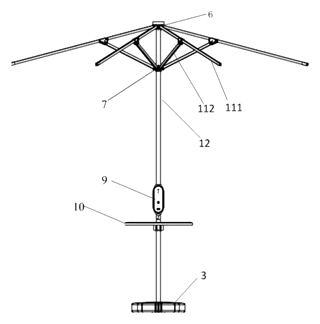
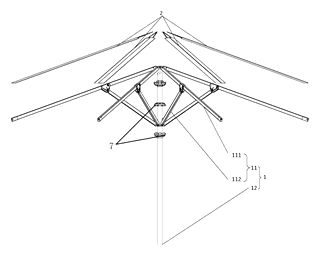
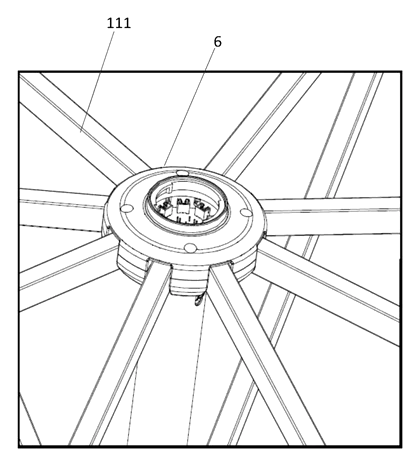
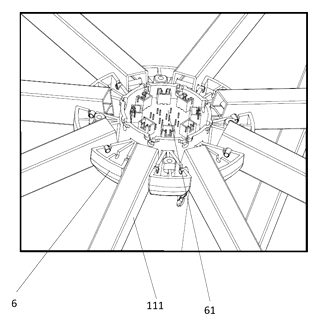
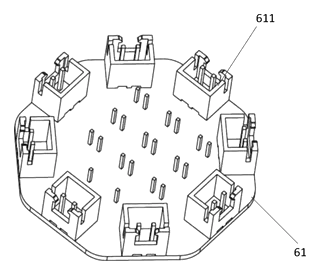
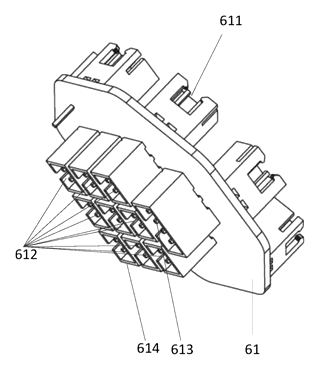
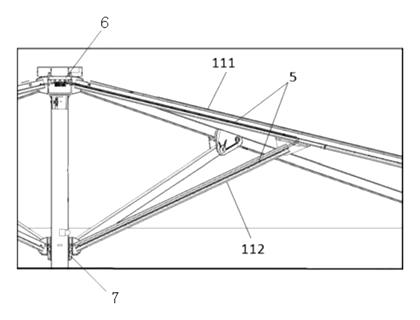
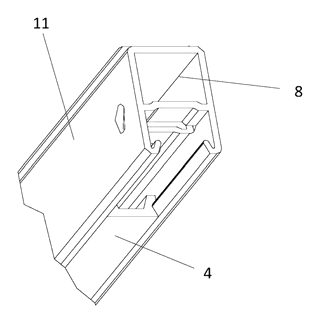
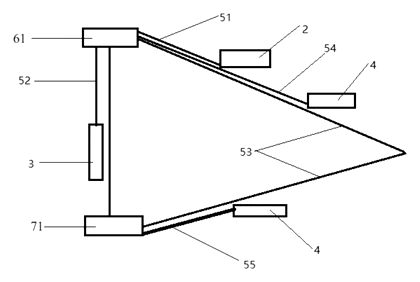
Drawings reproduced from the public patent document for reference.