
Patent CN210370292U
Updated October 25, 2026Quick-Release Toilet Seat Hinge with a Push-Button Two-Strip Latch
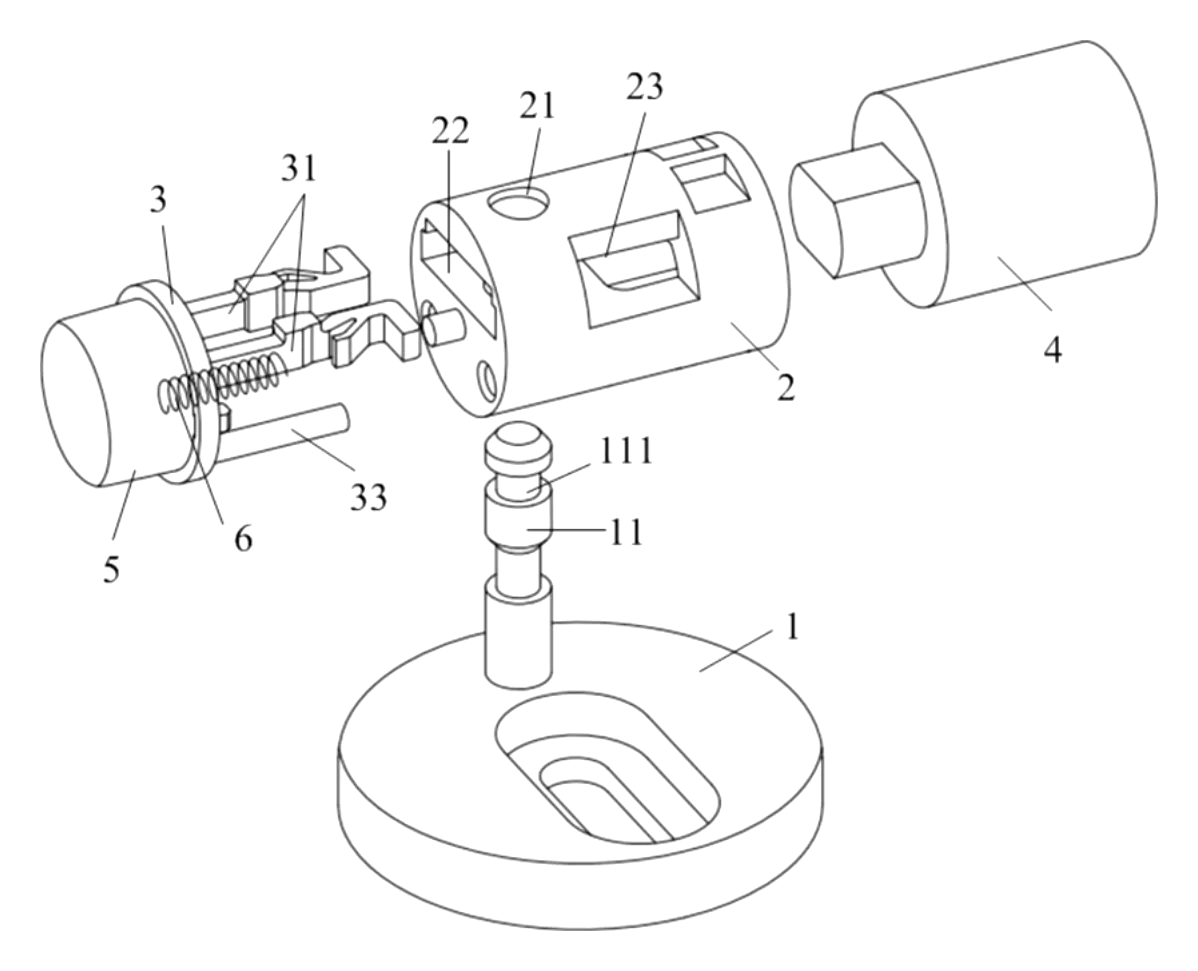
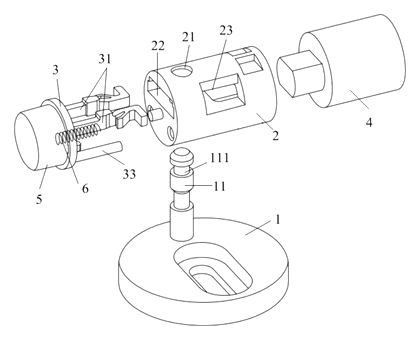
The worst-cleaned spot in most bathrooms is the hinge area behind the toilet seat, because taking a seat off means reaching under the bowl for nuts. Quick-release seats fix that, but many use bulky latches or several parts per hinge. This hinge uses just two flat strips. A support bolted to the bowl carries an upright post with a groove around it. The seat's hinge shaft has a hole that drops over the post, and a slot along the shaft holds two latch strips facing each other. On the way down, the strips spring into the groove and a catch locks them. To remove the seat, the user pushes the latch: small bumps on the strips ride against the post and spread them apart, and a second catch holds them open until the post is out.
- China utility model - in force in China until Apr 2029 at most
- No filings outside China
- Toilet seats & bathroom hardware
- Zinc alloy or POM parts, stainless springs
Splat! What let you down?
⬇️
Drop-on mounting
The seat's hinge shaft drops over a grooved post and the latch strips snap into the groove.
👆
One push to release
Pushing the latch spreads the strips and a catch parks them open while the seat lifts off.
🧩
Two-strip latch
Just two flat strips with bumps and catches do the locking - few parts per hinge.
🧼
Clean behind the seat
Remove the seat and lid to clean the hinge area, then click them back on.
Bring this product to market
- ✓ Patent vetted China-only family and legal status checked
- 2 Product brief · now How it works, uses and options written up
- 3 Prototype First samples for buyers to review
- 4 Pilot run Small first batch for launch customers
- 5 Volume production Repeat orders at scale
Buyer interest
– of 100 buyers needed to start prototyping
One click, no sign-up. Each vote is one real visitor, and products with the most interest go to prototyping first.
Build team: no members yet. Need a partner, co-funding or skills to build this? Join and we introduce the team once it forms.
The problem
Bacteria and grime build up around toilet seat hinges, where a cloth cannot reach with the seat in place. Removing a standard seat means unbolting nuts under the bowl. According to the patent, the aim is a hinge with a simple structure that holds the seat firmly and still lets it be removed easily.
The solution
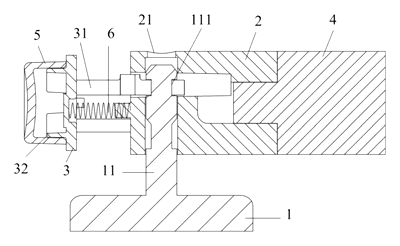
- A support (1) is fixed to the toilet bowl. On top it has an upright post (11) with a groove (111) running around it.
- The seat or lid carries a hinge shaft (2) with a mounting hole (21) across it that fits over the post. At one end the shaft has a slot (22) along its axis that crosses the hole, and in its side wall a positioning notch (23) opens into the slot.
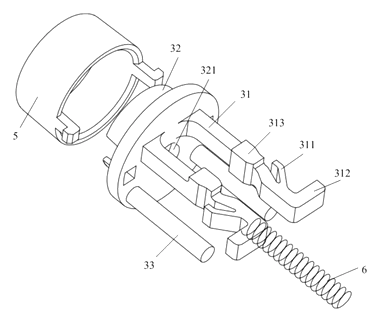
- A latch (3) of at least two strips (31) facing each other slides in the slot. The strips are as thick as the groove is tall, so they can sit in it.
- Each strip carries, in order, a bump (313) pointing inward, an elastic catch (311) and a positioning catch (312) at its end; both catches reach outside the slot.
- Locked: the positioning catch sits in the notch and keeps the strips closed in the post’s groove, so the seat cannot lift off.
- Release: pushing the latch makes the bumps press against the post, which spreads the strips; the elastic catch then sits in the notch and holds them open, and the post slides out. A push button and spring at the latch’s outer end make the push easy and return it.
Who it is for
- Toilet seat brands offering quick-release seats as an easy-clean upgrade.
- Bathroom fixture makers that supply complete toilets and want a simple, low-part-count seat hinge.
- Hospitality and healthcare facility suppliers whose cleaning staff remove seats for deep cleaning.
- Home improvement private labels looking for a better replacement-seat hinge.
How it works
The main parts
| No. | Part | What it does |
|---|---|---|
| 1 | Support | Fixed to the bowl. |
| 11, 111 | Post and groove | The post the seat drops onto; groove for the latch. |
| 2 | Hinge shaft | Fixed to the seat or lid. |
| 21 | Mounting hole | Fits over the post. |
| 22 | Slot | Holds the latch strips. |
| 23 | Positioning notch | Receives the catches. |
| 31 | Latch strips | Two strips that grip the groove. |
| 311, 312, 313 | Elastic catch, positioning catch, bump | Hold the strips open or closed. |
Removing and refitting the seat
- Push the latch on each hinge - the strips spread and stay open.
- Lift the seat and lid straight up off the posts.
- Clean the bowl rim, posts and hinge area.
- Lower the seat back onto the posts; the strips snap into the grooves and lock.
Applications
Family bathrooms
Parents can take the seat off to clean properly without tools.
Hotels and rentals
Housekeeping can remove seats for weekly deep cleaning in seconds.
Hospitals and care homes
Infection-control routines often call for cleaning behind and under seat hinges.
Public restrooms
Maintenance staff can swap damaged seats quickly without crawling under the bowl.
Replacement seats
The support fits standard bolt holes, so a replacement seat can bring the quick-release feature to an existing toilet.
Where it is less suitable
- Vandal-prone public toilets - a tool-free release may be unwanted where seats get stolen; a lockable version would be needed.
- Electronic bidet seats - these have their own mounting plates and electrical connections.
- Very heavy wooden seats - the strip size and material are checked for the seat weight.
Frequently asked questions
How do I take the seat off?
Push the latch on each hinge. The strips spread apart and a catch holds them open, so the seat and lid lift straight up off the posts.
How does it lock back on?
Lower the seat so the hinge shafts drop over the posts. The latch strips spring into the grooves around the posts and the positioning catch locks them.
Will the seat come off by accident?
The strips sit in the post’s groove and are held closed by the positioning catch until the latch is pushed. Cycle and pull tests on samples confirm the hold.
Can it have a soft-close lid?
The patent covers the latch. A soft-close damper can be built into the hinge shaft as part of the design.
Will it fit standard US toilets?
The support is designed to suit standard US bolt spacing for round and elongated bowls; fit is checked on sample bowls.
What materials are used?
Zinc alloy or stainless steel with a plated finish for visible parts, and engineering plastic for the latch strips, chosen for strength and smooth sliding.
Can this design be made and sold in the US?
The patent was filed only in China, so it does not restrict the design in the US. It is in force in China until April 2029 at most, and making or selling it there needs the owner’s permission. Toilet seat hinges may be covered by other US patents - see Patent & Production - so we recommend a freedom-to-operate check before volume production.
Are you affiliated with the patent owner?
No. IP2M is an independent design and manufacturing service working from the public patent document.
Request a quote
Click Request a Quote below to see our email address - copy it, or open your email app with a ready-made message. Please mention patent CN210370292U in the subject.
Helpful details to include:
- Your company and channel (seat brand, fixture maker, facility supplier, private label)
- Seat shape (round, elongated) and material
- Hinge finish and soft-close option
- Hinge kits or complete seats
- Estimated quantity and target price
- Timeline - when you would like samples and the first shipment
You can also reach us at (332) 203-9997.
Explore this product
Interested in building this?
Tell us your target market, quantity and timeline. We reply with options for prototyping, small-batch runs or volume production.
Send your inquiry to
Please put CN210370292U in the subject line and tell us your company, country, estimated quantity and timeline.
Prefer to talk? Call (332) 203-9997.
More product-ready patents
All Bath & Personal Care patents →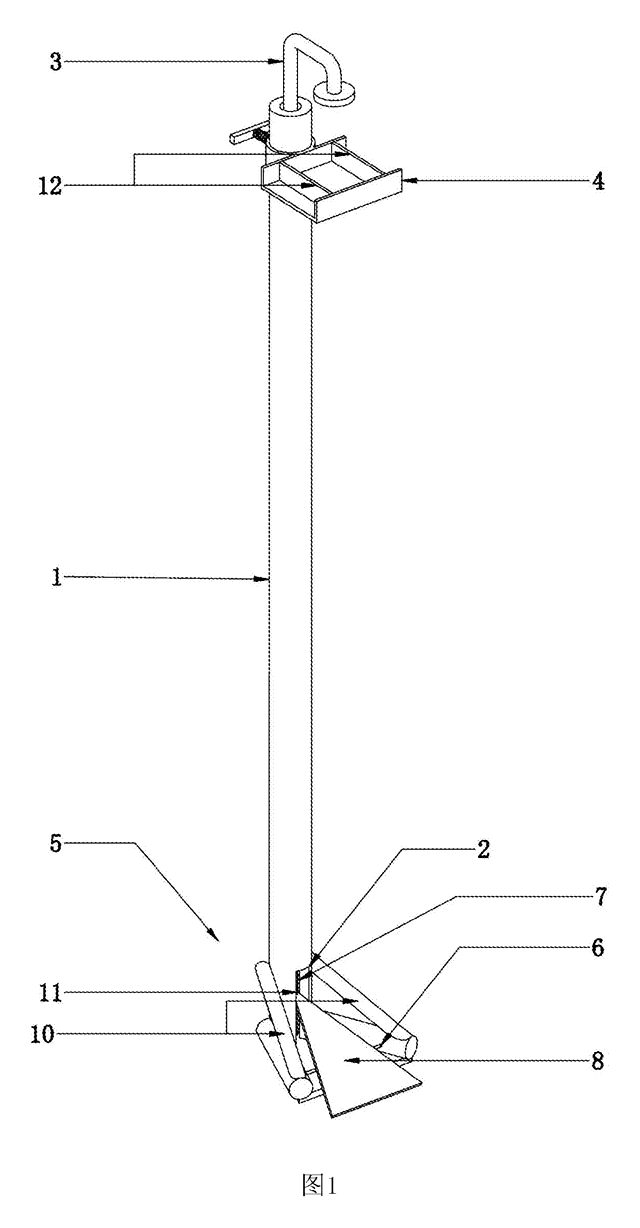
Bath & Personal Care
Foot-Pedal Soap & Sanitizer Dispenser Stand
Hands-free, battery-free dispenser stand - step on a pedal to press the pump of any soap or sanitizer bottle.
Patent CN207461995U
Bath & Personal Care
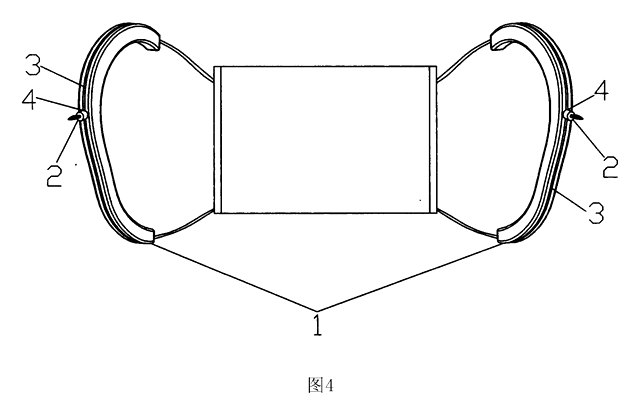
Ear-Shaped Mask Strap Guard with Tension Adjuster
Ear-shaped silicone guard and strap-length adjuster that make ear-loop masks comfortable to wear for long hours.
Patent CN205456233U
Bath & Personal Care
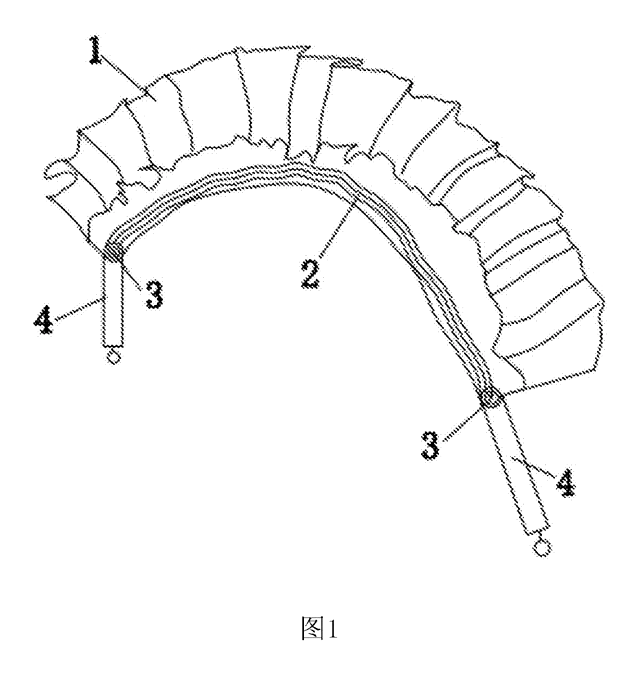
Adjustable-Length Back Scrubber Strap with Push-Button Handles
Back-scrubber strap with push-button handles that set its length and a spring that keeps it taut.
Patent CN207041452U
Bath & Personal Care
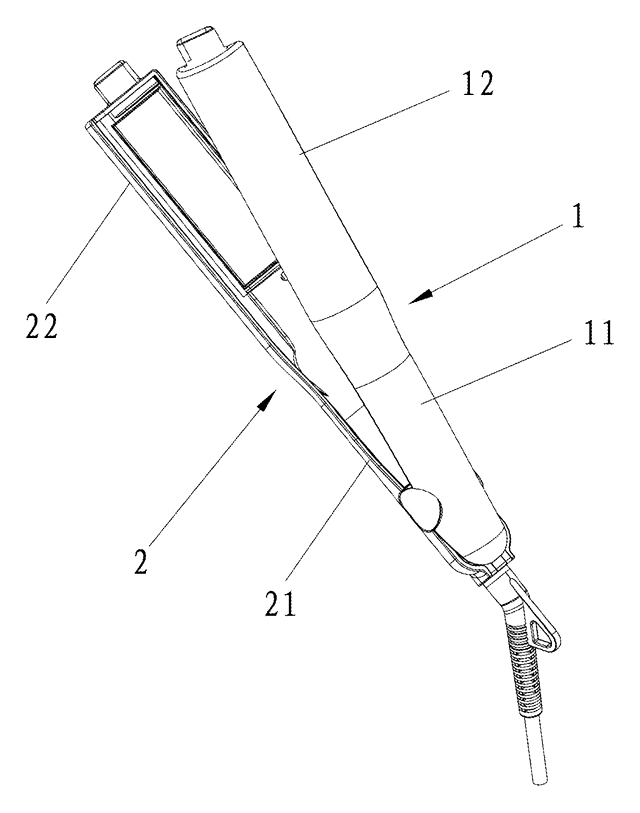
Angled-Plate Hair Straightener
Flat iron with plates twisted 45-75° to the handle, a curling groove and rubber-capped tips.
Patent CN206137462U
Bath & Personal Care
Refillable Lipstick Case with Sealed Snap-In Refill Pods
Reusable twist-up lipstick case; sealed refill pods unlock at the top of the stroke for shade swaps.
Patent CN206909979U
Bath & Personal Care
Essential Oil Dispensing Hair Straightener with Auto-Feed Cartridge
Flat iron with a built-in cartridge that releases essential oil onto hair as you style.
Patent CN207023588U
Browse by category
- Apparel & Accessories (22)
- Baby & Kids (16)
- Bags & Luggage (9)
- Bath & Personal Care (16)
- Car Accessories (10)
- Furniture, Bedding & Storage (12)
- Garden & Outdoor (18)
- Health & Wellness (8)
- Home, Kitchen & Cleaning (24)
- Lighting (12)
- Packaging & Containers (6)
- Pet Products (6)
- Phone & Camera Accessories (4)
- Retail Display (13)
- School, Office & Art (19)
- Sports & Recreation (25)
- Tools & Workshop (27)
- Toys & Games (12)
This page is based on the public patent document CN210370292U, assigned to Arrow Home Group Co., Ltd.. IP2M is an independent manufacturing service and is not affiliated with, endorsed by or licensed by the patent owner. Images marked as concept renderings are illustrations, not photos of an existing product. Patent status information is provided for reference only and is not legal advice; confirm freedom to operate for your market before production. Full disclaimer.