At a glance
| Patent number | CN210540477U (application CN201921100687) |
| Type | China utility model (实用新型) - protects product shape and structure |
| Original title | Metal teapot capable of preventing the lid from falling off (一种可防止壶盖掉落的金属茶壶) |
| Patent owner | Jiangmen Shenglong Ironware Technology Co., Ltd. |
| Inventor | Tang Shaowei |
| Priority date | 2018-08-07 |
| Filing date | 2019-07-12 |
| Grant date | 2020-05-19 |
| Status (China) | Lapsed - terminated for non-payment of annual fees (recorded 2024-06-21) |
| Patent family | Chinese filings only - no US, European, Japanese, PCT or other filings listed |
| Cited by | No later documents listed |
| Source | Google Patents (search for CN210540477U) |
What the claims cover, in plain language
Claim 1 - a metal teapot with a body, a lid over the top opening, a spout and a pivoting handle. The opening has an upright ring-shaped collar; the lid has a round boss under its center that fits inside the collar, and the top of the collar is a seat for the edge of the lid. The key point: at least two holes spaced evenly around the underside of the lid edge, each holding a magnet that is attracted to the seat.
Claims 2-4 - cylindrical magnets set into round holes, fixed with adhesive; preferably three magnets. Claims 5-6 - a metal protective layer, preferably copper, on the underside covering the magnets. Claims 7-9 - a hollow ball knob with vent openings, fixed by a screw with a heat-insulating sleeve, an insulating ring and a cover plate under it. Claim 10 - handle ends pivot in two mounts on the body, with insulating sleeves.
This is a simplified reading for orientation only. The legal scope is defined by the exact claim wording in the official Chinese document.
What this means for US production
This patent was filed only in China, and it lapsed in 2024 because annual fees were not paid. It no longer restricts anyone - in China or elsewhere.
Before production, keep in mind:
- Other patents may exist. Magnetic lid retention has been used in other cookware and containers, and teapot and kettle shapes are often protected by design patents. Use your own styling and have a freedom-to-operate (FTO) search done by a US patent attorney before volume production.
Customization and manufacturing
What can be customized
| Area | Options |
|---|---|
| Body | Cast iron (enameled inside), stainless steel or enameled steel |
| Capacity | Small teapot to large kettle sizes - to be confirmed in design |
| Magnets | Number and size; grade chosen for the lid temperature |
| Lid underside | Copper layer as in the patent, or stainless cover plate |
| Knob | Vented metal ball, wood or silicone; insulating spacers |
| Handle | Swing handle with insulating sleeves, or fixed handle |
| Finish & colors | Powder coat, enamel colors, polished or brushed steel |
| Packaging | Gift box, retail box, bundles with cups or infuser |
Things to plan for (US market)
- Food contact - inner surfaces and coatings must be food-safe; check lead and cadmium in enamels and California Proposition 65.
- Magnet temperature - many neodymium magnets lose strength above about 80 °C; choose a high-temperature grade or another magnet type, and test on a boiling kettle.
- Stovetop use - state which hob types it works on and test handle and knob temperatures.
How a project runs
- Inquiry - material, capacity, style and quantity.
- Design - body and lid shapes, magnet layout, knob and handle.
- Prototype - samples tested for pouring, lid hold and heat.
- Pilot run - small batch to check casting or forming, coating and assembly.
- Production - volume production, packaging and shipping.
Quantities & timeline
Cast-iron bodies need casting patterns; stainless bodies need drawing dies. Magnets, screws and insulators are standard parts. Send us your material, capacity, quantity and target price and we will reply with options.
Patent drawings
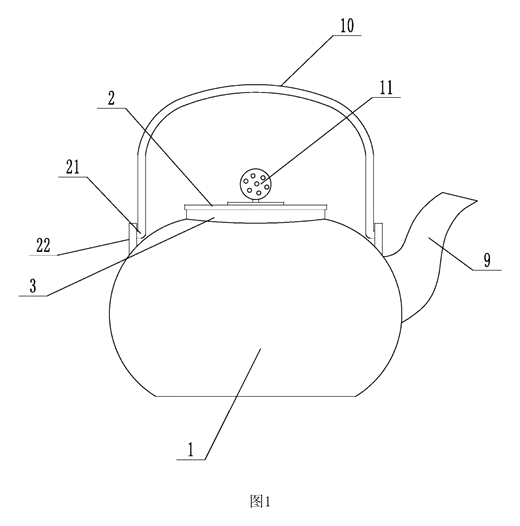
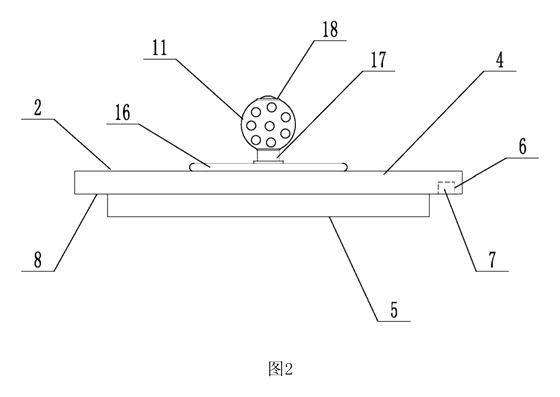
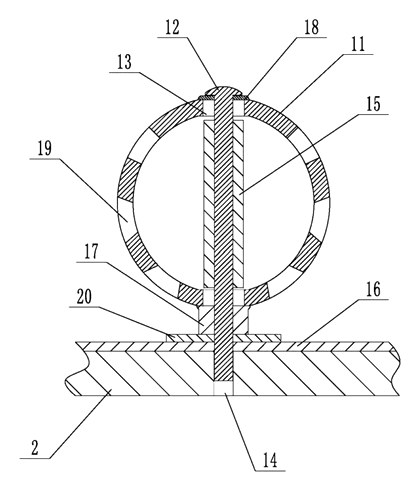
Drawings reproduced from the public patent document for reference.