At a glance
| Patent number | CN211242041U (application CN201921811685) |
| Type | China utility model (实用新型) - protects product shape and structure |
| Original title | Multi-purpose hair curler of straight roll comb (一种直卷梳的多用烫发器) |
| Patent owner | Wenzhou Rose Technology Co ltd |
| Inventors | Chen Liu Xi |
| Filing date | 2019-10-26 |
| Grant date | 2020-08-14 |
| Status (China) | Lapsed - terminated for non-payment of annual fees (recorded 2022-10-11) |
| Patent family | Chinese filings only - no US, European, Japanese, PCT or other filings listed |
| Cited by | 3 later documents |
| Source | Google Patents (search for CN211242041U) |
What the claims cover, in plain language
Claim 1 - defines a multi-purpose hair curler comprising an upper plate (100), a lower plate (200), and a handle (300). The lower plate is fixed to the handle. The upper plate is rotatably assembled with the handle. A resetting means is provided between the upper plate and the handle. The upper plate has a curling board, and the lower plate has a straightening board (210). A switch (310) on the handle starts and adjusts the temperature of both boards. A power supply line (320) connects to the handle. An anti-scald comb (110) is located at the end of the upper plate away from the lower plate. This comb includes aluminum alloy comb teeth and plastic anti-scald comb teeth, arranged in a staggered manner, with the plastic teeth being higher than the aluminum teeth.
Claim 2 - specifies that the heads of the plastic anti-scald comb teeth have spherical protrusions. Claim 3 - specifies that the cross-section of the aluminum alloy comb teeth is oval. Claim 4 - adds an infrared ray emitting tube (220) seated in a groove on the straightening plate. Claim 5 - includes a chamber in the handle for an anion generator. Claim 6 - adds a net (330) between the upper and lower plates to allow anions to escape. Claim 7 - identifies the resetting means as a return torsion spring. Claim 8 - describes the rotation mechanism using a rotating shaft on the handle and a corresponding rotating boss on the upper plate.
This is a simplified reading for orientation only. The legal scope is defined by the exact claim wording in the official Chinese document.
What this means for US production
This patent was filed only in China and is currently lapsed due to non-payment of fees. It has no US or other foreign counterpart. Consequently, the specific structural disclosures in this document do not restrict manufacturing or sales in the United States based on this patent alone.
Two points to settle early:
- Other patents may exist. Hair styling tools are a crowded IP landscape. Major competitors like Dyson, GHD, and Remington hold numerous patents on heating element configurations, airflow designs, and ergonomic handles. Specifically, L’Oréal has cited this patent in EP4265148A1, indicating interest in similar technology areas. A freedom-to-operate (FTO) review is strongly recommended before tooling to ensure the combination of straightening/curling plates and the specific comb tooth geometry does not infringe on active US patents.
- Safety Compliance. Electrical heating devices sold in the US must meet strict safety standards. The design’s integration of moving parts (rotation) and heating elements requires careful engineering to prevent electrical faults or mechanical failure under load.
Customization and manufacturing
What can be customized
| Area | Options |
|---|---|
| Plate Material | Ceramic coating, tourmaline, or bare aluminum for the heating surfaces. |
| Comb Teeth | Height ratio of plastic vs. aluminum; density of teeth; material grade (heat-resistant nylon, silicone). |
| Temperature Control | Digital display vs. analog dial; range of heat settings; auto-shutoff timer. |
| Add-ons | Integration of infrared emitters or anion generators (as per Claims 4-6). |
| Ergonomics | Handle grip texture; weight distribution; cord swivel angle. |
| Finish | Soft-touch paint, matte black, metallic accents on the housing. |
Things to plan for (US market)
- UL 859 - Standard for household electric clothes dryers and similar appliances, but more relevantly UL 1431 for personal care appliances (hair dryers, curling irons). Certification is critical for retail acceptance.
- FCC Part 15 - If the device includes digital controllers or wireless components, electromagnetic compatibility testing is required.
- California Prop 65 - Materials used in plastics and coatings must be screened for listed chemicals.
- CPSC Regulations - General consumer product safety rules apply, particularly regarding electrical insulation and fire hazards.
How a project runs
- Inquiry - Define target price, quantity, and feature set (e.g., with/without anion generator).
- Design - Finalize thermal simulation, mold flow analysis for the comb teeth, and electrical schematics.
- Prototype - Create functional samples using off-the-shelf heating elements and 3D-printed housings for fit checks.
- Pilot Run - Produce small batches with hard tooling for UL testing and durability cycles.
- Production - Injection molding of housings, stamping/forming of metal plates, assembly, and quality control.
Quantities & timeline
Tooling for injection molds (housing, comb teeth) and metal stamping dies (plates) typically takes 6-8 weeks. Prototyping allows for early validation of the anti-scald geometry. Mass production lead times depend on order volume and component sourcing. Send us your target specs, quantity, and certification requirements and we will reply with options.
Patent drawings
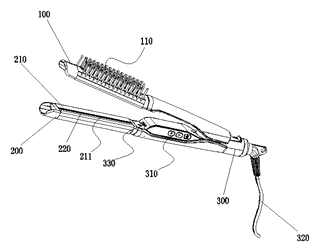
Drawings reproduced from the public patent document for reference.
Production notes
Tooling and process
Injection molding is likely used for the plastic housing and comb teeth components. Stainless steel forming or electroplating processes would be applied to the aluminum alloy teeth and heating plates. Assembly typically involves snap-fit connections for the outer casing and press-fit or screw assembly for the internal heating elements and torsion springs.
Cost drivers
Material grade typically drives cost most, especially for heat-resistant plastics and high-conductivity aluminum alloys. Plating grade and thickness affect both aesthetics and corrosion resistance. Packaging design also contributes to landed costs, particularly if drop-test compliant structures are required.
Prototyping path
Initial prototypes may use 3D-printed housings to verify the staggered comb tooth height difference. Off-the-shelf seals and heating elements can be used for early thermal testing. A water spray test sample might be needed if any liquid-based styling products are considered, though this device is primarily dry-use.
What we would change before tooling
We would likely refine the interface between the plastic and aluminum teeth to ensure consistent spacing. Adjustments to the torsion spring rate might be necessary after physical prototyping to balance ease of opening against secure closure.
Common failure points
Hinge fatigue is a risk given the rotating upper plate design. Spring fatigue and rate consistency could vary across units if not tightly controlled. Water ingress at seams is unlikely in normal use but should be checked during cleaning instructions development. Mold and mildew in trapped water could occur if the device is stored damp.