
Patent CN211483640U
Updated October 24, 2026Self-Leveling, Nesting Table Base with a Torsion-Ring Leg Hub
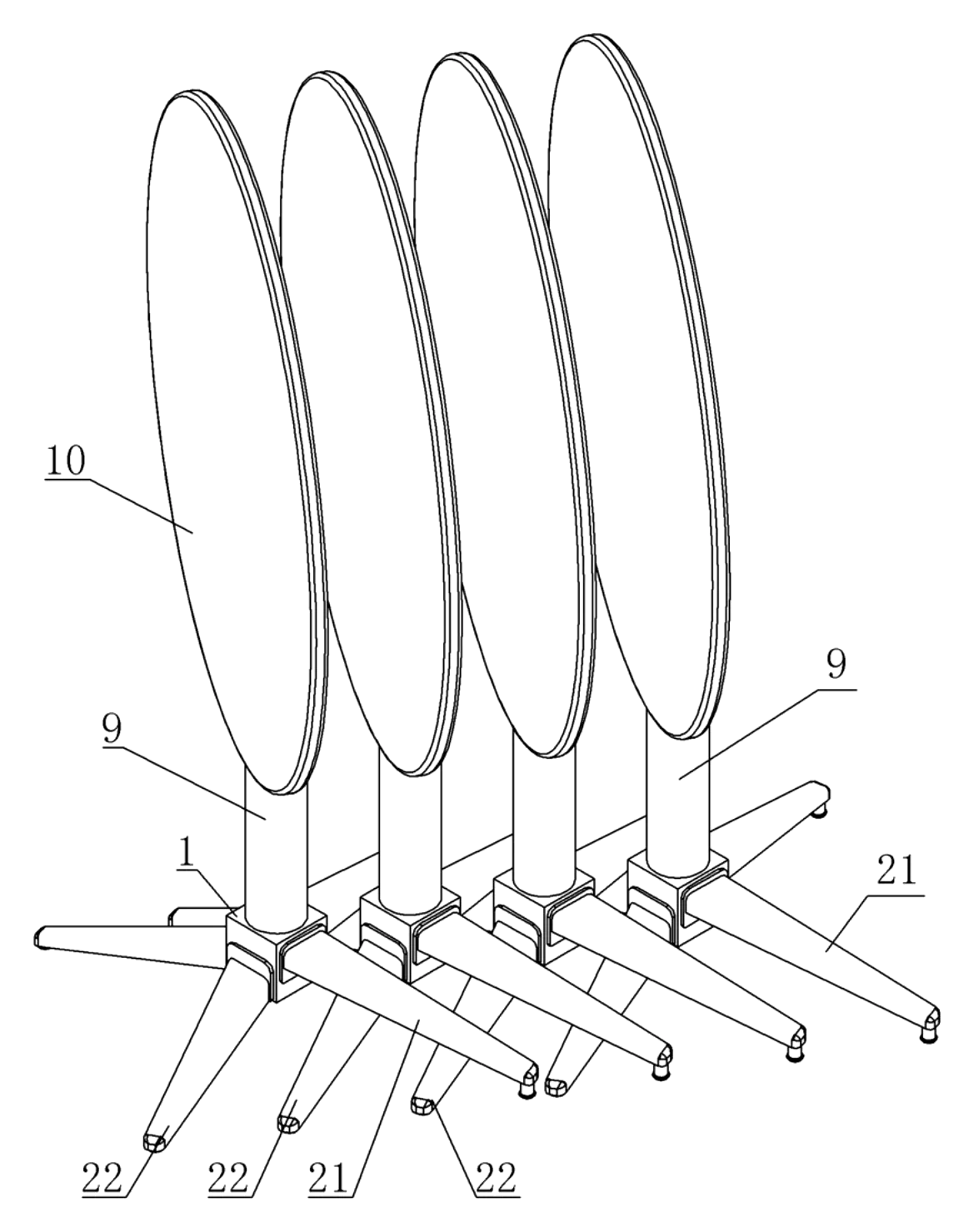
Café and event tables wobble because one of four feet always lands on a high spot, and the usual cures - folded napkins, screw-in glides, or a 'floor-finding' foot - each fix only one leg. This base levels itself through its hub. Each of the four inclined legs ends in a post that reaches a torsion ring turning inside the hub; teeth between posts and ring couple all legs together. When one leg presses on a bump, it rotates slightly and the ring passes the motion to the others until all four carry load. The hub also has two high legs and two low legs, so with the tabletop flipped up the bases slide into each other and a row of tables stores in little floor space.
- China utility model - lapsed
- No filings outside China
- Table bases & contract furniture
- Cast or welded steel hub, steel or aluminum legs
Splat! What let you down?
⚖️
Levels without tools
Legs are linked through a rotating ring, so a leg on a high spot lets the others settle until all four bear weight.
↔️
Nests sideways
Two legs sit higher on the hub than the other two, so the low legs of one base slide under the high legs of the next.
🔄
Flip-top ready
The top is hinged on a column above the hub and turns vertical for nesting.
🏋️
For heavy loads
The patent states the structure can also be used under heavy objects, not only tables.
Bring this product to market
- ✓ Patent vetted China-only family and legal status checked
- 2 Product brief · now How it works, uses and options written up
- 3 Prototype First samples for buyers to review
- 4 Pilot run Small first batch for launch customers
- 5 Volume production Repeat orders at scale
Buyer interest
– of 100 buyers needed to start prototyping
One click, no sign-up. Each vote is one real visitor, and products with the most interest go to prototyping first.
Build team: no members yet. Need a partner, co-funding or skills to build this? Join and we introduce the team once it forms.
The problem
Every four-legged table rocks on a floor that is not perfectly flat - patios, old wooden floors, tiled restaurant floors with grout lines, event-hall carpets over uneven slabs. The fixes in use today work one leg at a time: screw-in glides that must be adjusted by hand for each spot, wedges that fall out, or single self-adjusting feet that only compensate a small amount. Event and training-room tables have a second headache: storing dozens of them takes a lot of floor area unless the bases can nest.
The solution
The patent couples all legs through the hub, and shapes the hub so bases nest:
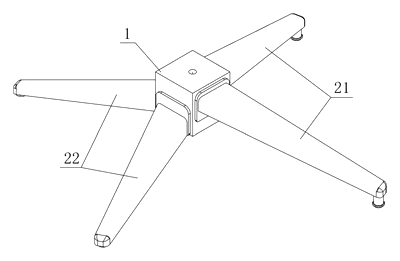
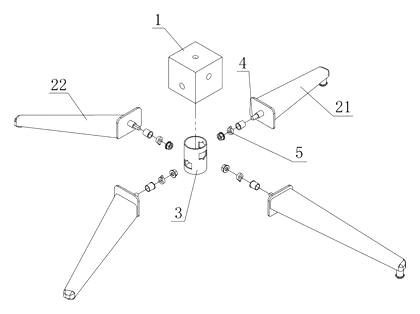
- A fixed seat (1) is mounted under the object - in the main example, under a column (9) that carries a hinged tabletop (10).
- Four legs (2) are fitted around the seat at an incline. Two neighbouring legs are mounted higher on the seat (high legs, 21) than the other two (low legs, 22), but all four feet reach the same floor plane.
- Inside the seat a cylindrical torsion ring (3) turns about a vertical axis. It has a torsion groove (31) facing each leg.
- Each leg carries a connecting post (4) that passes through the seat into its groove, with a dial tooth (5) between post and groove. Limiting features stop the parts from twisting the wrong way.
- On a flat floor all legs press evenly and the ring is balanced. On an uneven floor, the leg standing on a high spot rotates slightly about its horizontal axis under the load; the tooth turns the ring, and the ring turns the other legs until all four carry load and the top is level.
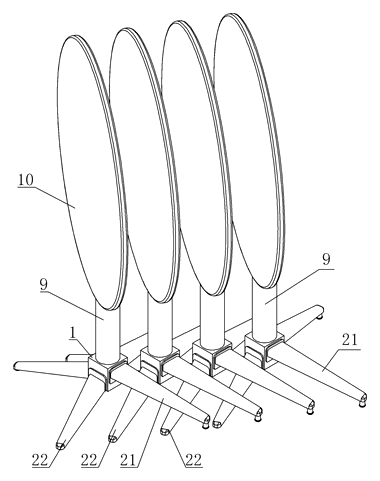
- With the top turned vertical about its hinge, the low legs of one base slide under the high legs of the next, so a row of tables nests in a line.
Who it is for
- Contract furniture makers supplying training-room, conference and banquet tables that must be moved, nested and set up often.
- Café and restaurant furniture brands selling outdoor tables for patios and sidewalks, where wobble is the most common complaint.
- Table-base specialists who sell bases separately to shops that fit their own tops.
- Equipment and display makers looking for a stand that settles on uneven ground under a heavier load.
How it works
The main parts
| No. | Part | What it does |
|---|---|---|
| 1 | Fixed seat | Hub mounted under the object; holds the legs and the ring. |
| 2 (21, 22) | Legs | Four inclined legs; two high-mounted, two low-mounted. |
| 3 | Torsion ring | Turns inside the seat about a vertical axis and links the legs. |
| 31, 32 | Torsion grooves and limit slots | Receive the leg posts; the slot direction sets how each leg reacts. |
| 4 | Connecting post | Fixed to the leg; reaches through the seat into the ring. |
| 5 | Dial tooth | Transfers the leg’s rotation to the ring and back. |
| 9 | Column | Upright on top of the seat. |
| 10 | Supported object | Tabletop hinged to the top of the column. |
Using it
- Set the table down. On a flat floor the ring stays centered and all legs load evenly.
- On an uneven floor, the leg on the high spot is pushed up and turns a little; the ring passes the motion to the other legs, and the base settles level by itself.
- To store, turn the top to vertical about its hinge on the column.
- Push the next table in so its low legs slide under the high legs of the first. Repeat to nest a whole row.
The patent shows two ring layouts: grooves whose limit slots on opposite sides run in the same direction, or adjacent slots running in opposite directions (figure 8 shows the ring).
Applications
Training rooms and conference centers
Flip-top training tables are set up and cleared daily. A base that nests reduces storage space, and self-leveling saves staff from fiddling with glides on every table.
Outdoor cafés and terraces
Paving, decking and sloped sidewalks make tables rock. A base that settles on its own removes the folded-napkin fix and the spilled-coffee complaints.
Banquet halls and hotel event spaces
Large numbers of tables move between rooms with different floors. Nesting bases fit more tables on each storage dolly or in each store room.
Office furniture and coworking spaces
Reconfigurable spaces need tables that can be pushed together, cleared and nested quickly, then stand steady wherever they are placed.
Display and equipment stands
The patent notes the structure can carry heavy objects; display plinths, signage and equipment stands on uneven floors are a natural use.
Where it is less suitable
- Fixed dining tables at home - if the table never moves and the floor is flat, a simple glide is cheaper.
- Large rectangular tables on four corner legs - this is a central-hub design; long tables with corner legs need a different leveling approach.
Frequently asked questions
How does the base level itself?
All four legs connect to one torsion ring inside the hub. When a leg lands on a high spot, the load turns it slightly; a tooth passes that rotation to the ring, which turns the other legs until all four feet are carrying weight. No screws need adjusting.
How uneven can the floor be?
The patent does not give a range. The leveling travel is set by the tooth and slot geometry in design and confirmed on test surfaces with steps and slopes.
Will the table feel springy?
That depends on the friction and stiffness in the hub, which are tuned on prototypes. For bar-height tables we would test the feel under a leaning load before freezing the design.
How do the bases nest?
Two adjacent legs are fixed higher on the hub than the other two. With the top flipped vertical, the low legs of the next base slide underneath the high legs, so a row of tables stands close together.
Can I use it with a fixed top?
Yes. The hinged column is one example in the patent; the same hub can carry a fixed top plate or another object - you lose the nesting but keep the self-leveling.
Is it suitable for outdoor use?
With aluminum or coated steel parts, outdoor-grade glides and a sealed hub, yes. Coatings and plastic parts are specified for UV and corrosion in design.
Can this design be made and sold in the US?
The patent was filed only in China and has lapsed, so it does not restrict the design in the US or in China. Self-leveling table bases may be covered by other US patents - see Patent & Production - so we recommend a freedom-to-operate check before volume production.
Are you affiliated with the patent owner?
No. IP2M is an independent design and manufacturing service working from the public patent document.
Request a quote
Click Request a Quote below to see our email address - copy it, or open your email app with a ready-made message. Please mention patent CN211483640U in the subject.
Helpful details to include:
- Your company and channel (contract furniture, hospitality, table-base dealer, resale)
- Table height and top size and shape
- Flip-top or fixed top, indoor or outdoor
- Materials and finish for legs and hub
- Estimated quantity and target price
- Timeline - when you would like samples and the first shipment
You can also reach us at (332) 203-9997.
Explore this product
Interested in building this?
Tell us your target market, quantity and timeline. We reply with options for prototyping, small-batch runs or volume production.
Send your inquiry to
Please put CN211483640U in the subject line and tell us your company, country, estimated quantity and timeline.
Prefer to talk? Call (332) 203-9997.
More product-ready patents
All Furniture, Bedding & Storage patents →
Furniture, Bedding & Storage
Roll-Up Travel Neck Pillow with Buckles
U-shaped travel pillow with a front buckle and a back buckle that holds it rolled up for carrying.
Patent CN206543091U
Furniture, Bedding & Storage
Width-Adjustable Slide Rail for Pull-Out Baskets
Basket slide rail on a slotted, scaled adjusting plate, so one pull-out basket fits several cabinet widths.
Patent CN208909382U
Furniture, Bedding & Storage
Lift-Up Storage Bed with Four-Bar Linkage That Slides the Deck Away from the Headboard
Storage bed deck that rises on four-bar linkages and gas springs, clearing the headboard as it opens.
Patent CN210870645U
Furniture, Bedding & Storage
Rack-and-Pinion Synchronized Drawer Slide with a Folded-In Fixed Rail
Full-extension drawer slide: a pinion between two racks keeps the rails moving in step.
Patent CN206314843U
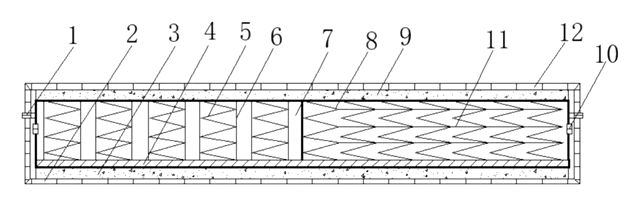
Furniture & Bedding
Dual-Zone Split-Spring Mattress with Removable Fabric Cover
Half-pocket, half-standard spring mattress sharing one base plate, with a removable cover.
Patent CN208355064U
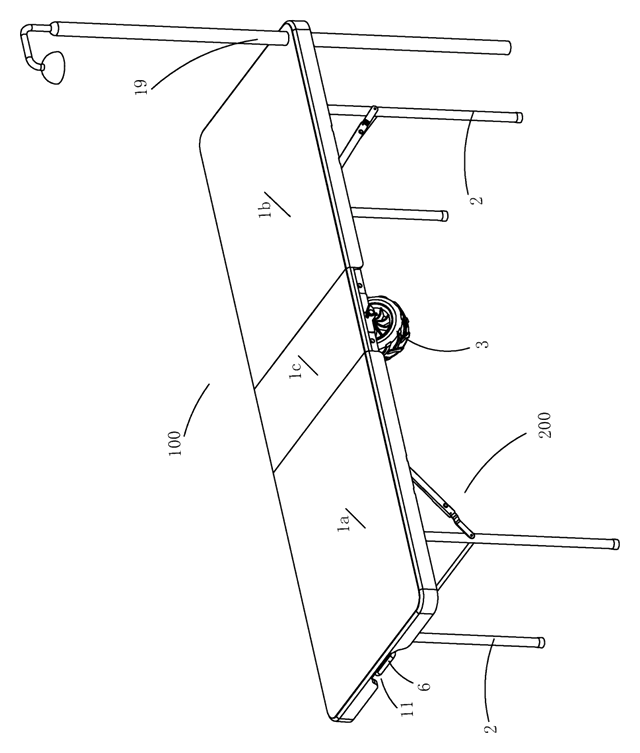
Furniture, Bedding & Storage
Telescopic Folding Table with Extension Panel and Built-In Trolley
Blow-molded folding table: slides open for an insert panel, folds into a wheeled trolley.
Patent CN216293323U
Browse by category
- Apparel & Accessories (22)
- Baby & Kids (16)
- Bags & Luggage (9)
- Bath & Personal Care (16)
- Car Accessories (10)
- Furniture, Bedding & Storage (12)
- Garden & Outdoor (18)
- Health & Wellness (8)
- Home, Kitchen & Cleaning (24)
- Lighting (12)
- Packaging & Containers (6)
- Pet Products (6)
- Phone & Camera Accessories (4)
- Retail Display (13)
- School, Office & Art (19)
- Sports & Recreation (25)
- Tools & Workshop (27)
- Toys & Games (12)
This page is based on the public patent document CN211483640U, assigned to Alma Manufacturing Co., Ltd. (广州南沙澳美发金属塑料制品有限公司). IP2M is an independent manufacturing service and is not affiliated with, endorsed by or licensed by the patent owner. Images marked as concept renderings are illustrations, not photos of an existing product. Patent status information is provided for reference only and is not legal advice; confirm freedom to operate for your market before production. Full disclaimer.