
Patent CN211845567U
Updated October 31, 2026Sleeve-Joint Combined Container Lid with Inner Stopper and Fixing Ring
Traditional single-mold lids limit material options and aesthetic flexibility. This sleeve-joint design decouples the visible outer cover from the internal stopper. A cylindrical fixing sleeve joins them, allowing the outer part to be made of premium or decorated materials while the inner part uses food-safe or flexible seals. The assembly includes a flared opening on the outer cover that mates with a convex edge on the fixing sleeve to control insertion depth. A circumferential groove on the outer cover accepts a T-section fixing ring, which clamps onto the container’s rim. This ring can include a tear-strip feature, providing a tamper-evident seal without complex threading mechanisms.
- China utility model - active
- No filings outside China
- Packaging & Containers
- Modular sleeve joint, anti-counterfeit ring option
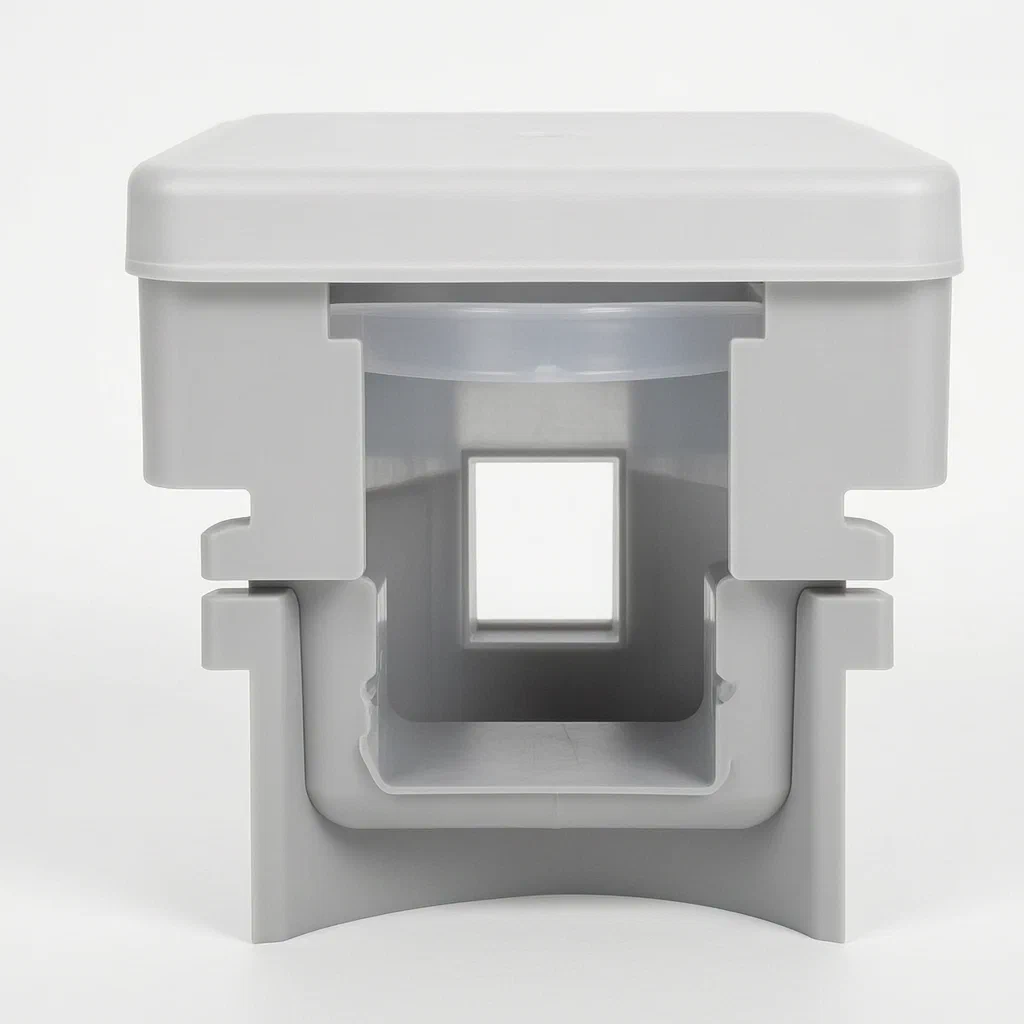
Splat! What let you down?
🔗
Sleeve-Joint Assembly
Outer cover and inner stopper connect via a central fixing sleeve, allowing mixed materials.
🛡️
Anti-Counterfeit Option
A T-shaped fixing ring with a tear strip locks the lid to the container and shows tampering.
📏
Depth Control
Flared outer cover opening and convex sleeve edge prevent over-insertion and sliding out.
🔄
Secure Fit
Concave-convex structures on contact surfaces prevent rotation between the joined parts.
Bring this product to market
- ✓ Patent vetted China-only family and legal status checked
- 2 Product brief · now How it works, uses and options written up
- 3 Prototype First samples for buyers to review
- 4 Pilot run Small first batch for launch customers
- 5 Volume production Repeat orders at scale
Buyer interest
– of 100 buyers needed to start prototyping
One click, no sign-up. Each vote is one real visitor, and products with the most interest go to prototyping first.
Build team: no members yet. Need a partner, co-funding or skills to build this? Join and we introduce the team once it forms.
The problem
Standard container lids often require a single mold for both the aesthetic exterior and the functional interior. This limits material choices; you cannot easily pair a premium, decorated outer surface with a specialized, flexible inner seal unless using expensive two-shot molding. Additionally, simple screw caps can loosen during transport, and snap-fit designs may lack a clear indication if they have been opened previously. There is a need for a modular lid that separates these functions, ensures a tight fit without rotation, and offers an easy way to add tamper evidence.
The solution
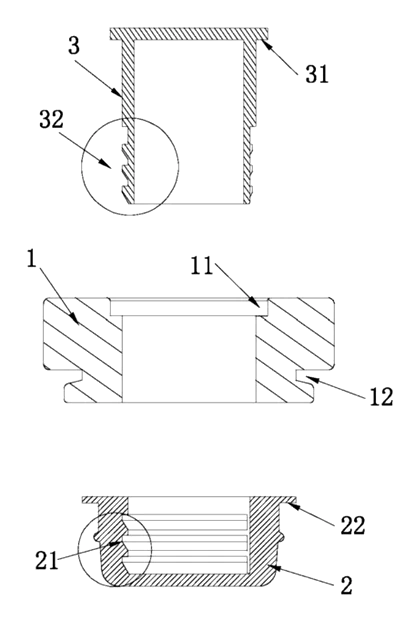
The patent describes a combined container lid consisting of three main interacting parts: an outer cover, an inner stopper, and a fixing sleeve.
- The outer cover has a vertical through-hole. Its upper opening is expanded to form a flared part.
- The inner stopper fits below the outer cover. It has either a corresponding through-hole or a blind cavity. In some versions, it extends horizontally to form a gasket (sheet ring) to seal against the container mouth.
- The fixing sleeve is a cylindrical component that joins the two. The outer cover inserts onto the fixing sleeve, and the inner stopper inserts onto (or is molded around) the same sleeve.
- To prevent movement, the contact surfaces between the sleeve and the cover/stopper feature concave-convex structures (interlocking ribs or grooves) that block relative rotation.
- For locking to the container, a circumferential annular groove is formed on the side of the outer cover. A T-shaped fixing ring snaps into this groove and clamps onto the outer edge of the container mouth.
Who it is for
- Premium beverage brands seeking to combine high-end outer aesthetics with reliable inner sealing materials without multi-material tooling costs.
- Pharmaceutical and supplement packagers who require tamper-evident closures that are distinct from standard screw threads.
- Cosmetic and personal care manufacturers looking for modular cap designs that allow quick changes to the top decoration while keeping the base mechanism constant.
- Packaging suppliers offering customizable solutions where clients can specify different materials for the visible and functional parts of the closure.
How it works
The main parts
| No. | Part | What it does |
|---|---|---|
| 1 | Outer Cover | Visible top part with a through-hole and flared opening. |
| 2 | Inner Stopper | Bottom part that seals against the container; can act as a gasket. |
| 3 | Fixing Sleeve | Cylindrical connector joining the outer cover and inner stopper. |
| 4 | Container Mouth | The opening of the bottle or jar being closed. |
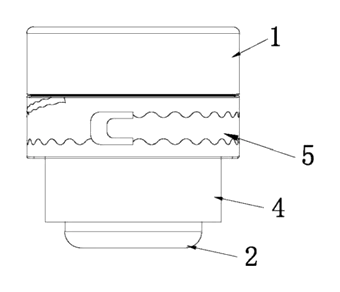
| 5 | Fixing Ring | T-shaped clamp that locks the lid to the container; can have a tear strip. |
| 11 | Flared Part | Expanded opening on the outer cover for alignment. |
| 31 | Convex Edge | Ridge on the fixing sleeve that stops insertion depth. |
| 12 | Annular Groove | Channel on the outer cover for the fixing ring. |
Operating steps
- Assembly: The fixing sleeve is inserted into the outer cover’s through-hole. The convex edge of the sleeve seats against the flared part of the cover, limiting how far it goes.
- Joining: The inner stopper is attached to the bottom of the fixing sleeve. This can be done by inserting it into a cavity or by injection molding the stopper directly onto the sleeve (where plastic flows through holes in the sleeve). Interlocking concave-convex shapes prevent the parts from twisting apart.
- Closing: The assembled lid is placed on the container. If using the fixing ring, the T-shaped ring is snapped into the annular groove of the outer cover and then pressed down so its lower leg clamps under the container’s rim.
- Tamper Evidence: If the fixing ring has a tear strip, removing the lid requires tearing the strip, leaving a visible mark that the package was opened.
Applications
Premium Liquor and Wine Bottles
Brands can use metal or high-gloss plastic for the outer cover for visual appeal, while the inner stopper uses cork-compatible or inert plastics. The modular sleeve allows these distinct materials to be joined mechanically rather than chemically bonded, simplifying recycling separation later.
Pharmaceutical Vials and Supplement Jars
The fixing ring provides a positive lock that resists accidental opening during shipping. The optional tear strip gives patients or pharmacists immediate visual confirmation that the safety seal has not been broken, enhancing compliance and safety perception without needing induction foil liners.
Cosmetic Creams and Lotions
Jars often require a smooth, wide-mouth access. This design allows the outer cover to be decorated with soft-touch coatings or metallic finishes, while the inner stopper remains a simple, cleanable polymer. The rotation-locking features ensure the cap doesn’t spin loosely when trying to unscrew or lift it.
Food Storage Containers
For reusable containers, the modular nature means the inner gasket (part of the stopper) can be replaced if worn, while the durable outer shell remains intact. The fixing ring ensures the lid stays securely attached to the bowl during stacking or transport, preventing spills.
Where it is less suitable
- High-pressure carbonated beverages: The sleeve-joint mechanism is designed for static sealing and mechanical locking, not necessarily for containing significant internal pressure without additional threaded reinforcement.
- Extreme temperature applications: If the materials of the outer cover and inner stopper have vastly different thermal expansion coefficients, the sleeve joint might loosen or crack under rapid thermal cycling unless carefully engineered.
- Ultra-low-cost commodity goods: The multi-part assembly (cover, sleeve, stopper, ring) involves more components and assembly steps than a single-piece screw cap, potentially increasing unit cost for mass-market disposables.
Frequently asked questions
Why use a sleeve joint instead of a single piece?
It allows you to use different materials for the outside and inside. You can make the outer cover look premium (metallic, glossy, textured) while the inner stopper uses a softer, food-safe material for sealing. It also simplifies recycling, as users can separate the materials easily.
How does the anti-counterfeit feature work?
If you choose the version with the fixing ring, the ring can have a tear strip. When the user opens the lid, they must tear the strip. Once torn, it cannot be restored, clearly showing that the package has been opened. This is common in pharmaceuticals and premium spirits.
Does the lid rotate when I try to open it?
No. The patent describes concave-convex structures (interlocking ridges and grooves) between the sleeve and the cover/stopper. These shapes prevent the parts from spinning independently, ensuring that when you grip the outer cover, the force is transferred directly to the seal or the container thread.
Can the inner stopper be replaced?
Yes. Since the inner stopper and outer cover are joined by a sleeve, they are technically modular. However, in the injection-molded version (Example 2), they become permanently fused. In the insert version (Example 1), they can be separated and replaced, which is useful for reusable containers where the gasket wears out.
Is this lid compatible with standard bottles?
The fixing ring is designed to clamp onto the outer edge of the container mouth. Compatibility depends on the specific neck finish geometry. We need to measure your container’s rim profile to design the T-shaped ring correctly so it snaps on securely without damaging the glass or plastic.
What materials are recommended for food contact?
The patent does not specify exact brands. Typically, Polypropylene (PP) or High-Density Polyethylene (HDPE) are used for the structural parts due to their chemical resistance. For the inner gasket, Thermoplastic Elastomers (TPE) or Silicone provide better sealing. All materials must be FDA-compliant for your specific product.
Can this design be made and sold in the US?
The patent is registered in China and is currently in force there. There is no US patent for this specific design. Therefore, you can manufacture and sell this design in the US without infringing on this patent. However, you should conduct a freedom-to-operate search to ensure no other US patents cover similar sleeve-joint or tamper-ring mechanisms.
Are you affiliated with the patent owner?
No. IP2M is an independent design and manufacturing service working from the public patent document.
Request a quote
Click Request a Quote below to see our email address - copy it, or open your email app with a ready-made message. Please mention patent CN211845567U in the subject.
Helpful details to include:
- Your company and channel (beverage brand, pharma packager, cosmetics manufacturer)
- Container specs - neck diameter, height, and material (glass/plastic)
- Lid requirements - size, color, finish (matte/gloss/metallic)
- Features - do you need the anti-counterfeit tear strip?
- Materials - any specific food-grade or eco-friendly constraints
- Estimated quantity and target price
- Timeline - when you would like samples and the first shipment
You can also reach us at (332) 203-9997.
Explore this product
Interested in building this?
Tell us your target market, quantity and timeline. We reply with options for prototyping, small-batch runs or volume production.
Send your inquiry to
Please put CN211845567U in the subject line and tell us your company, country, estimated quantity and timeline.
Prefer to talk? Call (332) 203-9997.
More product-ready patents
All Packaging & Containers patents →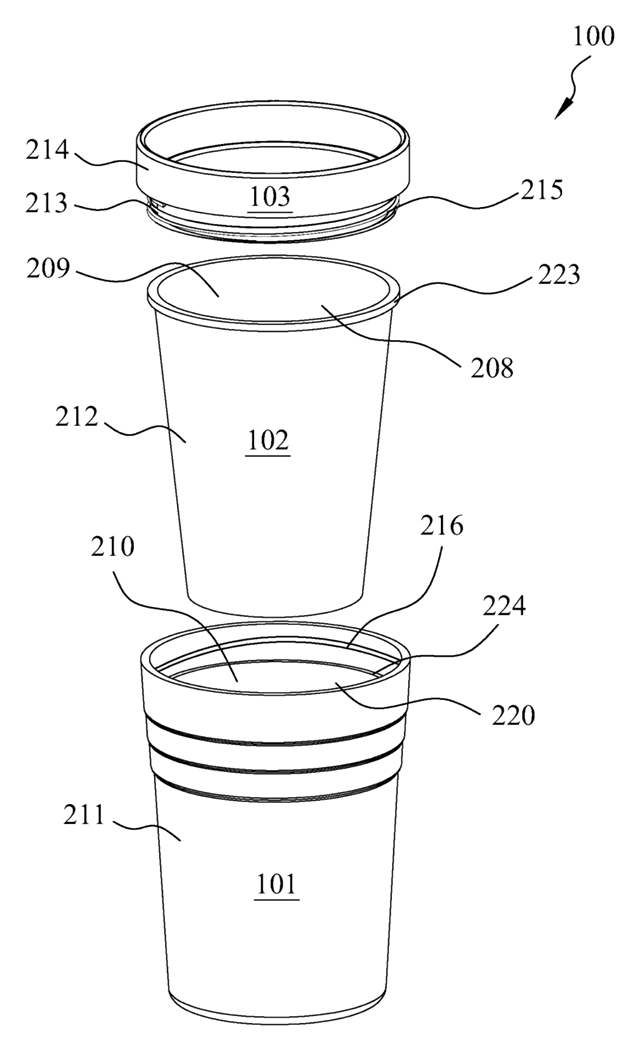
Packaging & Containers
Rigid Shell Container with Removable Silicone Liner
Cup or food box with a rigid outer shell and a removable, leak-tight silicone liner.
Patent CN212638395U
Packaging & Containers
Child-Resistant Paperboard Medicine Box with Three-Point Opening
Paperboard medicine box that opens only when press points on three sides are pushed together.
Patent CN107117365B
Packaging & Containers
Tape-Free Reusable Shipping Box with Zigzag Interlocking Flaps
Reusable carton closed without tape: zigzag flaps interlock, tabs tuck in, a U-clip locks the lid.
Patent CN207242262U
Packaging & Containers
Hinge Device for Folding Containers with Integrated Twistlock Hole
Folding container hinge with a built-in twistlock hole and observation port.
Patent CN113460518B
Packaging & Containers
Cylindrical Plastic Bottle Cap with Built-In Soup Ladle
Plastic bottle cap storing a soup ladle inside, with a flip-top lid and inner sealing closure.
Patent CN106144192B
Packaging & Containers
Insulated Food Packaging Box with Detachable Liner and Self-Heating Cavity
Detachable insulated food box with a sealed cavity for a self-heating sheet and a temperature sticker.
Patent CN108372980B
Browse by category
- Apparel & Accessories (23)
- Baby & Kids (18)
- Bags & Luggage (12)
- Bath & Personal Care (18)
- Car Accessories (14)
- Furniture, Bedding & Storage (13)
- Garden & Outdoor (19)
- Health & Wellness (9)
- Home, Kitchen & Cleaning (27)
- Lighting (13)
- Packaging & Containers (7)
- Pet Products (6)
- Phone & Camera Accessories (4)
- Retail Display (15)
- School, Office & Art (20)
- Sports & Recreation (26)
- Tools & Workshop (32)
- Toys & Games (13)
This page is based on the public patent document CN211845567U, assigned to Individual. IP2M is an independent manufacturing service and is not affiliated with, endorsed by or licensed by the patent owner. Images marked as concept renderings are illustrations, not photos of an existing product. Patent status information is provided for reference only and is not legal advice; confirm freedom to operate for your market before production. Full disclaimer.