At a glance
| Patent number | CN211845567U (application CN201922190987) |
| Type | China utility model (实用新型) - protects product shape and structure |
| Original title | Sleeve joint combined container cover (套接组合容器盖) |
| Patent owner | Individual |
| Inventors | Cai Lingming |
| Filing date | 2019-12-09 |
| Grant date | 2020-11-03 |
| Status (China) | In force - valid until at most 2029-12-09, subject to payment of annual fees |
| Patent family | Chinese filings only - no US, European, Japanese, PCT or other filings listed |
| Cited by | 2 later documents |
| Source | Google Patents (search for CN211845567U) |
What the claims cover, in plain language
Claim 1 defines a combined lid with an outer cover, an inner stopper, and a cylindrical fixing sleeve. The outer cover has a through-hole; the inner stopper has a matching hole or cavity. They join via the sleeve. The sleeve connects to the cover by insertion and to the stopper by insertion or molding.
Claim 2 adds a circumferential annular groove on the outer cover’s side for mounting a fixing ring. Claim 3 specifies the fixing ring is sleeved on the lower part of the outer cover, clamping into the groove and the container edge, and may include an anti-counterfeit tear strip. Claim 4 details the flared part on the outer cover’s opening mating with a convex edge on the fixing sleeve to limit insertion depth. Claims 5-7 describe variations in shape (cylindrical vs. non-cylindrical) to prevent rotation. Claim 8 mentions concave-convex structures on the contact surfaces between the sleeve and stopper to prevent axial sliding. Claim 9 covers a method where the inner stopper is injection molded onto the sleeve, with material flowing through holes in the hollow sleeve to lock them together. Claim 10 describes the inner stopper having a flexible material composition and a horizontal extension forming a gasket sheet ring.
This is a simplified reading for orientation only. The legal scope is defined by the exact claim wording in the official Chinese document.
What this means for US production
This patent was filed only in China and is currently in force there. It has no US or other foreign counterpart. Therefore, making or selling this specific design in China requires the owner’s permission. However, since there is no US patent, the design itself is not protected by patent law in the United States.
Two points to settle early:
- Other patents may exist. Container closures are a highly competitive field with many existing US patents regarding tamper-evident bands, child-resistant mechanisms, and specific snap-fit geometries. A freedom-to-operate (FTO) review is essential to ensure your specific implementation of the sleeve joint and fixing ring does not infringe on prior US art.
- Material compatibility. The patent suggests mixing rigid and flexible materials (e.g., a hard outer cover with a soft inner gasket). You must verify that the chosen materials meet FDA regulations for food contact if intended for consumables.
Customization and manufacturing
What can be customized
| Area | Options |
|---|---|
| Materials | Outer cover: ABS, PP, Metal-plated plastic. Inner stopper: Silicone, TPE, PP. |
| Decoration | Silk-screen printing, hot-stamping, UV coating on the outer cover. |
| Sealing Mechanism | Standard gasket vs. integrated silicone seal on the stopper. |
| Locking Feature | Plain fixing ring vs. ring with tear strip vs. ring with security dots. |
| Geometry | Cylindrical or polygonal (square/hexagonal) cross-sections to prevent rotation. |
| Colors | Custom Pantone matching for both outer and inner components. |
Things to plan for (US market)
- FDA 21 CFR 177 / 178 - Compliance for food-contact substances. All plastics used in the outer cover, inner stopper, and fixing ring must be certified for direct food contact.
- CPSC Guidelines - If the product is intended for children under 12, small parts rules apply. The detachable nature of the sleeve/stopper assembly needs careful risk assessment.
- Proposition 65 (California) - Screening for lead, cadmium, or phthalates in plated finishes or plasticizers.
- ASTM D2014 / D2015 - Standards for testing the integrity of packaging closures, including torque and leak tests, though not legally mandated, are industry best practices for quality control.
How a project runs
- Inquiry - Define container neck finish, desired aesthetics, and sealing requirements.
- Design - Create CAD models for the outer cover, sleeve, and stopper. Determine interference fits and locking angles.
- Prototype - 3D print or CNC machine samples to test assembly ease and rotational locking.
- Tooling - Manufacture molds for the outer cover, sleeve, and stopper. Set up insert-molding stations if combining parts.
- Production - Injection molding, assembly (manual or automated), quality inspection for seal integrity.
Quantities & timeline
This design typically requires three separate molds (outer cover, sleeve, stopper) unless insert-molding combines the sleeve and stopper. Tooling time is generally 6-8 weeks depending on complexity. Assembly adds labor cost compared to single-piece caps. Send us your container specifications, material preferences, quantity estimates, and target price and we will reply with options.
Patent drawings
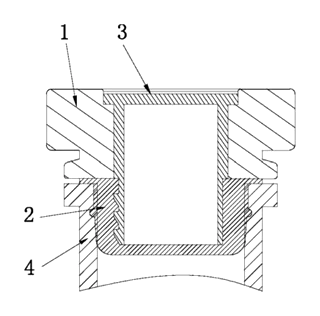
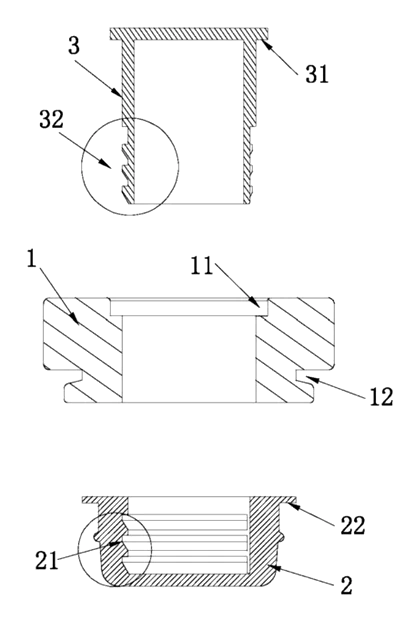
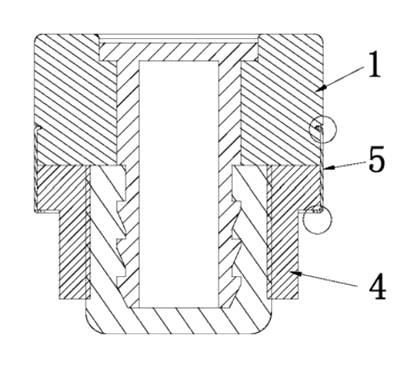
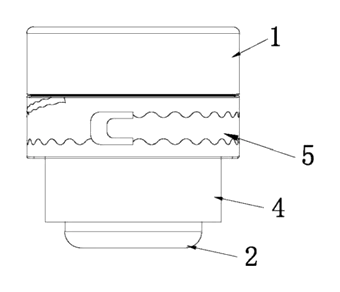
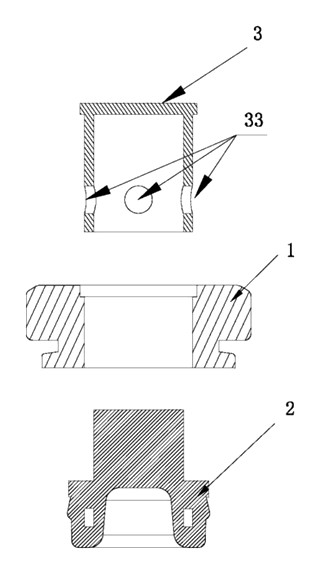
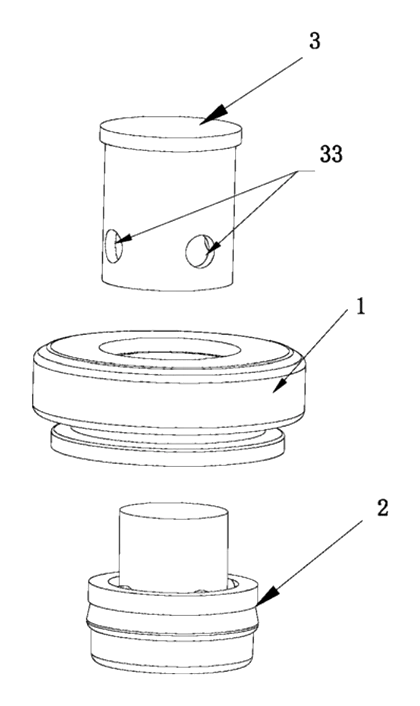
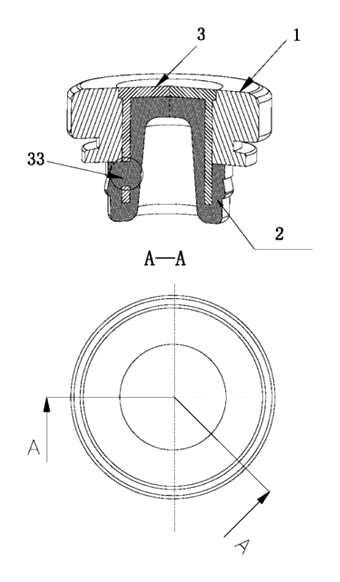
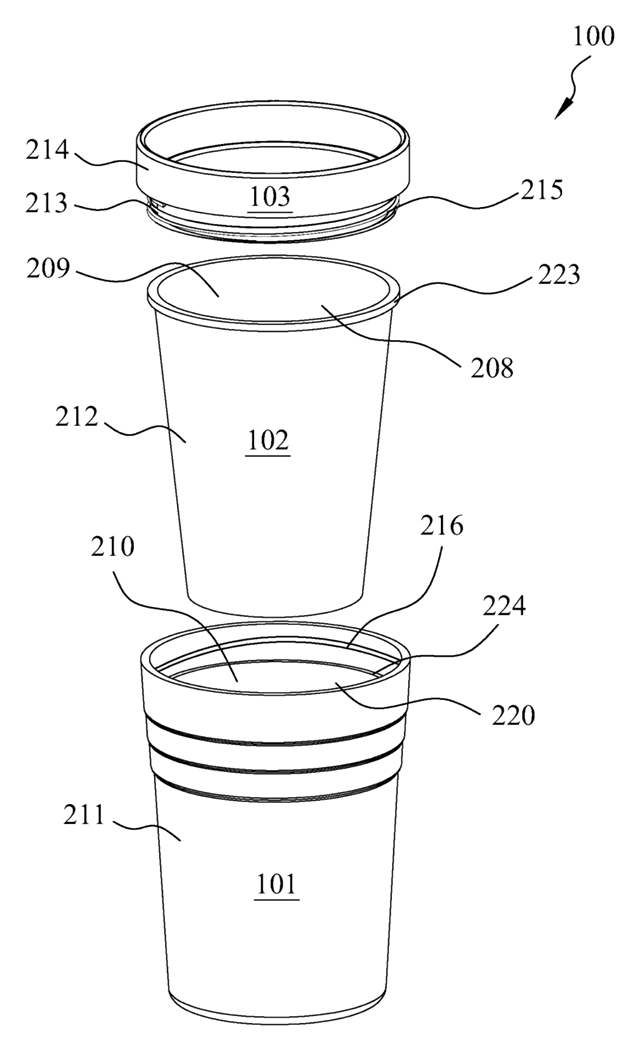
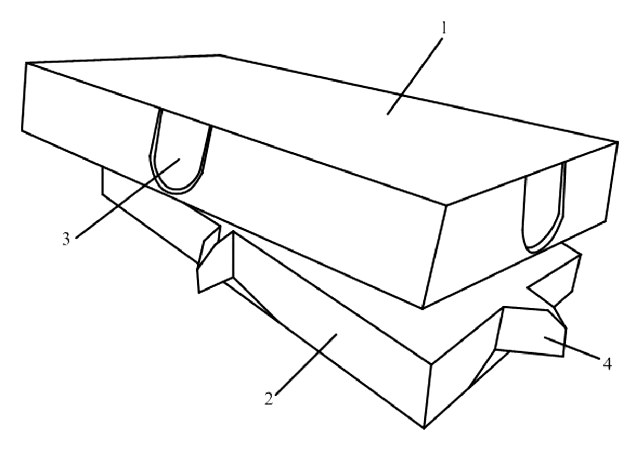
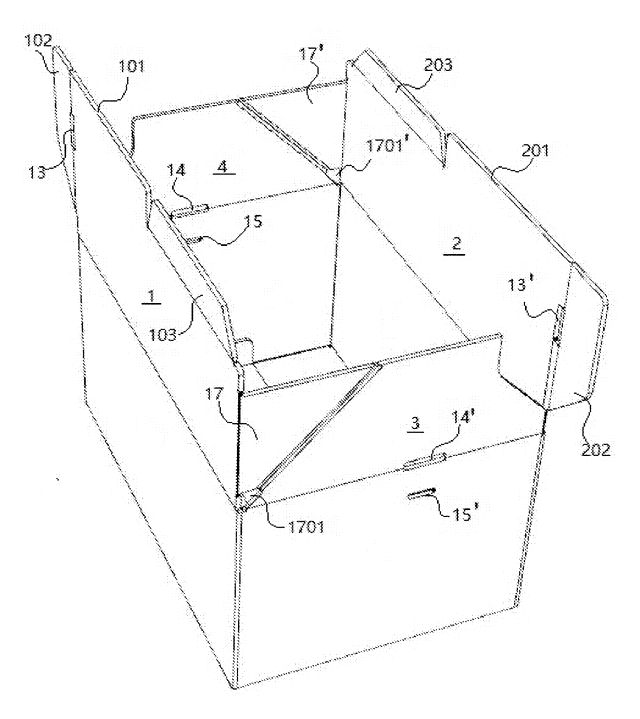
Drawings reproduced from the public patent document for reference.