
Patent CN212415653U
Updated October 28, 2026Single-Sided Hand-Free Flat Mop with Folding Plates and Squeezing Mechanism
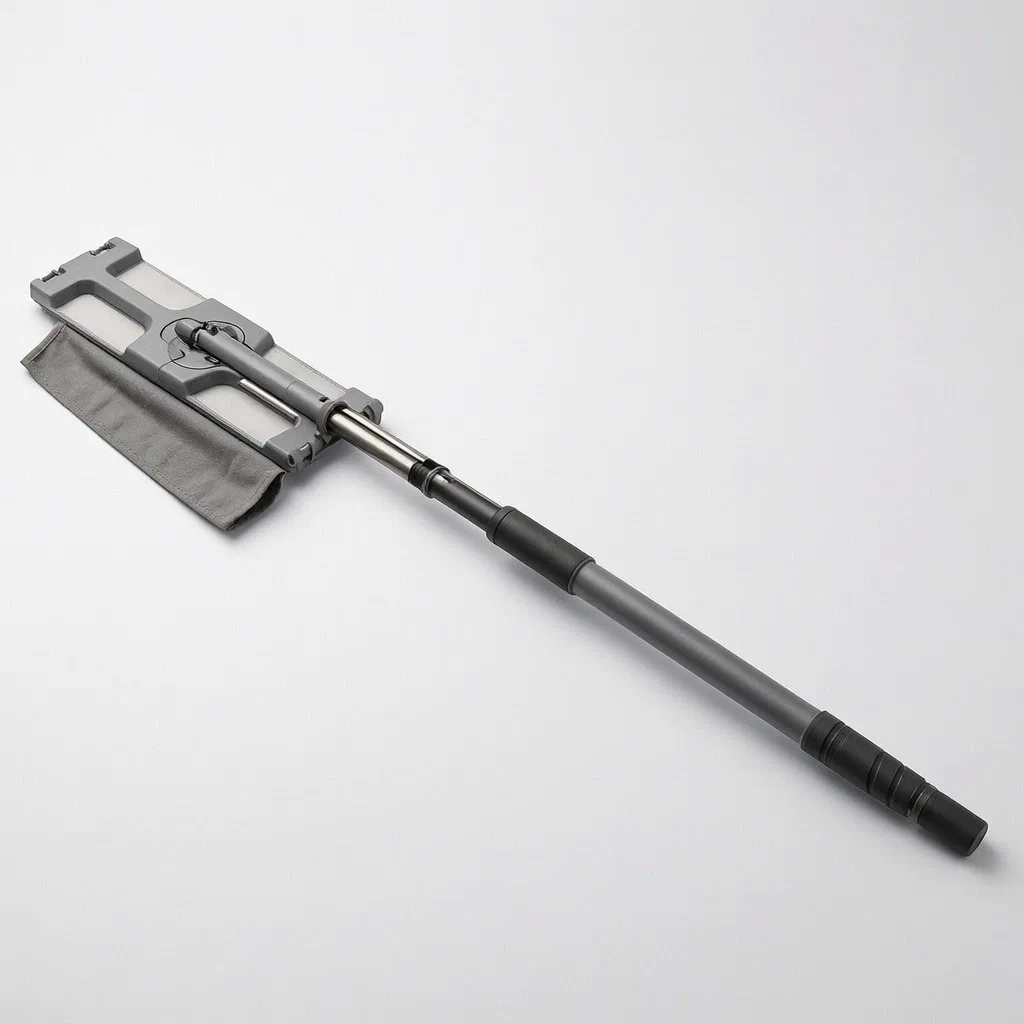
Wringing out a flat mop usually means bending over a bucket or grabbing a wet cloth. This design removes that step. The mop head is built from two plates connected by a spring. When you slide the grip sleeve down the handle, a hook catches a pull rod attached to the wiping cloth. Pulling the rod folds the first plate up toward the second plate, drawing the cloth through a squeezing mechanism mounted on the head. Dirty water is pressed out while your hands stay on the handle. When you let go, the spring pushes the plates back flat, ready for the next pass. Because the spring folds rather than stretches under load, the action takes less effort, and the elastic part sees less fatigue over time.
- China utility model - in force
- No filings outside China
- Floor cleaning tools
- Spring-hinged plates, pull rod, squeeze wringer
Splat! What let you down?
🧹
Hands-free wringing
The grip sleeve pulls the cloth through a squeezing mechanism so fingers never touch the wet pad.
🔗
Folding mop head
Two plates hinged by a spring fold together to feed the wiping material into the wringer.
🔄
Automatic reset
After squeezing, the spring returns the plates to a flat mopping position without extra steps.
📏
Guided sliding sleeve
An orientation protrusion and groove keep the grip sleeve running straight along the mop rod.
Bring this product to market
- ✓ Patent vetted China-only family and legal status checked
- 2 Product brief · now How it works, uses and options written up
- 3 Prototype First samples for buyers to review
- 4 Pilot run Small first batch for launch customers
- 5 Volume production Repeat orders at scale
Buyer interest
– of 100 buyers needed to start prototyping
One click, no sign-up. Each vote is one real visitor, and products with the most interest go to prototyping first.
Build team: no members yet. Need a partner, co-funding or skills to build this? Join and we introduce the team once it forms.
The problem
Flat mops clean hard floors well because the wide pad covers more area per stroke than a string mop. But when the pad gets dirty, the user faces a choice: stop and peel off the cloth to rinse it by hand, or drag the whole mop to a bucket and try to wring a stiff board. Both options interrupt the work. Bucket-based wringers made for flat mops are bulky to store, and reaching down to detach a soaking pad is unpleasant. Buyers of cleaning tools often look for a way to rinse and wring the pad while standing upright, keeping hands dry, without adding a large separate bucket station.
The solution
This mop solves the problem by building the wringing action into the mop head itself.
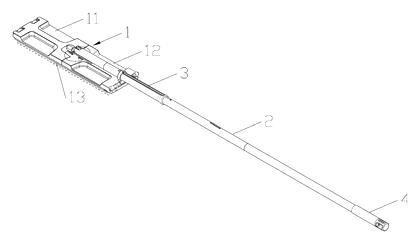
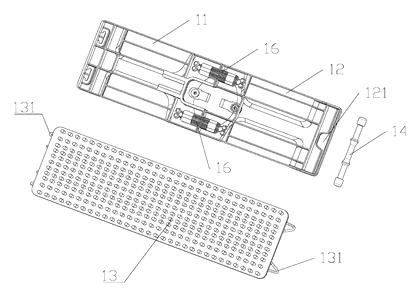
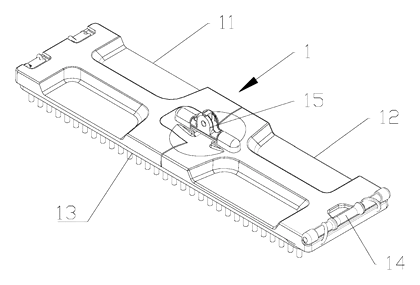
- The flat mop head (1) is divided into a first mop plate (11) and a second mop plate (12). Their adjacent ends are joined at the bottom by an elastic member, which can be a spring (16) or an elastic sheet.
- One end of the wiping material (13) is fixed to the first mop plate (11). The other end attaches to a pull rod (14) that passes through a squeezing mechanism located at the right end of the second mop plate (12).
- A grip sleeve (3) slides over the mop rod (2). At its lower end is a hook part (31).
- To clean or wring, the user pushes the grip sleeve (3) down. The hook part (31) catches the pull rod (14). Continued downward motion pulls the wiping material (13), dragging the first mop plate (11) to fold upward toward the second mop plate (12) against the spring force.
- As the first plate folds, the wiping material (13) is drawn through the squeezing mechanism, which presses out water and dirt.
- When the user releases the sleeve, the spring (16) pushes the first mop plate (11) back down, returning the head to a flat position for mopping.
Who it is for
- US cleaning-tool brands looking for a self-wringing flat mop to add to their catalog without requiring a separate bucket system.
- Amazon private-label sellers who need a compact floor-cleaning product with a clear hands-free feature for listing images and bullet points.
- Janitorial supply wholesalers serving offices, clinics and retail stores where staff must clean quickly between tasks without handling dirty pads.
- Household goods importers seeking a flat mop that ships flat, reducing carton volume compared to spin-mop buckets.
How it works
The main parts
| No. | Part | What it does |
|---|---|---|
| 1 | Flat mop head | Carries the wiping material and houses the folding and squeezing parts. |
| 2 | Mop rod | Handle the user holds; hinged to the mop head. |
| 3 | Grip sleeve | Slides on the mop rod; carries the hook part. |
| 11 | First mop plate | Left plate; holds one end of the wiping material. |
| 12 | Second mop plate | Right plate; carries the squeezing mechanism. |
| 13 | Wiping material | Sheet-form cloth that contacts the floor. |
| 14 | Pull rod | Connects the wiping material to the hook part through the squeezing mechanism. |
| 16 | Spring | Elastic member connecting the bottoms of the two plates. |
| 31 | Hook part | Lower end of the grip sleeve; engages the pull rod. |
| 112, 122 | Fixing columns | Hold the left and right ends of the spring. |
| 113, 123 | Limiting through holes | Guide and house the spring inside the plates. |
Operating steps
- Mop the floor - the spring (16) holds the first plate (11) and second plate (12) flat. The wiping material (13) lies across the bottom.
- Slide the grip sleeve down - the hook part (31) catches the pull rod (14).
- Pull further - the pull rod draws the wiping material (13) and forces the first plate (11) to fold toward the second plate (12), compressing the spring (16).
- Squeeze - the wiping material passes through the squeezing mechanism on the second plate, pressing out liquid.
- Release - the spring (16) expands, pushing the first plate (11) back to the flat position and resetting the cloth.
Applications
Hardwood and laminate floors
Homeowners use flat mops on sealed wood to avoid excess water. The built-in wringer lets them control how damp the pad stays without carrying a heavy bucket from room to room.
Retail and grocery aisles
Store staff need to wipe spills quickly between customer traffic. A mop that wrings by sliding a sleeve saves the time spent walking to a janitor closet.
Office and clinic hallways
Commercial cleaners cover long corridors. The folding head resets automatically after each squeeze, keeping the pace steady without manual reassembly.
Apartments and small homes
Storage space is limited. This mop eliminates the tall bucket required by many wringing systems, fitting behind a door or in a narrow closet.
Where it is less suitable
- Rough outdoor concrete - the flat plate and sheet wiping material are meant for smooth indoor floors; rough surfaces wear the cloth faster.
- Heavy industrial grease - thick grease may clog the squeezing mechanism; industrial deck brushes or pressure washers are used instead.
- Carpets and rugs - the design is for hard floors only.
Frequently asked questions
How does the mop wring itself without a bucket?
The mop head splits into two plates joined by a spring. Sliding the grip sleeve down the handle hooks a pull rod attached to the wiping cloth. Pulling the rod folds one plate over the other, dragging the cloth through a squeezing mechanism built into the head. Water is pressed out while your hands stay on the handle.
Do I have to touch the wet cloth?
No. The entire cleaning and squeezing cycle is driven by the grip sleeve and pull rod. The user holds only the handle and the sleeve.
Is the wiping cloth replaceable?
The patent describes the wiping material as a sheet connected to the first mop plate. In production, this connection can be designed as a hook-and-loop strip or a clamp so the cloth can be removed for washing or swapped for a new one.
How much force does it take to squeeze?
The patent does not list a force value. The effort depends on the spring stiffness and the squeezing mechanism geometry, which are set in design and confirmed on prototypes.
Does the mop head stay flat while mopping?
Yes. When the grip sleeve is not pulled down, the spring holds the first and second plates in a flat alignment. The head returns to this position automatically after every squeeze.
What keeps the sleeve from spinning on the handle?
A sliding orientation device prevents rotation. The patent specifies either a protrusion on the mop rod riding in a groove inside the grip sleeve, or a groove on the rod with a protrusion inside the sleeve.
Can this design be made and sold in the US?
The patent was filed only in China and has no US counterpart, so it does not restrict making or selling the design in the United States. However, the patent remains in force in China until at most 2030-06-15 (if annual fees are paid), meaning production in China requires the owner’s permission. Because self-wringing mops are covered by many patents globally, we recommend a freedom-to-operate review before launching in the US.
Are you affiliated with the patent owner?
No. IP2M is an independent design and manufacturing service working from the public patent document.
Request a quote
Click Request a Quote below to see our email address - copy it, or open your email app with a ready-made message. Please mention patent CN212415653U in the subject.
Helpful details to include:
- Your company and sales channel (cleaning brand, Amazon seller, wholesale distributor, janitorial supplier)
- Handle length and mop head dimensions
- Preferred materials for the plates, sleeve and spring
- Cloth attachment method (replaceable pad or fixed)
- Estimated order quantity and packaging format
- Target price range and delivery timeline
You can also reach us at (332) 203-9997.
Explore this product
Interested in building this?
Tell us your target market, quantity and timeline. We reply with options for prototyping, small-batch runs or volume production.
Send your inquiry to
Please put CN212415653U in the subject line and tell us your company, country, estimated quantity and timeline.
Prefer to talk? Call (332) 203-9997.
More product-ready patents
All Home, Kitchen & Cleaning patents →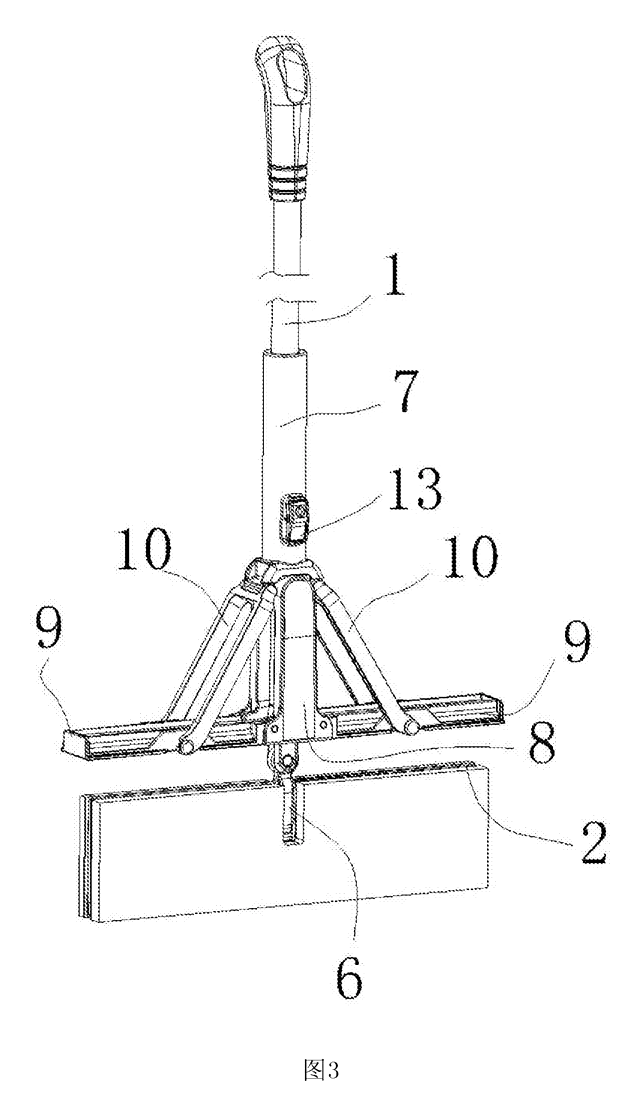
Home, Kitchen & Cleaning
Self-Wringing Flat Mop with Fold-Away Wringer
Flat mop with a built-in wringer that opens only when you wring and folds flat against the pole when you mop.
Patent CN207734114U
Home, Kitchen & Cleaning
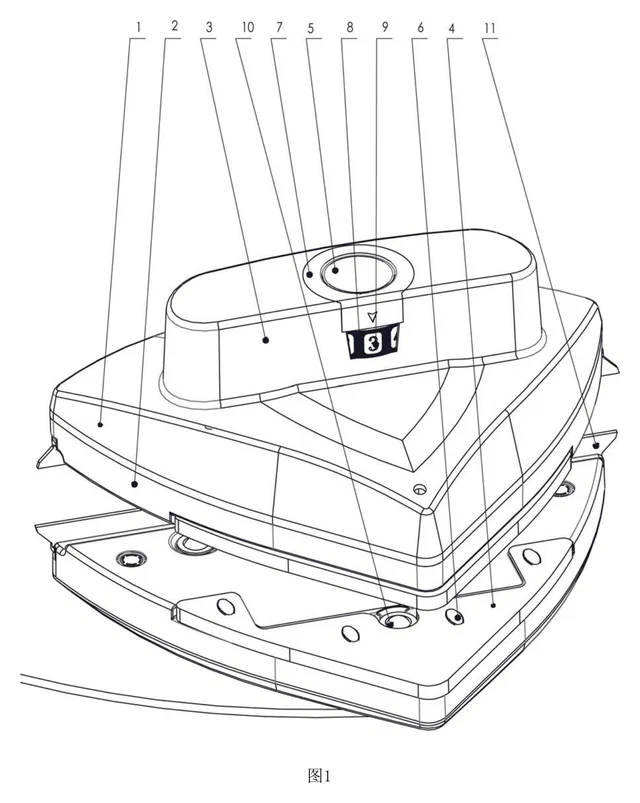
Magnetic Double-Sided Window Cleaner with Dial-Set Magnet Strength
Magnetic window cleaner with a sealed, sliding magnet, dial-set strength for different glass thicknesses and a spring-held idle position.
Patent CN209360543U
Home, Kitchen & Cleaning
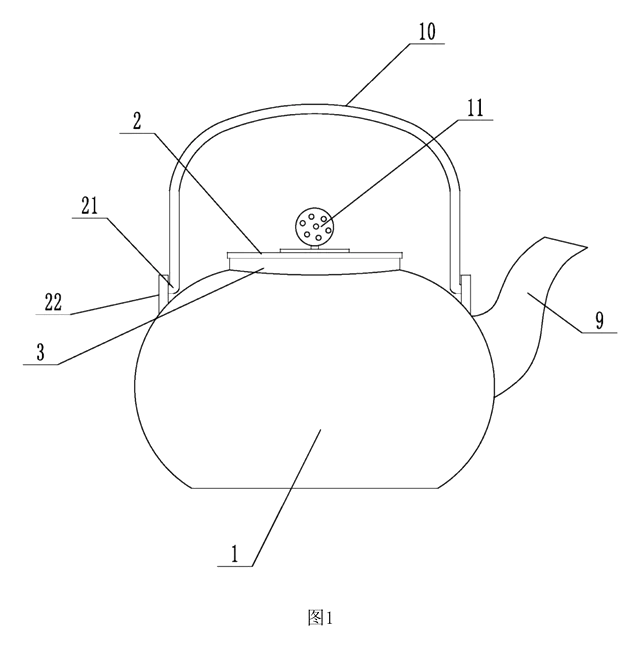
Metal Kettle with Magnetic Lid That Stays On When Pouring
Metal teapot/kettle with a magnet-held lid that does not fall off when pouring, and an insulated, vented lid knob.
Patent CN210540477U
Home, Kitchen & Cleaning
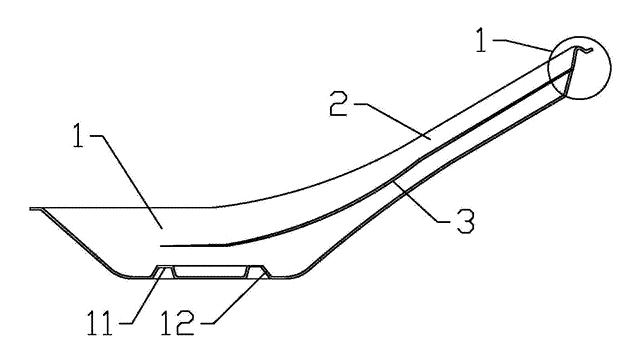
Reinforced Disposable Soup Spoon
Disposable soup spoon with a handle-to-bowl rib, stiffened edges and a ring foot to resist breaking.
Patent CN206964482U
Home, Kitchen & Cleaning
Self-Switching Double-Squeegee Window Cleaner
Cleaning head with two squeegee blades that switch automatically with the direction of movement.
Patent CN212630655U
Home, Kitchen & Cleaning
Self-Rinsing Roller Scrub Brush with Dirty-Water Tank
Powered roller brush that rinses and spins its bristles clean inside the body and stores the dirty water.
Patent CN210076909U
Browse by category
- Apparel & Accessories (22)
- Baby & Kids (16)
- Bags & Luggage (9)
- Bath & Personal Care (16)
- Car Accessories (10)
- Furniture, Bedding & Storage (12)
- Garden & Outdoor (18)
- Health & Wellness (8)
- Home, Kitchen & Cleaning (24)
- Lighting (12)
- Packaging & Containers (6)
- Pet Products (6)
- Phone & Camera Accessories (4)
- Retail Display (13)
- School, Office & Art (19)
- Sports & Recreation (25)
- Tools & Workshop (27)
- Toys & Games (12)
This page is based on the public patent document CN212415653U, assigned to Wuyi Egger Intelligent Technology Co ltd. IP2M is an independent manufacturing service and is not affiliated with, endorsed by or licensed by the patent owner. Images marked as concept renderings are illustrations, not photos of an existing product. Patent status information is provided for reference only and is not legal advice; confirm freedom to operate for your market before production. Full disclaimer.