At a glance
| Patent number | CN212467074U (application CN202021025085) |
| Type | China utility model (实用新型) - protects product shape and structure |
| Original title | New quick-change structure for ice skate blades (一种新型的冰刀快速更换结构) |
| Patent owner | Guangzhou Yongyuan Sporting Goods Technology Co., Ltd. (transferred from Hongwei Sporting Goods Manufacturing (Zhangjiakou) Co., Ltd., registered 2025-07-22) |
| Inventors | Yu Wenliang, Yu Tinghong, Yu Quanhong |
| Filing date | 2020-06-05 |
| Grant date | 2021-02-05 |
| Status (China) | Abandoned - the owner actively gave up the patent right (effective 2026-05-12) |
| Patent family | Chinese filings only - no US, European, Japanese, PCT or other filings listed |
| Cited by | 3 later documents |
| Source | Google Patents (search for CN212467074U) |
What the claims cover, in plain language
Claim 1 - a quick-change structure with a blade holder that has a front support shell, a rear support shell and a mounting slot for the blade; a limiting part at the rear of the slot that fixes the blade’s rear end; a rotary hook hinged in the front shell that fixes the blade’s front end; at least one elastic pressing device keeping the hook locked; an unlocking part that presses on the hook and passes out of the front shell; and a safety part on the front shell that limits the unlocking part’s movement.
Claim 2 - a quick ejection device: a plunger in a guide bore, pushed down by a spring onto the front of the blade. Claim 3 - the limiting part is a fixed shaft through the rear of the slot that fits a U-shaped notch on the blade. Claims 4-10 - further features described in the patent, such as the shaft fixing, the hook’s cross shape and the safety part’s details.
This is a simplified reading for orientation only. The legal scope is defined by the exact claim wording in the official Chinese document.
What this means for US production
This patent was filed only in China and has been abandoned, so it no longer restricts anyone in China either. It has no US or other foreign counterpart.
Two points to settle early:
- Other patents may exist. Quick-release blade holders are a crowded field - the major hockey brands hold US patents on push-button and trigger blade-release systems, and a hockey brand has filed a later international application citing this design - so a freedom-to-operate (FTO) review of the hook, button and ejector layout is essential before tooling.
- Blade compatibility. The blade’s rear notch and front hook must match the holder; the blade profile is designed together with the holder, or matched to an existing blade standard.
Customization and manufacturing
What can be customized
| Area | Options |
|---|---|
| Holder | Glass-filled nylon or composite; senior, junior and youth sizes; boot-mount hole pattern |
| Blade | Stainless steel grade, coated runners, profile and rocker |
| Release | Button position and shape, color-coded safety catch |
| Springs | Hook and plunger spring forces tuned for feel |
| Kits | Holder only, holder with blade, spare-blade packs |
| Branding | Holder colors, logo molding, blade etching |
Things to plan for (US market)
- Ice skate standards - there is no mandatory federal standard for skates, but hockey brands and leagues expect testing of holder and blade retention; we propose impact and pull-out testing on samples.
- CPSIA for youth sizes - skates for children 12 and under need lead and phthalate compliance, a Children’s Product Certificate and third-party testing.
- Sharp-edge labelling - blades and spare-blade packs should carry handling warnings and be packed with guards.
- California Prop 65 - plastics and coatings should be tested for listed substances.
How a project runs
- Inquiry - skate type, sizes, blade standard and quantity.
- Design - holder geometry, hook, button, plunger and safety catch; blade profile.
- Prototype - samples tested for retention under impact, release force and on-ice feel.
- Pilot run - small batch for durability testing and packaging.
- Production - volume production per size, packaging and shipping.
Quantities & timeline
The holder needs an injection mold per size with slides for the internal bores, the hook and button need small molds or metal stamping, springs need sourcing, and blades need stamping, heat treatment and grinding. Most development time goes into retention testing. Send us your skate type, size range, blade preference, quantity and target price and we will reply with options.
Patent drawings
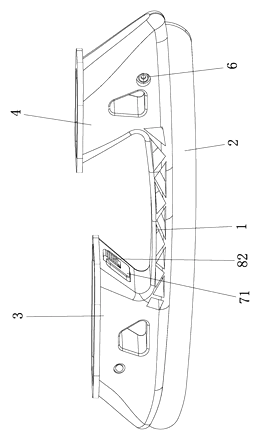
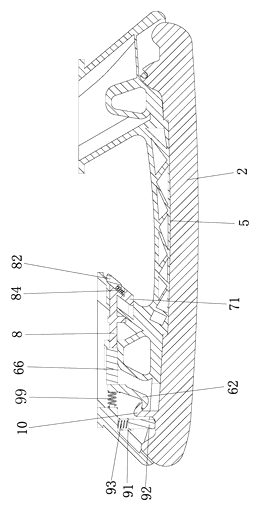
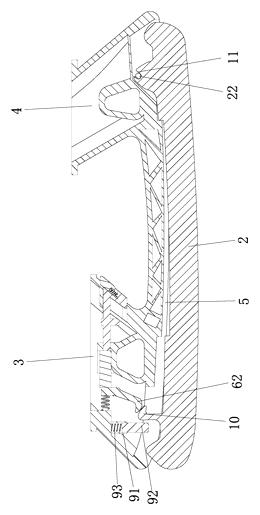
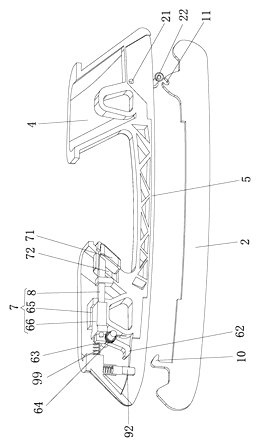
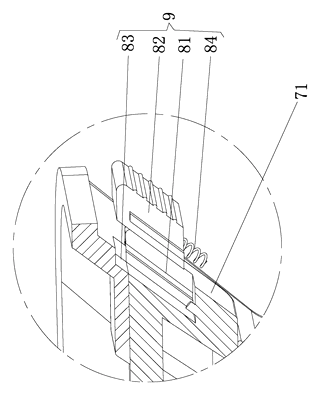
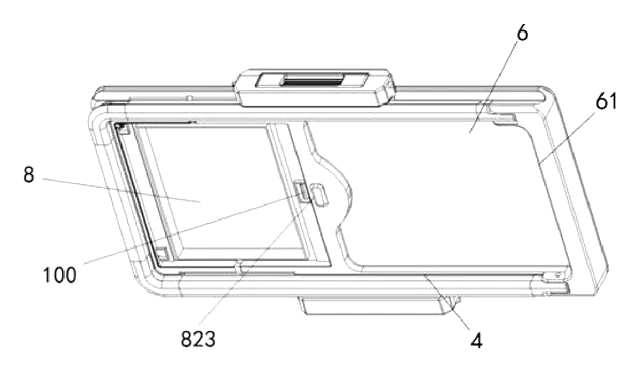
Drawings reproduced from the public patent document for reference.