
Patent CN212491429U
Updated November 7, 2026Sit-On Soccer Confrontation Entertainment Device with LED Scoring
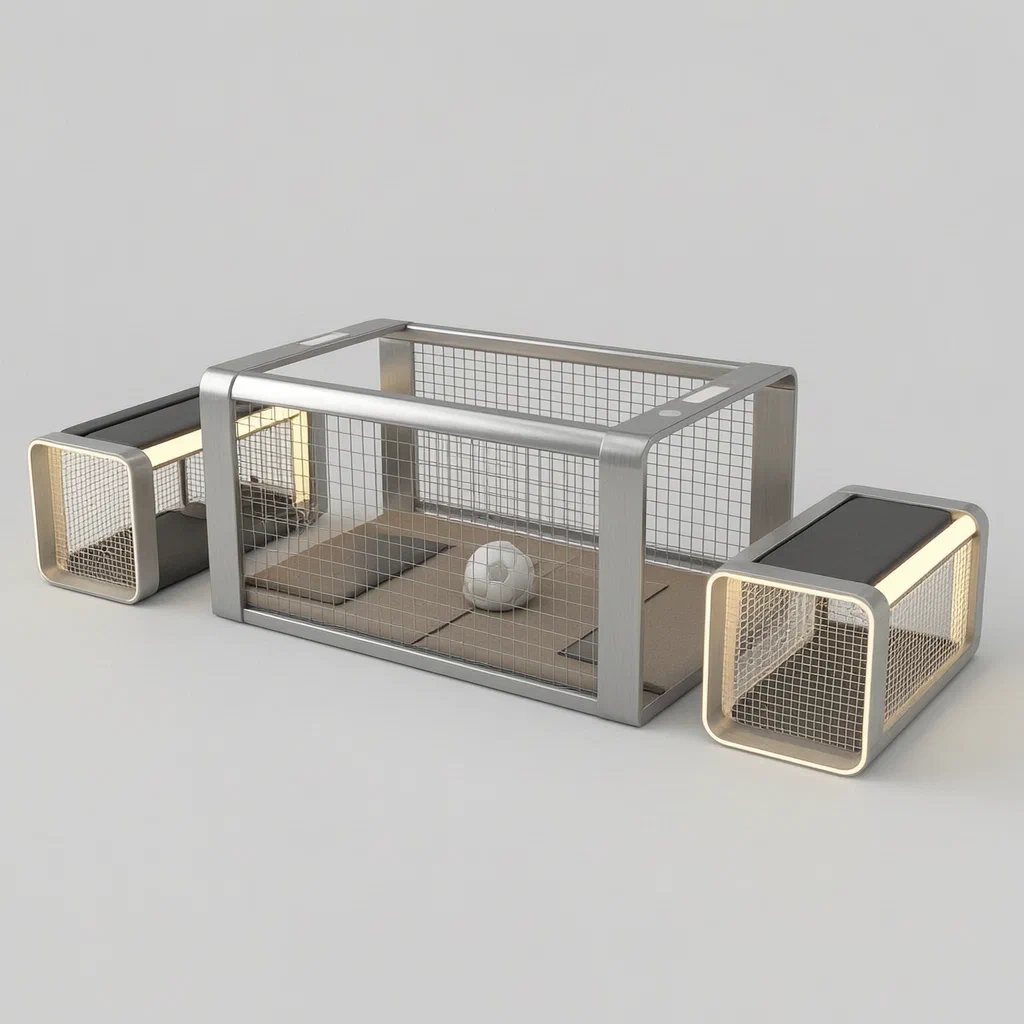
Traditional table football often requires standing or complex manual controls, which can limit accessibility and physical engagement. This sit-on confrontation device reimagines the format by integrating comfortable seating directly into the goal structures. Players sit opposite each other, using their legs and feet to propel soft balls through open goal entrances into semi-closed nets. The central playing field is enclosed in a protective cage with transparent visual panels, ensuring the ball stays in play while maintaining visibility. With built-in LED lighting that flashes upon scoring and a digital counter, the experience combines physical activity with immediate visual feedback, making it suitable for home entertainment centers, educational settings, and recreational clubs looking for active, seated games.
- China utility model - in force
- No filings outside China
- Seated sports equipment
- LED scoring, soft inflatable balls, metal frame cage
Splat! What let you down?
🪑
Integrated Goal Seats
Players sit directly in the goal modules, combining comfort with active gameplay.
⚽
Soft Ball Return
Inclined blocking nets guide balls naturally back to the central confrontation platform.
💡
LED Feedback
Luminous bodies flash during goals, enhancing the competitive atmosphere.
🛡️
Safety Cage
Visual protection units and boundary lines keep play contained and safe.
Bring this product to market
- ✓ Patent review Patent family and legal status reviewed in the relevant jurisdictions.
- 2 Product brief · now How it works, uses and options written up
- 3 Prototype First samples for buyers to review
- 4 Pilot run Small first batch for launch customers
- 5 Volume production Repeat orders at scale
Buyer interest
– of 100 buyers needed to start prototyping
One click, no sign-up. Each vote is one real visitor, and products with the most interest go to prototyping first.
Build team: no members yet. Need a partner, co-funding or skills to build this? Join and we introduce the team once it forms.
Patent Rights & Team Participation
Before joining a development team, participants should ensure they have the necessary rights or authorization to participate in the project.
Participation is generally appropriate where:
- You own the relevant patent rights or have obtained permission or a license from the rights holder.
- The relevant patent rights have expired or have been legally invalidated in the jurisdictions where the planned activities will take place.
- The planned development, manufacturing, and commercialization activities have been independently assessed and do not infringe applicable patent rights in the relevant jurisdictions.
Important: Being located outside a country where a patent is protected does not automatically exempt you from patent infringement risks. Patent rights may apply based on where development, manufacturing, use, sale, or import activities take place.
IP2M does not grant any patent license or authorization through team participation. Joining a project does not provide permission to use, manufacture, or commercialize patented technology.
The problem
Standard tabletop soccer games often require players to stand or use manual rods, which limits physical engagement and can be difficult for younger children or those with mobility constraints. Traditional full-size soccer requires large spaces and running, making it impractical for indoor environments like living rooms or small recreation centers. Existing seated alternatives frequently lack immersive feedback, relying on simple mechanical counters that do not enhance the excitement of scoring. There is a need for a compact, interactive device that allows players to remain seated while engaging in physical kicking actions, with built-in visual and electronic feedback to maintain interest and ensure safe, contained play.
The solution
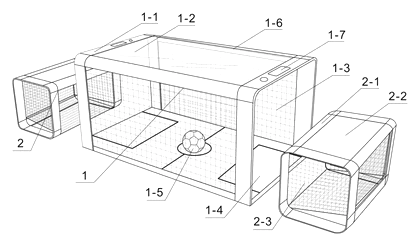
The device consists of two main assemblies: a central table cage main body module (1) and opposing goal seat modules (2).
- The table cage features a cubic frame structure made of metal section materials. It includes a boundary line confrontation platform unit (1-4) at the bottom, constructed from force-reducing fiber board material to absorb impact.
- Surrounding the platform are blocking net units (1-3) on the front and back sides, topped by visual protection units (1-2) made of breakage-resistant transparent material.
- Intelligent scoring units (1-7) are positioned on the left and right sides of the table body, providing digital display functionality.
- Luminous lighting units (1-6), consisting of LED bodies, are arranged around the periphery of the visual protection unit’s bottom, featuring a goal flickering function.
- The goal seat modules (2) are placed at opposite ends of the table cage. Each module comprises a goal main structure unit (2-1) with a cubic metal frame, a seat unit (2-2) made of soft leather, and a goal blocking net unit (2-3).
- The goal blocking net is semi-closed on four sides, creating an entrance facing the table cage. The bottom blocking units are designed with a low-front, high-back inclined plane to facilitate natural ball return.
Who it is for
- Home entertainment brands seeking compact, active gaming solutions for families who want screen-free physical interaction in limited indoor spaces.
- Educational institutions needing safe, structured play equipment that promotes coordination and basic soccer skills without requiring large fields.
- Recreational club operators looking for unique, self-contained attractions that offer immediate visual feedback and durable construction for high-frequency use.
- Toy manufacturers aiming to expand their range with sports-themed products that integrate electronic scoring and lighting features.
How it works
The main parts
| No. | Part | What it does |
|---|---|---|
| 1 | Table Cage Module | Central frame containing the play area and electronics. |
| 1-1 | Table Body Structure | Metal cubic frame supporting the cage components. |
| 1-2 | Visual Protection Unit | Transparent panels preventing ball escape while allowing visibility. |
| 1-3 | Blocking Net Unit | Nets on front/back sides defining the play boundaries. |
| 1-4 | Boundary Platform | Force-reducing fiber board floor for ball movement. |
| 1-5 | Sphere Unit | Soft inflatable balls used for gameplay. |
| 1-6 | Luminous Lighting | LEDs that flash upon scoring events. |
| 1-7 | Scoring Unit | Digital counters tracking goals. |
| 2 | Goal Seat Module | Combined seating and goal structure for players. |
| 2-1 | Goal Main Structure | Metal frame holding the seat and net. |
| 2-2 | Seat Unit | Soft leather seating for player comfort. |
| 2-3 | Goal Blocking Net | Semi-closed net with inclined return path. |
Operating steps
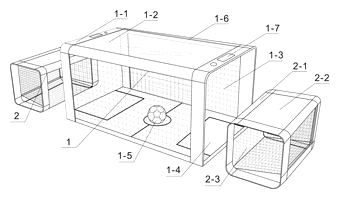
- Setup: Two players sit in the goal seat modules (2), facing each other across the table cage main body module (1).
- Play: Players use their feet to kick the sphere units (1-5) across the boundary line confrontation platform unit (1-4).
- Scoring: A goal is registered when a ball enters the goal blocking net unit (2-3) through the open entrance.
- Feedback: The intelligent scoring unit (1-7) updates the score, and the luminous lighting unit (1-6) triggers a flickering effect to celebrate the goal.
- Return: The inclined design of the blocking net guides the ball back toward the center, allowing continuous play without manual retrieval.
Applications
Family Living Rooms
Parents and children can engage in active play together in a confined space. The soft balls and protective cage prevent damage to furniture, while the seated position allows adults to participate comfortably without strenuous exercise.
School Physical Education
Teachers use the device to introduce soccer basics to students in gym classes or indoor activity periods. The clear visual boundaries and digital scoring help students understand rules and track performance in a controlled environment.
Community Recreation Centers
Facilities install these units as standalone attractions for youth programs. The durable metal frames and easy-to-clean surfaces withstand frequent use, while the LED feedback keeps users engaged during tournaments or casual play.
Indoor Play Areas
Commercial entertainment venues incorporate the devices into larger arcade zones. The compact footprint allows multiple units to be clustered, creating social competition areas that attract groups of friends looking for interactive, non-digital games.
Where it is less suitable
- Outdoor rugged terrain: The design relies on a flat, stable surface for the boundary platform; uneven ground compromises the ball return mechanism.
- High-speed professional training: The soft inflatable balls and short distance do not simulate the velocity or physics of real-world field soccer.
- Single-player solo use: The core mechanic involves confrontation between two seated players, limiting its appeal for solitary practice sessions.
Patent & Production
At a glance
| Patent number | CN212491429U (application CN202021255738) |
| Type | China utility model (实用新型) - protects product shape and structure |
| Original title | Sit-on soccer confrontation entertainment device (坐式足球对抗娱乐器材) |
| Patent owner | Zhongde Sports Technology (Jilin Province) Co.,Ltd. |
| Inventors | Liu Guochen |
| Filing date | 2020-07-01 |
| Grant date | 2021-02-09 |
| Status (China) | In force - valid until at most 2030-07-01 if annual fees are paid |
| Patent family | Public record shows Chinese filings only - no US, European, Japanese, PCT or other filings listed |
| Cited by | 6 later documents |
| Source | Google Patents (search for CN212491429U) |
What the claims cover, in plain language
Claim 1 - defines the overall structure comprising a table cage main body module (1) and goal seat modules (2). The table cage includes a table body main structure unit (1-1), visual protection unit (1-2), blocking net unit (1-3), boundary line confrontation platform unit (1-4), sphere unit (1-5), luminous lighting unit (1-6), and intelligent scoring unit (1-7). The goal seat modules consist of a goal main structure unit (2-1), seat unit (2-2), and goal blocking net unit (2-3). The arrangement places the sphere unit on the platform, with nets and visual protections enclosing the play area, and seats integrated into the goal structures at opposite ends.
Claim 2 - specifies that the left and right sides of the table cage have open ball outlets corresponding to the goal seat modules.
Claim 3 - details the vertical stacking: blocking net units (1-3) on the front/back, with boundary line confrontation platform units (1-4) at the bottom and visual protection units (1-2) at the top.
Claim 4 - identifies the luminous lighting units (1-6) as LED bodies with a goal flickering function, positioned around the bottom of the visual protection unit.
Claim 5 - describes the goal blocking net unit (2-3) as semi-closed on four sides, forming a goal entrance. Crucially, the blocking units at the bottom are designed with a low-front, high-back inclined plane to allow balls to naturally return to the central platform area.
This is a simplified reading for orientation only. The legal scope is defined by the exact claim wording in the official Chinese document.
What this means for US production
This patent was filed in China and is currently in force. The public record shows no US or other foreign counterpart. Therefore, the Chinese patent rights do not restrict manufacturing or sales within the United States. However, making or selling this specific design in China would require the owner’s permission.
Two points to settle early:
- Other patents may exist. Interactive sports equipment and table-game hybrids are a crowded field. Notably, 4 Feet Under Oy holds a later international filing (WO2021165573A1) citing this patent, suggesting potential overlap in related seated-sport technologies. A freedom-to-operate (FTO) review is recommended to ensure no US patents cover the specific combination of seated goals, LED scoring, and inclined ball return mechanisms.
- Component sourcing. The integration of digital scoring and LED systems with structural metal frames requires careful supplier selection to match electrical standards and mechanical tolerances.
Customization and manufacturing
What can be customized
| Area | Options |
|---|---|
| Frame Material | Aluminum extrusion or steel tubing finishes (powder coat colors). |
| Net Type | Nylon mesh density, color, and tensioning method. |
| Seat Comfort | Foam density, upholstery fabric/leather choice, ergonomic contour. |
| Electronics | LED color modes, sound options, scoring display interface. |
| Ball Design | Size, texture, and inflation level of the soft sphere unit. |
| Base Stability | Footprint size and anti-slip pad configuration. |
Things to plan for (US market)
- ASTM F963 - Consumer Safety Specification for Toy Products, covering mechanical hazards, small parts, and flammability.
- UL 60950 / UL 62368 - Safety standards for electronic components (LEDs, scoring units) if powered by mains or batteries.
- CPSIA - Lead and phthalate restrictions for accessible plastics and paints.
- FCC Part 15 - Electromagnetic interference compliance for any wireless or digital scoring circuits.
How a project runs
- Inquiry - Define target age group, usage frequency, and desired electronic features.
- Design - Finalize frame geometry, net attachment points, and electronics housing.
- Prototype - Build functional samples for stability and ball-return testing.
- Pilot Run - Verify assembly tolerances and electronic reliability.
- Production - Fabricate frames, mold plastic/electronic parts, assemble, and test.
Quantities & timeline
Tooling for injection-molded electronic housings and custom aluminum extrusions drives initial costs. Assembly time depends on fastener count and wiring complexity. Send us your target dimensions, feature set, quantity, and budget and we will reply with options.
Production notes
Tooling and process
Aluminum extrusion is likely used for the main cubic frames, requiring custom dies. Plastic components such as the visual protection units and electronic housings typically involve glass-filled nylon injection molding. The seat padding usually requires EVA or foam molding combined with sewing for the seat covers.
Cost drivers
The number of molds for electronic casings and structural connectors typically drives upfront costs. Impact grade materials for the transparent units add expense compared to standard acrylic. Fastener count also influences assembly labor costs, particularly for the modular goal seats.
Prototyping path
Initial prototypes typically use 3D-printed parts for fit checks of the net attachments and electronic housings. Machined frames provide structural validation before committing to extrusion tooling. Functional samples are essential to verify the inclined plane ball return efficiency.
What we would change before tooling
We would likely refine the joint design between the metal frame and the plastic visual units to reduce cracking risks. Adjusting the wall thickness of the electronic housings could improve durability against impact. Securing bolts with lock washers or rivets might replace standard screws to prevent loosening under vibration.
Common failure points
Cracking under impact is a primary concern for the transparent visual protection units. Bolts loosening due to repeated kicking vibrations can compromise structural integrity. UV degradation may affect plastic components if used in sunlit areas. Weight above target specifications could make the unit unstable or difficult to move.
Patent drawings
Drawings reproduced from the public patent document for reference.
Frequently asked questions
How does the scoring system work?
The device uses an intelligent scoring unit (1-7) positioned on the sides of the table cage. When a ball enters the goal area, the system registers the point digitally. Additionally, the luminous lighting units (1-6) provide visual feedback by flashing LEDs, creating a celebratory effect for each goal scored.
Is the game safe for children?
Yes, the design incorporates several safety features. The visual protection units (1-2) are made of breakage-resistant transparent material to prevent shattering. The boundary line confrontation platform (1-4) uses force-reducing fiber board to cushion impacts. The balls are soft inflatable neutral elastic leather, minimizing injury risk during play.
How does the ball return mechanism function?
The goal blocking net unit (2-3) is designed with a specific geometric constraint: the bottom blocking units form a low-front, high-back inclined plane. This slope ensures that once a ball passes through the goal entrance, gravity and the angle of the net guide it naturally back toward the central boundary line confrontation platform (1-4), allowing for continuous play without manual retrieval.
What materials are used for the frame?
The table body main structure (1-1) and goal main structure (2-1) are constructed from metal section materials in a cubic frame design. This provides rigidity and stability. The seats (seat unit 2-2) are upholstered in soft leather materials for comfort, while the nets are typically metal or fiber meshes.
Can the LED lights be changed or replaced?
The LED units are integrated into the peripheral structure. While specific replacement protocols depend on the final manufacturing design, the modular nature of the luminous lighting unit (1-6) suggests they can be serviced. Customization options for light color and mode are available during the production phase.
Is assembly required?
The device consists of distinct modules: the central table cage main body (1) and the two goal seat modules (2). These are designed to be connected at the open ball outlets. Assembly typically involves securing the goal seats to the table cage using bolts or screws, following standard furniture hardware practices.
Can this design be made and sold in the US?
The patent was filed in China and is in force there. However, the public record shows no US counterpart. This means the Chinese patent rights do not restrict the manufacture or sale of this design in the United States. We recommend a freedom-to-operate check to ensure no other US patents cover similar interactive sports equipment features.
Are you affiliated with the patent owner?
No. IP2M is an independent design and manufacturing service working from the public patent document.
Request a quote
Click Request a Quote below to see our email address - copy it, or open your email app with a ready-made message. Please mention patent CN212491429U in the subject.
Helpful details to include:
- Your company and channel (toy brand, educational supplier, recreation center operator)
- Target dimensions and weight limits
- Material preferences for frame finish and upholstery
- Electronic features (sound options, display types)
- Estimated quantity and target price
- Timeline - when you would like samples and the first shipment
You can also reach us at (332) 203-9997.
Page editor: Daniel Chen, Product Research Editor · IP2M
Last updated November 7, 2026. If something on this page looks wrong, email [email protected] and we will check it against the patent.
Interested in building this?
Tell us your target market, quantity and timeline. We reply with options for prototyping, small-batch runs or volume production.
Send your inquiry to
Please put CN212491429U in the subject line and tell us your company, country, estimated quantity and timeline.
Prefer to talk? Call (332) 203-9997.
More product-ready patents
All Sports & Recreation patents →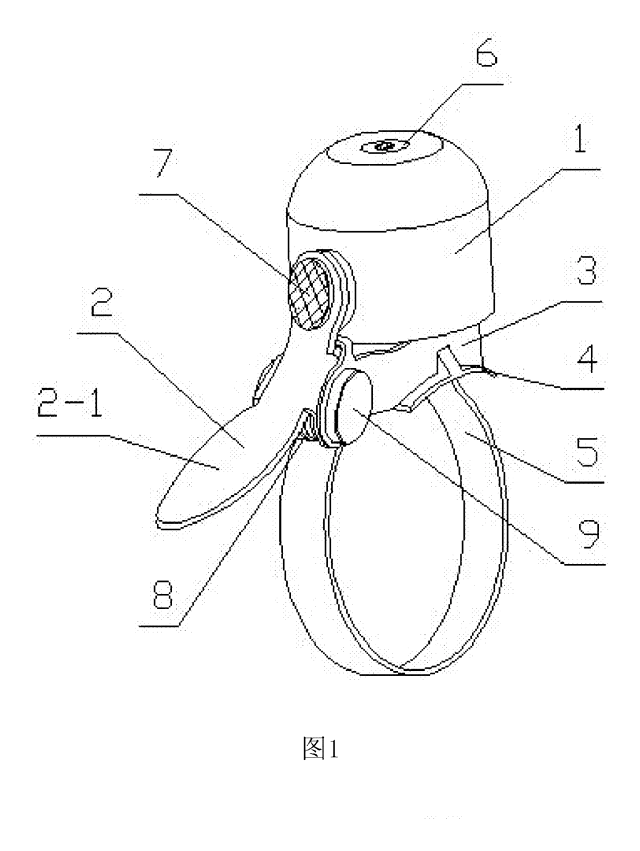
Sports & Recreation
Compact Torsion-Spring Bike Bell
Mini bike bell with a standard torsion spring and a rubber-floated dome - small size, clear tone, quick strap mount.
Patent CN205819384U
Sports & Recreation
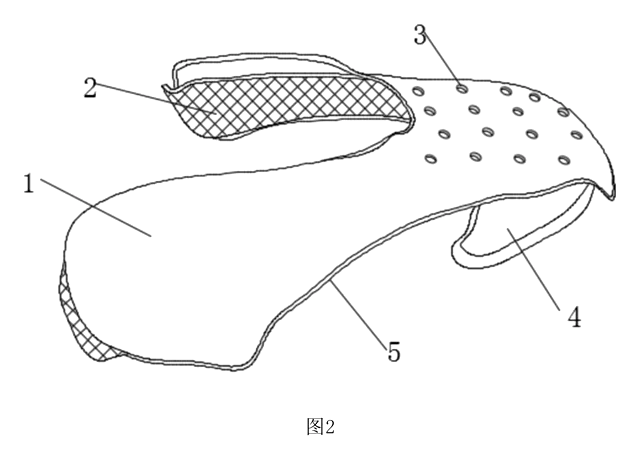
Padded Toe-Box Shield for Sneakers
Ventilated, silicone-lined toe-box insert that supports the front of a sneaker and cushions the toes.
Patent CN209473731U
Sports & Recreation
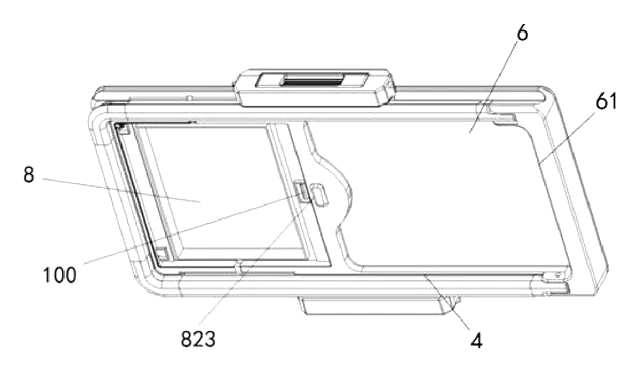
Reversible Fishing Seat-Box Lid with Backrest
Fishing seat-box lid that flips on removable hinge pins: cushion, backrest and storage on one face.
Patent CN208624426U
Sports & Recreation
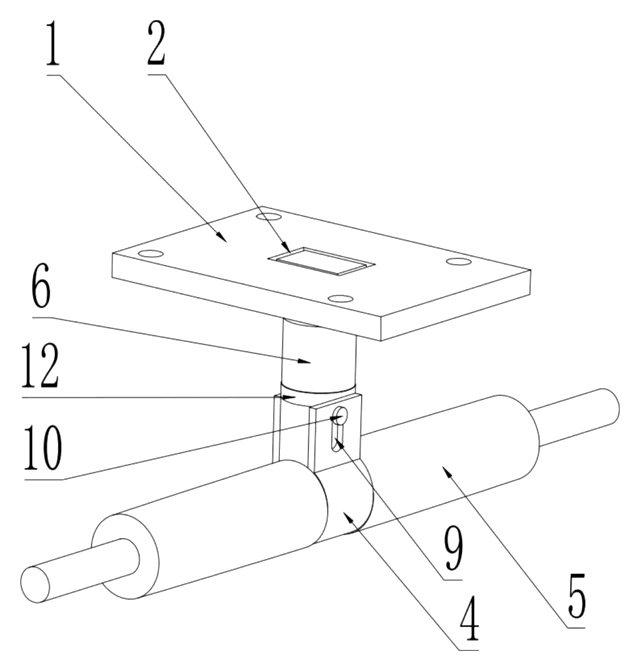
Swivel-Pin Skateboard Truck with Rubber Sleeve
Skateboard truck with a turning center pin, a tilting axle clamp and a rubber sleeve that centers it.
Patent CN216777880U
Sports & Recreation
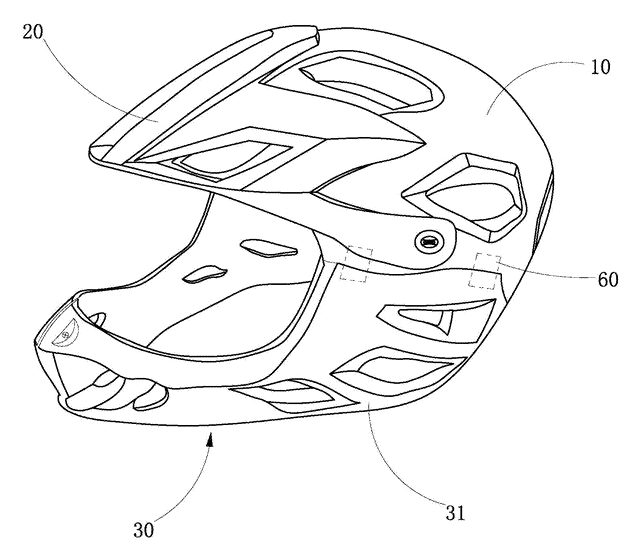
Full-Face Bike Helmet with Magnetic Detachable Chin Bar
Full-face cycling helmet whose chin bar clips on and off with magnetic, latching side connectors.
Patent CN206630067U
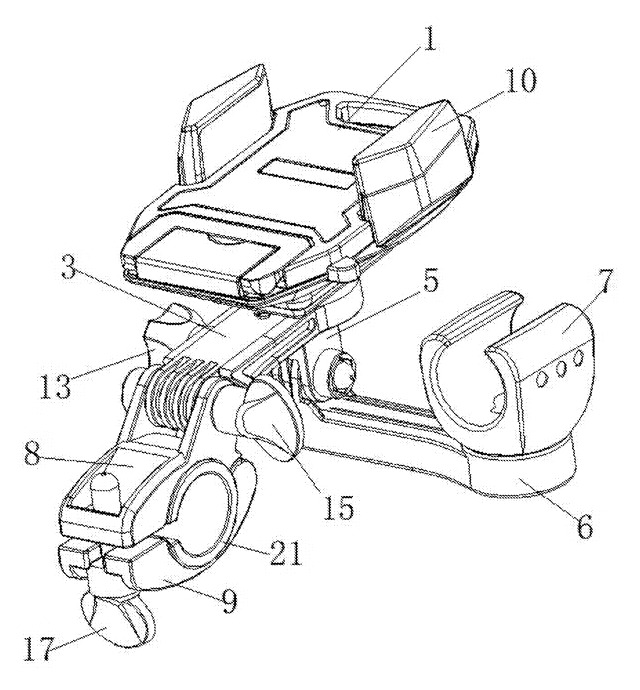
Sports & Recreation
Bike Phone Holder with Built-In Flashlight Clamp
Handlebar mount with a phone cradle on top and a flashlight clamp below, on one arm.
Patent CN206077485U
Browse by category
- Apparel & Accessories (49)
- Baby & Kids (29)
- Bags & Luggage (17)
- Bath & Personal Care (32)
- Car Accessories (25)
- Furniture, Bedding & Storage (25)
- Garden & Outdoor (34)
- Health & Wellness (14)
- Home, Kitchen & Cleaning (51)
- Lighting (23)
- Packaging & Containers (12)
- Pet Products (12)
- Phone & Camera Accessories (9)
- Retail Display (25)
- School, Office & Art (37)
- Sports & Recreation (47)
- Tools & Workshop (55)
- Toys & Games (23)
This page is based on the public patent document CN212491429U, assigned to Zhongde Sports Technology (Jilin Province) Co.,Ltd.. IP2M is an independent manufacturing service and is not affiliated with, endorsed by or licensed by the patent owner. Images marked as concept renderings are illustrations, not photos of an existing product. Patent status information is provided for reference only and is not legal advice; confirm freedom to operate for your market before production. Full disclaimer.