At a glance
| Patent number | CN213237087U (application CN202022488774) |
| Type | China utility model (实用新型) - protects product shape and structure |
| Original title | 4D-printed light-sensitive self-folding desk lamp (一种4D打印感光自动折叠台灯) |
| Patent owner | Shaanxi University of Science and Technology |
| Inventors | Yan Xiaojie, Li Duanling, Zhang Wencai |
| Filing date | 2020-11-02 |
| Grant date | 2021-05-18 |
| Status (China) | Lapsed - terminated for non-payment of annual fees (recorded 2022-10-14) |
| Patent family | Chinese filings only - no US, European, Japanese, PCT or other filings listed |
| Cited by | 3 later documents |
| Source | Google Patents (search for CN213237087U) |
What the claims cover, in plain language
Claim 1 - a desk lamp with a lamp shade, a self-folding stem and a base; the shade sits on top of the stem and the base at its bottom. The stem is printed from a shape-memory polymer, is S-shaped and folded when not activated and unfolds when activated.
Claim 2 - the bulb in the shade is an incandescent lamp. Claim 3 - the shade and the stem are connected through an adjusting handle. Claim 4 - the handle is L-shaped: one side at the joint between shade and stem, the other perpendicular to the shade, on its back.
This is a simplified reading for orientation only. The legal scope is defined by the exact claim wording in the official Chinese document.
What this means for US production
This patent was filed only in China and has lapsed, so it no longer restricts anyone in China either. It has no US or other foreign counterpart.
Before production, keep in mind:
- Other patents may exist. Shape-memory actuators and 4D-printed structures are an active research and patent area, and convertible lamps with phone holders are common in US design patents. Have a freedom-to-operate (FTO) search done by a US patent attorney before volume production.
- The heat source must change. The patent relies on the warmth of an incandescent bulb; an LED lamp with a separate heater is a new design that has to be engineered and tested.
Customization and manufacturing
What can be customized
| Area | Options |
|---|---|
| Stem | Shape-memory polymer grade and transition temperature; printed or molded; length and number of folds |
| Heating | Heating element in the stem, timer or button-triggered change |
| Light | LED module, color temperature, brightness levels, dimming |
| Phone stand | Ledge size and angle; optional wireless charging pad in the shade back |
| Power | USB-C, plug-in adapter, rechargeable battery |
| Finish | Shade and base colors, materials, branding |
Things to plan for (US market)
- Electrical safety - UL 153 (portable electric luminaires) testing for a plug-in lamp, with a UL-listed adapter.
- FCC Part 15 - for LED drivers and any heater controller; a wireless charging pad needs FCC authorization.
- Battery - a rechargeable version needs UL 2054 or UL 62133 cells and UN 38.3 transport testing.
- Surface temperature - the heated stem must stay below safe touch temperatures; this is a key test on prototypes.
- DOE and California Title 20 - lighting efficiency rules rule out an incandescent bulb as the main light source.
How a project runs
- Inquiry - target price, lamp or stand priority, power source and quantity.
- Material trials - select the shape-memory polymer and transition temperature, test fold cycles.
- Prototype - working lamps with LED and heater for function and temperature tests.
- Pilot run - small batch with UL and FCC testing.
- Production - volume production, packaging and shipping.
Quantities & timeline
The shade and base need injection molds; the stem needs either a printing process qualified for volume or a mold for the shape-memory polymer, plus cycle testing of the fold. Send us your target price, features and quantity and we will reply with options.
Patent drawings
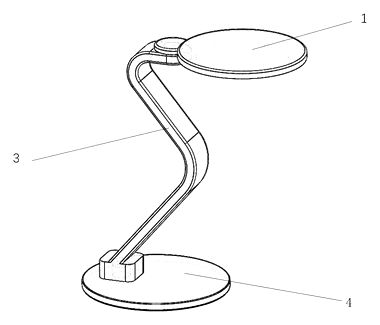
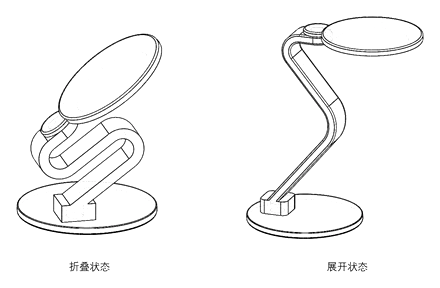
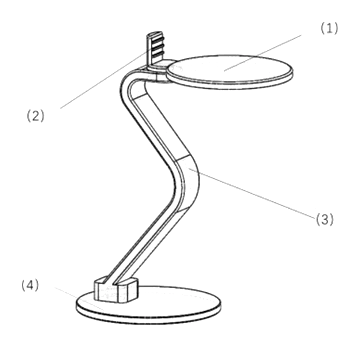
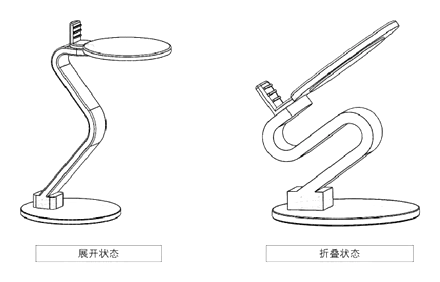
Drawings reproduced from the public patent document for reference.