At a glance
| Patent number | CN213640365U (application CN202022428632) |
| Type | China utility model (实用新型) - protects product shape and structure |
| Original title | Humidifier fruit vegetables frame (一种加湿器果蔬架) |
| Patent owner | Hebei Mokaihan Information Technology Co., Ltd. |
| Inventors | Li Zhongjun, Chen Jianguang, Huang Shuai |
| Filing date | 2020-10-28 |
| Grant date | 2021-07-09 |
| Status (China) | In force in China until at most 2030-10-28 (if annual fees are paid) |
| Patent family | Chinese filings only - no US, European, Japanese, PCT or other filings listed |
| Cited by | 2 later documents |
| Source | Google Patents (search for CN213640365U) |
What the claims cover, in plain language
Claim 1 — A humidifier produce rack comprising a left support, first, second and third fog pipes connected at the upper, middle and lower portions of one side of the left support, a right support connected to the far end of the third fog pipe, fruit and vegetable basket supports arranged between the left and right supports, and a humidification system assembly mounted on the opposite lower side of the left support. The assembly includes a water pump, air inlet fan, semiconductor refrigeration sheet, water pipe, fog forming pipe, water level sensor, piezoelectric ceramic sheet, temperature sensor, atomization sheet driving plate and main control plate. The fan sits beside the pump, the cooling sheet below the pump, the water pipe beside the fan, the fog forming pipe atop the water pipe, the level sensor inside the water pipe, the piezoelectric sheet on the outer lower part, the temperature sensor beside it, and the driving and control plates below.
Claim 2 — The left support is hollow, and the three fog pipes communicate with its interior. Claim 3 — The fog pipes are vertically distributed along the left support and attached via movable joints. Claim 4 — The basket supports are equidistantly distributed, with three supports provided. Claim 5 — The fog forming pipe is vertically aligned with and communicates into the left support. Claim 6 — The atomization sheet driving plates are arranged in parallel, with six plates provided.
This is a simplified reading for orientation only. The legal scope is defined by the exact claim wording in the official Chinese document.
What this means for US production
This patent was filed only in China. It is currently in force in China until at most 2030-10-28 (if annual fees are paid), so manufacturing or selling the covered design within China requires the patent owner’s permission. It has no US or other foreign counterpart, meaning the design itself is not restricted by this particular document in the United States.
Two points to settle early:
- Other patents may exist. Commercial produce misting systems and humidified display cases are actively patented by major grocery equipment manufacturers in the US, covering nozzle arrays, ultrasonic transducer mounting and airflow management. A freedom-to-operate (FTO) review focusing on the hollow-upright distribution method and the specific sensor-control loop is needed before tooling.
- Electrical and water safety. Combining mains-powered electronics with a water reservoir and ultrasonic vibration near food demands rigorous insulation and grounding design.
Customization and manufacturing
What can be customized
| Area | Options |
|---|---|
| Frame dimensions | Overall height, width and depth to fit standard grocery aisle spacing; number of basket tiers (three is shown, but two or four can be engineered) |
| Frame material | Stainless steel (e.g., 304 grade for wet environments), powder-coated aluminum, or food-safe coated carbon steel |
| Basket supports | Wire grid, solid perforated trays, or rails sized for standard produce lugs and crates |
| Fog pipe routing | Diameter, length and joint style; quick-release fittings for daily sanitation |
| Cooling capacity | Semiconductor sheet wattage selected based on reservoir volume and target water temperature |
| Control interface | Basic dial switch, digital LED panel, or IoT-connected board for remote monitoring |
| Reservoir size | Water pipe volume scaled to reduce refill frequency during a full retail shift |
| Power input | 110-120 V / 60 Hz for North America, with appropriate plug and cord set |
Things to plan for (US market)
- UL 998 / UL 1018 — Standards for humidifiers and room conditioners; any electrical component introducing mist into a commercial space typically requires listing by a Nationally Recognized Testing Laboratory (NRTL).
- NSF/ANSI 2 or NSF/ANSI 18 — Food equipment standards applicable because the mist contacts unpackaged produce intended for human consumption; materials must be corrosion-resistant and cleanable.
- FCC Part 15 — The main control plate, atomization driving boards and sensors constitute intentional or unintentional radiators that must not cause harmful interference.
- FDA 21 CFR 174-179 — Indirect food additive regulations govern any plastic, sealant or coating inside the water path that could migrate into the mist landing on produce.
- California Prop 65 — Solder, brass fittings and certain plastics used in the pump or sensors must be screened for listed chemicals.
How a project runs
- Inquiry — Target environment (supermarket vs. farm stand), tier count, footprint constraints, power availability and quantity.
- Design — Mechanical CAD for the frame and hollow upright, fluid dynamics modeling for fog distribution, PCB layout for the six driving plates and main controller, and selection of the semiconductor cooling module.
- Prototype — Functional sample built to verify mist uniformity across all three basket supports, test the water level sensor shutoff logic, and measure actual water temperature drop from the refrigeration sheet.
- Pilot run — Small batch subjected to continuous-duty testing, ingress protection checks around the electronics, and third-party safety certification submissions (UL, NSF).
- Production — Sheet metal fabrication or extrusion for the uprights, injection molding for pipe joints and fan housings, SMT assembly for control boards, final waterproofing and bench testing.
Quantities & timeline
The hollow uprights require either welded stainless steel tube fabrication or custom aluminum extrusion dies. The six parallel driving plates and main control board need SMT stencils and programming. Piezoelectric ceramic discs and semiconductor cooling sheets are sourced components but require matched impedance tuning. Safety certifications (UL, NSF) represent the longest lead time once prototypes are finalized. Send us your dimensional requirements, material preferences, target environment, estimated quantity and timeline, and we will reply with engineering options.
Patent drawings
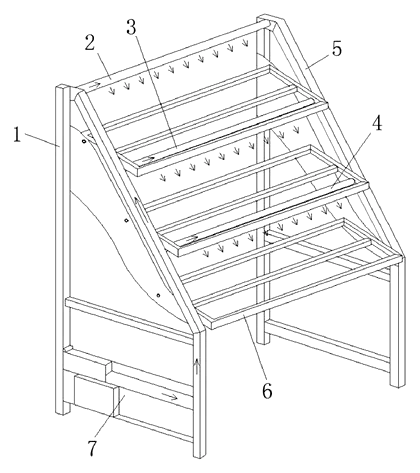
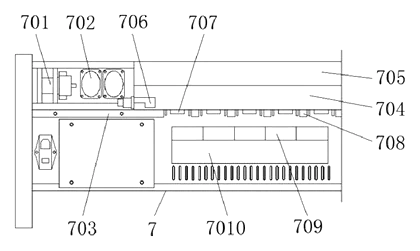
Drawings reproduced from the public patent document for reference.