
Patent CN214637502U
Updated November 4, 2026Rotary Self-Locking Push Spray Cap with Integrated Nozzle and Safety Lock
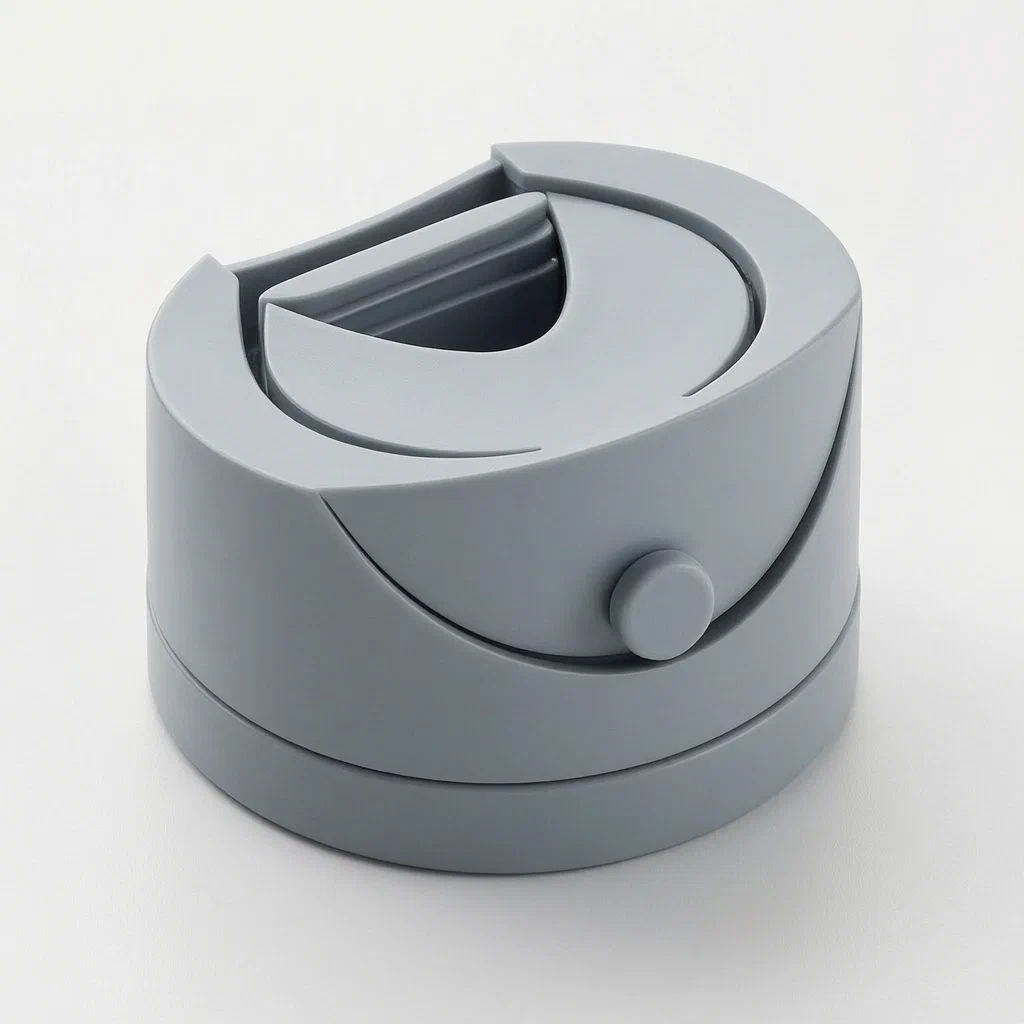
Standard trigger sprays often leak if pressed accidentally in a bag or box. This cap uses a rotating collar to mechanically block the press button until the user intentionally unlocks it. When rotated to the open position, the button aligns with the nozzle and can be pressed down to spray. When rotated to the closed position, a physical barrier stops the button from moving, preventing leaks and protecting children from accidental exposure to cleaning agents.
- China utility model - in force
- No filings outside China
- Household & industrial spray packaging
- Plastic injection molded components
Splat! What let you down?
🔒
Mechanical Lock
Rotating the cap engages a limiting plate that physically blocks the press button.
👆
Push-to-Spray
Simple vertical press action activates the flexible nozzle once unlocked.
🔄
Tactile Feedback
Flexible tongues and grooves provide a click and resistance when locking/unlocking.
💧
Leak Prevention
Closed position seals the nozzle area, reducing evaporation and accidental discharge.
Bring this product to market
- ✓ Patent vetted China-only family and legal status checked
- 2 Product brief · now How it works, uses and options written up
- 3 Prototype First samples for buyers to review
- 4 Pilot run Small first batch for launch customers
- 5 Volume production Repeat orders at scale
Buyer interest
– of 100 buyers needed to start prototyping
One click, no sign-up. Each vote is one real visitor, and products with the most interest go to prototyping first.
Build team: no members yet. Need a partner, co-funding or skills to build this? Join and we introduce the team once it forms.
The problem
Many consumer and industrial products packaged in spray bottles suffer from accidental activation. If a standard push-down spray cap is stored in a crowded box or carried in a bag, external pressure can depress the actuator, causing liquid to leak out. This leads to product loss, contamination of packaging materials, and potential safety hazards if the contents are harsh chemicals or allergens. Existing solutions often rely on separate child-resistant closures that are difficult to operate with one hand, or they lack a positive mechanical stop that ensures the button cannot move when the device is intended to be off. Users need a cap that is secure during transport but intuitive and easy to unlock for daily use.
The solution
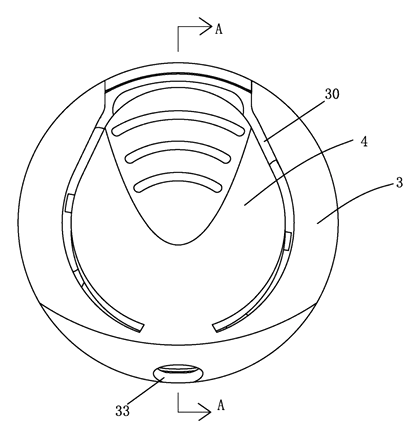
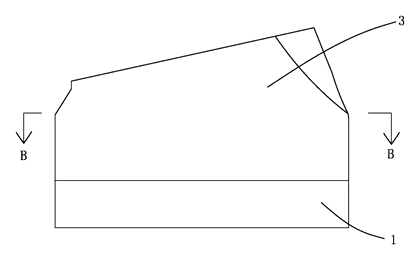
The patent describes a rotary self-locking push spray cap that integrates the locking mechanism directly into the actuator housing. The core solution involves three main interacting parts: a fixed base (1) attached to the bottle, a pressing nozzle (2) mounted on the base, and a rotating cap (3) that covers the nozzle.
- Dual-Position Rotation: The rotating cap (3) can turn relative to the fixed base (1) between two distinct positions: a latched position (locked) and an unblock position (open).
- Press Button Interlock: A press button (4) is located on the top of the rotating cap. This button is designed to press down on the nozzle (2) to initiate spraying. However, its movement is restricted by a pressure limiting mechanism.
- Limiting Plate and Tongue: The limiting mechanism consists of a limiting plate (11) on the fixed base and a limiting tongue (41) extending from the bottom of the press button. When the cap is rotated to the latched position, the limiting plate (11) abuts against the limiting tongue (41), physically preventing the button from being pressed down. When rotated to the unblock position, this obstruction is removed, allowing the button to descend and actuate the nozzle.
- Rotation Control: To ensure the cap stays in the correct position, a stop gear is included. This comprises a sliding groove (13) on the fixed base and a sliding hook (31) on the inner wall of the rotating cap. As the cap turns, the hook slides within the groove until it hits the end, defining the locked and unlocked states.
Who it is for
- Household Cleaner Brands: Manufacturers of glass cleaners, disinfectants, and kitchen degreasers who need to minimize shipping damage and return rates due to leaked bottles.
- Industrial Chemical Suppliers: Companies selling solvents, lubricants, or adhesives in small volumes where accidental release could damage labels or other goods in transit.
- Personal Care Formulators: Producers of hair tonics, facial mists, or sanitizers who want a premium feel with a secure lock that doesn’t look like a bulky child-proof cap.
- Private Label Retailers: Amazon sellers and big-box retailers looking for differentiated packaging that solves the common complaint of “sprayers leaking in the box.”
How it works
The main parts
The assembly relies on precise plastic molding to create the interlocking geometries. The primary components identified in the patent drawings and claims include:
| No. | Part | Function |
|---|---|---|
| 1 | Fixed Base | Mounts to the bottle neck; houses the nozzle and limiting plates. |
| 2 | Pressing Nozzle | Flexible plate with an outlet; creates suction/pressure when pushed. |
| 3 | Rotating Cap | Outer shell that turns to lock/unlock; contains the button. |
| 4 | Press Button | Top actuator; pushes down on nozzle 2 when unlocked. |
| 11 | Limiting Plate | Static barrier on base 1 that blocks button 4 in locked mode. |
| 13 | Sliding Groove | Track on base 1 that guides the rotation of cap 3. |
| 31 | Sliding Hook | Feature on cap 3 that rides in groove 13 and acts as a latch. |
| 32 | Flexible Plectrum | Elastic tab on cap 3 that clicks over bumps on base 1 for feedback. |
Operating Steps
- Unlocking: The user grasps the rotating cap (3) and turns it counterclockwise (or clockwise, depending on thread direction) relative to the fixed base (1). The sliding hook (31) moves along the sliding groove (13). As the hook passes a raised bump (screen protrusion 14), the flexible plectrum (32) snaps past it, creating a tactile “click” and audible sound indicating the cap has reached the unblock position.
- Spraying: With the cap in the unblock position, the limiting plate (11) is no longer aligned with the limiting tongue (41) of the press button (4). The user presses the button down. The button contacts the flexible plate (21) of the nozzle (2), forcing liquid through the connection pipe (23) and out the nozzle hole (22).
- Locking: After use, the user rotates the cap back to the latched position. The sliding hook (31) returns to the start of the groove. The limiting plate (11) rotates under the limiting tongue (41). Now, any downward force on the button is stopped by the plate, preventing accidental activation. Additionally, a hole blocking plate (15) may cover the spray opening to seal the unit against dust and evaporation.
Applications
Glass and Surface Cleaners
Window cleaners and bathroom sprays are often shipped in mixed cartons. The self-locking cap ensures that if a carton is crushed or stacked heavily, the buttons do not depress, keeping the liquid inside the bottle and preventing label damage from mist.
Disinfectant and Sanitizer Mists
For high-alcohol content sanitizers, evaporation is a risk. The locking mechanism keeps the nozzle sealed when not in active use. It also prevents accidental spraying in bags, which can cause skin irritation or eye contact for users who forget to close the cap properly.
Industrial Lubricants and Solvents
Small cans of penetrating oil or brake cleaner used in workshops need to be safe on shelves. The rotary lock provides a clear visual and physical indication of whether the tool is ready to fire, reducing accidents in busy environments where workers might grab the wrong bottle.
Pet Care Products
Flea sprays or pet shampoos often contain ingredients that should not be exposed unnecessarily. The robust lock prevents pets or curious children from activating the spray mechanism simply by pawing or pushing at the top of the bottle.
Where it is less suitable
- High-Viscosity Liquids: The push-nozzle design described relies on a flexible plate mechanism typical for thin fluids; thick creams or gels may require a pump piston rather than this specific nozzle geometry.
- Extreme Temperature Cycles: While plastic is durable, very hot fill applications might warp the delicate sliding groove and limiting plate interfaces, potentially compromising the lock’s precision.
- Continuous Flow Needs: This is an intermittent spray device. It is not suitable for applications requiring a steady stream without repeated finger pumping.
Frequently asked questions
How does the self-locking mechanism work?
The cap rotates around the base. Inside, there is a physical barrier—a limiting plate—that sits under the press button. When you rotate the cap to the “locked” position, this barrier slides under the button, stopping it from being pushed down. When you rotate it to the “open” position, the barrier moves away, allowing the button to depress and spray.
Is this cap child-resistant?
Not automatically. While it requires a deliberate rotation to unlock, it is not certified as Child-Resistant Packaging (CRP) under US CPSC standards unless specifically engineered and tested for those forces. If your product requires CRP certification, we can modify the design to meet 16 CFR 1700 requirements.
What materials are used?
Typically, Polypropylene (PP) or Polyethylene (PE) is used for the cap and base due to their chemical resistance and durability. The nozzle may use softer elastomers or specialized plastics depending on the fluid viscosity. Materials are selected based on the liquid being packaged.
Can I customize the spray pattern?
Yes. The nozzle insert can be changed to produce a fine mist, a straight stream, or a foam. This requires a different mold for the nozzle component but keeps the rest of the cap assembly identical.
Does it leak if dropped?
The design aims to prevent accidental activation. However, drop testing is part of our prototyping process. The sealing depends on the tightness of the nozzle valve and the integrity of the connection to the bottle. Proper assembly and compatible bottle threads are essential for leak prevention.
How do I know if it’s locked or unlocked?
The patent describes a tactile and auditory feedback system. When you rotate the cap, a flexible tab clicks over a bump. You can feel and hear this “click,” which signals that the cap has moved from the locked to the unlocked state (or vice versa).
Can this design be made and sold in the US?
The patent CN214637502U is filed only in China and is currently in force there. It does not have a US counterpart, so it does not legally restrict sales in the US. However, because spray closures are heavily patented globally, we strongly recommend a freedom-to-operate (FTO) search to ensure your specific version doesn’t infringe on other active US patents.
Are you affiliated with the patent owner?
No. IP2M is an independent design and manufacturing service working from the public patent document.
Request a quote
Click Request a Quote below to see our email address - copy it, or open your email app with a ready-made message. Please mention patent CN214637502U in the subject.
Helpful details to include:
- Your company and channel (cleaner brand, personal care, industrial supplier)
- Bottle neck finish (e.g., 28/400, 24/410) and capacity
- Liquid type (water-based, alcohol, oil, bleach) for material selection
- Desired spray pattern (mist, stream, foam)
- Color and decoration preferences
- Estimated quantity and target price
- Timeline - when you would like samples and the first shipment
You can also reach us at (332) 203-9997.
Explore this product
Interested in building this?
Tell us your target market, quantity and timeline. We reply with options for prototyping, small-batch runs or volume production.
Send your inquiry to
Please put CN214637502U in the subject line and tell us your company, country, estimated quantity and timeline.
Prefer to talk? Call (332) 203-9997.
More product-ready patents
All Packaging & Containers patents →
Packaging & Containers
Rigid Shell Container with Removable Silicone Liner
Cup or food box with a rigid outer shell and a removable, leak-tight silicone liner.
Patent CN212638395U
Packaging & Containers
Child-Resistant Paperboard Medicine Box with Three-Point Opening
Paperboard medicine box that opens only when press points on three sides are pushed together.
Patent CN107117365B
Packaging & Containers
Tape-Free Reusable Shipping Box with Zigzag Interlocking Flaps
Reusable carton closed without tape: zigzag flaps interlock, tabs tuck in, a U-clip locks the lid.
Patent CN207242262U
Packaging & Containers
Hinge Device for Folding Containers with Integrated Twistlock Hole
Folding container hinge with a built-in twistlock hole and observation port.
Patent CN113460518B
Packaging & Containers
Cylindrical Plastic Bottle Cap with Built-In Soup Ladle
Plastic bottle cap storing a soup ladle inside, with a flip-top lid and inner sealing closure.
Patent CN106144192B
Packaging & Containers
Insulated Food Packaging Box with Detachable Liner and Self-Heating Cavity
Detachable insulated food box with a sealed cavity for a self-heating sheet and a temperature sticker.
Patent CN108372980B
Browse by category
- Apparel & Accessories (36)
- Baby & Kids (25)
- Bags & Luggage (15)
- Bath & Personal Care (25)
- Car Accessories (21)
- Furniture, Bedding & Storage (19)
- Garden & Outdoor (27)
- Health & Wellness (12)
- Home, Kitchen & Cleaning (40)
- Lighting (20)
- Packaging & Containers (10)
- Pet Products (9)
- Phone & Camera Accessories (7)
- Retail Display (21)
- School, Office & Art (30)
- Sports & Recreation (37)
- Tools & Workshop (46)
- Toys & Games (19)
This page is based on the public patent document CN214637502U, assigned to Zhongshan Huiyu Packaging Technology Co ltd. IP2M is an independent manufacturing service and is not affiliated with, endorsed by or licensed by the patent owner. Images marked as concept renderings are illustrations, not photos of an existing product. Patent status information is provided for reference only and is not legal advice; confirm freedom to operate for your market before production. Full disclaimer.