
Patent CN215189805U
Updated November 5, 2026Mica-Based Heating Assembly for Hair Dryers with Integrated Anion Generation
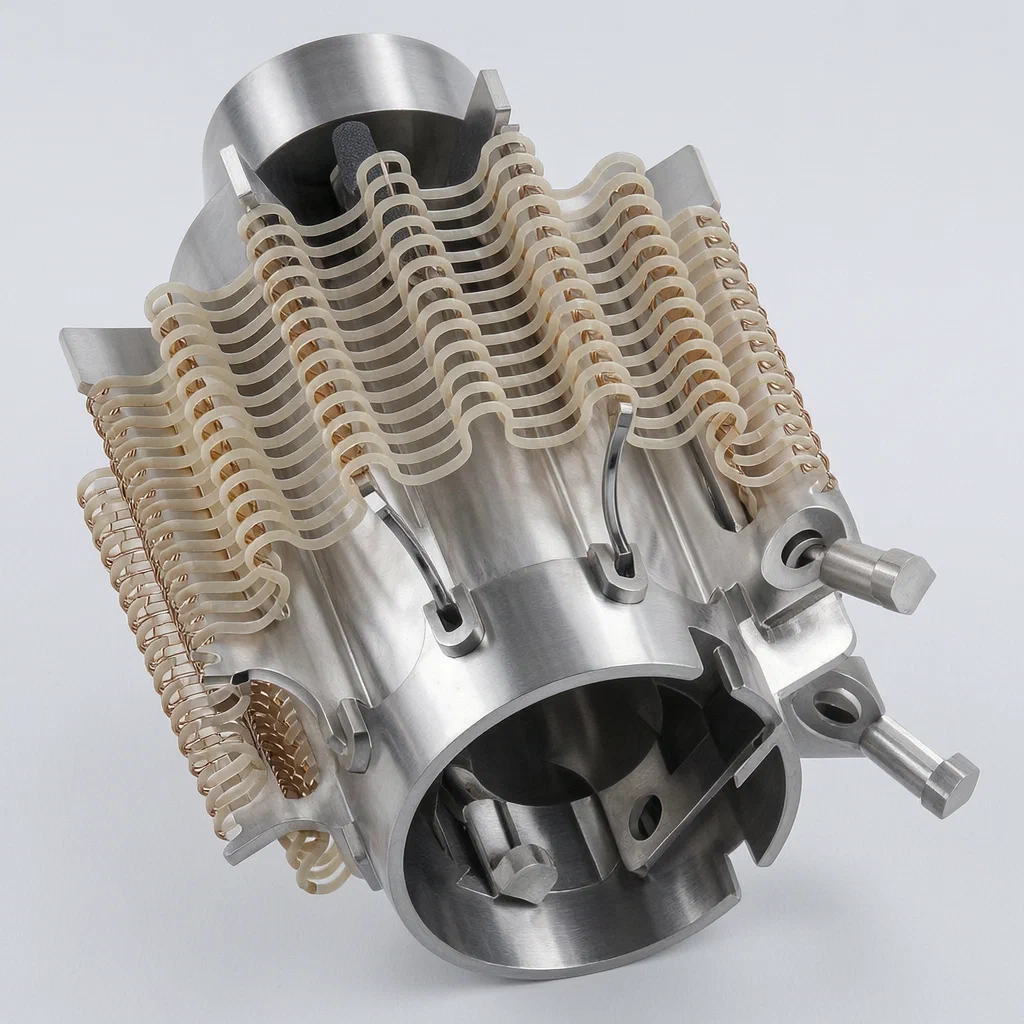
Traditional ceramic heaters are heavy and brittle; metal housings conduct too much heat to the casing. This patent describes a heating assembly built from mica—a hard, tubular insulating material. The core structure uses two concentric mica cylinders to create a smooth airflow channel. The heating wire wraps around mica support sheets that snap into slots on a central bracket. Crucially, the design integrates safety sensors (thermostat and fuse) directly into the inner cylinder walls so they read the actual air temperature, not just the heater surface. It also embeds an anion generator with a carbon brush tip at the exit, turning the heater housing into a multi-functional module without extra external parts.
- China utility model - lapsed
- No filings outside China
- Personal care appliances
- Mica insulation, integrated anion generator
Splat! What let you down?
🔥
Mica Construction
Uses high-strength mica cylinders instead of ceramic or metal for better insulation and durability.
🧲
Slot-In Wire Support
Heating wire wraps around support sheets that insert into circumferential slots on the mounting bracket.
🌬️
Direct Air Sensing
Thermostat and fuse access the airflow through side holes, monitoring true outlet temperature.
⚡
Integrated Anions
Anion generator with carbon brush tip is housed within the structure, emitting ions at the air outlet.
Bring this product to market
- ✓ Patent review Patent family and legal status reviewed in the relevant jurisdictions.
- 2 Product brief · now How it works, uses and options written up
- 3 Prototype First samples for buyers to review
- 4 Pilot run Small first batch for launch customers
- 5 Volume production Repeat orders at scale
Buyer interest
– of 100 buyers needed to start prototyping
One click, no sign-up. Each vote is one real visitor, and products with the most interest go to prototyping first.
Build team: no members yet. Need a partner, co-funding or skills to build this? Join and we introduce the team once it forms.
Patent Rights & Team Participation
Before joining a development team, participants should ensure they have the necessary rights or authorization to participate in the project.
Participation is generally appropriate where:
- You own the relevant patent rights or have obtained permission or a license from the rights holder.
- The relevant patent rights have expired or have been legally invalidated in the jurisdictions where the planned activities will take place.
- The planned development, manufacturing, and commercialization activities have been independently assessed and do not infringe applicable patent rights in the relevant jurisdictions.
Important: Being located outside a country where a patent is protected does not automatically exempt you from patent infringement risks. Patent rights may apply based on where development, manufacturing, use, sale, or import activities take place.
IP2M does not grant any patent license or authorization through team participation. Joining a project does not provide permission to use, manufacture, or commercialize patented technology.
The problem
Standard hair dryer heating elements often rely on fragile ceramic tubes or metal housings that require separate insulation layers. Ceramic can crack under thermal shock, while metal conducts heat to the outer casing, risking user burns if the casing isn’t thick enough. Furthermore, safety thermostats are often placed away from the direct airflow path, leading to delayed response times when temperatures spike. Adding negative ion functionality usually requires bolting a separate generator onto the existing frame, increasing assembly complexity and size. There is a need for a compact, robust heating module that combines structural insulation, accurate temperature sensing, and optional ion generation into a single cohesive unit.
The solution
The patent describes a heat generating component composed of concentric mica cylinders.
- A first mounting cylinder forms the inner core.
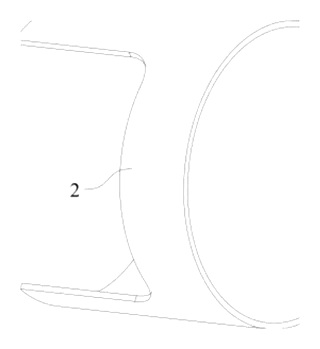
- A second mounting cylinder sleeves over the first, creating a defined ventilation channel between them for air to flow.
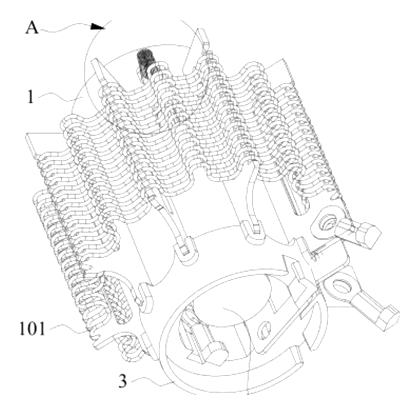
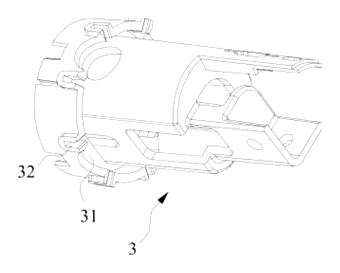
- A mounting bracket inserts into the first cylinder. Its outer wall has an annular groove with multiple slots.
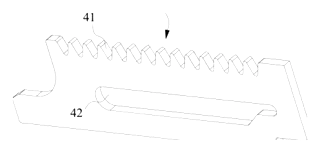
- Support sheets, made of mica, slide into these slots. The heating wire winds around the outer sides of these sheets.
- Safety devices (temperature controller and fuse) are placed inside the first cylinder, accessing the air channel through through-holes in the cylinder wall.
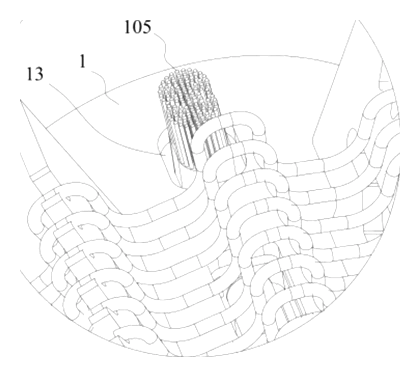
- An anion generator is mounted on the bracket, with its carbon brush head positioned in a third through-hole at the outlet end to emit ions into the passing air.
Who it is for
- Personal care appliance brands looking to differentiate their hair dryers with integrated ion technology and improved thermal safety.
- OEM/ODM manufacturers seeking a modular heating assembly that simplifies wiring and sensor placement compared to traditional loose-component designs.
- Product designers aiming to reduce the overall weight and volume of the heating section by replacing bulky ceramic/metal hybrids with thin-wall mica structures.
- Safety compliance officers who value redundant temperature protection (fuse + thermostat) with direct air-path monitoring for faster cutoff response.
How it works
The main parts
| No. | Part | What it does |
|---|---|---|
| 1 | First Mounting Cylinder | Inner mica tube; houses sensors and bracket. |
| 2 | Second Mounting Cylinder | Outer mica sleeve; forms the air channel with Part 1. |
| 3 | Mounting Bracket | Central support; holds sensors and anion generator. |
| 4 | Support Sheets | Mica plates inserted into bracket slots; hold the wire. |
| 101 | Heating Wire | Wound around the support sheets. |
| 102 | Temperature Controller | Monitors air temp via first through-hole. |
| 104 | Fuse | Cuts power if temp exceeds limit; monitors via second through-hole. |
| 106 | Anion Generator | Produces negative ions. |
| 105 | Carbon Brush Head | Outputs ions into the airflow. |
Operating steps
- Assembly: The mounting bracket slides into the first cylinder. Support sheets are snapped into the bracket’s slots. The heating wire is wrapped around the sheets.
- Enclosure: The second cylinder is sleeved over the first, locking the structure together and defining the smooth internal air path.
- Power On: Current flows through the heating wire, warming the mica support sheets.
- Airflow: Blower pushes air through the channel between the cylinders. Heat transfers from the wire/sheets to the air.
- Sensing: Air passes through the small holes in the inner cylinder, hitting the thermostat and fuse directly. If temperature rises too fast, the thermostat cuts power; if it fails, the fuse melts.
- Ion Emission: As air exits, it passes the carbon brush head connected to the anion generator, picking up negative ions before reaching the nozzle.
Applications
High-end consumer hair dryers
Brands selling premium models can use this module to advertise “ionic care” and “smart thermal control” without adding external attachments, keeping the handle slim.
Professional salon tools
Stylists require durable equipment that doesn’t crack easily. Mica’s high mechanical strength and resistance to thermal shock make this assembly suitable for daily heavy use in salons.
Travel-size foldable dryers
The compact, self-contained nature of the mica cylinders allows for smaller heating sections, which helps in designing lightweight, packable travel dryers.
Sensitive scalp products
The precise temperature regulation via direct air sensing ensures the output stays within safe limits, appealing to users with sensitive skin who fear hot spots.
Where it is less suitable
- Industrial drying applications: This design is optimized for low-pressure airflow typical of hair dryers, not high-volume industrial ducts.
- Extreme heat environments: While mica is heat resistant, standard consumer electronics ratings apply; this is not for furnaces or kilns.
- Cost-sensitive entry-level units: Mica machining and the integration of sensors/generators may be more expensive than basic nickel-chrome wire on plastic frames.
Patent & Production
At a glance
| Patent number | CN215189805U (application CN202120517814) |
| Type | China utility model (实用新型) - protects product shape and structure |
| Original title | Heat Generating Component and Hair Dryer (一种发热组件及吹风机) |
| Patent owner | Wuxi Roidmi Information Technology Co Ltd |
| Inventors | Xu Jianjun, Wang Tianzhi |
| Filing date | 2021-03-11 |
| Grant date | 2021-12-17 |
| Status (China) | Lapsed - terminated for non-payment of annual fees (recorded 2026-03-13) |
| Patent family | Public record shows Chinese filings only - no US, European, Japanese, PCT or other filings listed |
| Cited by | 4 later documents |
| Source | Google Patents (search for CN215189805U) |
What the claims cover, in plain language
Claim 1 defines a heat generating component with a first mounting cylinder and a second mounting cylinder sleeved over it, creating a ventilation channel. A mounting bracket inserts into the first cylinder, featuring an annular mounting groove with slots. Support sheets insert into these slots, and the heating wire winds around them.
Claims 2-4 detail the slots arranged circumferentially on the bracket, grooves on the support sheets to seat the wire, and through-holes in the sheets.
Claims 5-7 add a temperature controller and fuse inside the first cylinder, communicating with the air channel via through-holes in the cylinder wall to detect air temperature directly. Claim 7 specifies these holes are aligned on the same radial tangent plane.
Claim 8 includes an anion generator and carbon brush head mounted on the bracket, exiting through a third through-hole at the outlet.
Claim 9 states the cylinders and support sheets are made of mica.
Claim 10 covers a hair dryer comprising this component.
This is a simplified reading for orientation only. The legal scope is defined by the exact claim wording in the official Chinese document.
What this means for US production
This patent was filed in China and has lapsed due to non-payment of fees, so it no longer restricts anyone in China. The public record shows no US or other foreign counterpart.
Two points to settle early:
- Other patents may exist. Hair dryer heating assemblies are a crowded field. Foreign entities like LG Electronics and Shenzhen Ruyuan have cited this patent in their own filings (e.g., WO2025123185A1, EP4505900A4), indicating active innovation in this specific area. A freedom-to-operate (FTO) review is essential to ensure your design does not infringe on any live US patents regarding mica construction, anion integration, or sensor placement.
- Component sourcing. The mica cylinders and specialized brackets require precision tooling; verify supplier capabilities for consistent wall thickness and slot tolerances.
Customization and manufacturing
What can be customized
| Area | Options |
|---|---|
| Wire Material | Nickel-chromium, Kanthal, or ceramic-coated variants |
| Sensor Placement | Adjust hole positions for different airflow profiles |
| Anion Module | Optional inclusion or exclusion based on SKU tier |
| Dimensions | Cylinder diameter and length to fit various dryer bodies |
| Bracket Design | Slot count and spacing for wire density |
Things to plan for (US market)
- UL 859 / IEC 60335-2-23: Safety standards for household electric hair dryers, covering electrical insulation, fire hazard, and thermal protection.
- FCC Part 15: Electromagnetic compatibility requirements for the anion generator and electronic controls.
- California Prop 65: Warning labels required if certain chemicals (potentially in plastics or coatings) exceed safe harbor levels.
- RoHS Compliance: Restriction of hazardous substances in solder, wires, and electronics.
How a project runs
- Inquiry - Define target wattage, airflow rate, and feature set (anions yes/no).
- Design - Finalize mica cylinder specs, bracket geometry, and sensor locations.
- Prototype - Build sample modules using off-the-shelf mica tubes and 3D printed brackets.
- Testing - Validate thermal response, fuse blow time, and ion output consistency.
- Production - Mold/inject bracket, machine mica, assemble wire, integrate electronics.
Quantities & timeline
Mica machining requires careful handling to prevent breakage during cutting and drilling. Injection molding for the bracket needs steel tooling. Electronic components (sensors, generators) have long lead times. Certification testing typically takes 8-12 weeks. Send us your wattage, dimensions, feature list, quantity and target price and we will reply with options.
Production notes
Tooling and process
Injection molding is likely used for the mounting bracket, requiring precision molds to ensure the slots align correctly with the mica sheets. Stainless steel forming might be needed for internal contacts or fuse holders. Electroplating could be applied to specific metal parts for corrosion resistance, though mica itself is inert.
Cost drivers
Material grade is typically a significant factor, as mica sheets of consistent grade must withstand repeated thermal cycling without delaminating. Seal and gasket quality around the sensor holes impacts both cost and reliability. Packaging must protect the brittle mica cylinders during shipping, adding to logistics costs.
Prototyping path
Initial prototypes can use 3D-printed housings for the bracket to test fitment quickly. Off-the-shelf mica tubes should be cut to size. A water spray test sample is not relevant here, but thermal cycle testing is critical. Plating trials on coupons may be needed if metal accents are included.
What we would change before tooling
We would likely adjust the wall thickness and joint design of the mica cylinders to improve durability against vibration. Ensuring the heat path and thermal clearance around the sensors is optimal to prevent false triggers. We might simplify the slot geometry to ease assembly.
Common failure points
Water ingress at seams is unlikely, but dust accumulation in the ventilation channel can cause overheating. Plating flaking or corrosion on metal contacts could affect conductivity. Hinge fatigue is not applicable, but thermal stress cracking in the mica is a primary risk. Mold and mildew in trapped moisture is a concern if the dryer is stored wet.
Patent drawings
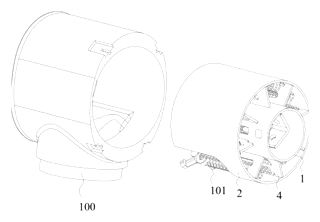
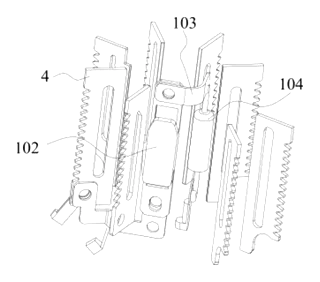
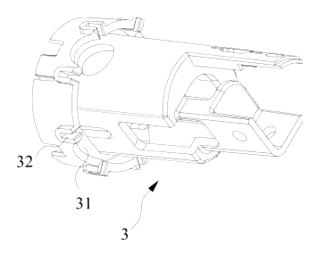
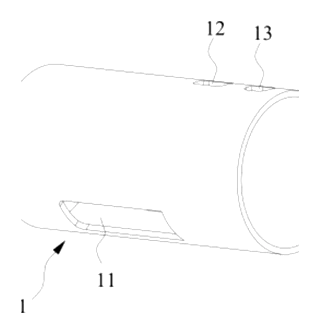
Drawings reproduced from the public patent document for reference.
Frequently asked questions
Why use mica instead of ceramic?
The patent specifies mica for the cylinders and support sheets because it offers good electrical insulation, high mechanical strength, and resistance to thermal shock. It is lighter and less prone to shattering than traditional ceramic tubes, while still withstanding high temperatures.
How does the safety system work?
It uses a dual-layer protection system. A temperature controller and a fuse are placed inside the inner cylinder. Small holes allow the flowing air to reach these sensors directly. If the air gets too hot, the thermostat cuts power. If the thermostat fails, the fuse melts to stop the current completely.
Is the anion generator standard?
No, it is an optional feature described in Claim 8. The design allows for an anion generator and carbon brush head to be mounted within the same bracket structure, emitting ions into the airflow at the outlet. You can choose to include or exclude this module depending on your product positioning.
Can the heating wire be replaced easily?
The wire winds around support sheets that slot into the bracket. This modular design suggests easier maintenance or replacement compared to fixed ceramic coils, though the patent focuses on the structure rather than serviceability instructions.
What are the temperature limits?
The patent does not specify exact operating temperatures or voltage ratings. These parameters must be determined during the design phase based on your motor and power supply specifications, then confirmed through UL/IEC testing.
Does this design help with noise?
The smooth ventilation channel formed by the two concentric cylinders may reduce turbulence compared to irregular frames, potentially lowering airflow noise. However, the patent does not provide acoustic data or decibel ratings.
Can this design be made and sold in the US?
The patent was filed in China and has lapsed due to non-payment of fees, and the public record shows no US counterpart, so it does not restrict the design in the US. However, hair dryer technology is heavily patented globally. Other companies (like LG) have cited this patent, suggesting related technologies may be protected elsewhere. We recommend a freedom-to-operate check before volume production.
Are you affiliated with the patent owner?
No. IP2M is an independent design and manufacturing service working from the public patent document.
Request a quote
Click Request a Quote below to see our email address - copy it, or open your email app with a ready-made message. Please mention patent CN215189805U in the subject.
Helpful details to include:
- Your company and channel (appliance brand, OEM manufacturer, private label seller)
- Target wattage and voltage
- Dimensions required for the dryer body
- Features (anion generator yes/no, specific sensor types)
- Estimated quantity and target price
- Timeline - when you would like samples and the first shipment
You can also reach us at (332) 203-9997.
Page editor: Daniel Chen, Product Research Editor · IP2M
Last updated November 5, 2026. If something on this page looks wrong, email [email protected] and we will check it against the patent.
Interested in building this?
Tell us your target market, quantity and timeline. We reply with options for prototyping, small-batch runs or volume production.
Send your inquiry to
Please put CN215189805U in the subject line and tell us your company, country, estimated quantity and timeline.
Prefer to talk? Call (332) 203-9997.
More product-ready patents
All Bath & Personal Care patents →
Bath & Personal Care
Foot-Pedal Soap & Sanitizer Dispenser Stand
Hands-free, battery-free dispenser stand - step on a pedal to press the pump of any soap or sanitizer bottle.
Patent CN207461995U
Bath & Personal Care
Ear-Shaped Mask Strap Guard with Tension Adjuster
Ear-shaped silicone guard and strap-length adjuster that make ear-loop masks comfortable to wear for long hours.
Patent CN205456233U
Bath & Personal Care
Adjustable-Length Back Scrubber Strap with Push-Button Handles
Back-scrubber strap with push-button handles that set its length and a spring that keeps it taut.
Patent CN207041452U
Bath & Personal Care
Angled-Plate Hair Straightener
Flat iron with plates twisted 45-75° to the handle, a curling groove and rubber-capped tips.
Patent CN206137462U
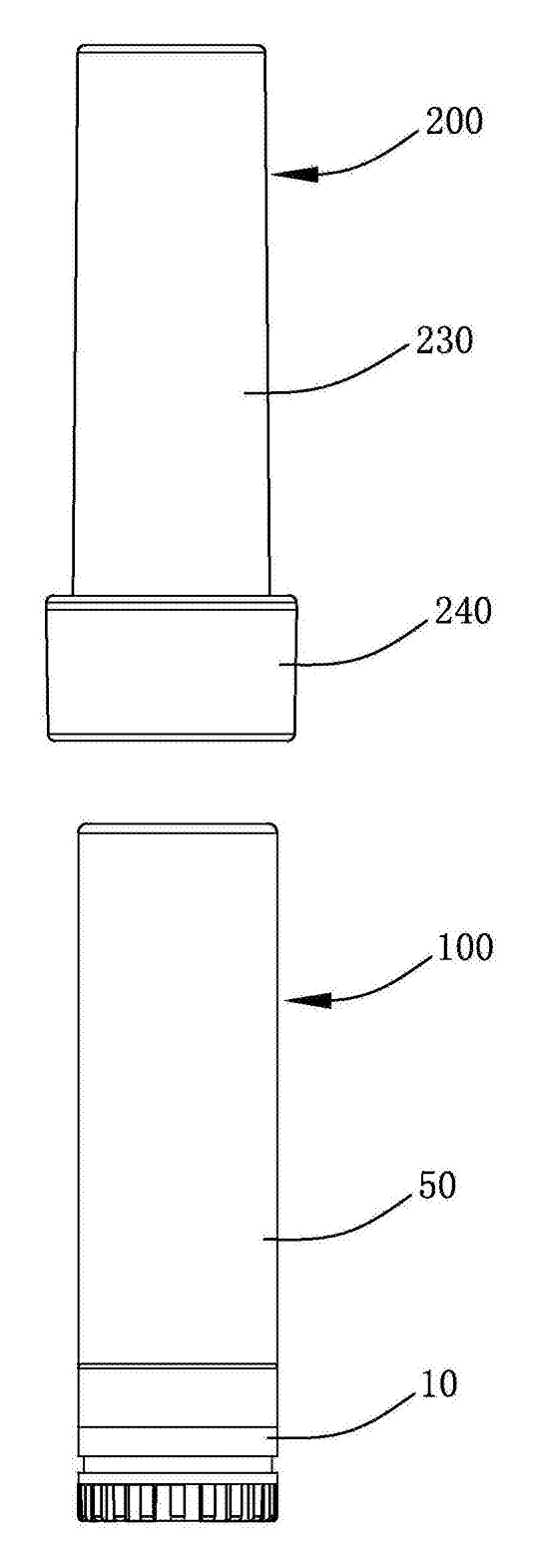
Bath & Personal Care
Refillable Lipstick Case with Sealed Snap-In Refill Pods
Reusable twist-up lipstick case; sealed refill pods unlock at the top of the stroke for shade swaps.
Patent CN206909979U
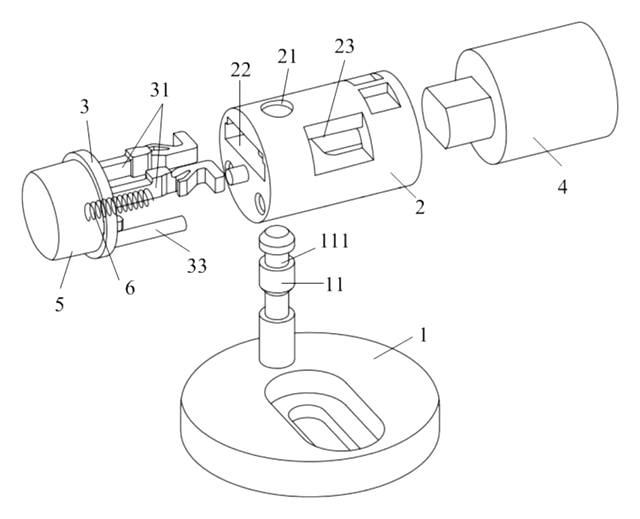
Bath & Personal Care
Quick-Release Toilet Seat Hinge with a Push-Button Two-Strip Latch
Toilet seat hinge: drop the shaft onto a grooved post to lock; one push parks the latch open to lift it off.
Patent CN210370292U
Browse by category
- Apparel & Accessories (41)
- Baby & Kids (26)
- Bags & Luggage (15)
- Bath & Personal Care (27)
- Car Accessories (22)
- Furniture, Bedding & Storage (21)
- Garden & Outdoor (29)
- Health & Wellness (12)
- Home, Kitchen & Cleaning (44)
- Lighting (21)
- Packaging & Containers (11)
- Pet Products (10)
- Phone & Camera Accessories (8)
- Retail Display (22)
- School, Office & Art (31)
- Sports & Recreation (40)
- Tools & Workshop (49)
- Toys & Games (20)
This page is based on the public patent document CN215189805U, assigned to Wuxi Roidmi Information Technology Co Ltd. IP2M is an independent manufacturing service and is not affiliated with, endorsed by or licensed by the patent owner. Images marked as concept renderings are illustrations, not photos of an existing product. Patent status information is provided for reference only and is not legal advice; confirm freedom to operate for your market before production. Full disclaimer.