At a glance
| Patent number | CN215245266U (application CN202121516879) |
| Type | China utility model (实用新型) - protects product shape and structure |
| Original title | A Drinking Cup Holder (一种水杯架) |
| Patent owner | Individual |
| Inventors | Huang Zegang |
| Filing date | 2021-07-05 |
| Grant date | 2021-12-21 |
| Status (China) | In force - valid until at most 2031-07-05, provided annual fees are paid |
| Patent family | Chinese filings only - no US, European, Japanese, PCT or other filings listed |
| Cited by | 3 later documents |
| Source | Google Patents (search for CN215245266U) |
What the claims cover, in plain language
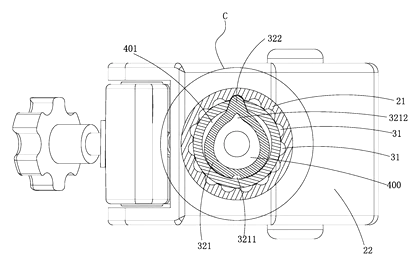
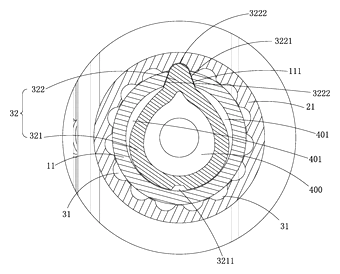
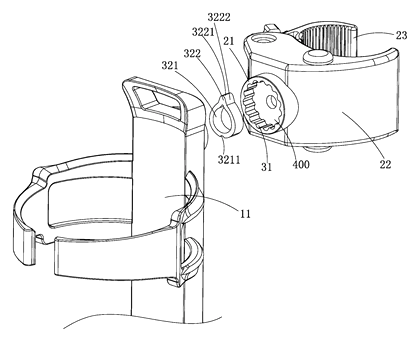
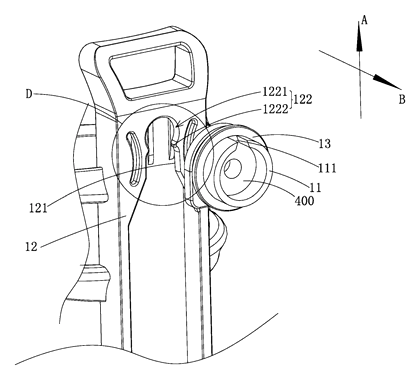
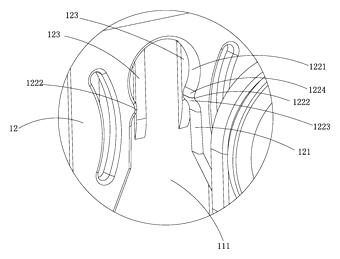
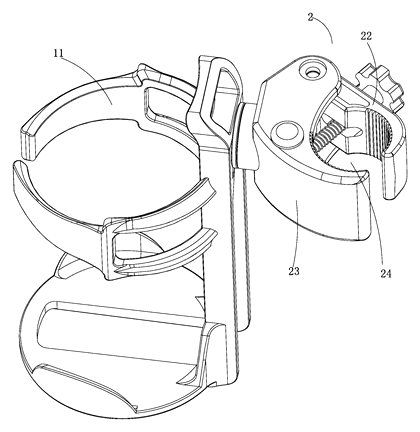
Claim 1 defines a cup holder with a holder component and a clamping component rotatably connected. A positioning device fixes them together. This device has circumferential positioning grooves on the clamp and an elastic clamping piece on the holder. The piece engages the grooves to lock positions. Relative rotation causes the piece to deform and separate from the groove.
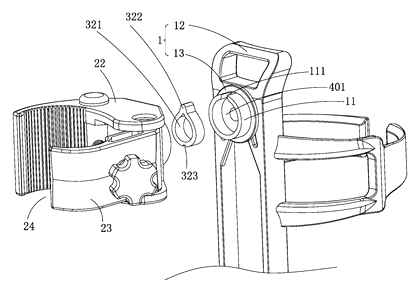
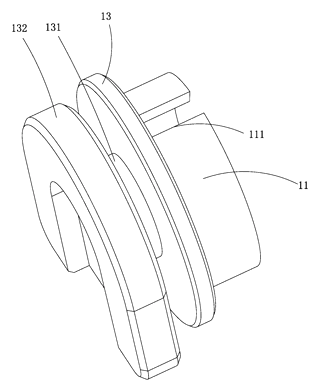
Claim 2 adds a holding tank (clearance space) between the components so the elastic piece can deform when squeezed. Claim 3 specifies a protruding ring on the holder forms the tank wall, with an opening for the clamping part to move through. Claims 4-6 describe the annular body of the elastic piece, optional outer/inner grooves for deformation, and integral formation of the body and clamping part with arc-shaped ends and inclined sliding faces. Claim 7 details the snap-fit connection: the holder body connects to a connecting block, which inserts into an annular protrusion on the clamp. Claims 8-10 define the sliding slot and clamping position on the body that secures the block. Protrusions with arc-shaped surfaces allow the block to snap in and out. An anti-slip strip increases friction.
This is a simplified reading for orientation only. The legal scope is defined by the exact claim wording in the official Chinese document.
What this means for US production
This patent was filed only in China and is currently in force. Making or selling this specific configuration in China requires the owner’s permission. It has no US or other foreign counterpart.
Two points to settle early:
- Other patents may exist. Cup holders and stroller/bike accessories are a crowded field. While we did not find direct citations from major global brands in the public database for this specific Chinese filing, similar rotary and snap-fit mechanisms are often patented by competitors like Thule, Yakima, or large toy/stroller manufacturers. A freedom-to-operate (FTO) review is strongly recommended before launching in the US market to ensure no existing US patents cover the specific geometry of the elastic clip or the snap-fit interface.
- Material Safety. Since these holders often carry liquids for children or active users, material choice is critical. Ensure plastics meet impact resistance standards for the intended application.
Customization and manufacturing
What can be customized
| Area | Options |
|---|---|
| Color | Black, white, gray, or custom Pantone matches for branding. |
| Mounting Diameter | Adjust the internal diameter of the clamping arm (2) to fit standard stroller bars (e.g., 22mm, 25mm) or bike handlebars. |
| Cup Size | Modify the inner diameter of the support body (12) to hold standard disposable cups vs. reusable thermos bottles. |
| Indexing Steps | Change the number and spacing of positioning grooves (31) to offer more or fewer angle options. |
| Finish | Matte texture to reduce glare or glossy finish for aesthetics. |
Things to plan for (US market)
- ASTM F833: Standard Consumer Safety Specification for Strollers. If marketed for strollers, the holder must not introduce tip-over risks or sharp edges.
- CPSC Guidelines: General safety for consumer products. Materials should be free from excessive lead, phthalates, or other restricted substances.
- FDA Compliance: Not applicable unless the holder itself contacts food/beverages directly in a way that classifies it as a food contact article (usually the cup does, not the holder, but verify resin grades).
- Proposition 65 (California): Screening of plasticizers and flame retardants in polymer materials.
How a project runs
- Inquiry - Define target mounting diameters, cup sizes, and aesthetic preferences.
- Design - Finalize CAD models, focusing on the tolerance stack-up for the snap-fit and elastic clip deformation.
- Prototype - Create functional samples using 3D printing or soft tooling to test the “click” feel and retention force.
- Pilot Run - Injection mold trial, checking for sink marks, warping, and consistent clipping action.
- Production - Full-scale injection molding, assembly of moving parts, packaging.
Quantities & timeline
Injection molds are required for the holder body, clamping arm, and elastic clip. The complexity lies in the snap-fit tolerances. Tooling typically takes 6-8 weeks. Production volume depends on order size, but MOQs are usually driven by mold cavity count. Send us your target mounting specs, quantity, and color requirements and we will reply with options.
Production notes
Tooling and process
Likely requires precision injection molds for the three main plastic components. Glass-filled nylon is typically used for the elastic clip to maintain spring properties. Aluminum extrusion might be used if a metal core is added for weight or durability, though the patent suggests all-plastic. Assembly relies heavily on snap-fit integrity.
Cost drivers
Number of molds is typically the primary driver. Impact grade material costs vary based on resin selection. Fastener count is low (zero screws in the final assembly per claims), reducing labor. Weight affects shipping costs. Packaging needs to protect the delicate clip during transit.
Prototyping path
Typically, prototyping starts with 3D-printed parts to validate the geometry of the positioning grooves and snap-fit. Move to machined frames if metal alternatives are considered. Functional samples are essential to test the force required to rotate the clamp and the retention strength of the body connection. Impact test samples verify durability.
What we would change before tooling
We would likely adjust the wall thickness of the elastic clip to balance flexibility with longevity. Hinge boss and pivot wear areas should be reinforced. The opening shape for the clip movement might need slight enlargement to prevent binding in mass-produced units.
Common failure points
Cracking under impact is a risk for thin plastic sections. Spring fatigue could cause the positioning to become loose over time. UV degradation may embrittle the material if left outdoors. Bolts are not used, but snap-fit joints can fail if the protrusions are too sharp or the mating surfaces are misaligned.
Patent drawings
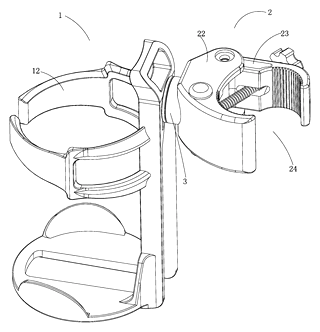
Drawings reproduced from the public patent document for reference.