
Patent CN215455856U
Updated October 26, 2026Belt Buckle with Tail Clip and Friction Lock for Holeless Belts
Traditional holeless belts often have the strap end sewn directly onto the buckle bar, making it impossible to trim the belt to fit or swap the strap later. Sewn folds also create uneven thickness that can feel bulky. This buckle design replaces the sewn joint with a tail clip. The belt end slides into an open slot in the clip, and locking bolts thread up from below to press the strap firmly against the slot wall. Because nothing is stitched, the user can cut the belt to their exact waist size or change straps entirely. On the other side of the clip, a dedicated friction bar with angled teeth grips the running portion of the belt. When pulled forward, the belt slides smoothly; if tension reverses, the teeth dig in to stop backward slipping. Separating the clamping function from the friction function keeps the profile flat and the grip reliable.
- China utility model - in force
- No filings outside China
- Apparel & accessories hardware
- Metal or alloy frame, bolts
Splat! What let you down?
🔩
Bolt-clamped tail clip
Locking bolts in threaded holes press the belt end against the slot wall, replacing sewn joints.
✂️
Adjustable length
Because the strap is not sewn, users can trim the belt to fit or swap it for another.
⚙️
Directional friction bar
Angled teeth on a fan-shaped bar let the belt slide forward but grip it against backward slipping.
📐
Flat, even profile
Separating the clamp and friction parts avoids the thick folded layers of sewn buckles.
Bring this product to market
- ✓ Patent vetted China-only family and legal status checked
- 2 Product brief · now How it works, uses and options written up
- 3 Prototype First samples for buyers to review
- 4 Pilot run Small first batch for launch customers
- 5 Volume production Repeat orders at scale
Buyer interest
– of 100 buyers needed to start prototyping
One click, no sign-up. Each vote is one real visitor, and products with the most interest go to prototyping first.
Build team: no members yet. Need a partner, co-funding or skills to build this? Join and we introduce the team once it forms.
The problem
Many holeless belts use a herringbone or figure-eight buckle where the strap end is folded and sewn directly onto the center bar. This permanent stitch creates two issues. First, the wearer cannot shorten the belt by cutting the strap, nor can they replace a worn strap without discarding the entire assembly. Second, folding and sewing the material doubles or triples its thickness at the attachment point, resulting in an uneven profile that presses against the body and affects comfort. Additionally, relying solely on the center bar for friction means the holding power depends entirely on how tightly the strap is wrapped around it, which can loosen over time as the material compresses.
The solution
This buckle separates the attachment point from the friction mechanism, solving both problems.
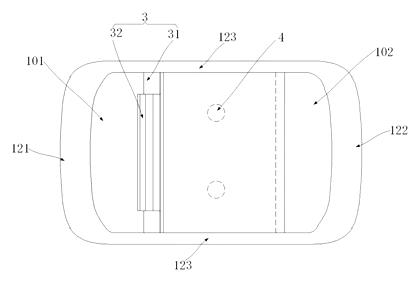
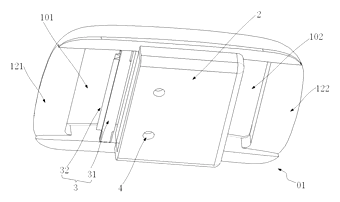
- An outer frame (12) provides the main structure, formed by a first limit edge (121), a second limit edge (122), and two support edges (123).
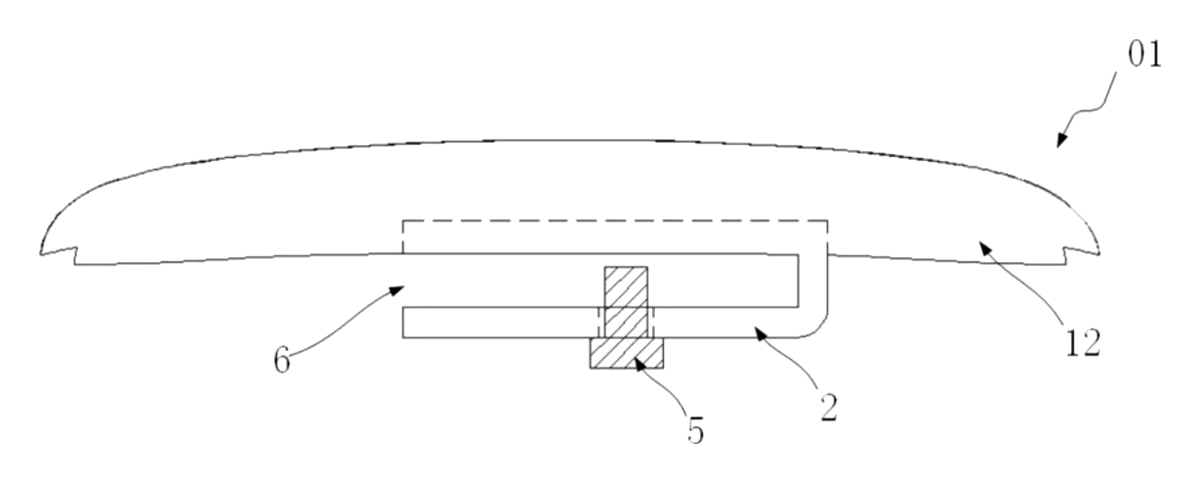
- A tail clip (2) is fixed to the middle of the support edges. It features an open slot (6) where the belt end is inserted. Below the slot, threaded holes (4) accept locking bolts (5) that press upward against the strap to lock it in place without sewing.
- A friction part (3) is positioned on the left side of the tail clip, separated by a first gap (101). It consists of a friction rod (31) with a fan-shaped cross-section and multiple friction teeth (32) distributed along its surface.
- The teeth are set at an angle to the radial direction. When the belt passes forward, resistance is low; when pulled backward, the teeth catch the strap to prevent slipping.
- A second gap (102) between the right side of the tail clip and the second limit edge allows the belt to route cleanly.
Who it is for
- Fashion accessory brands looking for a clean, adjustable buckle system for men’s or women’s holeless belts without visible stitching.
- Uniform and workwear suppliers needing durable belt hardware where straps can be quickly replaced or sized to individual workers on-site.
- Amazon private-label sellers offering customizable belts where buyers can trim the strap to their exact waist measurement before wearing.
- Leather goods manufacturers wanting to sell interchangeable strap sets that attach to a single buckle head via the bolt-clamp mechanism.
How it works
The main parts
| No. | Part | What it does |
|---|---|---|
| 01 | Buckle head | The complete assembled buckle unit. |
| 12 | Outer frame | Rectangular or circular boundary holding all components. |
| 121, 122 | First and second limit edges | Left and right boundaries of the frame. |
| 123 | Support edges | Connect the limit edges and anchor the tail clip. |
| 2 | Tail clip | Central clamp fixed to the support edges; holds the belt end. |
| 6 | Open slot | Channel inside the tail clip where the belt end is inserted. |
| 4 | Threaded holes | Holes in the bottom wall of the open slot. |
| 5 | Locking bolts | Thread into the holes to press the belt against the slot wall. |
| 3 | Friction part | Independent component on the left side of the tail clip. |
| 31 | Friction rod | Fan-shaped bar fixed to the outer frame. |
| 32 | Friction teeth | Angled teeth on the rod surface for directional grip. |
| 101, 102 | First and second gaps | Spaces for the belt to pass through on either side of the clip. |
Operating steps
- Insert the belt end into the open slot (6) of the tail clip (2) to the desired length.
- Tighten the locking bolts (5) from below so they press the strap firmly against the inner top wall of the slot, securing it without stitches.
- Route the running end of the belt through the first gap (101), over the friction rod (31).
- Pull the belt forward to fasten it around the waist; the angled friction teeth (32) allow smooth forward movement.
- Release tension; if the belt tries to slip backward, the angled teeth bite into the strap surface to lock it in place.
Applications
Everyday fashion belts
Buyers who purchase belts online often struggle with sizing. With this buckle, the user inserts the strap, tightens the bolts, and trims any excess material with scissors for a custom fit. Brands can ship one standard long strap, reducing inventory complexity.
Workwear and uniforms
Workers in logistics or trades frequently wear out belts or need different colors for department identification. The bolt-clamp allows maintenance staff to swap straps in seconds using basic tools rather than sending the belt out for re-stitching.
Golf and sports apparel
Athletes adjust their belts depending on the layers they wear. The directional friction bar holds the strap securely during active movement, while the flat profile prevents the buckle from digging into the waist when bending or swinging.
Travel and retail packaging
Retailers selling belts as gifts benefit from the unsewn design because the strap can be rolled flat without a rigid sewn loop. The end customer simply inserts the strap and locks it upon unpacking, making the product easier to package in slim boxes.
Where it is less suitable
- Heavy-duty tactical load-bearing - applications requiring extreme pull-force ratings may rely on fully integrated forged steel buckles rather than bolt-clamped assemblies.
- Thin dress belts under about 25 mm - the open slot and threaded holes require a minimum strap width to accommodate the bolts; very narrow straps may not fit the tail clip dimensions.
- Elastic or highly stretchable webbing - the locking bolts compress the material; continuous stretching could cause the strap to thin out and slip from the slot over time.
Frequently asked questions
How does the belt attach without sewing?
The tail clip has an open slot. You insert the end of the belt strap into this slot and tighten the locking bolts from below. The bolts press the strap against the inner wall of the slot, clamping it firmly in place.
Can I change the belt strap later?
Yes. Because the strap is held by bolts rather than stitches, you can unscrew them, remove the old strap, insert a new one, and tighten the bolts again.
How do I adjust the belt to my waist size?
You can cut the strap to the length you need before inserting it into the tail clip’s open slot. Once trimmed, clamp it with the locking bolts. The exact maximum strap width the slot accepts is set in design.
What stops the belt from slipping when I move?
A separate friction part sits next to the tail clip. It features a rod with angled teeth. When you pull the belt forward to fasten it, the teeth offer little resistance. If the belt tries to slide backward, the angled teeth dig into the strap to hold it.
Is the friction bar part of the clip?
The patent describes two options. The friction portion can be spaced apart from the tail clip as an independent piece, or it can be formed as a single unitary structure with the clip. The choice is set in design based on manufacturing preferences.
What shapes can the outer frame be?
The patent specifies that the outer frame can have a rectangular or circular shape. Other custom outlines can be developed during the design phase.
Will the locking bolts loosen over time?
The holding force depends on the thread pitch, bolt length, and strap material. Pull-test parameters and torque specifications are confirmed on prototypes to ensure the bolts stay secure during normal wear.
Can this design be made and sold in the US?
The patent was filed only in China and is currently in force there until at most 2031-08-16 (if annual fees are paid). It has no US counterpart, so it does not restrict making or selling the design in the United States. However, other belt buckle patents may exist in the US, so we recommend a freedom-to-operate check before volume production.
Are you affiliated with the patent owner?
No. IP2M is an independent design and manufacturing service working from the public patent document.
Request a quote
Click Request a Quote below to see our email address - copy it, or open your email app with a ready-made message. Please mention patent CN215455856U in the subject.
Helpful details to include:
- Your company and channel (fashion brand, uniform supplier, Amazon seller, leather goods maker)
- Strap width and material you plan to use
- Frame shape preference (rectangular, circular, or custom)
- Metal and finish requirements
- Estimated quantity and target price
- Timeline - when you would like samples and the first shipment
You can also reach us at (332) 203-9997.
Explore this product
Interested in building this?
Tell us your target market, quantity and timeline. We reply with options for prototyping, small-batch runs or volume production.
Send your inquiry to
Please put CN215455856U in the subject line and tell us your company, country, estimated quantity and timeline.
Prefer to talk? Call (332) 203-9997.
More product-ready patents
All Apparel & Accessories patents →
Apparel & Accessories
Stacked Zipper with Teeth That Mesh Top-to-Bottom
Zipper whose two identical tooth rows mesh on top of each other, closed by a simplified slider.
Patent CN205795062U
Apparel & Accessories
Impact-Resistant Glove with a 3D-Printed Lattice Layer
Work glove with a 3D-printed lattice impact layer, TPU knuckle guards and a light mounting area.
Patent CN213785583U
Apparel & Accessories
Massage Insole with Spring-Back Silicone Nubs and a Removable Top Layer
Layered insole: silicone nubs rise through a removable perforated top sheet and sink under each step.
Patent CN208286505U
Apparel & Accessories
Heel-Less Carbon Plate Running Shoe Sole for Forefoot Strikers
Running sole for forefoot strikers: no ground-touching heel, winged carbon plate between two midsoles.
Patent CN216723354U
Apparel & Accessories
Waterproof Magnetic Zipper Stop That Snaps the Two Halves Together
Separating-zipper stop with sealed magnets: pin and box snap together one-handed, safe in rain and wash.
Patent CN215075936U
Apparel & Accessories
Left-Right Specific Soccer Socks: Grip for the Plant Foot, Touch Pads for the Kicking Foot
Soccer socks knitted as a left-right pair: grip zones for the plant foot, pads for the kicking foot.
Patent CN212728807U
Browse by category
- Apparel & Accessories (22)
- Baby & Kids (16)
- Bags & Luggage (9)
- Bath & Personal Care (16)
- Car Accessories (10)
- Furniture, Bedding & Storage (12)
- Garden & Outdoor (18)
- Health & Wellness (8)
- Home, Kitchen & Cleaning (24)
- Lighting (12)
- Packaging & Containers (6)
- Pet Products (6)
- Phone & Camera Accessories (4)
- Retail Display (13)
- School, Office & Art (19)
- Sports & Recreation (25)
- Tools & Workshop (27)
- Toys & Games (12)
This page is based on the public patent document CN215455856U, assigned to Individual. IP2M is an independent manufacturing service and is not affiliated with, endorsed by or licensed by the patent owner. Images marked as concept renderings are illustrations, not photos of an existing product. Patent status information is provided for reference only and is not legal advice; confirm freedom to operate for your market before production. Full disclaimer.