At a glance
| Patent number | CN216494520U (application CN202123023659) |
| Type | China utility model (实用新型) - protects product shape and structure |
| Original title | Foldable and detachable baby tableside dining chair (一种可折叠拆卸的婴儿桌边餐椅) |
| Patent owner | Xiamen Anbaobei Fuyou Products Co., Ltd. (name/address recorded changed on 2025-07-25) |
| Inventors | Xie Fagen, Dai Luoyong |
| Filing date | 2021-12-01 |
| Grant date | 2022-05-13 |
| Status (China) | In force - a China utility model lasts at most 10 years from filing, i.e. until 2031-12-01, if annual fees are paid |
| Patent family | Chinese filings only - no US, European, Japanese, PCT or other filings listed |
| Cited by | 0 later documents |
| Source | Google Patents (search for CN216494520U) |
What the claims cover, in plain language
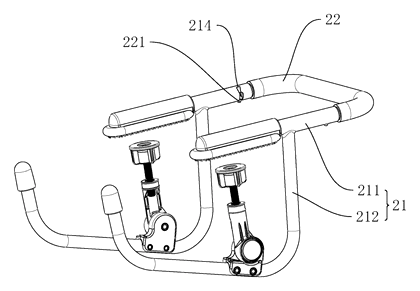
Claim 1 - a tableside baby dining chair with a seat portion (1) on a main body frame (2). The frame has two mounting brackets (21) that install on a table and one connecting rod (22) whose ends plug into the brackets. Each rod end carries a spring pin (221); each bracket has a snap hole (214) that catches the pin, locking rod to bracket without tools.
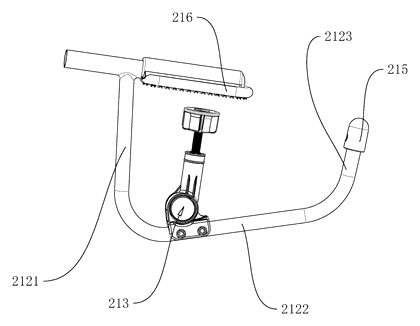
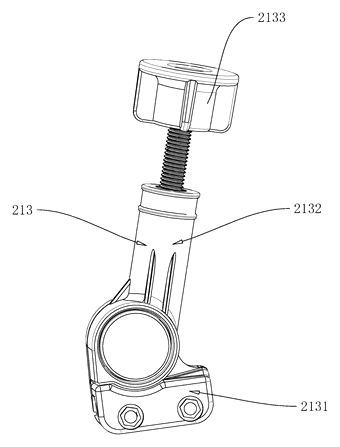
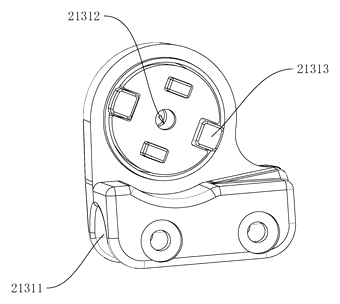
Claim 2 - each bracket combines a fixing rod (211) and a U-shaped force-applying rod (212): one arm joins the middle of the fixing rod, the free arm hooks under the table bottom, and the spacing geometry lets the clamp hug the table edge. Claim 3 - the U-arm is built from a first vertical rod, a horizontal cross bar and a second vertical rod, with arc transitions at the joints. Claim 4 - adds a telescopic extension rod (213) rising toward the table underside to fit different board thicknesses. Claim 5 onward - the extension rod’s swiveling fixed / connecting / abutment parts with a threaded sleeve; protective sleeves, pad parts and friction features are described in the specification.
This is a simplified reading for orientation only. The legal scope is defined by the exact claim wording in the official Chinese document.
What this means for US production
This patent was filed only in China and is in force there until at most 2031-12-01. Making or selling the claimed design in China requires the owner’s permission; it gives the owner no rights in the United States, and there is no US counterpart.
Two points to settle early:
- Other patents may exist. Restraint seating and clamp-on child seats are a crowded field with many US and international patents covering harness systems, clamp mechanisms and seat geometries unrelated to this one, so a freedom-to-operate (FTO) review before tooling is strongly recommended.
- Safety-critical structure. The clamp grip, spring-pin lock and telescopic rod carry the child’s load; wall thickness, pin spring rate and thread engagement must be engineered and validated, not copied from drawings alone.
Customization and manufacturing
What can be customized
| Area | Options |
|---|---|
| Seat shell | Material, cushion fabric, colorway; harness/buckle provision is outside this patent’s scope |
| Bracket span | Rod length sets the distance between the two table-edge clamps |
| Table-thickness range | Extension-rod stroke chosen for the target market’s tables |
| Contact protection | Sleeve material and pad size/hardness for wood, laminate or glass tops |
| Pin mechanism | Spring-pin style, button reach, retention force |
| Finish | Powder coat, plating or paint on steel/aluminum parts |
Things to plan for (US market)
- ASTM F1235 - standard consumer safety specification for infant feeding chairs, including restraint products used at tables; covers stability, strength and entrapment hazards.
- 16 CFR 1227 - ASTM F1235 is incorporated as a mandatory rule for infant feeding chairs sold in the US; CPSIA testing, tracking labels and third-party certification apply.
- CPSIA lead/phthalate limits - coatings, sleeves and any soft parts must pass total-lead and phthalate screening.
- California Prop 65 - finishes and plastics are screened for listed chemicals.
How a project runs
- Inquiry - target markets, table types, seat style, quantity.
- Design - bracket profile, rod and pin geometry, extension-rod range, seat interface.
- Prototype - samples for clamp grip, pin endurance and table-compatibility tests.
- Pilot run - strength, stability and fatigue testing; ASTM/CPSIA lab submission.
- Production - tube bending and stamping for brackets, machining or molding for rods and pins, finishing, assembly.
Quantities & timeline
Brackets need bending dies and stamping or casting tooling per size family, spring pins require precision molds or turned stock, and the telescopic rod needs threading capability. Safety-cycle testing and lab certification dominate the schedule. Send us your target table range, seat style, finish, quantity and target price and we will reply with options.
Patent drawings
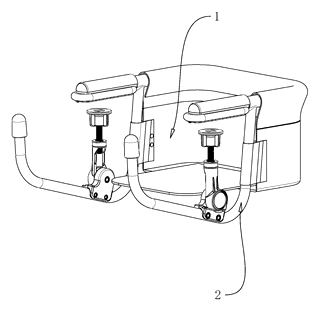
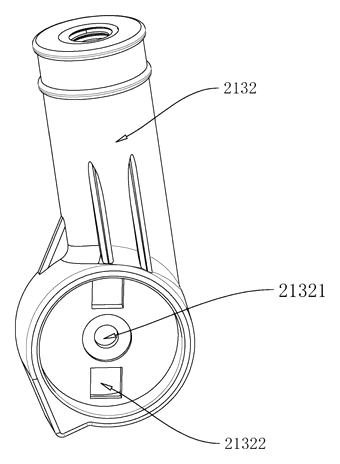
Drawings reproduced from the public patent document for reference.