At a glance
| Patent number | CN216723354U (application CN202220218415) |
| Type | China utility model (实用新型) - protects product shape and structure |
| Original title | Heel-less sole and shoe (无后跟鞋底及鞋) |
| Patent owner | Li Ning (China) Sports Goods Co., Ltd. |
| Inventors | Sun Jingyi, Yang Chang, Yang Fan, Wang Xu, Meng Huanhuan, Hong Yuru, Xu Jianguang |
| Filing date | 2022-01-26 |
| Grant date | 2022-06-14 |
| Status (China) | In force - no termination recorded; a China utility model lasts at most 10 years from filing (to 2032-01-26) |
| Patent family | Chinese filings only - no US, European, Japanese, PCT or other filings listed |
| Cited by | 4 later documents |
| Source | Google Patents (search for CN216723354U) |
What the claims cover, in plain language
Claim 1 - a heel-less sole with an upper midsole and a lower midsole that enclose a cavity holding a carbon plate. The upper midsole has forefoot, arch and heel parts; the lower midsole has only forefoot and arch parts, matching those of the upper midsole, so that the heel of the upper midsole is suspended.
Claim 2 - the plate is wing-shaped, with an inner wing under the inner front of the foot and an outer wing under the outer front. Claims 3-4 - a plate support section at the heel, attached under the heel of the upper midsole and suspended with it. Claims 5-6 - forefoot, midfoot and support sections, with a raised support region in the arch so the forefoot and wings lie near the ground. Claims 7-14 - further features described in the patent, such as the plate groove in the upper midsole, a fixing block on the lower midsole, the outsole and a shoe using the sole.
This is a simplified reading for orientation only. The legal scope is defined by the exact claim wording in the official Chinese document.
What this means for US production
This patent was filed only in China. It is still in force in China, so making or selling this design in China would need the owner’s permission while it lasts (at most until 2032-01-26). It has no US or other foreign counterpart and does not restrict the design outside China.
Two points to settle early:
- Other patents may exist. Carbon-plated running shoes are one of the most heavily patented areas in footwear - plate shapes, foam and plate stacks and sole geometries are claimed by the large US and European sports brands - so a freedom-to-operate (FTO) review of plate geometry and midsole layout must come before tooling.
- No brand elements. The patent owner’s brand, logos and model names are not part of the design and are not used; the upper, tread pattern and styling are developed fresh for each customer.
Customization and manufacturing
What can be customized
| Area | Options |
|---|---|
| Plate | Full carbon fiber, carbon/glass blend or nylon plate for a lower price point; wing size and stiffness |
| Upper midsole foam | Supercritical-foamed PEBA-type, TPU or EVA blends; stack height |
| Lower midsole & outsole | Forefoot rubber coverage, tread pattern, cut-outs to save weight |
| Upper | Engineered mesh or knit, lacing, heel counter shape |
| Sizing | Men’s and women’s lasts, half sizes, wide fits |
| Branding | Your logo, colorways, insole print, box and hang tags |
Things to plan for (US market)
- FTC footwear labeling and country-of-origin marking - the shoe or its box must show the country of origin; material content claims must be accurate.
- California Prop 65 - foams, adhesives, rubber and printed parts should be tested for listed substances such as phthalates and lead.
- Performance claims - statements about energy return or running economy need test data; marketing should be reviewed against FTC guidance.
- Customs classification - athletic footwear with textile uppers and rubber soles has its own HTS lines and duty rates; confirm before costing.
How a project runs
- Inquiry - target runner, size range, plate material, colorways and quantity.
- Design - last, midsole geometry, plate shape and stiffness, upper.
- Prototype - wear-test samples for fit, plate feel, heel stability and durability.
- Pilot run - small batch for bonding strength, flex testing and packaging checks.
- Production - volume production per size run, packaging and shipping.
Quantities & timeline
Each size needs midsole compression or injection molds and outsole molds, the carbon plate needs its own press tooling per size range, and the upper needs patterns and samples. Most development time goes into the plate layup and wear testing. Send us your target runner, size range, plate choice, quantity and target price and we will reply with options.
Patent drawings
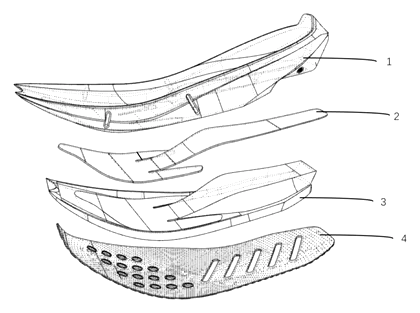
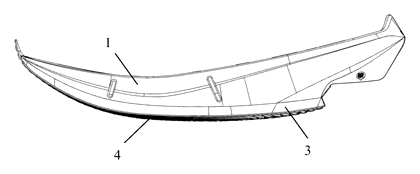
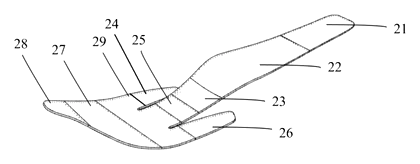
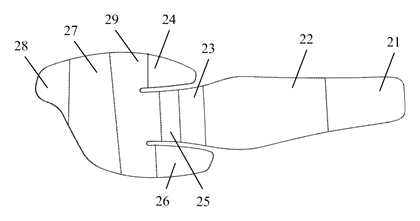
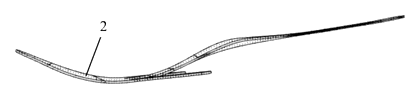
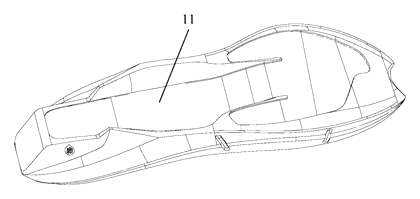
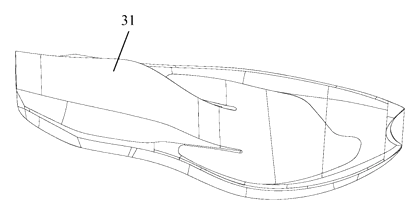
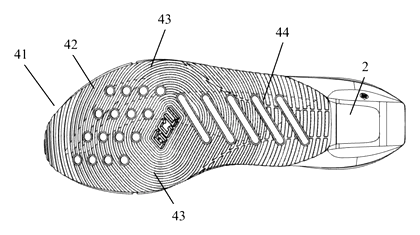
Drawings reproduced from the public patent document for reference.