
Patent CN217703512U
Updated October 25, 2026Stationary Clipper Blade with Skin-Guard Tooth Protrusions
Standard clipper blades use teeth that are as thick as the base plate, which can tug hair and scratch the scalp when pressed hard. This stationary blade solves that by machining grooves into the substrate so the teeth end up thinner than the main body. The grooves leave small protrusions at each tooth tip. According to the patent, these keep the sharp points away from the skin while providing a combing effect.
- China utility model - in force
- No filings outside China
- Hair clipper & trimmer hardware
- Stamped and ground blade
Splat! What let you down?
✂️
Thinner cutting teeth
Material-removal grooves make each tooth thinner than the substrate for a closer trim.
🛡️
Skin guards
The grooves leave small protrusions at every tooth tip to shield the scalp from sharp edges.
〰️
Curved substrate option
The outer surface can be curved to follow the contour of the head.
⚙️
Efficient manufacturing
Outer grooves are stamped; inner grooves are ground, combining speed with precision.
Bring this product to market
- ✓ Patent vetted China-only family and legal status checked
- 2 Product brief · now How it works, uses and options written up
- 3 Prototype First samples for buyers to review
- 4 Pilot run Small first batch for launch customers
- 5 Volume production Repeat orders at scale
Buyer interest
– of 100 buyers needed to start prototyping
One click, no sign-up. Each vote is one real visitor, and products with the most interest go to prototyping first.
Build team: no members yet. Need a partner, co-funding or skills to build this? Join and we introduce the team once it forms.
The problem
When an electric hair clipper runs over the scalp, the stationary blade sits directly against the skin. If the cutting teeth are as thick as the base plate, they tend to push hair aside rather than catching it cleanly, and any burr or sharp point at the tooth tip can scratch or nick the skin. According to the patent, the goal is to provide a stationary blade that improves the hair-trimming effect while protecting the user’s skin from punctures and irritation.
The solution
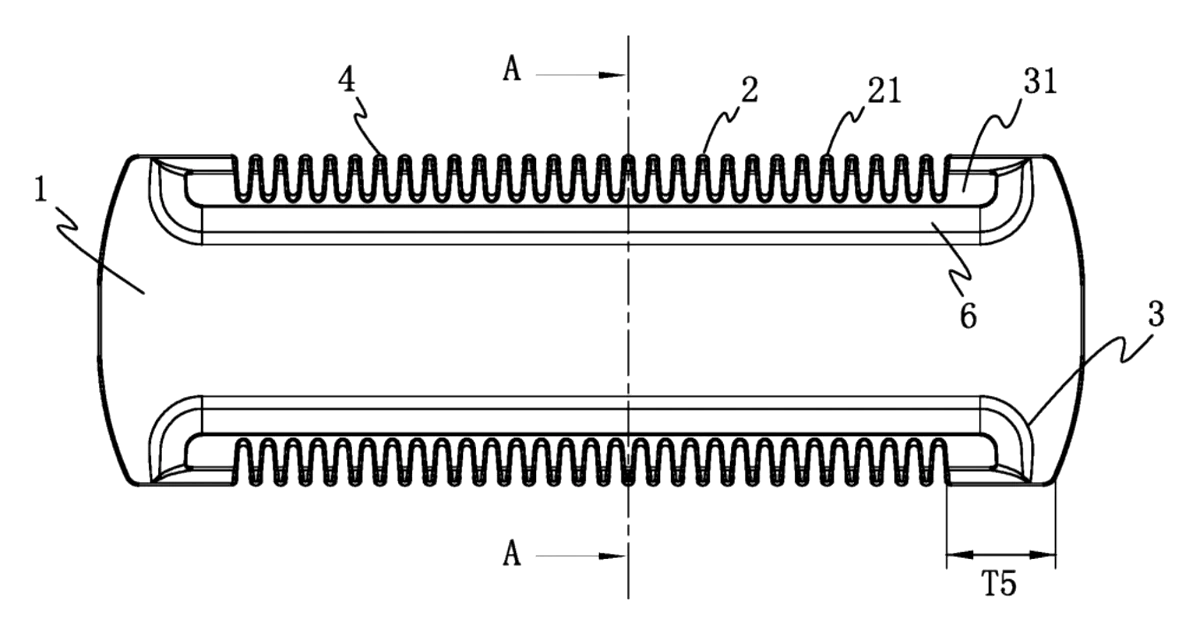
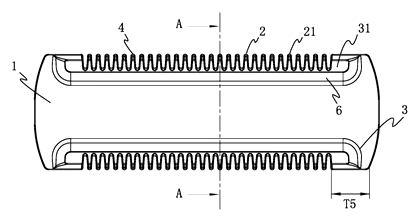
- A substrate (1) forms the main body of the blade. At least one side edge carries a cutter tooth group (2) made of multiple cutting teeth (21).
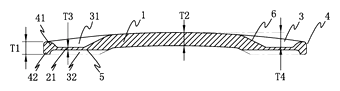
- Material removing grooves (3) are machined into the upper face, the lower face, or both faces of the substrate. Because material is taken away at the teeth, the thickness of each cutting tooth (T3) becomes smaller than the substrate thickness (T2).
- Where the groove meets the tip of each cutting tooth, a small tooth protrusion (4) remains on the upper face, the lower face, or both. These protrusions act as physical guards.
- The patent describes the protrusions as designed to prevent the sharp tips from stabbing the skin, while also functioning like a comb during trimming.
Who it is for
- Professional clipper brands looking to upgrade their replacement blade lineup with a design that reduces scalp irritation for barbers working all day.
- Consumer grooming appliance makers who want a safer blade for home-use hair clippers, especially models marketed for children or sensitive skin.
- Pet grooming tool manufacturers needing a blade that cuts close to animal skin without nicking, where thin teeth and guard protrusions offer a clear advantage.
- Aftermarket blade suppliers selling replacement heads for popular clipper models, seeking a differentiated feature to justify a premium price point.
How it works
The main parts
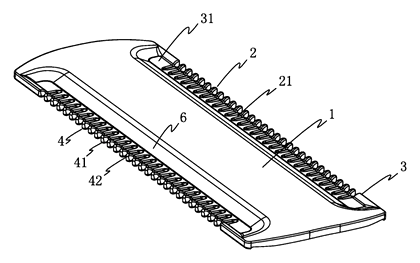
| No. | Part | What it does |
|---|---|---|
| 1 | Substrate | The main metal body of the stationary blade. |
| 2 | Cutter tooth group | The row of teeth along one or both side edges. |
| 21 | Cutting tooth | Individual teeth; each is thinner than the substrate. |
| 3 | Material removing groove | Grooves on the upper or lower face that reduce tooth thickness. |
| 4 | Tooth protrusion | Small bumps left at the tooth tips by the grooves. |
| 41 | Upper tooth protrusion | Protrusion on the outer (skin-facing) face. |
| 42 | Lower tooth protrusion | Protrusion on the inner face, guarding against the moving blade. |
| T1 | Protrusion height | Height of the bump, less than or equal to substrate thickness. |
| T2 | Substrate thickness | Full thickness of the main blade body. |
| T3 | Tooth thickness | Thickness of each cutting tooth after grooving (≥ 0.08 mm). |
Manufacturing and assembly steps
- Stamping the outer groove - A punch press forms the material removing groove (3) on the outer surface of the substrate (1) in one stroke.
- Grinding the inner groove - A grinding wheel removes material from the inner surface to further thin the cutting teeth (21) to the target thickness (T3).
- Cutting the teeth - A tooth-cutting grinding wheel slices the edge of the substrate to separate individual cutting teeth (21), leaving the upper tooth protrusions (41) intact inside the stamped groove.
- Smoothing transitions - The joints where the upper protrusions (41) and lower protrusions (42) meet the cutting teeth are finished with smooth, rounded transitions.
- Assembly - The finished stationary blade is paired with a moving blade that oscillates back and forth across it inside the clipper housing.
Applications
Professional barber fades
Barbers run clippers over the same area repeatedly. The patent describes the upper tooth protrusions as designed to stimulate the scalp nerves and accelerate blood circulation, producing a more comfortable sensation during long fading sessions. Thinner teeth catch short hairs more easily.
Children’s home haircuts
Parents using clippers on young children worry about nicks. The upper protrusions sit between the sharp tooth tips and the scalp, acting as a physical barrier. This makes the blade forgiving even if the user presses too hard or moves at an awkward angle.
Pet grooming salons
Animal skin is loose and easily caught between standard clipper teeth. The lower tooth protrusions described in the patent prevent the moving blade from cutting the skin when it swings back and forth. The thinner teeth slice through dense undercoats with less pulling.
Sensitive-skin consumer trimmers
Users with eczema or easily irritated scalps often avoid close-cutting clippers. The combination of thin teeth for a clean cut and guard protrusions for skin protection addresses this specific pain point, allowing a close trim without direct blade-to-skin scraping.
Beard and body grooming attachments
While primarily designed for head hair, the geometry applies to body groomers where skin safety is paramount. The curved substrate option mentioned in the claims allows the blade to follow body contours better than a flat plate.
Where it is less suitable
- Heavy-duty livestock shearing - sheep and cattle shears require much thicker, wider-spaced teeth to handle dirty, matted wool; thin teeth would bend or break.
- Zero-gap balding clippers - some barbers file the guard off entirely to achieve a completely flush shave; this blade relies on the protrusions for its safety function, so removing them defeats the design.
- Ceramic-only blades - the patent specifies stamping and grinding, which are metalworking processes; ceramic blades require sintering and diamond grinding, making this specific groove-and-protrusion geometry harder to replicate in pure ceramic.
Frequently asked questions
How do the grooves make the teeth thinner?
Material is removed from the flat surfaces of the base plate right where the teeth are located. After the edge is sliced into individual teeth, the section that had material removed ends up thinner than the rest of the solid base plate. The patent specifies the tooth thickness must remain greater than or equal to 0.08 mm.
What exactly is the “tooth protrusion”?
Because the groove does not extend all the way to the very edge of the base plate, a small bump of original metal is left standing at the tip of each newly formed tooth. The patent describes these protrusions as designed to sit between the sharp cutting edge and the user’s skin, preventing direct contact.
Does the blade have protrusions on both sides?
It can. The claims cover an upper protrusion on the skin-facing side and a lower protrusion on the side facing the moving blade. The patent states that the upper protrusion width is smaller than the lower protrusion width when viewed from the tip. Having both is described as the preferred embodiment for improved safety.
Will this fit my existing clipper model?
The patent defines the blade geometry but not the mounting holes or overall width for specific commercial clippers. The outer dimensions, screw hole spacing and tooth alignment must be matched to your target clipper housing during the design phase.
Can the blade be curved?
Yes. Claim 5 explicitly states that the outer surface of the substrate can be curved when viewed from either end. This allows the blade to follow the contour of a head or body more closely than a perfectly flat plate.
What metals are used for this type of blade?
The patent mentions manufacturing via stamping and grinding, which are standard processes for high-carbon steel and stainless steel clipper blades. Specific alloy selection and hardness targets are set in design based on the intended use and coating requirements.
How are the grooves manufactured at scale?
According to the patent description, the outer groove is formed in a single stamping operation using a punch press, while the inner groove is achieved by grinding. The teeth are then separated using a tooth-cutting grinding wheel. This combination is highlighted as having high production efficiency.
Can this design be made and sold in the US?
The patent was filed only in China and is currently in force there. It has no US counterpart, so this specific document does not restrict manufacturing or sales in the United States. However, hair clipper blades are covered by numerous other US patents held by major grooming brands, so we recommend a freedom-to-operate check before volume production.
Are you affiliated with the patent owner?
No. IP2M is an independent design and manufacturing service working from the public patent document.
Request a quote
Click Request a Quote below to see our email address - copy it, or open your email app with a ready-made message. Please mention patent CN217703512U in the subject.
Helpful details to include:
- Your company and channel (clipper brand, aftermarket supplier, pet grooming manufacturer)
- Target clipper model or required blade dimensions (width, mounting hole spacing)
- Material and surface coating preferences
- Groove configuration (upper only, lower only, or dual)
- Estimated quantity and target price
- Timeline - when you would like samples and the first shipment
You can also reach us at (332) 203-9997.
Explore this product
Interested in building this?
Tell us your target market, quantity and timeline. We reply with options for prototyping, small-batch runs or volume production.
Send your inquiry to
Please put CN217703512U in the subject line and tell us your company, country, estimated quantity and timeline.
Prefer to talk? Call (332) 203-9997.
More product-ready patents
All Bath & Personal Care patents →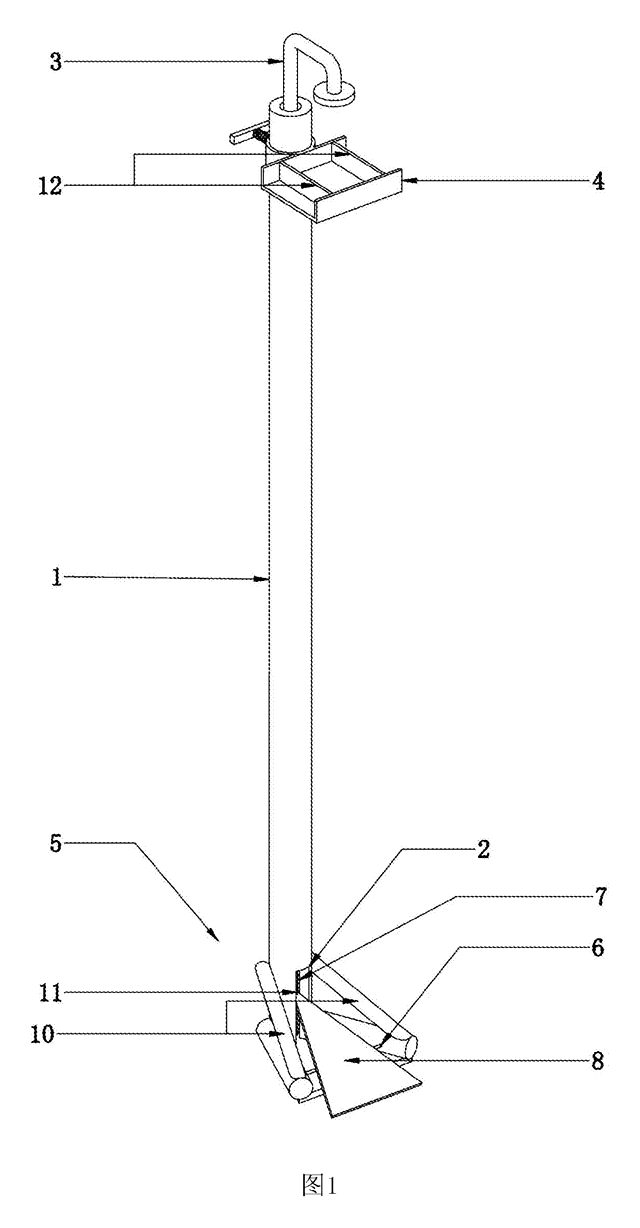
Bath & Personal Care
Foot-Pedal Soap & Sanitizer Dispenser Stand
Hands-free, battery-free dispenser stand - step on a pedal to press the pump of any soap or sanitizer bottle.
Patent CN207461995U
Bath & Personal Care
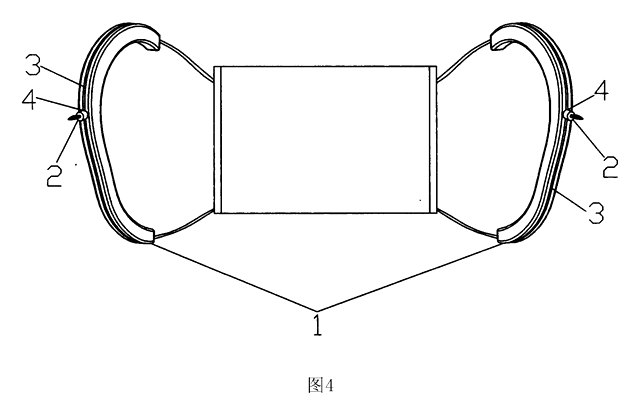
Ear-Shaped Mask Strap Guard with Tension Adjuster
Ear-shaped silicone guard and strap-length adjuster that make ear-loop masks comfortable to wear for long hours.
Patent CN205456233U
Bath & Personal Care
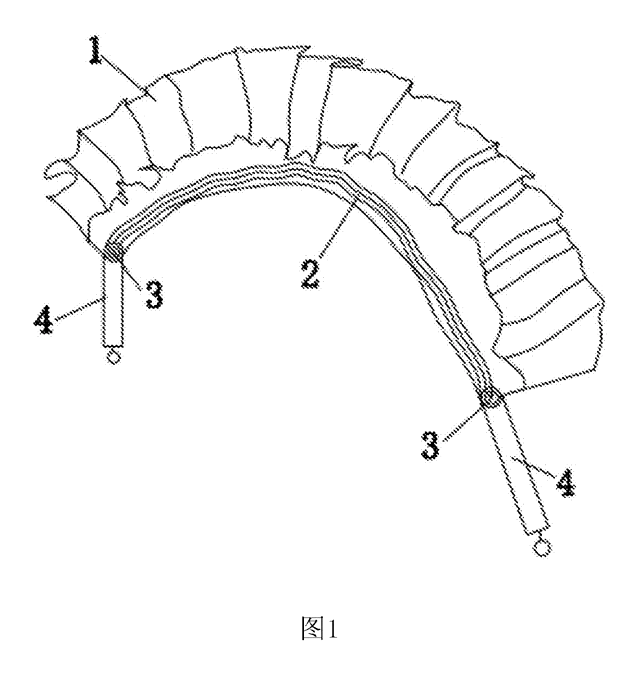
Adjustable-Length Back Scrubber Strap with Push-Button Handles
Back-scrubber strap with push-button handles that set its length and a spring that keeps it taut.
Patent CN207041452U
Bath & Personal Care
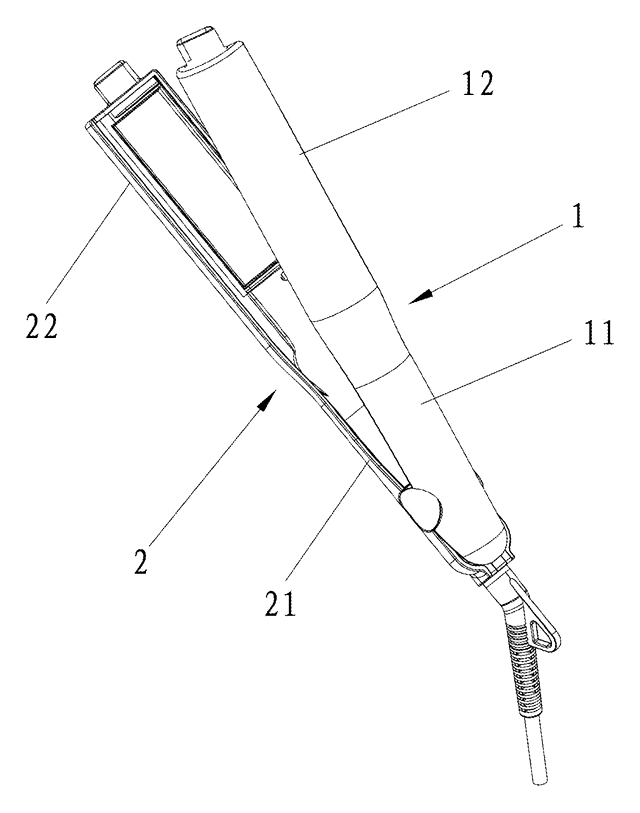
Angled-Plate Hair Straightener
Flat iron with plates twisted 45-75° to the handle, a curling groove and rubber-capped tips.
Patent CN206137462U
Bath & Personal Care
Refillable Lipstick Case with Sealed Snap-In Refill Pods
Reusable twist-up lipstick case; sealed refill pods unlock at the top of the stroke for shade swaps.
Patent CN206909979U
Bath & Personal Care
Quick-Release Toilet Seat Hinge with a Push-Button Two-Strip Latch
Toilet seat hinge: drop the shaft onto a grooved post to lock; one push parks the latch open to lift it off.
Patent CN210370292U
Browse by category
- Apparel & Accessories (22)
- Baby & Kids (16)
- Bags & Luggage (9)
- Bath & Personal Care (16)
- Car Accessories (10)
- Furniture, Bedding & Storage (12)
- Garden & Outdoor (18)
- Health & Wellness (8)
- Home, Kitchen & Cleaning (24)
- Lighting (12)
- Packaging & Containers (6)
- Pet Products (6)
- Phone & Camera Accessories (4)
- Retail Display (13)
- School, Office & Art (19)
- Sports & Recreation (25)
- Tools & Workshop (27)
- Toys & Games (12)
This page is based on the public patent document CN217703512U, assigned to ZHEJIANG HAISHUN ELECTRICAL CO Ltd. IP2M is an independent manufacturing service and is not affiliated with, endorsed by or licensed by the patent owner. Images marked as concept renderings are illustrations, not photos of an existing product. Patent status information is provided for reference only and is not legal advice; confirm freedom to operate for your market before production. Full disclaimer.