At a glance
| Patent number | CN217703512U (application CN202221861797) |
| Type | China utility model (实用新型) - protects product shape and structure |
| Original title | Static blade (一种静刀片) |
| Patent owner | ZHEJIANG HAISHUN ELECTRICAL CO Ltd |
| Inventors | Not published (the inventor asked not to be named) |
| Filing date | 2022-07-18 |
| Grant date | 2022-11-01 |
| Status (China) | In force in China until at most 2032-07-18 (if annual fees are paid) |
| Patent family | Chinese filings only - no US, European, Japanese, PCT or other filings listed |
| Cited by | 4 later documents |
| Source | Google Patents (search for CN217703512U) |
What the claims cover, in plain language
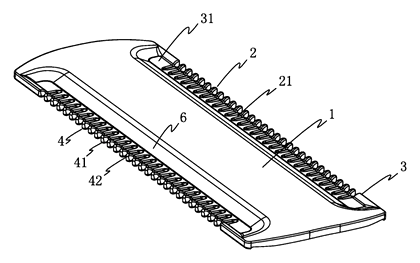
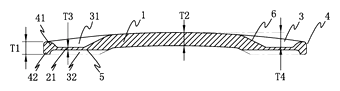
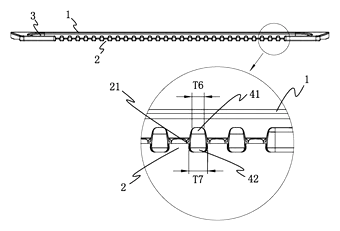
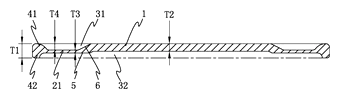
Claim 1 - a stationary blade comprising a substrate with a cutter tooth group made of multiple cutting teeth along at least one side edge. A material removing groove is provided on the upper end surface and/or the lower end surface of the substrate, so that the thickness of each cutting tooth is smaller than the substrate thickness. This arrangement causes a tooth protrusion to form on the upper and/or lower end surface at the tip of each cutting tooth.
Claim 2 - the tooth protrusion height is less than or equal to the substrate thickness. Claim 3 - the protrusions include upper tooth protrusions and lower tooth protrusions on opposite faces of the tooth tip, with rounded joints where they meet the cutting tooth. Claim 4 - viewed in projection, the upper tooth protrusion width is smaller than the lower tooth protrusion width. Claim 5 - the outer surface of the substrate is curved when viewed from either end. Claim 6 - each cutting tooth has a thickness less than the substrate but greater than or equal to 0.08 mm. Claim 7 - the groove depth is smaller than the substrate thickness. Claim 8 - blade teeth are on opposite side edges, and their length is shorter than the substrate so both ends are spaced from the substrate edges by 3 mm to 10 mm. Claim 9 - the discharging groove comprises an upper discharging groove on the outer surface (forming the upper tooth protrusion) and a lower discharging groove on the inner surface (thinning the tooth and forming the lower tooth protrusion).
This is a simplified reading for orientation only. The legal scope is defined by the exact claim wording in the official Chinese document.
What this means for US production
This patent was filed only in China and is currently in force in China until at most 2032-07-18 (if annual fees are paid). It has no US or other foreign counterpart. Manufacturing or selling this exact blade design within China during the effective term requires the patent owner’s permission. Outside China, this specific document does not restrict production or sale.
Two points to settle early:
- Freedom to operate (FTO). Hair clipper blade geometries, including tooth profiles, guard features and groove patterns, are heavily patented by major grooming brands such as Wahl, Andis and Oster. An FTO review covering the thin-tooth-with-protrusion concept is essential before committing to tooling for the US market.
- Moving blade pairing. This patent covers the stationary blade only. The moving blade that oscillates against it must be designed to match the tooth spacing, thickness and protrusion heights to avoid jamming or excessive wear.
Customization and manufacturing
What can be customized
| Area | Options |
|---|---|
| Blade width | Standard clipper widths (about 46 mm) or trimmer sizes (about 32 mm), to be confirmed in design |
| Tooth pitch | Spacing between cutting teeth set for coarse cutting or fine detailing |
| Material | High-carbon steel, stainless steel or titanium-coated steel |
| Groove configuration | Upper groove only, lower groove only, or both (dual protrusions) |
| Protrusion profile | Height and width of upper vs. lower bumps adjusted for skin sensitivity |
| Substrate shape | Flat or curved outer surface to match specific clipper housings |
| Surface finish | Diamond-like carbon (DLC) coating, black oxide or polished |
Things to plan for (US market)
- UL 859 / UL 1727 - household electric personal grooming appliances standards covering the complete clipper; the blade is a critical component evaluated during motor stall and temperature tests.
- FDA 21 CFR - if the clipper is marketed for medical or surgical hair removal (e.g., pre-operative prep), it may fall under FDA device regulations; standard consumer grooming clippers generally do not.
- California Proposition 65 - metal alloys and surface coatings must be screened for lead, cadmium and other listed substances.
- CPSC - if the clipper is specifically packaged and marketed for children, general consumer product safety rules apply to sharp edges and small parts.
How a project runs
- Inquiry - target clipper model, blade dimensions, material preference and order volume.
- Design - CAD modeling of the substrate, groove depths, tooth pitch and protrusion geometry to mate with the chosen moving blade.
- Prototype - stamping and grinding sample batches for dimensional verification and cutting tests on hair swatches.
- Pilot run - durability testing (cycle counts), noise measurement and heat buildup checks when paired with the moving blade.
- Production - progressive die stamping for outer grooves, CNC grinding for inner grooves and tooth separation, heat treatment, coating and final inspection.
Quantities & timeline
Manufacturing this blade requires custom progressive stamping dies for the substrate outline and outer grooves, plus dedicated grinding wheels shaped to produce the exact tooth pitch and inner groove profile. Heat treatment fixtures and coating racks must match the blade dimensions. Tooling fabrication and prototype validation take the majority of the initial schedule. Send us your target dimensions, material, groove configuration, quantity and target price and we will reply with options.
Patent drawings
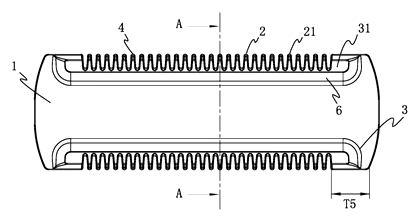
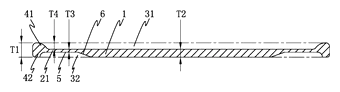
Drawings reproduced from the public patent document for reference.