At a glance
| Patent number | CN218791055U (application CN202223136082) |
| Type | China utility model (实用新型) - protects product shape and structure |
| Original title | Inner container, food heat-preservation storage and transportation box, warming box and heat-preservation storage and transportation knapsack (一种内容器及食品保温储运箱、增温箱和保温储运背囊) |
| Patent owner | Institute of Systems Engineering of PLA Academy of Military Sciences |
| Inventors | Liu He, Sheng Yijian, Liu Xueqiang, Li Yanjun |
| Filing date | 2022-11-24 |
| Grant date | 2023-04-07 |
| Status (China) | In force - valid until at most 2032-11-24 (subject to annual fee payments) |
| Patent family | Chinese filings only - no US, European, Japanese, PCT or other filings listed |
| Cited by | 1 later document |
| Source | Google Patents (search for CN218791055U) |
What the claims cover, in plain language
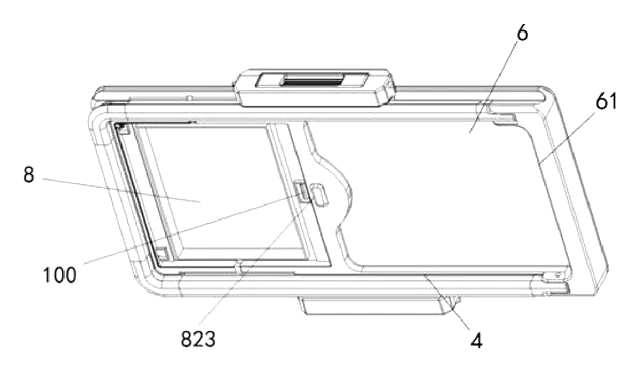
Claim 1 defines an inner container comprising a serving tray body with an open end having an outwardly extending expansion portion. The serving tray cover has an outer edge connected to a vertical wall, which connects to a transverse wall extending toward the center. A protruding part on the transverse wall contains a handle and a vent valve. The distance from the top of the protrusion to the transverse wall is smaller than the distance from the vertical wall’s top edge to the transverse wall, aiding stability. Fixing buckles secure the cover to the tray body. Lifting belts are attached to the expansion portion. A sealing ring ensures a closed space when the cover is seated.
Claim 2 adds two lugs diagonally arranged relative to the extension portion, passing through holes to slide, likely for locking mechanisms. Claim 3 specifies two retaining tabs on the side walls of the tray body. Claim 4 details the lifting belt structure: an I-shaped strap made of ductile plastic with hook-shaped ends clamped onto the expansion portion sides. Claim 5 describes a complete insulated food container system, combining the inner container with an insulated container body and cover, both hollow structures with internal insulation layers, holding two inner containers side-by-side. Claim 6 introduces a fixing frame connecting to the inner wall of the insulated body to secure the inner containers.
This is a simplified reading for orientation only. The legal scope is defined by the exact claim wording in the official Chinese document.
What this means for US production
This patent was filed only in China and is currently in force. Making or selling products covered by this specific design in China requires the owner’s permission. However, since there are no corresponding US patents, the design itself is not restricted by this patent in the United States.
Two points to settle early:
- Other patents may exist. The field of insulated food containers, particularly those with venting mechanisms or specific latch designs, is crowded with existing IP held by major consumer goods companies (e.g., Cambro, Rubbermaid Commercial Products, Thermos). A freedom-to-operate (FTO) review is essential to ensure your specific implementation of the handle, valve, or stacking geometry does not infringe on prior US patents.
- Material Compliance. The patent mentions plastic materials for straps and seals. For food contact applications in the US, all components must meet FDA regulations regarding food-safe plastics, which may limit the choice of raw materials compared to what might be used in non-food contexts.
Customization and manufacturing
What can be customized
| Area | Options |
|---|---|
| Capacity | Tray volume adjusted by depth of the serving tray body (41). |
| Valve Type | One-way check valves vs. manual toggle vents; material selection for high-temp resistance. |
| Strap Material | Silicone, nylon webbing, or TPE for the lifting belts (45); color coding options. |
| Insulation Layer | Foam density or vacuum panel integration in the outer box (Claims 5-6). |
| Stacking Geometry | Adjustments to the protruding part (424) height to optimize shelf fit. |
| Locking Mechanism | Variation in the fixing buckle (44) design for different security levels. |
Things to plan for (US market)
- FDA 21 CFR - All parts contacting food (tray, lid, seals, straps) must comply with FDA regulations for food-contact substances.
- Prop 65 (California) - Plastics and rubber components require screening for listed chemicals.
- Thermal Shock Testing - While not a federal regulation, industry standards often require testing for cracking or warping when moving from freezer to microwave or dishwasher.
- Dishwasher Safe Certification - If marketed for institutional use, validation against NSF/ANSI standards for cleaning efficacy and durability is recommended.
How a project runs
- Inquiry - Specify capacity, target temperature retention time, and intended outer housing (box/knapsack).
- Design - Finalize mold cavities for the tray body, cover, and valve seat; select FDA-compliant polymers.
- Prototype - Create samples to test vent valve functionality under thermal load and strap durability.
- Pilot Run - Small batch production to verify sealing consistency and stacking stability.
- Production - Injection molding of trays/lids, assembly of valves and straps, final QC inspection.
Quantities & timeline
Tooling for the complex cover geometry (including the internal valve channel) typically takes 8-12 weeks. Injection molds for the tray body and cover are required. Assembly involves snap-fitting the valve and threading the straps. Send us your capacity requirements, material preferences, and estimated annual volume and we will reply with options.
Patent drawings
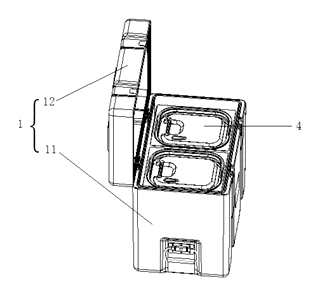
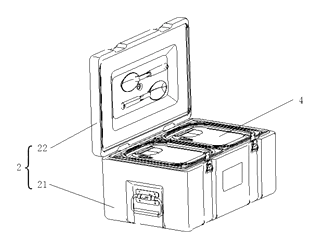
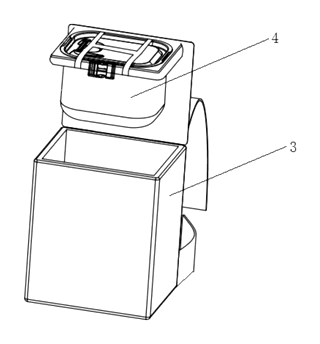
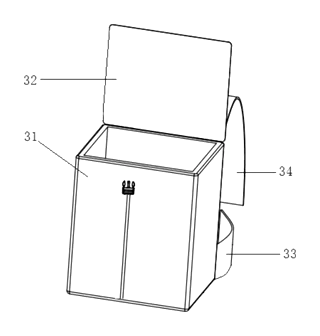
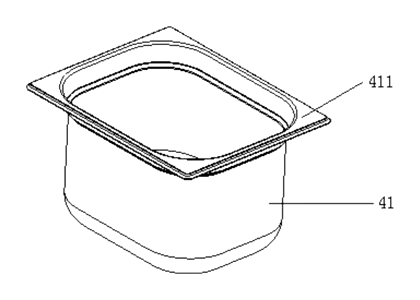
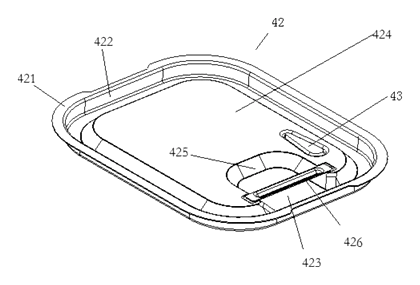
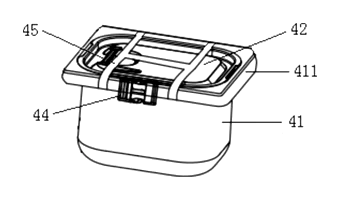
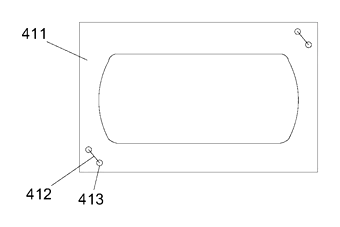
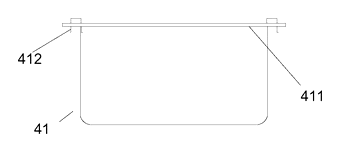

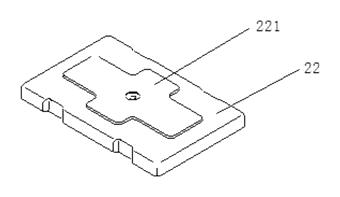
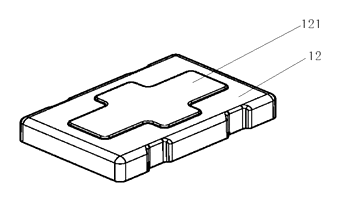
Drawings reproduced from the public patent document for reference.