At a glance
| Patent number | CN219396873U (application CN202320285206) |
| Type | China utility model (实用新型) - protects product shape and structure |
| Original title | Cup cover with sealing device and drinking container (一种具有封口装置的杯盖及饮用容器) |
| Patent owner | Guangdong Musen Commodity Co ltd |
| Inventors | Huang Sihua |
| Filing date | 2023-02-22 |
| Grant date | 2023-07-25 |
| Status (China) | In force - valid until at most 2033-02-22 (if annual fees are paid) |
| Patent family | Chinese filings only - no US, European, Japanese, PCT or other filings listed |
| Cited by | 0 later documents |
| Source | Google Patents (search for CN219396873U) |
What the claims cover, in plain language
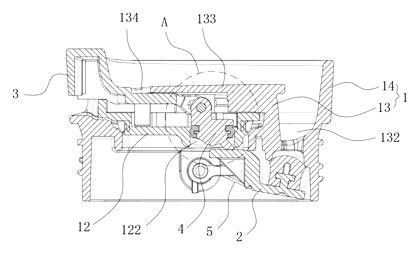
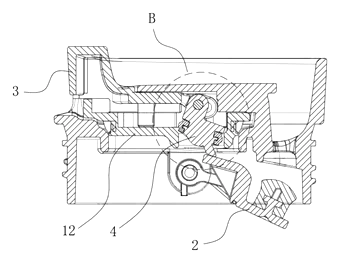
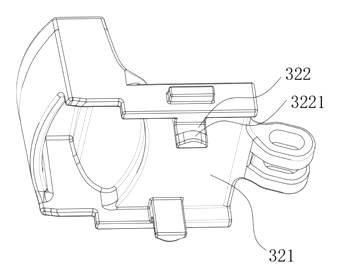
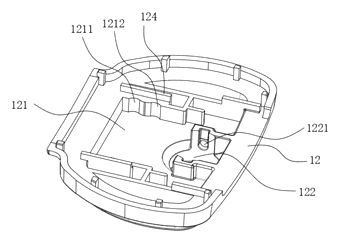
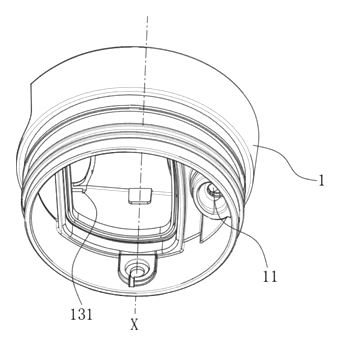
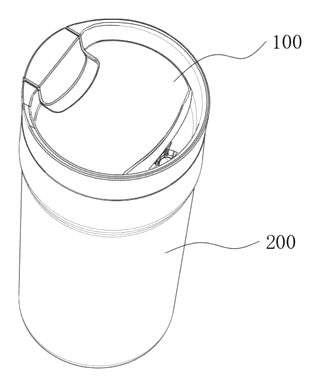
Claim 1 defines a cup lid comprising a lid main body with a drinking opening, a sealing piece, an operating piece, and a transmission piece. The sealing piece penetrates the top of the lid body and is rotatably connected to the inner wall, moving between a first (sealed) and second (open) position. A reset piece biases the sealing piece to the first position. The operating piece has an external part and an internal sliding part that engages with a first sliding groove on an internal mounting plate. The transmission piece is rotatably connected to the mounting plate; its upper end connects to the sliding part, and its lower end abuts the sealing piece. Sliding the operating piece toward the opening rotates the transmission piece, which pushes the sealing piece to the open position.
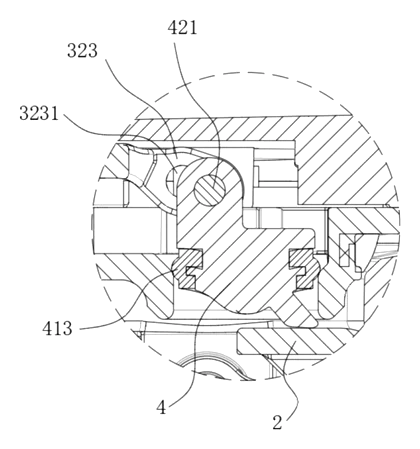
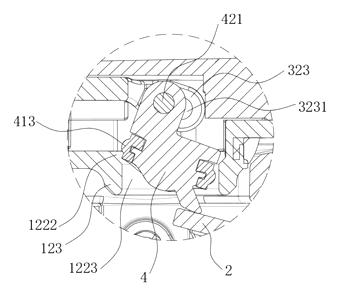
Claim 2 specifies the transmission piece structure: a rotor connected via a positioning shaft in a longitudinal rotation channel of the mounting plate. It includes a first transmission part protruding upward to connect with the sliding part, and a second transmission part protruding downward to abut the sealing piece.
Claim 3 adds a sealing ring installed in a sealing groove on the rotor’s periphery, ensuring the rotation channel remains sealed. The positioning shaft is arranged above the sealing groove.
Claim 4 details the geometry of the sealing groove and sealing ring, involving concave and convex rings that interlock to form a cambered surface structure, enhancing the seal integrity during rotation.
Claim 5 describes the spatial arrangement where the first transmission part protrudes above the rotation channel and the second below, forming a V-shaped structure within the channel to optimize force transfer.
This is a simplified reading for orientation only. The legal scope is defined by the exact claim wording in the official Chinese document.
What this means for US production
This patent was filed only in China and is currently in force in China. Making, using, or selling this specific mechanism in China requires permission from the patent owner. However, because there are no corresponding US patents, the design itself is not restricted by this specific patent number in the United States.
Two points to settle early:
- Other patents may exist. The drinkware market is highly competitive with many existing utility models and design patents regarding flip-lids, ball-valves, and magnetic closures. A freedom-to-operate (FTO) review is recommended to ensure your specific implementation of the slider-lever mechanism does not infringe on other active US patents in the “one-touch lid” category.
- Material Safety. Since this involves food contact, the choice of plastics (PP, Tritan, etc.) and silicone seals must comply with FDA regulations regardless of patent status.
Customization and manufacturing
What can be customized
| Area | Options |
|---|---|
| Actuator Type | Slider length, button shape, color, and texture for better grip. |
| Sealing Material | Silicone, EPDM, or TPE rings; hardness adjustments for different temperature ranges. |
| Lid Profile | Diameter and height adjustments to fit various bottle neck sizes (e.g., 51mm, 58mm, 63mm standards). |
| Mechanism Housing | Internal mounting plate material (plastic vs. metal inserts) for durability. |
| Spring Force | Adjusting the reset piece tension to balance ease of opening vs. secure closing. |
Things to plan for (US market)
- FDA Food Contact Regulations: All materials contacting the beverage must be compliant with 21 CFR parts for food additives.
- CPSC General Product Safety: Ensure no small parts detach during normal use that could pose a choking hazard, especially if marketed towards families.
- California Prop 65: If using certain plastics or finishes, screening for lead, cadmium, or phthalates may be required for labeling warnings.
- BPA-Free Claims: If marketing as BPA-free, verify all resin suppliers provide certificates of analysis.
How a project runs
- Inquiry - Define bottle neck size, desired capacity, and aesthetic requirements.
- Design - CAD modeling of the lid, simulation of the slider-lever kinematics, and selection of sealing materials.
- Prototype - 3D printed or soft-tool samples to test opening force, sealing integrity, and drop resistance.
- Pilot Run - Injection molding trial, assembly, and quality control checks for leak rates.
- Production - Full-scale injection molding, silicone compression molding, automated assembly, and packaging.
Quantities & timeline
Tooling for multi-part plastic lids typically takes 4-6 weeks for mold creation. Injection molding cycles are fast, but assembly of the spring and transmission pieces may require semi-automated stations. Certification testing for food safety adds 2-4 weeks. Send us your target bottle neck size, estimated annual volume, and preferred materials and we will reply with options.
Patent drawings
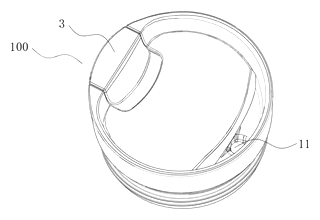
Drawings reproduced from the public patent document for reference.