At a glance
| Patent number | CN222786704U (application CN202421625122) |
| Type | China utility model (实用新型) - protects product shape and structure |
| Original title | A pet food dispensing toy (一种宠物漏食玩具) |
| Patent owner | Jiangsu Tianquan Pet Products Co ltd |
| Inventors | Qiu Bin |
| Filing date | 2024-07-10 |
| Grant date | 2025-04-25 |
| Status (China) | Active - In force in China until at most 2034-07-10 (if annual fees are paid) |
| Patent family | Chinese filings only - no US, European, Japanese, PCT or other filings listed |
| Cited by | 1 later document |
| Source | Google Patents (search for CN222786704U) |
What the claims cover, in plain language
Claim 1 defines a pet food dispensing toy comprising a tubular member with a body portion and at least two head portions. The head portions have internal cavities with coupling members that releasably connect to the body. The body has grain outlets. Block members attach to the body via a second cavity and feature weeping mouths.
Claims 2-3 specify that the head portions include molar bumps located on rounded tips to aid chewing and protect oral tissue.
Claim 4 adds wet troughs (grooves) to the surface of the block members for holding soft food.
Claims 5-6 describe the locking mechanism: the body has guide channels with through-slots and resilient members. The head portions have mating protrusions that slide into the channels and rotate to lock under the resilient member.
Claims 7-8 detail the geometry of the guide channel, including axial sections for translation and rotational segments for twisting the head into the locked position.
Claim 9 introduces alignment marks on the head portions to visually indicate the locked or unlocked state.
This is a simplified reading for orientation only. The legal scope is defined by the exact claim wording in the official Chinese document.
What this means for US production
This patent was filed only in China and is currently active. Making or selling this specific design in China requires the owner’s permission. Since there are no US patents claiming priority to this application, the design itself is not restricted by this patent in the United States. However, general pet toy safety regulations apply.
Two points to settle early:
- Other patents may exist. The pet toy market is crowded with patents covering treat dispensers, especially those with modular or locking features. A freedom-to-operate (FTO) review is essential to ensure your specific implementation of the locking mechanism and modularity does not infringe on existing US utility or design patents held by major brands like Kong, West Paw, or others.
- Material Safety. US buyers strictly enforce non-toxic material standards. Ensure the injection molding resins meet FDA or equivalent requirements for pet products.
Customization and manufacturing
What can be customized
| Area | Options |
|---|---|
| Dimensions | Tube length, diameter, and wall thickness based on target pet size. |
| Colors | Pantone-matched colors for body, heads, and blocks. |
| Textures | Variation in molar bump density and wet groove depth. |
| Locking Feel | Adjust tolerance of the resilient member for tighter or looser fit. |
| Packaging | Blister packs, boxes, or eco-friendly paper sleeves. |
Things to plan for (US market)
- ASTM F963 - Standard Consumer Safety Specification for Toy Safety. Although this is a pet product, many retailers use similar mechanical hazard tests (small parts, sharp edges) as a baseline.
- FDA 21 CFR - If the toy is marketed for contact with human food (e.g., spreading peanut butter), materials should ideally comply with food-contact grade standards.
- Proposition 65 - California warning labels may be required if certain chemicals are present in plastics or finishes.
- CPSC Guidelines - While CPSC regulates children’s toys, pet products fall under FDA/AAFCO oversight, but safe design practices (avoiding small detachable parts that could cause choking) are critical for liability.
How a project runs
- Inquiry - Define pet size range, desired capacity, and color scheme.
- Design - Finalize CAD models for the body, heads, and locking mechanism.
- Prototype - 3D print samples to test the locking torque and ease of assembly.
- Testing - Conduct bite tests, drop tests, and washability checks.
- Production - Injection mold tooling creation, followed by mass production and assembly.
Quantities & timeline
Tooling costs depend on the complexity of the multi-slide molds needed for the undercuts in the locking mechanism. Lead times typically range from 8-12 weeks for tooling and initial production. Send us your target retail price, estimated volume, and specific material preferences and we will reply with options.
Production notes
Tooling and process
Injection molding is the likely primary process for the body, heads, and blocks due to the complex geometries and undercuts required for the locking mechanism. TPE overmolding might be used if softer grip zones are desired, though the patent specifies rigid structures. Assembly relies heavily on snap-fit principles facilitated by the spring-loaded locking tabs.
Cost drivers
Part count is likely a significant driver because each module (head, block, body) requires separate molding operations. Bite-resistant material selection impacts resin cost. Cleaning design considerations affect mold complexity; avoiding deep crevices reduces post-processing needs. Packaging must accommodate the modular nature without excessive bulk.
Prototyping path
Typically, prototyping starts with a 3D-printed sample to verify the locking mechanism’s tactile feedback and durability. Obtain material safety certificates early to confirm non-toxicity. Perform bite and pull tests on functional samples to ensure small parts do not detach under stress. Only proceed to tooling after validating the fit and finish of the resilient members.
What we would change before tooling
We would likely adjust the wall thickness uniformity to prevent warping during cooling, especially in the long tubular body. Joint design tolerances between the head and body need careful calibration to balance ease of unlocking with security against pet manipulation. Ensuring the molar bumps are smooth enough to prevent injury but textured enough to engage teeth is critical.
Common failure points
Bite penetration remains a risk if the plastic grade is too brittle. Small parts detaching is the primary safety concern; the locking mechanism must withstand repeated twisting without fatigue failure. Dirt trapped in seams can occur if the fit between modular pieces is too tight or irregular. Fastener corrosion is unlikely given the snap-fit design, but material degradation from saliva exposure should be tested.
Patent drawings
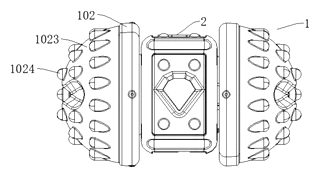
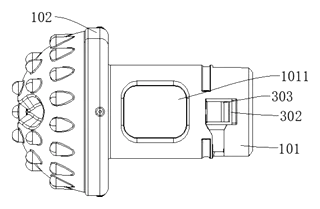
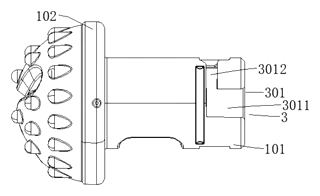
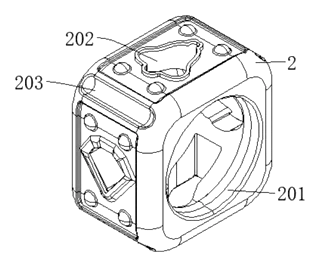
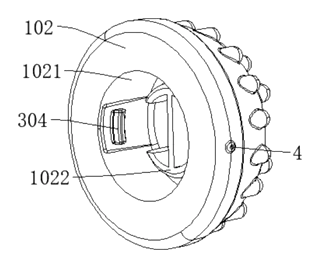
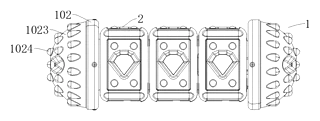
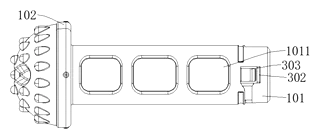
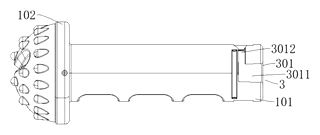
Drawings reproduced from the public patent document for reference.