Executive summary
The U.S. market for automatic self-cleaning cat litter boxes was estimated at about USD 125.3 million in 2024, on a definition that covers automatic and self-cleaning units only, and is projected to reach USD 182.2 million by 2030 at a compound annual growth rate of 6.6%. [F1] That is a narrow slice of a large pet category: U.S. pet spending reached USD 158 billion in 2024, of which USD 34.4 billion went to supplies, live animals and over-the-counter medicine. [F4]
A second estimate puts the global automatic self-cleaning litter box market at USD 719 million in 2025, with North America at USD 262 million, or 36.5% of the total, and unit shipments of 3.35 million at a blended average selling price of USD 215. [F2] The two estimates do not reconcile: the first implies a global market of roughly USD 559 million in 2024, while the second gives USD 719 million in 2025, and their definitions of “automatic” and their channel coverage differ. [F1] [F2] This report therefore presents both and does not average them.
Europe is the second-largest market on the same definition: USD 134.0 million in 2024, or 24.0% of the global total, rising to USD 216.4 million by 2030 at 8.5% a year, with the UK the fastest-growing country. [F11] Japan does not publish a standalone automatic-litter-box figure; the wider pet-appliance market that contains it was JPY 5.2 billion in 2024, up 13.0%, and is forecast at JPY 6.3 billion in 2027, about USD 35 million and USD 42 million at the 2025 average rate. [F12] [F14] In China, AVC data put online pet-appliance sales at RMB 410 million in 2025, up 5.5%, on 330,000 units, up 24.3%, a total that covers several appliance types rather than litter boxes alone. [F13] [F14]
The demand base is growing. Forty-nine million U.S. households owned a cat in 2024, up from 40 million in 2023, a 23% increase, and the share of single-cat households fell from 64% in 2018 to 58% in 2024, which shifts the mix toward multi-cat capacity. [F3] Automatic units are also taking a larger share of litter-box revenue: they are put at roughly 22–28% of U.S. litter box revenue in 2026 and 35–45% by 2035. [F5]
The competitive field is concentrated at the top but crowded below: Whisker holds 27.1% of global revenue, PETKIT 8.5%, CATLINK 7.0% and PetSafe Brands 6.3%, in a market the same source counts at 613 players. [F2] The sources show revenue shares at the global level, not U.S. or European retail shares.
The regulatory questions are electrical, ozone and claims, not food or medical. A connected unit falls under FCC Part 15, an appliance under UL 60335-1, and any ozone generator sold as an air cleaner must meet California’s ozone limit and certification rules; UV or ozone claims of germ kill bring the product under EPA pesticide-device rules. [F6] [F7] [F8] [F9] A unit sold in Europe or Japan also needs the local electrical and EMC approvals, which are separate from the U.S. path. [F15]
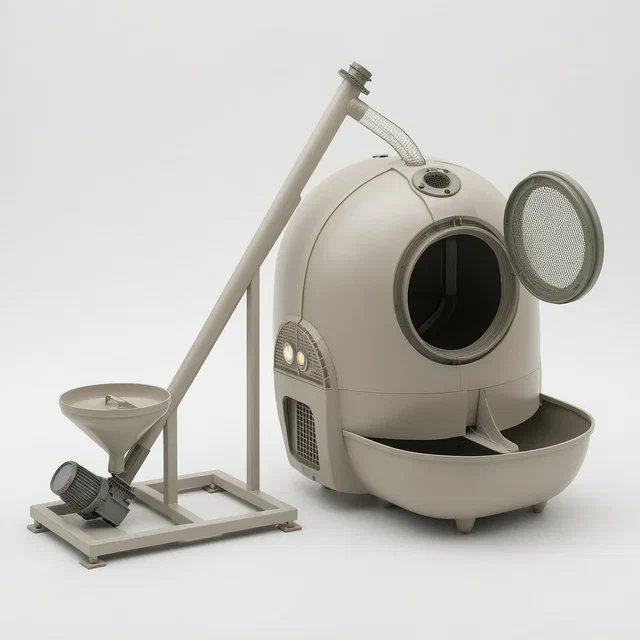
The report covers the U.S., Europe, Japan and China, with import and channel data where a country estimate is not public. One patent on this site relates to a product in this category, a rotating-drum automatic cat toilet with a screening grid, waste compaction, ozone and UV treatment. It is listed at the end of this report; the market analysis below is separate from its structure.
Market size and growth
U.S. automatic units. The U.S. automatic self-cleaning litter box market generated USD 125.3 million in 2024 and is projected to reach USD 182.2 million by 2030, a 6.6% compound annual growth rate for 2025–2030. Single-cat systems were 86.91% of 2024 revenue and multi-cat systems are the faster-growing segment. [F1]
Global and North America. A second source values the global market at USD 719 million in 2025, rising to USD 1.19 billion by 2032 at 7.5% a year, on unit shipments of 3.35 million and a blended average selling price of USD 215. North America is put at USD 262 million, or 36.5% of global revenue, with a 6.7% growth rate for 2025–2030. [F2]
Europe. Europe generated USD 134.0 million in 2024 and is projected to reach USD 216.4 million by 2030, an 8.5% compound annual growth rate for 2025–2030. Europe was 24.0% of the global market in 2024; single-cat systems were 90.22% of European revenue, multi-cat is the faster-growing segment, and the UK is expected to register the highest country growth rate. [F11]
Japan. The automatic cat toilet sits inside Japan’s pet-appliance category, which covers monitoring cameras, automatic feeders and waterers, cat toilets, deodorisers, clippers, dryer rooms and heaters. That category was JPY 5.2 billion in 2024, up 13.0% on 2023, and is forecast at JPY 6.3 billion in 2027, a 21.2% increase on 2024. [F12] At the 2025 average rate of JPY 149.6 per dollar, that is about USD 35 million and USD 42 million. [F14] No public source in this review isolates the automatic toilet within that total.
China. AVC data cited in the Chinese appliance press put online pet-appliance sales at RMB 410 million in 2025, up 5.5%, on 330,000 units, up 24.3% in volume. [F13] At the 2025 average rate of CNY 7.13 per dollar, that is about USD 58 million. [F14] The wording covers pet appliances overall rather than litter boxes alone, and the category is described as past the concept-education stage and now competing on stability, safety and user experience. [F13]
Other markets. Asia-Pacific is the fastest-growing region in the global estimate, at a 9.5% compound annual growth rate for 2025–2030, but the source does not isolate its value or the value of individual countries. [F2]
Why the two global estimates do not reconcile. The U.S. figure implies a global market of about USD 559 million in 2024 at the stated U.S. share of 22.4%, while the second source gives USD 719 million for 2025. [F1] [F2] The gap is larger than a year of growth, so the definitions differ — most likely in whether connected, self-flushing and high-capacity units are included, and in whether values are retail or manufacturer level. Neither source publishes a reconciliation, and this report does not average them.
Share of the wider litter-box market. Automatic and self-cleaning units are estimated at roughly 22–28% of U.S. litter box revenue in 2026, rising to 35–45% by 2035, with furniture-style units also growing. [F5]
Households. Forty-nine million U.S. households owned a cat in 2024, up from 40 million in 2023, and the single-cat share fell from 64% in 2018 to 58% in 2024 while three-or-more-cat households rose 36% over the same period. [F3] Total pet-owning households are put at 95 million. [F4]
IP2M estimate. A new entrant taking 5% of the 2030 U.S. automatic segment would hold about USD 9.1 million at retail, based on the USD 182.2 million projection. [F1] This is an orientation figure, not a forecast; it assumes the projected segment and a share that no source supports.
Product segments and who buys
| Segment | Typical product form | Buyer and channel | What decides the purchase |
|---|---|---|---|
| Single-cat drum | Rotating globe or drum with a sifting grid | Households through e-commerce and pet specialty | Price, footprint, cycle time, litter compatibility |
| Multi-cat high capacity | Larger drum or drawer with a bigger waste bin | Multi-cat households through e-commerce and mass retail | Capacity, cycle frequency, odour control |
| Rake and comb | Rake that sifts clumps into a drawer | Price-sensitive households through mass retail | Price, litter type, jam history |
| Self-flushing or washing | Unit plumbed to water and waste | Premium households with plumbing | Installation, reliability, service |
| Connected health monitoring | Unit with weight and visit tracking and an app | Tech-adopting households | Data quality, app, privacy, subscription |
| Furniture-style enclosure | Litter box built into a cabinet | Design-conscious households | Appearance, room fit, capacity |
The published figures cover the category, not these rows: single-cat systems were 86.91% of 2024 U.S. revenue and 90.22% of 2024 European revenue, and the sources do not split revenue by mechanism. [F1] [F11]
Channel structure differs by market. In the U.S., e-commerce and pet specialty carry the category; in Japan, mail order accounts for about 60% of pet-appliance sales [F12]; in China, online marketplaces and content commerce dominate, and the category is now judged on stability and user experience rather than on novelty [F13].
The buyer’s comparison set is the manual box. An automatic unit costs several times a basic tray and has to justify itself on time saved, odour and litter use, so the purchase is decided by reliability and by the cost of a failed cycle, not by the feature list. [F5]
Competitive landscape
Whisker holds 27.1% of global revenue, PETKIT 8.5%, CATLINK 7.0%, PetSafe Brands 6.3%, Neakasa 3.5%, Casa Leo 2.1%, CatGenie 2.0%, AIRROBO 1.7%, Meowant 1.7% and Petree 1.1%, in a field the source counts at 613 players. [F2] The top three therefore account for about 42.6% of global revenue on those figures. [F2]
The structure is a premium brand leader with a long tail of marketplace sellers. Whisker’s position rests on a long-running drum product and an app ecosystem; PETKIT and CATLINK, both Chinese brands, compete on price and feature density and are strong in cross-border e-commerce. [F2] The sources do not give U.S. or European retail shares, so a launch should treat the global ranking as a guide to competitors, not as a local share table.
Trends and innovation opportunities
Trends
Connected health monitoring. Weight and visit tracking is the main software differentiator, and it is the feature most likely to justify a subscription. [F2]
Odour control as a system. Ozone, UV, carbon filters and sealed waste compartments are sold together, which raises the compliance burden rather than lowering it. [F1] [F6] [F9]
Multi-cat capacity. The shift away from single-cat households supports larger drums, bigger waste bins and more frequent cycles. [F3]
Price-tier spread. Automatic units are quoted from about USD 100 to USD 600, with super-premium models above USD 300, so the category is not a single price point. [F5]
Japan’s pet-appliance channel. Mail order is about 60% of Japanese pet-appliance sales, and large electronics and furniture retailers have entered the category, which favours units that can be shipped and installed without a specialist. [F12]
China’s online volume. Chinese online pet-appliance volume grew 24.3% in 2025 while value grew 5.5%, a sign of price pressure alongside adoption. [F13]
Innovation opportunities
The opportunities below are an analyst reading of the segment structure, not a sourced forecast.
- A cycle that cannot trap a cat. A rotating drum with a gravity sensor needs a fail-safe: what to prove is detection of a cat inside, a stop that does not depend on the app, and a manual release.
- Waste compaction that survives wet clumps. Compaction raises capacity but concentrates the failure mode; what to prove is torque margin, jam recovery and odour containment after repeated cycles.
- Odour treatment that is legal to sell. Ozone and UV are effective selling points only if the device meets the ozone limit and the claims stay within pesticide-device rules. [F6] [F9]
- Litter compatibility. The grid has to work with clumping clay, crystal and plant litter; what to prove is sift rate and dust tolerance across the common litter types.
- A unit that ships flat. A collapsible or knock-down frame lowers the cost of the cross-border and mail-order channels that matter in Japan and China. [F12] [F13]
Manufacturing and supply chain
An automatic litter box is a consumer appliance built around a moulded drum and base, a gear motor and transmission, position and weight sensors, a controller with an optional Wi-Fi module, and a waste drawer. Odour treatment adds a UV lamp, an ozone generator, a fan and a filter pack.
Processes. Injection moulding of the drum, base and drawer; metal stamping for the frame and axles; gear-motor assembly; sensor and harness assembly; board assembly; filter and lamp fitting; final assembly, cycle testing and packaging.
Tooling. The drum and base moulds are the main tooling cost, followed by the drawer and the cover. A rotating drum is a large, round part with tight tolerances at the seal, so tooling and mould qualification take longer than the electronics.
Cost drivers. Mould size and cavitation, motor and gearbox, sensors, Wi-Fi module, UV lamp and ozone generator, filter media, and assembly labour. The electronics are commodity; the cost sits in the moulded drum, the drive and the test time needed to prove the cycle is safe.
Quality and testing. Buyers test cycle life, jam detection, cat-presence detection, motor torque, noise, odour containment, seal wear and app connectivity. No public source in this review breaks down component cost or lead time for automatic litter boxes; the paragraphs above are manufacturing judgment, to be replaced with supplier quotes before a commercial commitment.
Compliance and market entry
A connected unit falls under FCC Part 15 for its radio and digital circuitry. [F7] As a household appliance it is normally tested to UL 60335-1 or an equivalent standard, and a lithium battery pack, if used, to UL 2054 or UL 1642. [F8]
Ozone is the category-specific trap. California limits ozone emissions from indoor air cleaning devices to 0.050 ppm and requires certification, labelling and a compliant test report under 17 CCR 94800 et seq.; an ozone generator sold as an air cleaner without that certification cannot legally be sold in California. [F6]
Claims are the second trap. A UV lamp or ozone generator that claims to kill or inactivate micro-organisms is a pesticide device under FIFRA, which requires an EPA establishment number, compliant labelling and import notice, and generic germ-kill claims that are not supported by product-specific testing are treated as misleading. [F9] California Proposition 65 applies to the plastics, coatings and electronics in the usual way. [F10]
Outside the United States, the same unit needs the local electrical and EMC approvals: CE marking under the Low Voltage and EMC Directives, RoHS and REACH for materials, and PSE under Japan’s Electrical Appliance and Material Safety Act. These are separate from the FCC and UL path and should be planned per market. [F15]
No food-contact or medical-device rule applies to the litter box itself. Local rules on disposing of cat waste are separate from product regulation, and a seller should not claim that used litter is flushable or compostable without checking the local rule.
The public record shows no U.S. family member for the patent linked to this report. That is an opening rather than a clearance: separate U.S. patents on rotating litter boxes, sifting drums and waste drawers may still apply, and a freedom-to-operate review is required before launch.
For a launch, the practical sequence is: settle the odour-treatment design and its claims first, because that decision drives certification; confirm the ozone path or remove the ozone generator; test the cycle and the cat-presence detection; complete electrical and EMC testing for each target market; and review materials against Proposition 65 and REACH. A partner already selling into the pet channel usually owns this process.
Commercial paths, risks and open questions
Path 1: OEM for a pet brand. The brand brings the channel, the app and the compliance work; IP2M supplies the drum mechanism, the compaction system and the production package. This is the realistic route because certification and claims are the expensive part.
Path 2: private label for a retailer. A retailer’s own brand in the U.S., Europe or Japan can absorb a simpler unit without connectivity, priced for mass retail, with the odour system reduced to a filter.
Path 3: contract manufacturing for an existing brand. Building a known brand’s next model uses the same tooling and test capability without carrying the brand’s marketing cost.
Path 4: distribution of a completed unit. The lowest-margin route, and the one most exposed to the ozone and claims rules because the distributor owns the listing.
Risks. Cat safety and entrapment, jam recovery, sensor reliability, ozone and UV claims, motor and gearbox life, noise, litter compatibility, returns, app privacy and country-specific approvals are the recurring risks. A cycle that traps a cat is a safety event, not a warranty claim.
Open questions. The public record does not give a defensible U.S. or European retail value, a split by mechanism, a standalone Japanese value, or field reliability data for rotating-drum units. The grade for any single product would improve if a partner commits to a non-ozone odour path, the unit passes cycle and cat-presence testing, and an FTO review finds no blocking U.S. claims; it would fall if the product depends on ozone claims to sell, if the drum cannot be made reliable across litter types, or if the app data creates a privacy problem.
Sources
- [F1] Grand View Research, U.S. Automatic Self-Cleaning Cat Litter Box Market Size & Outlook, 2030, research report (public summary), 2024.
- [F2] Ken Research, Global Automatic Self-Cleaning Cat Litter Box Market 2025–2032, research report (public summary), 2025.
- [F3] American Pet Products Association, 2025 Dog & Cat Report (press release), industry association survey, 2025.
- [F4] American Pet Products Association, Industry Trends and Stats, industry association statistics, 2025.
- [F5] IndexBox, Litter Boxes Market in the United States, research report (public summary), 2026.
- [F6] California Air Resources Board, Regulation for Limiting Ozone Emissions from Indoor Air Cleaning Devices, 17 CCR 94800 et seq., regulation, current.
- [F7] U.S. Federal Communications Commission, 47 CFR Part 15 – Radio Frequency Devices, regulation, current.
- [F8] UL Solutions, UL 60335-1, UL 2054 and UL 1642 – Household Appliance and Battery Safety Standards, safety standards, current.
- [F9] U.S. Environmental Protection Agency, Pesticide Devices (40 CFR 152.500 and Pesticide Registration Manual chapter 13), regulation and guidance, current.
- [F10] California Office of the Attorney General, California Proposition 65, regulation, current.
- [F11] Grand View Research, Europe Automatic Self-Cleaning Cat Litter Box Market Size & Outlook, 2030, research report (public summary), 2025.
- [F12] Yano Research Institute (矢野経済研究所), 2025 Pet-Related Market Marketing Overview (in Japanese, Nikkei press release), research report, 2025.
- [F13] All View Cloud (奥维云网, AVC) cited in Mysteel, 2025 China Household Pet Appliance Industry Report (in Chinese), industry media, 2026.
- [F14] Internal Revenue Service, Yearly Average Currency Exchange Rates, official statistics, 2025.
- [F15] EUR-Lex, Low Voltage Directive 2014/35/EU, EMC Directive 2014/30/EU, RoHS 2011/65/EU and REACH; Ministry of Economy, Trade and Industry (Japan), Electrical Appliance and Material Safety Act, regulations, current.