Market & Commercial Opportunity
The U.S. Child Seating Market
Market size, product segments, buyer channels, competition, trends, manufacturing, compliance and the commercial opportunity in U.S. high chairs, booster seats and folding child seats.
Published November 10, 2026
Executive summary
Child seating is a brand-led, safety-led category in which a failure is a recall rather than a return. Public estimates put U.S. high chairs and booster seats at about USD 536.7 million in 2024 on a narrow definition, while a broader high-chair measure puts the U.S. market at USD 1,092.1 million. [F1] [F2] The two figures use different definitions and are not additive.
Within the broader measure, traditional high chairs hold about 30.12% of value, convertible models are the fastest-growing type at 4.9% a year, plastic accounts for 52.14% of material use, and offline channels hold 72.25% of sales. [F2] Parents inspect the product in a store before buying, which is why the physical channel still dominates and why a mechanism that works in one movement demonstrates better than one that needs two hands.
The U.S. category is served by Graco, Chicco, Fisher-Price, Evenflo, Peg Perego, Stokke, Britax and Inglesina. Public summaries describe brand presence and product types but do not rank folding-seat mechanisms or their suppliers. [F1] [F2] [F3]
Compact and convertible is where the growth is, and that is the part a folding seat addresses: apartments, grandparents’ homes, travel and strollers that need a detachable seat unit. No public source in this review measures folding child-seat modules separately.
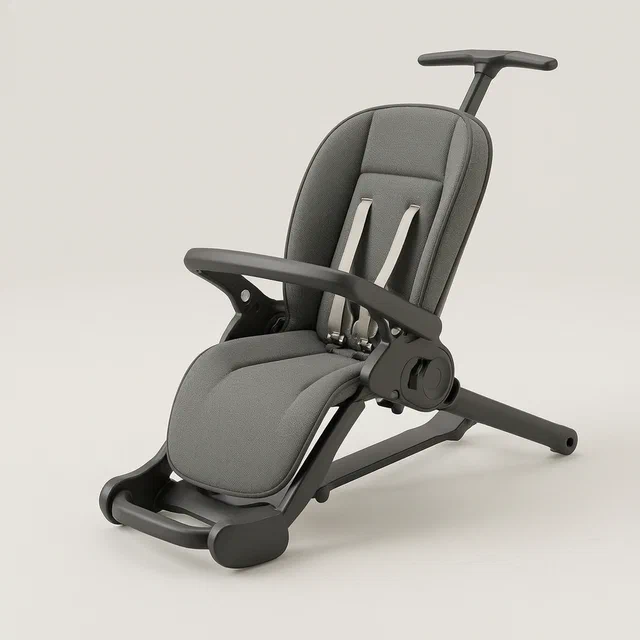
One patent on this site relates to a product sold in this market, a folding child seat. It is listed at the end of this report; the market analysis below is separate from its structure.
1. Market size and growth
U.S. high chairs and booster seats. About USD 536.7 million in 2024 on a narrow definition. [F1]
Broader measure. USD 1,092.1 million for the U.S. high-chair market, with traditional high chairs at about 30.12% of value. [F2]
Growth type. Convertible models are the fastest-growing type at 4.9% a year. [F2]
Materials and channels. Plastic accounts for 52.14% of material use, and offline channels hold 72.25% of sales. [F2]
Folding seat modules. No public source in this review reports folding child-seat modules separately in dollars or units. [F2] [F3]
IP2M estimate. Based on the broad U.S. figure, an illustrative 5% share for folding-seat modules and seats would imply roughly USD 55 million at manufacturer level. That is orientation arithmetic on an unreported sub-segment, not a segment estimate. [F2]
2. Product segments and who buys
| Segment | Typical product forms | Buyer and channel | What decides the purchase |
|---|---|---|---|
| Traditional high chair | Full-size chair with tray and recline | Families through mass and baby retail | Stability, tray, cleaning, price |
| Convertible high chair | Chair that converts to a booster or a child seat | Families through baby retail and e-commerce | Growth range, recline, footprint |
| Booster seat | Seat that straps to a dining chair | Families with older toddlers through mass retail | Size, straps, portability |
| Hook-on and travel seat | Clamps to a table or folds flat | Travelling families, grandparents | Compactness, weight, setup time |
| Stroller seat unit | Seat module that attaches to a stroller frame | Parents with a stroller system | Compatibility, folding, weight |
The published figures cover high chairs and booster seats; the stroller-seat row is described from product types in the channel, not from a measured volume. [F1] [F2]
The buying decision is made by an adult but judged against a child’s safety, and it is inspected in person. That combination rewards visible stability and an obvious one-movement fold, and punishes a mechanism that needs explanation. The compact buyer — apartment, grandparent, travel — is the one who pays for the folding action, and that buyer is a minority of the category but the growth part of it. [F2] [F3]
3. Competitive landscape
Graco, Chicco, Fisher-Price, Evenflo, Peg Perego, Stokke, Britax and Inglesina serve the U.S. category, through mass retail, baby specialists and e-commerce. The sources establish brand presence and product types, not share. [F1] [F2] [F3]
The structure is brand-led and safety-led. Established brands own the retail relationships and the certification record, and a new entrant carries the full test programme before its first sale. That is why the realistic route for a mechanism is supply to a brand rather than a new brand of its own: the partner already owns the certificate, the test history and the shelf. Above the brand level, the mechanism itself is a component business, and component suppliers are not ranked in the public summaries. [F1] [F2]
4. Trends and innovation opportunities
Trends
Convertible is the growth type. Convertible models are the fastest-growing type at 4.9% a year, which means buyers pay for a seat that lasts longer rather than for one that does one job. [F2]
Offline still dominates. Offline channels hold 72.25% of sales, so the product has to work as a demonstration. [F2]
Plastic-dominant construction. Plastic accounts for 52.14% of material use, which sets the tolerances a mechanism has to hold and the appearance standard it has to meet. [F2]
Compact and secondary-home demand. Apartments, grandparents’ homes and travel create demand for seats that fold or detach. This is a reading of product types in the channel, not a measured trend in the sources. [F3]
Innovation opportunities
The opportunities below are an analyst reading of the segment structure, not a sourced forecast.
- One-movement fold. A backrest that drives the armrests through an idle stroke lets the seat open and fold as one action, which is demonstrable on a shop floor. What to prove: the linked action holds tolerance in production, the seat cannot partially collapse, and fold cycle life meets the buyer’s target.
- Everyday recline without a second mechanism. An angle adjustment slot that keeps recline while the fold stays linked removes a latch the parent has to learn. What to prove: the slot holds under a child’s movement, and the two motions cannot be confused.
- A seat unit for a stroller frame. A module that folds flat and attaches to an existing frame extends the stroller system. What to prove: attachment compatibility, folded envelope and weight.
- Pinch-point design. Joints placed and guarded so that a child’s fingers cannot reach them during folding. What to prove: entrapment and shear testing, and that guards do not block cleaning.
5. Manufacturing and supply chain
A folding child seat is a plastic-dominant assembly with metal joints. The shell, armrests and seat are injection-molded plastic, the frame may be steel or aluminum tube, the pivots are metal pins with plastic bushings, the latch parts are springs and clips, and the tray is molded plastic.
Processes. Injection molding, tube bending and coating where a frame is used, pivot and latch assembly, seat assembly, stability and cycle testing, and packaging. A linked folding action adds a controlled idle stroke between the backrest and the armrests, which is a tolerance question at the mold and at the assembly jig rather than a new process.
Tooling. Body, armrest and seat molds carry the tooling cost, and a folding variant usually needs new armrest and backrest molds plus a pivot tool. The latch and slot parts are cheap to tool; the assembly fixture that sets the idle stroke is the piece that decides whether the action feels right in production.
Cost drivers. Mold cavity count, plastic grade and finish, steel in the frame, pivot and latch hardware, assembly labour, testing and packaging. The added pivots and idle strokes are a small bill of materials and a large assembly-tolerance burden, which is where a cost estimate goes wrong on a first run.
Quality and testing. Buyers run stability, entrapment, pinch and shear, drop, dynamic and cycle testing against the applicable high-chair or booster standard, plus a production-sample check. A folding seat should be cycle-tested at the fold joint and at the latch, because the failure mode is a seat that collapses under a child, not a part that wears out slowly.
No public source in this review breaks down component cost or lead time for child seats. The manufacturing paragraphs above are manufacturing judgment, to be replaced with supplier quotes before a commercial commitment.
6. Compliance and market entry
A child seat is a children’s product under CPSIA, requiring lead and phthalate compliance, third-party testing and a Children’s Product Certificate. A high-chair configuration falls under 16 CFR 1231 and ASTM F404-21, a hook-on configuration under 16 CFR 1233 and ASTM F1235-18, and a frame carrier under 16 CFR 1230. The sharp-point and sharp-edge rules in 16 CFR 1500.48 and 1500.49, the 16 CFR 1303 lead-paint limit and California Proposition 65 warnings also apply. [F4] [F5] [F6] [F7]
The standard that applies depends on the configuration, which matters for a seat that can be a chair, a stroller module or a table-mounted seat: each configuration is tested, and a product that switches between them may need more than one programme. That is the costliest part of the development and the reason a brand partner is the realistic route. [F5]
The public record shows no U.S. family member for the patent linked to this report. That is an opening rather than a clearance: separate U.S. patents on folding child seats, stroller seats and latch mechanisms may still apply, and a freedom-to-operate review is required before launch.
For a U.S. launch, the practical sequence is: fix the configurations the product will be sold in; identify the standard for each; run the third-party test programme and prepare the certificate; test the fold joint for cycle life and the seat for entrapment and stability; review materials against Proposition 65 and the lead-paint limit; and keep the records with the product file. A stroller or high-chair brand already selling into the channel usually owns this process.
7. Commercial paths, risks and open questions
Path 1: component supply to a stroller or high-chair brand. The brand brings the certification programme, the retail relationships and the warranty; IP2M supplies the folding mechanism, the seat interface and the production package. This is the shortest route to a first sale.
Path 2: OEM for a compact or travel-seat line. A brand building a folding or travel range needs a mechanism that folds in one movement, and a pilot run can be small.
Path 3: licence for a stroller platform. A seat module designed for an existing frame can be licensed to the platform owner, which concentrates the volume but fixes the interface.
Risks. Certification cost, pinch points near a child’s hands, tolerance drift in the linked idle strokes, stability complaints and a recall are the recurring risks. A seat that collapses under a child ends the brand relationship and the product line at once.
Open questions. The public record does not give U.S. volume for folding child seats, willingness to pay for a one-movement fold, or cycle data for the mechanism described on the linked patent page. The grade for any single product would improve with a brand pilot and passing stability, entrapment, pinch and cycle testing, and would fall if the linked action cannot hold tolerance in mass production or if an FTO review finds blocking U.S. claims.
Sources
- [F1] Global Industry Analysts, Baby High Chairs and Booster Seats – Global Market Trajectory and Analytics, public summary, 2024 (narrow U.S. figure).
- [F2] Grand View Research, U.S. Baby High Chair Market Size and Industry Report, 2033, public summary, 2025 (broad U.S. figure, segment shares).
- [F3] 6Wresearch, North America Baby High Chairs and Booster Seats Market 2025–2031, public listing, 2025 (channel context).
- [F4] U.S. Consumer Product Safety Commission, CPSIA business guidance, current.
- [F5] eCFR, 16 CFR Part 1231, Part 1233 and Part 1230, current.
- [F6] eCFR, 16 CFR Part 1500 and Part 1303, current.
- [F7] California Office of the Attorney General, California Proposition 65, current.
Related patent categories
Related patents
Product pages for patents that fit this market. Each page covers the mechanism, use cases, customization and patent status.