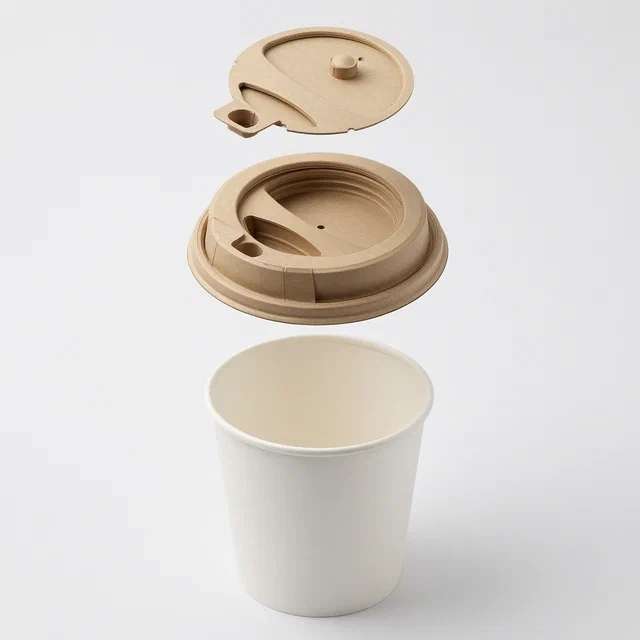
Market & Commercial Opportunity
The U.S. Paper Cup Lid Market
Market size, product segments, buyer channels, competition, trends, manufacturing, compliance and the commercial opportunity in U.S. paper cup lids.
Published November 10, 2026
Executive summary
Cup lids are a high-volume, low-margin packaging component sold almost entirely to businesses. U.S. demand for cups and lids is forecast to grow about 3.4% a year to USD 15.5 billion in 2027, or roughly 479 billion units, with foodservice accounting for 66% of value. [F1] The broader U.S. foodservice single-use products market, which includes cups, lids and containers, was estimated at USD 31.50 billion in 2023 and is forecast to reach USD 38.51 billion by 2029 at about 3.40% a year. [F2]
In North America, paper dominates the material mix for beverage cups and lids, and lids are the fastest-growing product category in that mix. [F3] Paper lids matter because a paper cup with a plastic lid is a mixed-material package that is hard to recycle, and operators under pressure from customers and municipalities increasingly ask for an all-paper answer.
The buyers are converters, foodservice chains and distributors, not consumers. Value is concentrated in foodservice rather than take-home, and converters compete on unit cost, tooling speed and the ability to run board from their existing supply. [F1] [F2] That makes the commercial question a manufacturing one: can the design run on high-speed lid equipment at a cost close to the plastic lid it replaces?
One patent on this site relates to a product sold in this market, a paper cup lid with a venting function. It is listed at the end of this report; the market analysis below is separate from its structure.
1. Market size and growth
U.S. cups and lids. Demand is forecast to grow about 3.4% a year to USD 15.5 billion in 2027, or roughly 479 billion units, with foodservice accounting for 66% of value. [F1]
U.S. foodservice single-use products. The broader category, which includes cups, lids and containers, was estimated at USD 31.50 billion in 2023 and is forecast to reach USD 38.51 billion by 2029 at about 3.40% a year. [F2]
Material mix. In North America, paper dominates the material mix for beverage cups and lids, and lids are the fastest-growing product category. [F3]
IP2M estimate. Based on the foodservice share of the U.S. category, an illustrative 5% of the foodservice value would imply roughly USD 510 million at retail level. That number is large compared with a converter’s lid line, which is why the realistic target is a converter’s own lid programme rather than the whole category. It is orientation arithmetic, not a measured lid segment. [F1] [F2]
2. Product segments and who buys
| Segment | Typical product forms | Buyer and channel | What decides the purchase |
|---|---|---|---|
| Hot-drink lid | Dome, flat and sip lids for coffee and tea cups | Coffee chains, c-stores and distributors through converters | Fit, venting, cost per thousand, delivery |
| Cold-drink lid | Flat and domed lids, straw slots | Quick-service restaurants and distributors | Fit, stackability, leak resistance, cost |
| All-paper lid | Paper or moulded-fibre lids with no plastic liner | Chains and municipalities pushing recyclability | Run speed, seal, cost, recyclability claim |
| Sip and vent feature lid | Lids with a vent hole, plug or flavour pod | Chains and brand programmes | Hygiene, leak, consumer experience |
| Food container lid | Lids for bowls, trays and takeaway containers | Restaurants and food retailers | Fit, strength, stackability |
The published figures cover cups and lids together, not these rows. [F1] [F3]
The buyer’s decision is a line decision, not a consumer decision. A converter buys a design that can run on its existing presses and die-cutters at a known rate; a chain buys a lid that fits its cup, does not leak on a delivery bike and can be explained to a municipal recycling programme. A lid that cannot run fast has no market, whatever its feature. [F1] [F2]
3. Competitive landscape
The U.S. cups and lids market is served by Dart Container, International Paper, Graphic Packaging, Pactiv Evergreen, Berry Global, Huhtamaki, Sonoco and Sabert, a mix of paper converters, plastic moulders and foodservice packagers. The summaries list participants but do not rank them or report their lid volumes. [F1] [F2] [F3]
The structure is converter-led. Large converters own the cup, lid and board supply, which lets them price a lid as part of a system; smaller converters compete on a single product and on tooling speed. A new lid design has to be adopted by one of these converters, because a foodservice chain rarely buys a lid directly from a design owner. [F1] [F2]
4. Trends and innovation opportunities
Trends
Plastic substitution. Municipalities and operators keep pushing away from plastic lids, and an all-paper lid avoids the mixed-material problem that makes a paper cup hard to recycle. [F3]
Paper’s growing share. Paper dominates the North American material mix for cups and lids, and lids are the fastest-growing product category in that mix. [F3]
Venting and consumer experience. Vent holes, sip features and flavour pods have moved the lid from a cover to part of the drinking experience, which creates room for a feature to be branded. This is a reading of product forms in the channel, not a measured trend in the sources. [F3]
Substantiated environmental claims. Recyclable and compostable claims must be backed by evidence, which pushes design toward single-material constructions that are easier to defend. [F7]
Innovation opportunities
The opportunities below are an analyst reading of the segment structure, not a sourced forecast.
- A vent that works without a plastic plug. A paper lid with an integrated vent removes a loose part and keeps the package single-material. What to prove: the vent resists leakage under tilt, it does not tear when the cup is opened, and the lid still stacks and runs at line speed.
- A lid that seals on a standard cup. A paper lid that fits an existing cup rim avoids new cup tooling and lets a converter trial it on an existing line. What to prove: the seal holds on the standard rim, the lid does not split when pressed on, and fit is consistent across board lots.
- One-piece construction. A lid formed from one board blank with no added liner is easier to defend as recyclable. What to prove: the blank forms without cracking at the folds, and the lid keeps its shape in a hot, humid environment.
- Feature without slowing the line. Any vent or sip feature has to run at the converter’s existing rate. What to prove: cycle time, scrap rate and packing density stay within the converter’s limits.
5. Manufacturing and supply chain
A paper cup lid is a formed board product. It starts from coated or uncoated paperboard, sometimes with a thin polyolefin or water-based barrier layer, and is pressed or formed into a rim, a dome or a flat disc with a sip and vent feature. Plastic lids are injection-molded or thermoformed instead, which is a different factory and a different cost structure.
Processes. Board printing, die cutting, forming or pressing, rim rolling, vent punching and packing. A lid that must seal to a cup needs a rim profile matched to the cup’s rolled edge, which is a tooling and tolerance question before it is a design question.
Tooling. Forming dies and rim tools carry the tooling cost, and each lid diameter needs its own set. A vent or sip feature adds a punch or a forming step, which is cheap to tool but can slow the line; that trade-off decides whether a converter will run it.
Cost drivers. Board grade and coating, barrier layer, die life, forming speed, scrap rate, printing and freight. In this category the unit price is measured in fractions of a cent, so a feature survives only if it costs less than the value it adds to the chain or the brand.
Quality and testing. Buyers test fit on the cup, seal under tilt and squeeze, hot-drink performance, stackability, and run speed on the converter’s line. An all-paper lid also needs a recyclability or compostability case that survives scrutiny, because the environmental claim is often the reason for the purchase.
No public source in this review breaks down component cost or lead time for cup lids. The manufacturing paragraphs above are manufacturing judgment, to be replaced with converter quotes before a commercial commitment.
6. Compliance and market entry
Paper and paperboard that contact food must use substances permitted under 21 CFR Part 176, and any polyolefin coating or liner falls under 21 CFR 177.1520. California Proposition 65 warnings may be needed for coatings, inks and adhesives, and recyclable or compostable claims must be substantiated under 16 CFR Part 260. [F4] [F5] [F6] [F7]
This review did not identify a product-specific mandatory federal performance standard for paper cup lids. That is a finding of absence in this review, not a legal conclusion that no standard exists; state packaging rules, extended producer responsibility programmes and customer specifications can still add scope. [F4] [F7]
The public record shows no U.S. family member for the patent linked to this report. That is an opening rather than a clearance: separate U.S. patents on lid vents, cup lid rims and formed-fibre lids may still apply, and a freedom-to-operate review is required before launch.
For a U.S. launch, the practical sequence is: confirm every food-contact material and coating; run fit, seal and hot-drink tests on the target cup; run the lid on the converter’s line and record speed and scrap; substantiate any recyclability claim; and review inks and adhesives against Proposition 65. A converter already supplying the chain usually owns this process, which is why a licence to a converter is the realistic first route.
7. Commercial paths, risks and open questions
Path 1: licence or OEM to a cup-and-lid converter. The converter brings the presses, the board supply and the customer relationships; IP2M supplies the lid design and tooling package. This is the only route that reaches foodservice volume.
Path 2: chain-specific programme. A coffee or quick-service chain that wants a differentiated lid can sponsor the tooling for its own cup. The volume is concentrated and the specification is strict, but the environmental or experience claim is easier to justify.
Path 3: distributor or food-service supplier. A distributor can carry a lid as a catalogue item, which suits a smaller converter without a chain relationship.
Risks. Line speed and scrap rate, seal failure on a standard cup, board cracking at the folds, a recyclability claim that does not survive scrutiny, food-contact documentation, and price competition from plastic and imported lids are the recurring risks. In this category a one-cent difference per thousand units decides the order.
Open questions. The public record does not isolate all-paper lids, give lid unit prices, or report a vented paper lid’s line performance, and there is no test data for the mechanism described on the linked patent page. The grade for any single product would improve with a converter trial and measured line speed, seal and recyclability data, and would fall if the lid cannot run at the converter’s rate or if an FTO review finds blocking U.S. claims.
Sources
- [F1] Research and Markets via GlobeNewswire, United States Cups & Lids Markets Report, 2024-04-03.
- [F2] Research and Markets via GlobeNewswire, US Foodservice Single-Use Products Market Insights Report 2023–2029, 2024-02-13.
- [F3] Nova One Advisor, North America Beverage Cups And Lids Market Size, Share & Trends Analysis Report, public summary, 2025.
- [F4] eCFR, 21 CFR Part 176, current.
- [F5] eCFR, 21 CFR 177.1520, current.
- [F6] California Office of the Attorney General, California Proposition 65, current.
- [F7] eCFR, 16 CFR Part 260, current.
Related patent categories
Related patents
Product pages for patents that fit this market. Each page covers the mechanism, use cases, customization and patent status.