
Market & Commercial Opportunity
The U.S. Desk Lamp Market
Market size, product segments, buyer channels, competition, trends, manufacturing, compliance and the commercial opportunity in U.S. desk and task lighting.
Published November 10, 2026
Executive summary
Desk lamps are a mature, replacement-driven category inside portable and task lighting. Public summaries put the global desk-lamp market at about USD 1.52–1.60 billion in 2024, growing at roughly 3.8–5.3% a year, with the U.S. portion estimated at about USD 423.1 million. Smart desk lamps are counted separately at about USD 326 million worldwide. [F1] [F2] [F3]
Those figures cover the whole category, not premium task lamps, adjustable-beam lamps or lamps sold mainly for eye comfort. The public record does not isolate those segments, so a product plan should use the category numbers as a ceiling and a direction rather than as a forecast. [F1] [F2] [F3]
The category splits by buyer and by job: a commodity task lamp bought on price, an eye-care lamp bought on measured comfort, a smart lamp sold into an app ecosystem, a specialist lamp for drafting or studio work, and a portable lamp for a dorm or bedside. Each has a different channel, price point and proof requirement.
Two patents on this site relate to products sold in this market, one built around a long-reach folding frame and one around an adjustable beam. They are listed at the end of this report; this report covers the market around them, not their structures.
1. Market size and growth
Global desk lamps. Public estimates put the category at about USD 1.52–1.60 billion in 2024, with reported growth of 3.8–5.3% a year depending on the source and scope. The two figures differ in definition, so they are best read as a range. [F1] [F2]
United States. The U.S. portion of the desk-lamp category is estimated at about USD 423.1 million in 2024. [F1]
Smart desk lamps. A narrower estimate sizes smart desk lamps at about USD 326 million globally in 2024. This includes app-connected and sensor-equipped lamps, not the broader category, and should not be added to the figures above. [F3]
IP2M estimate. Based on the U.S. desk-lamp figure, an illustrative 5% share for premium adjustable-beam or long-reach task lamps would imply about USD 21 million at category level. That is orientation arithmetic derived from the published range, not a measured segment, forecast or valuation. [F1]
2. Product segments and who buys
The category is not one product and not one buyer. The table below is a working segmentation built from the product forms described in the sources, not a set of measured shares.
| Segment | Typical product forms | Buyer and channel | What decides the purchase |
|---|---|---|---|
| Commodity task lamp | Fixed or single-hinge desk lamps, often with a clamp base | Households and students through e-commerce, discount retail and office supply | Price, brightness, size, delivery |
| Eye-care and premium desk lamp | Wide-head lamps, flicker-free drivers, glare-controlled panels | Households through e-commerce, electronics retail and office supply | Measured glare and uniformity, adjustability, brand trust |
| Smart desk lamp | App control, scheduling, sensors, sometimes a display or charging | Households through smart-home and electronics channels | Ecosystem fit, setup, app support, design |
| Specialist task lamp | Drafting, piano, sewing and studio lamps with long reach | Professionals and hobbyists through specialist dealers and e-commerce | Reach, footprint, stability, light quality |
| Portable desk lamp | Battery or USB-powered lamps for dorm, bedside and travel | Students and renters through e-commerce and marketplaces | Runtime, charging, fold-flat storage, price |
The published figures cover the category, not these rows. That is why the market-size section treats the category number as a ceiling: a segment number cannot be read from it. [F1] [F2] [F3]
Channel matters as much as size. A commodity lamp is compared on a listing against a dozen near-identical products; an eye-care lamp is sold with test data and a comfort claim; a smart lamp is sold into an ecosystem the buyer may already own. The same lamp rarely serves all three without changes to cost, electronics and packaging. [F1] [F3] [F4]
3. Competitive landscape
The desk-lighting landscape includes Philips (Signify), Opple, Xiaomi, BenQ, Yeelight, Verilux, EZVALO, Meross and Haier, sold through retail, e-commerce, office supply and smart-home channels. The sources establish brand presence and channel, not market share. [F3] [F4]
The competitive structure is layered rather than fragmented. BenQ and other eye-care brands hold the premium comfort story; Xiaomi, Yeelight and Meross compete on smart-home integration and price; Philips and Opple cover broad retail distribution; Verilux and EZVALO occupy narrower wellness and design niches. A new mechanism has to beat an incumbent that already has a listing, a warranty process and a compliance file, and it has to explain its benefit in the first screen of a product page. [F3] [F4]
4. Trends and innovation opportunities
Trends
Eye comfort as a premium claim. Glare control, flicker performance and uniformity have become the features buyers use to justify a price above commodity lamps, and the premium brands already market on them. [F3] [F4]
Smart-home integration. Smart desk lamps are tracked as a separate segment, which shows that app control and sensors now support a distinct product tier rather than a novelty add-on. [F3]
Slimmer heads and integrated optics. Panel-style heads and edge-lit designs have moved from monitors and televisions into task lighting, pushing lamp makers toward light guides, diffusion films and thin housings instead of exposed LED boards. This is a design direction visible in the category, not a measured trend in the sources.
Reach and adjustability. Articulated arms are the default way to move light across a desk; buyers in drafting, music and shared-study settings still pay for reach and for a lamp that stores smaller. The sources describe the category, not the share of adjustable models. [F1] [F2]
Innovation opportunities
The opportunities below are an analyst reading of the segment structure, not a sourced forecast. Each one succeeds or fails on a test the buyer can see.
- Long reach from a small base. A counterweighted arm can put light across a drafting table without a large footprint, and can fold flat for storage. What to prove: the arm holds position when the desk is bumped, the locks do not drift, and the frame survives cycle testing at a weight the premium shelf accepts.
- Beam spread that changes without moving the head. A lamp that widens or narrows its pool of light while the head stays aimed at the book removes a re-aiming step on a shared desk. What to prove: the beam stays uniform across the adjustment, the moving optic does not collect dust, and the optical test report is strong enough to support the claim.
- Fold-flat and pack-flat designs. A lamp that collapses into its own base suits dorm rooms, small apartments and e-commerce packaging. What to prove: the folded size survives shipping, the joints do not loosen, and assembly stays short enough for a retail carton.
- Power and data at the desk. USB charging, pass-through power and cable routing are increasingly expected on premium task lamps. What to prove: the added electronics pass certification without raising the price above the shelf, and the power supply does not compromise the lamp’s thermal design.
5. Manufacturing and supply chain
A desk lamp is a multi-process assembly. The light engine is an LED strip or module, often built around a light guide plate with a reflecting film, a diffusion film and sometimes a prism or lens layer. The housing and joints are injection-molded plastic, die-cast aluminum or stamped steel; arms are aluminum or steel tube; counterweights, springs, friction hinges and, on some designs, small pneumatic parts sit inside the joints. Electronics include the driver, dimming control and, on smart models, a radio module and antenna.
Processes. Injection molding covers housings, joints, lenses and light-guide parts; die casting and extrusion cover metal arms and bases; board assembly and driver production are usually bought in; final assembly, photometric testing and packaging are done at the lamp factory.
Tooling. The main cost sits in injection molds for the optical parts and housings, die-cast or extrusion dies for arms, and assembly fixtures for the joints and wiring. An optical change — a different prism angle or a different light-guide pattern — usually means a new mold, not a new setting, which is why optical differentiation is expensive to iterate.
Cost drivers. LED binning, optical films, driver electronics, the number of joint parts, coating or anodizing, certification testing and packaging move the landed cost more than the shape of the head. Premium lamps carry the extra cost of photometric reports and retail packaging, and smart lamps carry radio certification and app support.
Quality and testing. The tests that decide a retail listing are electrical safety, optical performance and cycle life of the joints. A moving arm, a sliding optic or a lock should be cycle-tested to a target the buyer accepts, and the photometric report should be kept with the product file.
No public source in this review breaks down component cost or factory lead time for desk lamps. The manufacturing paragraphs above are manufacturing judgment, to be replaced with supplier quotes before a commercial commitment.
6. Compliance and market entry
Portable electric luminaires sold in the United States are commonly evaluated to UL 153, with ANSI/UL 8750 referenced for LED equipment; digital or wireless electronics fall under FCC Part 15; DOE 10 CFR 430 can apply depending on lamp type; and California Proposition 65 warnings may be required. The exact listing scope must be confirmed with a test lab. [F5] [F6] [F7] [F8]
This review did not identify a product-specific mandatory federal performance standard for desk lamps beyond the electrical and radio rules above. That is a finding of absence in this review, not a legal conclusion that no standard exists; state rules, retailer requirements and voluntary standards can still add scope. [F5] [F8]
Separately, the public record shows no U.S. family member for the patents linked to this report. That is an opening rather than a clearance: separate U.S. patents on articulated arms, counterweight linkages, sliding optics and pneumatic locks may still apply, and a freedom-to-operate review is required before launch.
For a U.S. launch, the practical sequence is: confirm the lamp’s listing scope with a test lab; run the applicable electrical, photometric and radio tests; prepare the compliance file for the retailer; review materials and finishes against Proposition 65; and keep the photometric and cycle-test records with the product file. A partner already selling into the channel usually owns this process, which is one reason OEM supply is a better first route than a new direct-to-consumer brand.
7. Commercial paths, risks and open questions
Path 1: OEM or private-label supply to a lamp brand. The brand brings the listing, brand trust and warranty process; IP2M supplies the mechanism, optics, tooling and assembly package. The sale is repeatable but competitive, and the mechanism has to pass optical, safety and cycle testing before a pilot.
Path 2: specialist dealer for drafting, studio or music use. A long-reach or beam-adjustable lamp is easy to demonstrate where the buyer already uses a wide work surface. The volume is smaller, but the proof requirement is clearer and the price premium is easier to defend.
Path 3: component or optical-module supply. A lamp maker may want the folding arm, the sliding optic or the lock as a module rather than a finished lamp. This is the lowest-volume, highest-margin route and the easiest to test with one partner.
Risks. Optical tolerance, dust on a moving optic, pneumatic or friction-lock drift, electrical certification, tariff and freight cost, and price competition against mature articulated lamps are the recurring risks in this category. A premium claim also invites comparison: if the measured glare or uniformity does not beat the incumbent, the mechanism does not support the price.
Open questions. The public record does not provide U.S. volume for premium task lamps, willingness to pay for long reach or adjustable beam spread, or cycle-life data for the mechanisms described on the linked patent pages. The grade for any single product would improve with a committed brand pilot and passing optical and cycle data, and would fall if the mechanism cannot meet the price point or if an FTO review finds blocking U.S. claims.
Sources
- [F1] Global Industry Analysts, Desk Lamps – Global Market Trajectory & Analytics, public summary, 2024.
- [F2] Global Market Insights, Desk Lamp Market Opportunity, Growth Drivers, Industry Trend Analysis, public summary, 2024 (2023 data).
- [F3] QYResearch, Global Smart Desk Lamp Market Research Report 2025, public summary, 2025.
- [F4] Global Info Research, global smart LED desk lamp report, public listing, 2026 (brand landscape only).
- [F5] Intertek, UL 153 standard information for portable electric luminaires, 2025.
- [F6] U.S. Federal Communications Commission, Part 15 – Radio Frequency Devices, current.
- [F7] eCFR, 10 CFR Part 430 – Energy Conservation Program for Consumer Products, current.
- [F8] California Office of the Attorney General, California Proposition 65, current.
Related patent categories
Related patents
Product pages for patents that fit this market. Each page covers the mechanism, use cases, customization and patent status.
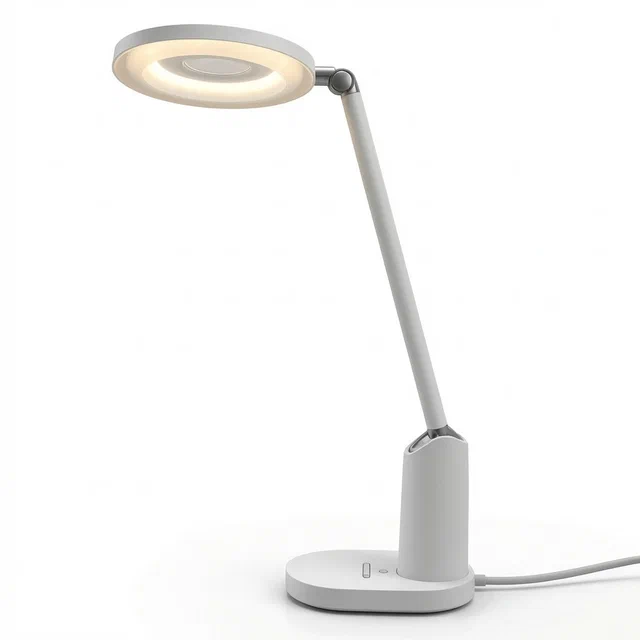
Lighting
Desk Lamp with Adjustable Light-Emitting Angle via Sliding Prism Sheet
Sliding prism sheet controls light angle in a slim LED desk lamp; prevents glare.
Patent CN118167961B
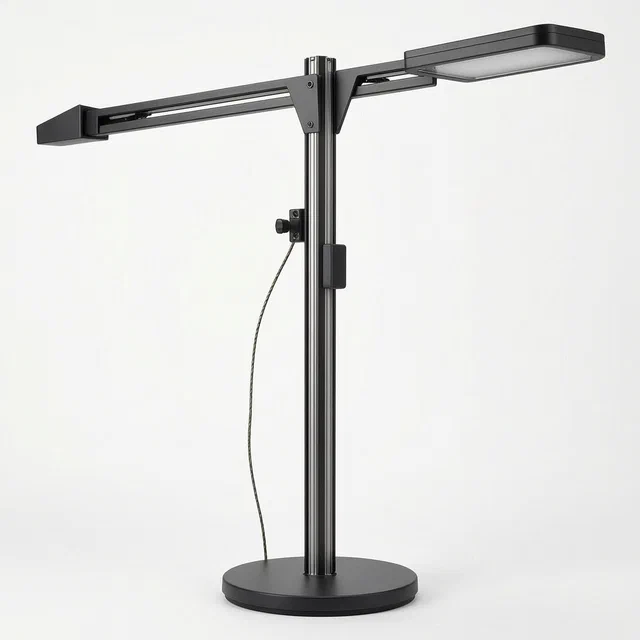
Lighting
Truss-Type Foldable Desk Lamp with Longitudinal and Transverse Guide Adjustment
Foldable desk lamp with vertical and horizontal sliding guides and pneumatic locking.
Patent CN115127051B