Market & Commercial Opportunity
The U.S. Eye Massager Market
Market size, product segments, buyer channels, competition, trends, manufacturing, FDA and FCC compliance, and the commercial opportunity in U.S. consumer eye massagers.
Published November 10, 2026
Executive summary
Consumer eye massagers are a small wellness category with unusually poor public data. Estimates for 2024 range from about USD 68 million on a narrow eye-massage-instrument definition to USD 789.1 million on a broad consumer-device definition, with reported growth of 5.7–7.1% a year. [F1] [F2] [F3] [F4] The spread is more than tenfold and the broadest source carries a data-quality warning, so this report does not present a market size and does not derive a share from these figures.
No source in this review isolates the United States, or the atomisation-plus-heat subcategory that a mist-and-warmth device belongs to. That gap is the central finding: the category is directionally growing with screen time, self-care and gift demand, but the public numbers are too inconsistent to support a total addressable market. [F2] [F3] [F4]
The competitive field includes Xiaomi, Huawei, Panasonic, Breo, Tokuyo, Ifive, TECO and RENPHO, mainly through e-commerce and retail. The sources show presence, not share, and they do not establish that any competitor uses a see-through atomising architecture. [F2]
The larger risk is not hardware but claims. A consumer eye massager marketed for general wellness commonly fits FDA Class I, product code ISA, 21 CFR 890.5660, which is generally 510(k)-exempt but still subject to general controls and the quality-system rules; claims about dry-eye treatment or meibomian gland dysfunction can move the product to Class II, product code ORZ, 21 CFR 886.5200, with a 510(k) pathway. [F5] [F6] [F7] [F8] That makes the wording on the box a regulatory decision, not a marketing one.
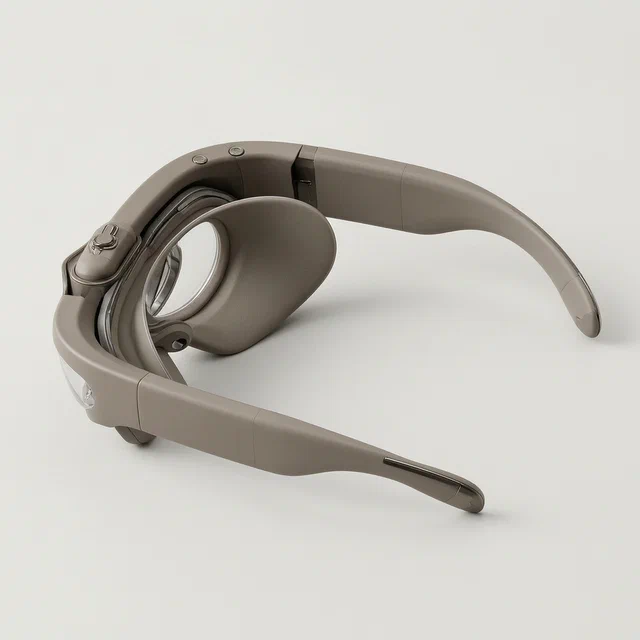
One patent on this site relates to a product in this category, a see-through spectacle-frame device with atomisation and hot compress. It is listed at the end of this report; the market analysis below is separate from its structure.
1. Market size and growth
The range. Public estimates for 2024 run from about USD 68 million on a narrow definition to USD 789.1 million on a broad one, with reported growth of 5.7–7.1% a year. [F1] [F2] [F3] [F4]
Why the range is unusable. The definitions differ in what they count — a dedicated massage instrument, a general eye-care device, or a wearable wellness product — and the broadest source carries a data-quality warning. A tenfold spread cannot be resolved into a growth trend. [F1] [F2]
United States. No source in this review isolates a U.S. value for the category. [F1] [F4]
Atomisation and heat. No source in this review measures the mist-and-warmth subcategory separately. [F2] [F3]
IP2M estimate. None is given. Taking 5% of the broadest figure would produce a number with no more support than the figure itself, and a share of an undefined market is not an estimate. [F1] [F2]
2. Product segments and who buys
| Segment | Typical product forms | Buyer and channel | What decides the purchase |
|---|---|---|---|
| Heated eye mask | Fabric mask with a heater and timer | Households through mass retail and e-commerce | Comfort, heat range, price, washability |
| Vibration massager | Wearable unit with airbags or vibration | Office workers and gift buyers through e-commerce | Pressure pattern, noise, battery, price |
| Mist and heat device | Atomiser with a heated cavity and a frame | Premium wellness buyers through e-commerce | Comfort, seal, cleanliness, price |
| Vision-aware device | Frame that lets the user see while wearing it | Office and travel buyers | Whether the user can keep working, fit, weight |
| Medical-adjacent device | Dry-eye or lid-care device sold with a treatment claim | Patients through eye-care channels | Clinical evidence, prescription path, price |
The published figures cover eye massagers as a category, not these rows and not the United States. [F1] [F4]
The buyer’s comparison set is wide and that is the commercial problem: a buyer may weigh this device against a heated mask, a vibration massager, a dry-eye medical device or a spa accessory, which are different markets with different price points and different regulatory paths. A product that sits between them has to pick one to be compared against, and the choice decides both the price and the claims. [F2] [F5]
3. Competitive landscape
Xiaomi, Huawei, Panasonic, Breo, Tokuyo, Ifive, TECO and RENPHO appear in the category, mainly through e-commerce and retail. The sources show presence, not share, and do not establish that any competitor uses a see-through atomising architecture. [F2]
The structure is consumer-electronics at the top and marketplace-led below. Large consumer brands bring distribution and a claims discipline that keeps them in the wellness lane; marketplace sellers compete on price, appearance and review volume. That leaves room for a premium feature tier — a device that does something the cheap units do not — but the tier is defined by demonstrable comfort and by clean, defensible claims, not by a longer feature list. [F2]
4. Trends and innovation opportunities
Trends
Screen time and self-care. Reported growth of 5.7–7.1% a year tracks the broader self-care and screen-time pattern, which is directionally supportive even though the base is disputed. [F2] [F3]
Gift and travel formats. Compact wearable formats sell as gifts and travel accessories, which favours small, self-contained units. [F2]
Claims discipline. Devices stay in the wellness lane only while their claims stay functional; treatment language moves them into a regulated category. [F5] [F6] [F7]
Cleanliness as a differentiator. Anything that touches the face is judged on what it looks like after a month of use, which rewards designs that can be cleaned and that do not show residue. This is a reading of the product category, not a measured trend in the sources. [F3]
Innovation opportunities
The opportunities below are an analyst reading of the segment structure, not a sourced forecast.
- Warmth and moisture without losing sight. A see-through frame that lets the user keep working while the eyes are warmed and misted is a different use case from a mask that blocks vision. What to prove: the lens stays clear in use, the seal fits a range of faces, and the mist does not condense on the lens.
- A liquid path that does not leak. A reservoir and nozzle next to the eyes is the failure that matters. What to prove: no leakage in any orientation, no clogging after repeated fills, and a reservoir that can be cleaned or replaced.
- Heat inside a safe band. A heated cavity against skin needs a bounded temperature. What to prove: surface temperature limits under fault conditions, and a cut-out that cannot be defeated.
- Sealing that stays soft. An elastic sealing part at the cavity edge decides comfort and mist containment. What to prove: fit across face shapes, and that the material does not harden or crack over a season of use.
5. Manufacturing and supply chain
An eye massager is a small wearable electromechanical device. The frame and housing are moulded ABS or polycarbonate; the lens is injection-moulded optical plastic; the heater is a resistance element on a conducting strip; the atomiser is a piezo or ultrasonic element with a reservoir and nozzle; the seal is silicone or a soft elastomer; the electronics are a small board with a controller, a timer and a battery.
Processes. Injection moulding, lens moulding and coating, heater lamination, atomiser assembly, board assembly, seal fitting, leak testing, thermal testing, final assembly and packaging. A see-through design adds lens cleanliness and condensation as an assembly and test concern.
Tooling. Frame, housing and lens moulds carry the tooling cost, with tooling for the reservoir and nozzle. A sealed cavity with a lens and an atomiser is a compact design problem, so the mould work is where most of the engineering time goes rather than in the electronics.
Cost drivers. Mould cavity count, optical lens quality, heater and atomiser parts, seal material, battery and controller, and assembly labour. The electronics are commodity; the cost sits in the sealed lens cavity and in the test steps that prove it does not leak.
Quality and testing. Buyers test leak, thermal behaviour, skin-contact temperature, seal fit, mist output and battery runtime, and a regulated path adds the quality-system requirements that go with the chosen classification. A device that puts liquid and heat next to the eyes should be tested for both failures at once, because the combination is the hazard.
No public source in this review breaks down component cost or lead time for eye massagers. The manufacturing paragraphs above are manufacturing judgment, to be replaced with supplier quotes before a commercial commitment.
6. Compliance and market entry
A consumer eye massager marketed for general wellness commonly fits FDA Class I, product code ISA, 21 CFR 890.5660, which is generally 510(k)-exempt but still subject to general controls and quality-system requirements under 21 CFR Part 820. Claims about dry-eye treatment or meibomian gland dysfunction can move the product toward Class II, product code ORZ, 21 CFR 886.5200, with a 510(k) pathway. FCC Part 15, UL 2054 for the battery pack, and California Proposition 65 may also apply; the final scope depends on the electronics and the claims. [F5] [F6] [F7] [F8] [F9] [F10] [F11]
The largest risk is therefore the claim, not the hardware. A listing that makes a disease-treatment or vision claim changes the regulatory category and creates a health-claim problem, and that decision is usually made by whoever writes the listing. The second risk is the combination of heat, liquid and skin: a leak at the nozzle, a hot spot in the heated cavity, a poor elastic seal or a contaminated reservoir. [F5] [F6] [F10]
The public record shows no U.S. family member for the patent linked to this report. That is an opening rather than a clearance: separate U.S. patents on heated eye masks, atomisers and wearable frames may still apply, and a freedom-to-operate review is required before launch.
For a U.S. launch, the practical sequence is: fix the claim set and confirm the regulatory classification before designing the packaging; run leak, thermal, skin-contact and cleaning validation; run electrical and battery testing; review materials against Proposition 65; and keep the records in a quality system that matches the classification. A partner already selling into the wellness channel usually owns this process.
7. Commercial paths, risks and open questions
Path 1: OEM for a wellness or personal-care brand. The brand brings the channel, the claim discipline and the quality system; IP2M supplies the see-through atomising mechanism and the production package. This is the realistic route, because the regulatory and claims work is the expensive part.
Path 2: narrow OEM test with non-medical claims. A small pilot sold purely as a comfort device keeps the classification simple and produces the leak and thermal evidence a larger partner will ask for.
Path 3: gifting and travel channel. A compact, presentable device fits gifting, where the appearance of the lens and the seal matters as much as the mechanism.
Risks. Regulatory classification and claim wording, leakage, thermal safety, seal fit, reservoir hygiene, battery and electrical certification, and low-confidence market data are the recurring risks. A device that leaks near the eyes is a safety event, not a warranty claim.
Open questions. The public record does not give a defensible U.S. market size, a measured atomisation-plus-heat segment, or leak and thermal data for the mechanism described on the linked patent page. The grade for any single product would improve if a partner commits to a wellness claim set, the device passes leak and thermal testing, and a U.S. regulatory review confirms the Class I path; it would fall if the product needs a dry-eye or treatment claim to sell, if the seal or reservoir cannot be cleaned safely, or if an FTO review finds blocking U.S. claims.
Sources
- [F1] Data Bridge Market Research, global eye massager market, public summary, 2025 (broad definition; data-quality warning).
- [F2] QYResearch, global and China eye massager report, public summary, 2025 (mid-range definition, company landscape).
- [F3] Global Info Research, Global Eye Massage Instrument Market 2025–2031, public summary, 2025 (narrow definition).
- [F4] YH Research, global eye-care massager report, public summary, 2025 (narrow definition).
- [F5] U.S. Food and Drug Administration, product code ISA establishment registration and device listing, current.
- [F6] eCFR, 21 CFR 890.5660 – Therapeutic massager, current.
- [F7] U.S. Food and Drug Administration, product classification for code ORZ, current.
- [F8] eCFR, 21 CFR Part 820 – Quality System Regulation, current.
- [F9] U.S. Federal Communications Commission, 47 CFR Part 15, current.
- [F10] UL Solutions, UL 2054 – Household and Commercial Batteries, current.
- [F11] California Office of the Attorney General, California Proposition 65, current.
Related patent categories
Related patents
Product pages for patents that fit this market. Each page covers the mechanism, use cases, customization and patent status.