Market & Commercial Opportunity
The U.S. Flashlight Market
Market size, product segments, buyer channels, competition, trends, manufacturing, compliance and the commercial opportunity in U.S. handheld and work lighting.
Published November 10, 2026
Executive summary
Flashlights are a mature, replacement-driven and highly seasonal category. Public summaries put the global flashlight market at roughly USD 0.981–2.03 billion in 2024, growing at 5.7–7.1% a year; the wide spread reflects a narrow flashlight definition in one source and a broader portable-lighting scope in the other. Neither source gives a U.S.-only figure. [F1] [F2]
The category is not one product and not one buyer. It splits into pocket and everyday-carry lights, duty and tactical lights, work and industrial lights, outdoor and emergency lights, and promotional or gift lights. Each has a different channel, price point and durability claim, and a mechanism that suits one rarely suits all five.
Competition is brand-led at the top and price-led at the bottom. Fenix, Streamlight, Olight, Nitecore and Maglite hold the premium and professional shelf through output, runtime, battery ecosystem and durability claims, while unbranded imports compete on price in marketplaces and promotional catalogues. [F3]
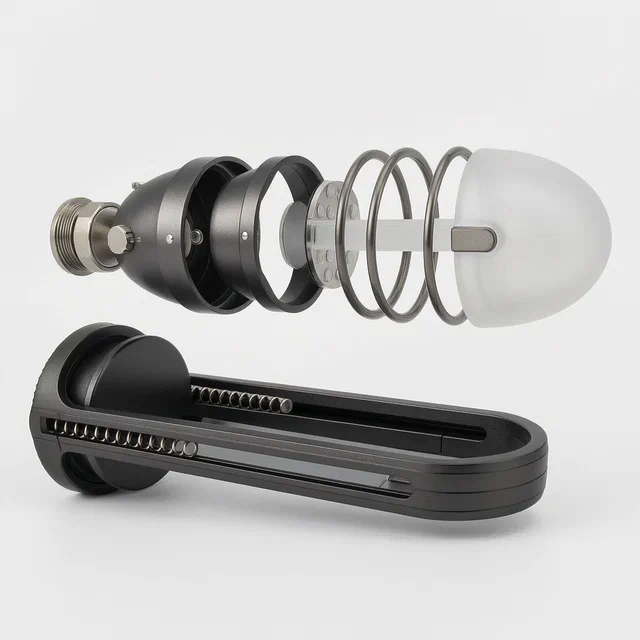
One patent on this site relates to a product sold in this market, a light whose tube and diffuser slide on a vertical rail and are spaced by magnetic rings. It is listed at the end of this report; the market analysis below is separate from its structure.
1. Market size and growth
Global flashlights. Public report summaries put the category at roughly USD 0.981–2.03 billion in 2024 with reported growth of 5.7–7.1% a year. The two figures use different definitions and should be read as a range, not a consensus number. [F1] [F2]
United States. This review did not find a published U.S.-only flashlight figure in the sources. Any U.S. number used in a business plan has to come from a source that isolates the country. [F1] [F2]
Sub-segments. No source in this review isolates sliding-focus, work-light or tactical models in dollars, so the segment volumes in the next section are a working segmentation, not measured shares. [F1] [F2]
IP2M estimate. Based on the published global range, an illustrative 5% share for a mechanically adjustable work light would imply roughly USD 49–102 million at manufacturer level. That is orientation arithmetic, not a measured segment, forecast or valuation. [F1] [F2]
2. Product segments and who buys
| Segment | Typical product forms | Buyer and channel | What decides the purchase |
|---|---|---|---|
| Pocket and everyday carry | Compact single-cell lights, pocket clips, keychain lights | Households and enthusiasts through e-commerce and outdoor retail | Size, output, battery type, clip and switch feel |
| Duty and tactical | Weapon-mountable, tail-switch, high-output lights | Law enforcement, security and enthusiasts through specialist dealers | Reliability, switching, mounting, warranty |
| Work and industrial | Right-angle lights, stand lights, inspection lights | Contractors, maintenance teams and utilities through industrial distribution | Hands-free use, drop and water resistance, battery availability |
| Outdoor and emergency | Camp and car lights, rechargeable lanterns with a flashlight mode | Households and campers through outdoor retail and e-commerce | Runtime, charging, weather resistance, price |
| Promotional and gift | Printed-body lights, keyring lights | Corporate buyers and retailers through promotional distributors | Unit cost, print area, delivery date |
The published figures cover the whole category, not these rows. That is why the market-size section warns against reading a category number as a segment number. [F1] [F2]
Channel shapes the product. A duty light is bought on a specification sheet and a warranty; a work light is bought on availability and battery logistics; a pocket light is bought on a listing image and reviews; a promotional light is bought on landed cost and delivery date. A mechanism that adds parts has to earn its place in one of those decisions. [F2] [F3]
3. Competitive landscape
Fenix, Streamlight, Olight, Nitecore and Maglite are the brands most visible in the category, sold through e-commerce, outdoor retail, dealer networks and industrial distribution. The sources establish presence and channel position, not market share. [F3]
The premium tier competes on measured output, runtime curves and battery ecosystems: a light that shares cells and chargers with the rest of a brand’s line keeps the customer inside that line. The professional tier adds warranty and service, and it is slow to change suppliers. The lower tier is a price market in which a visible mechanical feature — a sliding head, a magnetic mount, a folding stand — is one of the few ways to avoid being a commodity listing. [F2] [F3]
4. Trends and innovation opportunities
Trends
Battery ecosystems. Rechargeable cells, USB-C charging and cross-product battery packs have become the main way premium brands differentiate, and they raise the cost of switching brands. [F3]
Output and runtime transparency. Buyers increasingly compare specified lumens and runtime curves rather than marketing language, which pushes brands toward measured performance claims and documented testing. This is a category reading from how the brands present their products, not a measured trend in the sources. [F3]
Hands-free and mounted use. Right-angle lights, magnetic bases and rail mounts have widened the work-light use case beyond the hand-held beam, and that pulls design toward stands, clamps and attachment points. [F2] [F3]
Size and sealing pressure. Compact bodies with high output run hot and need careful thermal paths, while buyers expect drop and water resistance. The two requirements pull against each other in every new model. This is an engineering reading, not a sourced trend.
Innovation opportunities
The opportunities below are an analyst reading of the segment structure, not a sourced forecast. Each one succeeds or fails on a test the buyer can see.
- Beam adjustment without a twisting head. A light that changes its beam by sliding internal parts, rather than turning the whole bezel, is easier to operate with gloves and easier to demonstrate. What to prove: the slide stays sealed, the setting repeats, and the mechanism survives drops onto the head.
- Magnetic or rail mounting. A body that snaps onto a rail, a bracket or a steel surface turns a hand light into a work light. What to prove: the magnet or latch holds a loaded light at an angle, it cannot release under vibration, and the mount is not a small-parts hazard.
- A work light that stands on its own. A base that lets the light stand at a set height while the beam is aimed by hand suits inspection and repair work. What to prove: stability on a sloped surface, locking that does not slip under load, and a footprint the toolbox accepts.
- Serviceable battery and switch. A light whose cell and switch can be replaced without scrapping the body fits both the professional warranty model and the sustainability story. What to prove: the joint reseals after service and the part cost fits the warranty budget.
5. Manufacturing and supply chain
A metal-bodied flashlight is a precision assembly more than a molded product. The body and bezel are turned or milled from aluminum bar or extruded tube, then anodized; the reflector or total-internal-reflection lens is molded in optical-grade plastic or machined from aluminum; the driver and switch are assembled on a small board; the lens is glass or polycarbonate; the sealing relies on O-rings and a threaded joint.
Processes. CNC turning and milling, extrusion, anodizing, injection molding for optics and buttons, board assembly, lens coating, final assembly and testing. Plastic-bodied and promotional lights substitute injection molding and ultrasonic welding for the metal processes, at lower cost and lower durability.
Tooling. Aluminum bodies need little tooling beyond programs and fixtures, which keeps variant cost low; optics need molds or diamond-turned masters, and a new optical design is the expensive part of a variant. Sealing features are cut into the body, so a change in the sliding or threaded joint usually means a new body program rather than a new part.
Cost drivers. Aluminum grade and wall thickness, anodizing, optical part cost, LED bin, driver electronics, cell and charger, O-ring count, and testing time move landed cost. A moving mechanism adds machining steps, sealing features and assembly time, which is why mechanical differentiation is easier to sell at the professional tier than at the promotional tier.
Quality and testing. Buyers judge a flashlight on output, runtime, beam pattern, drop, water ingress, switch cycles and thermal behaviour. A sliding beam mechanism should be cycle-tested together with a water test, because the two failures interact: a slide that passes one often fails the other.
No public source in this review breaks down component cost or factory lead time for flashlights. The manufacturing paragraphs above are manufacturing judgment, to be replaced with supplier quotes before a commercial commitment.
6. Compliance and market entry
A portable electric luminaire is commonly evaluated to UL 153, with LED equipment referenced to ANSI/UL 8750; a rechargeable pack brings UL 2054, and a lithium battery shipped by air brings UN 38.3 testing and transport rules; digital electronics fall under FCC Part 15; and California Proposition 65 warnings may apply to materials and coatings. Listing scope should be confirmed with a test lab. [F4] [F5] [F6] [F7] [F8]
This review did not identify a product-specific mandatory federal performance standard for flashlight focus mechanisms. That is a finding of absence in this review, not a legal conclusion that no standard exists; retailer requirements and voluntary standards can still add scope. [F4] [F8]
The public record shows no U.S. family member for the patent linked to this report. That is an opening rather than a clearance: separate U.S. patents on sliding bezels, magnetic retention and adjustable optics may still apply, and a freedom-to-operate review is required before launch.
For a U.S. launch, the practical sequence is: confirm listing scope with a test lab; run electrical, battery and radio tests; run drop, water and switch-cycle tests to the buyer’s target; review coatings and materials against Proposition 65; and keep the test records with the product file. A brand already selling into the channel usually owns this process, which is one reason OEM or licence supply is a better first route than a new direct brand.
7. Commercial paths, risks and open questions
Path 1: licence or OEM design for an outdoor, emergency or industrial lighting brand. The brand brings the channel, warranty and compliance file; IP2M supplies the mechanism and production package. This is the most realistic route for a mechanical feature that needs testing before it can be sold.
Path 2: work light for maintenance and inspection teams. A stand-mounted, height-locked light suits buyers who need hands-free light on a bench or a machine. Volume is smaller, the proof requirement is clearer, and the price premium is easier to defend.
Path 3: promotional or gift product. The sliding action and the magnetic parts are visible selling points at low cost, but the tier tolerates no certification delay and almost no price premium.
Risks. Sealing a moving joint, magnet retention and small-parts rules, thermal limits in a compact body, battery certification, and price competition from mature branded lights are the recurring risks. A warranty claim on a switch or a leaking joint reaches a professional buyer faster than almost any other failure.
Open questions. The public record does not give U.S. volume for adjustable-beam or work lights, willingness to pay for a sliding mechanism, or cycle and water test data for the mechanism described on the linked patent page. The grade for any single product would improve with a committed brand pilot and passing drop, water and cycle data, and would fall if the mechanism cannot be sealed at a competitive cost or if an FTO review finds blocking U.S. claims.
Sources
- [F1] Global Info Research, Global Flashlight Market 2025–2031, public summary, 2025 (2024 data).
- [F2] SkyQuest, Flashlight Market Size, Share, Growth Analysis, public summary, 2026 (broad portable-lighting scope).
- [F3] Fenix Store, brand comparison of Fenix, Streamlight, Olight and Nitecore, company site (brand presence only).
- [F4] Intertek, UL 153 standard information for portable electric luminaires, 2025.
- [F5] U.S. Federal Communications Commission, Part 15 – Radio Frequency Devices, current.
- [F6] UL Solutions, UL 2054 – Household and Commercial Batteries, current.
- [F7] International Air Transport Association, lithium-battery dangerous-goods guidance, current.
- [F8] California Office of the Attorney General, California Proposition 65, current.
Related patent categories
Related patents
Product pages for patents that fit this market. Each page covers the mechanism, use cases, customization and patent status.