Executive summary
The United States imported USD 280.0 million of folding-blade knives in 2024, up from USD 266.4 million in 2023, on 214.7 million units, a value increase of 5.1% against a 3.5% fall in volume. [F1] The divergence matters: the average declared value rose from about USD 1.20 to USD 1.30 a unit, which is consistent with a mix shift toward higher-priced knives rather than with a volume-led market. [F1]
The origin mix is concentrated. China supplied USD 148.7 million, Taiwan USD 45.8 million, Vietnam USD 39.5 million, Switzerland USD 11.9 million, Germany USD 7.8 million and Japan USD 6.8 million in 2024, so China is 53.1% of the import value and the top three origins are 83.5%. [F1] U.S. exports in the same heading were USD 89.1 million. [F1]
Europe is the largest region in the wider knife market: it held 32.7% of global knife revenue in 2025, and folding blades are the fastest-growing type in the global knife market at 6.9% a year for 2026–2033. [F11] Within the folding-blade customs heading, Germany imported USD 98.7 million, France USD 36.0 million, the UK USD 19.4 million, Canada USD 40.2 million, Australia USD 13.5 million and Japan USD 9.3 million in the latest year available. [F1] China exported USD 256.8 million in 2024, up from USD 245.3 million in 2023, and the United States took USD 148.7 million of that. [F1] These are import and export values, not retail market sizes.
Retail market estimates are global and inconsistent. One source puts the global folding knife market at USD 2.387 billion in 2024, rising to USD 3.882 billion by 2035 at 4.52% a year, and another at USD 2.54 billion in 2025, rising to USD 4.54 billion by 2034 at 6.67%. [F3] [F4] Neither isolates the United States or Europe, and the difference between them is too large to average, so this report uses the official import series as its anchor and treats the global figures as context.
The product is a mature, lock-led category. Locking folders are described as the leading pocketknife category by an industry publication, and the lapse of the Benchmade Axis Lock patent has opened the crossbar lock to other makers, with CRKT, Hogue, SOG and Civivi among those using bar-style locks. [F5] [F6]
The legal and tariff frame matters more than in most consumer categories. The Federal Switchblade Act prohibits interstate commerce in switchblades, with an exception for assisted-opening knives that have a bias toward closure, and state and local knife laws add their own limits. [F7] The general duty is 3 cents each plus 5.4%, and Chinese-origin goods in this heading also carry the 25% Section 301 List 3 duty. [F2] [F8] In the UK, Japan and the EU, the sale, carry and material rules are different again. [F12] [F13] [F14]
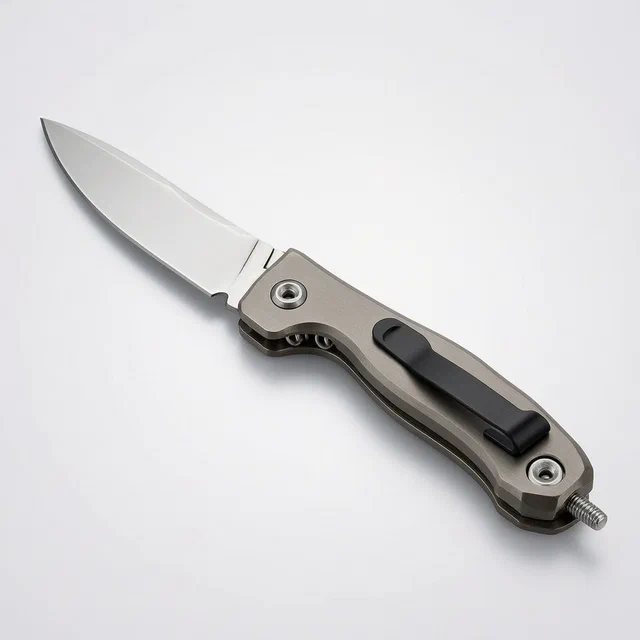
The report covers the U.S., Europe and China, with import data for Canada, Australia and Japan where no country market estimate is public. One patent on this site relates to a product in this category, a folding knife with a tool-free detachable belt clip and a screw-assembled pivot. It is listed at the end of this report; the market analysis below is separate from its structure.
Market size and growth
U.S. imports. The United States imported USD 280.0 million of knives having other than fixed blades in 2024, against USD 266.4 million in 2023, an increase of 5.1%. Volume fell from 222.6 million to 214.7 million units over the same period, so the average declared value rose from about USD 1.20 to USD 1.30 a unit. [F1] These are customs values, not retail prices.
Origins. China supplied USD 148.7 million, Taiwan USD 45.8 million, Vietnam USD 39.5 million, Switzerland USD 11.9 million, Germany USD 7.8 million and Japan USD 6.8 million in 2024. [F1] China is 53.1% of the total, Taiwan 16.3%, Vietnam 14.1%, Switzerland 4.2%, Germany 2.8% and Japan 2.4%. [F1]
Exports. U.S. exports under the same heading were USD 89.1 million in 2024, led by Canada at USD 23.2 million, Germany at USD 12.8 million, Australia at USD 5.8 million, the United Kingdom at USD 5.5 million, Singapore at USD 4.7 million and Korea at USD 3.9 million. [F1]
Europe. Europe held 32.7% of global knife revenue in 2025, the largest regional share, and the global knife market is projected to reach USD 7,790.2 million by 2033 at 6.4% a year, with folding blades the fastest-growing type at 6.9% for 2026–2033. [F11] Within the folding-blade customs heading, Germany imported USD 98.7 million and the UK USD 19.4 million in 2024; France imported USD 36.0 million in 2023, the latest year reported. [F1] The European total is not published on a comparable basis, so the country figures are the usable public data.
China. China exported USD 256.8 million of folding-blade knives in 2024, up from USD 245.3 million in 2023, and the United States took USD 148.7 million of the 2024 total. [F1] China’s domestic retail market is not isolated by any public source in this review; the export series shows it as the largest supplier to the markets that are measured.
Other import markets. Canada imported USD 40.2 million in 2024, Australia USD 13.5 million and Japan USD 9.3 million. [F1] Japan also has a domestic craft tradition, but no public source in this review gives a current production or retail value for Japanese folding knives.
Global retail context. One source values the global folding knife market at USD 2.387 billion in 2024 and USD 3.882 billion by 2035, a 4.52% compound annual growth rate. [F3] A second values it at USD 2.54 billion in 2025 and USD 4.54 billion by 2034, a 6.67% growth rate for 2026–2034. [F4] The definitions and base years differ, and neither isolates a single country.
U.S. retail value. No source in this review gives a defensible U.S. or European retail market value. The import series is the only official value series, and turning it into retail would require a markup assumption that no source supports.
IP2M estimate. A new brand taking 5% of the 2024 U.S. import value would hold about USD 14.0 million at declared value. [F1] This is an orientation figure, not a retail forecast, and the tariff wedge is excluded.
Product segments and who buys
| Segment | Typical product form | Buyer and channel | What decides the purchase |
|---|---|---|---|
| EDC locking folder | One-hand opening blade, liner, frame, crossbar or button lock, pocket clip | Everyday-carry buyers through knife specialty retail and e-commerce | Lock, steel, action, clip, price |
| Traditional slipjoint | Two-handed opener with a backspring | Traditional and collector buyers through specialty retail | Pattern, handle material, brand, finish |
| Tactical and duty | Reinforced frame, coated blade, assisted or manual action | Military, law enforcement and outdoor buyers | Strength, lock, coating, warranty |
| Hunting and outdoor | Fixed or folding blade with a game-processing focus | Hunters and campers through sporting goods | Edge geometry, grip, sheath, steel |
| Collector and custom | Limited runs, premium steels, hand finishing | Collectors through shows, dealers and drops | Maker, materials, rarity, fit and finish |
| Budget import | Value folder with a lock and a clip | First-time and price-led buyers through marketplaces | Price, appearance, review volume |
The segmentation above follows the categories used by the research sources — blade style, application, and price tier — rather than a published country revenue split. [F3] [F4]
The buyer’s comparison set is broad: an import folder, a brand folder and a custom piece are not substitutes, but they compete for the same pocket. The purchase is decided by lock confidence, edge retention and how the knife feels in the hand, which is why the mechanism and the materials carry the price.
Competitive landscape
The named field includes Buck, Gerber, Benchmade, Spyderco, Kershaw, CRKT, SOG, Victorinox, Case and Ka-Bar, with Civivi, Kizer, CJRB and Vosteed in the budget tier. [F3] [F5] [F6] Victorinox, Europe’s largest knife manufacturer, is reported to produce about 10 million Swiss pocketknives a year and to export to more than 120 countries. [F11]
The structural story is the lock. Locking folders are described as the leading pocketknife category, and the lapse of the Benchmade Axis Lock patent has produced an “uptick in knives featuring what was originally called the Axis Lock, now commonly referred to as the Crossbar Lock,” with CRKT adopting it in 2024 and Hogue, SOG and Civivi selling bar-style variants. [F5] [F6] That lowers the differentiation available from a lock alone and pushes competition toward action, materials and price.
The sources show presence, not share. No public source in this review gives U.S., European or Chinese brand shares, and the import series is by origin, not by brand, so a launch should treat the brand list as a map of competitors rather than a share table.
Trends and innovation opportunities
Trends
Crossbar and button locks. The crossbar lock’s move into the mainstream and the button lock’s position as the premium action benchmark are the defining 2025 trends. [F5] [F6]
Budget-tier quality. Crossbar and button locks are now standard in the USD 45–90 range, which compresses the premium for a lock alone. [F5]
Premium steels. High-performance steels and better heat treatment are the main material differentiators at the top of the market. [F3]
EDC as a consumer category. Everyday carry has widened the buyer base beyond outdoor and tactical users, with online communities driving discovery. [F3]
Tool-free maintenance. Replaceable clips and screw-assembled pivots are a small but real differentiator for buyers who clean and customise their knives, which is the space the linked patent occupies. [F6]
Carry law as a design input. The UK, Japanese and EU rules shape which blade lengths, locking systems and materials can be sold and carried, so a design for one market does not automatically travel. [F12] [F13] [F14]
Innovation opportunities
The opportunities below are an analyst reading of the segment structure, not a sourced forecast.
- A clip that comes off without tools. The linked patent’s snap-in clip and screw pivot target cleaning and customisation; what to prove is retention under load, repeat assembly and no rattle.
- A pivot that stays adjusted. A screw-assembled pivot needs thread locking and a repeatable torque; what to prove is play after cycles and blade-centring.
- Lock confidence at a lower price. Crossbar and button locks in the budget tier raise the bar for a new design; what to prove is lock strength and failure mode.
- Legal clarity by design. A manual folder with a bias toward closure sits outside the U.S. switchblade definition; what to prove is that the design cannot be opened by inertia or gravity alone. [F7]
- Market-specific variants. A shorter, non-locking folding knife for Japan and a nickel-controlled clip and handle for the EU are different specifications from the U.S. EDC pattern. [F13] [F14]
Manufacturing and supply chain
A folding knife is a metal-dominant assembly: a blade blank in stainless or tool steel, a handle in G10, FRN, aluminium or titanium, a pivot with washers or bearings, a lock interface, a pocket clip, and fasteners.
Processes. Blanking, grinding, heat treatment, surface finishing, handle machining or moulding, clip stamping, assembly, sharpening and inspection. Heat treatment is the process that decides edge retention and toughness, and it is the step most often outsourced.
Tooling. Blade blanks, handle moulds or machining fixtures, clip dies and assembly fixtures. A new clip and pivot design adds relatively little tooling compared with a new handle platform, which is why accessory-level innovations reach the market faster.
Cost drivers. Steel grade, heat treatment, handle material, bearings, clip material, finishing and assembly labour. Tariffs are a first-order cost for Chinese-origin knives: the general duty is 3 cents each plus 5.4%, and the Section 301 List 3 duty adds 25% for Chinese-origin goods. [F2] [F8]
Quality and testing. Buyers check blade hardness and edge retention, lock strength and lock-up, pivot play, blade centring, clip retention, corrosion and sharpness out of the box. No public source in this review breaks down component cost or lead time for folding knives; the paragraphs above are manufacturing judgment, to be replaced with supplier quotes before a commercial commitment.
Compliance and market entry
The Federal Switchblade Act is the first check. It defines a switchblade as a knife whose blade opens automatically by a button or other device in the handle, or by inertia, gravity or both, and prohibits introducing, manufacturing for introduction, transporting or distributing such a knife in interstate commerce, with exceptions for carriers, military contracts and duties, one-armed possession of a blade of three inches or less, and assisted-opening knives with a bias toward closure. [F7] A manual folder with a detent or backspring therefore sits outside the Act, while an assisted or automatic design needs a careful review of its opening mechanism.
State and local law is a separate layer. Blade-length limits and carry rules differ by state and city, and a product sold nationwide needs a state-by-state review before the listing goes live; the federal Act does not pre-empt those rules.
Outside the United States, the frame changes by market. In the UK, the Offensive Weapons Act 2019 restricts sale of bladed articles to persons under 18 and restricts delivery of bladed products to residential premises, with statutory defences. [F12] In Japan, the Firearms and Swords Control Act prohibits carrying a blade longer than 6 cm without a justifiable reason, with a narrow exception for folding knives up to 8 cm that meet specified dimensions and have no locking device. [F13] In the EU, REACH Annex XVII entry 27 limits nickel release from articles in direct and prolonged skin contact to 0.5 micrograms per square centimetre per week, which can cover a metal pocket clip or handle. [F14]
Import classification and duty are the next layer. Folding knives are classified under HTS 8211.93.00, with statistical suffixes for pen knives, pocket knives and other folding knives, a general duty of 3 cents each plus 5.4%, and the 25% Section 301 List 3 duty for Chinese-origin goods. [F2] [F8] California Proposition 65 applies to handle materials, coatings and nickel release in the usual way. [F9] The Consumer Product Safety Improvement Act is generally not applicable to a general-use knife sold to adults, but it becomes relevant if the product is marketed to children. [F10]
The public record shows no U.S. family member for the patent linked to this report. That is an opening rather than a clearance: separate U.S. patents on clips, pivots and lock mechanisms may still apply, and a freedom-to-operate review is required before launch.
For a launch, the practical sequence is: settle the opening mechanism and confirm it is not a switchblade in the U.S. and is within the carry rules in each target market; map the state, UK, Japanese and EU rules for the target channels; confirm the HTS classification and duty stack; run hardness, lock-strength and clip-retention testing; and review materials against Proposition 65 and REACH. A partner already selling into the knife channel usually owns this process.
Commercial paths, risks and open questions
Path 1: OEM for a knife brand. The brand brings the channel, the steel specification and the warranty; IP2M supplies the clip and pivot mechanism and the production package. This is the realistic route because brand and distribution are the expensive part.
Path 2: private label for a retailer or outdoor brand. A value folder with a tool-free clip fits a private-label programme and a mass-retail price point in the U.S. or Europe.
Path 3: component supply. The clip and pivot design can be sold to existing manufacturers as a subassembly, which avoids the brand and legal work of a finished knife.
Path 4: distribution of a completed knife. The lowest-margin route and the one most exposed to the legal classification of the opening mechanism in each market.
Risks. Legal classification and carry rules in the U.S., UK, Japan and EU, tariff cost, lock failure, clip retention, counterfeit competition, retailer restricted-product policies and product liability are the recurring risks. A knife that a seller describes as assisted or automatic without a legal review is a compliance event, not a marketing choice.
Open questions. The public record does not give a U.S. or European retail market value, a split by lock type, a Japanese production value, or a state-by-state carry database. The grade for any single product would improve if a partner confirms the opening mechanism is outside the U.S. Act and within the target-market carry rules, the clip and pivot pass retention and cycle testing, and an FTO review finds no blocking U.S. claims; it would fall if the design is classified as assisted or automatic, if the tariff stack makes the landed cost uncompetitive, or if carry rules close the main channels.
Sources
- [F1] United Nations Comtrade Database, HS 821193 knives with folding blades: U.S. imports and exports, European, Canadian, Australian and Japanese imports, and China exports, 2023–2024, official customs statistics, 2026.
- [F2] U.S. International Trade Commission, Harmonized Tariff Schedule of the United States, heading 8211.93, tariff schedule, current.
- [F3] Market Research Future, Folding Knives Market, research report (public summary), 2025.
- [F4] The Insight Partners, Folding Knives Market, research report (public summary), 2025.
- [F5] BLADE Magazine, Knife Mechanisms: Gimmicks or Game Changers?, industry media, 2026.
- [F6] BLADE Magazine, Locking Folders: Knives That Unlock EDC Ease, industry media, 2025.
- [F7] U.S. Code, 15 U.S.C. §§ 1241–1244 (Federal Switchblade Act), statute, current.
- [F8] Office of the U.S. Trade Representative, Section 301 China tariff actions, List 3 (HTS 9903.88.03), trade action, current.
- [F9] California Office of the Attorney General, California Proposition 65, regulation, current.
- [F10] U.S. Consumer Product Safety Commission, Consumer Product Safety Improvement Act, statute, current.
- [F11] Grand View Research, Knife Market Size, Share & Trends Analysis Report, 2026–2033, research report (public summary), 2026.
- [F12] UK Government, Offensive Weapons Act 2019, statute, current.
- [F13] Japan Police (Gunma Prefectural Police), Guide to the Firearms and Swords Control Act: carrying blades (in Japanese), official guidance, current.
- [F14] EUR-Lex, REACH Regulation (EC) No 1907/2006, Annex XVII, entry 27 (nickel), regulation, current.