Market & Commercial Opportunity
The U.S. Skateboard Market
Market size, product segments, buyer channels, competition, trends, manufacturing, compliance and the commercial opportunity in the U.S. skateboard market.
Published November 10, 2026
Executive summary
Skateboarding is a mature, culture-led U.S. category with a small number of strong brands and a long tail of deck and component makers. Public estimates put the U.S. skateboard market at about USD 911.7 million in 2024; other estimates put the North American market at about USD 1.329 billion for 2025 and forecast about USD 827.3 million by 2031. The figures differ in year and in scope, so this report treats them as a range rather than a trend, and does not add them. [F1] [F2] [F3]
Demand rests on a large participant base of more than six million U.S. skateboarders, and street boards are the largest product type. [F2] [F3] The category buys on culture, brand and rider feel before it buys on convenience, which is the central difficulty for any folding or portable design.
The brands named in the sources are Boardriders, Skate One, Powell Peralta and Alien Workshop, with Razor present in the ride-on category. None of the sources reports folding skateboards as a segment, with a dollar figure or otherwise. [F1] [F2] [F3] [F4]
That gap cuts both ways. A folding board competes for the commuter and travel buyer rather than for the skate-park rider, and that buyer is currently served by skateboards carried by hand, kick scooters and folding bikes. A mechanism has to win that comparison, not a comparison against a standard deck.
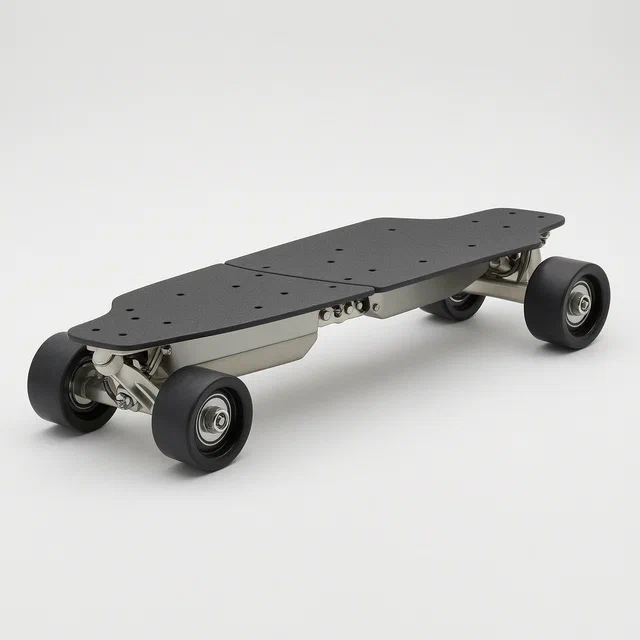
One patent on this site relates to a product sold in this market, a folding skateboard. It is listed at the end of this report; the market analysis below is separate from its structure.
1. Market size and growth
United States. The U.S. skateboard market is estimated at about USD 911.7 million in 2024. [F1]
Wider estimates. Other estimates put the North American market at about USD 1.329 billion for 2025 and forecast about USD 827.3 million by 2031. The year, geography and definition differ from the U.S. figure, so the two numbers describe a range rather than a trajectory. [F2] [F3]
Participants. More than six million people skateboard in the United States. [F2]
Folding boards. No public source in this review isolates folding or portable skateboards in dollars, so this report does not quote a segment figure. [F1] [F2] [F3]
IP2M estimate. Based on the U.S. figure, an illustrative 5% share for a folding board would imply roughly USD 46 million at retail level. That is orientation arithmetic on a category built for skate-park use, not a measured segment. [F1]
2. Product segments and who buys
| Segment | Typical product forms | Buyer and channel | What decides the purchase |
|---|---|---|---|
| Street and park deck | Standard popsicle deck, trucks, wheels, grip | Riders through skate shops and e-commerce | Brand, deck concave, truck feel, graphics |
| Cruiser and longboard | Wider deck, softer wheels | Commuters and campus riders through skate and outdoor retail | Ride comfort, size, graphic |
| Kids’ board | Shorter deck with licensed graphics | Families through mass retail and toy channels | Price, safety, character, age fit |
| Commuter and portable | Folding, collapsible or backpack-friendly boards | Commuters and travellers through e-commerce | Portability, unfolded rigidity, weight, price |
| Ride-on and scooter | Kick scooters and hybrid ride-ons | Families and commuters through mass retail | Price, foldability, safety features |
The published figures cover the category as a whole, not these rows; the commuter row is described from product types in the channel rather than from a measured volume. [F1] [F2] [F4]
The rider and the commuter are different buyers. A rider buys on brand and feel and will not accept a hinge in the deck; a commuter buys on whether the thing fits a train, a locker or a car boot, and tolerates a heavier deck if it folds. A folding board that is aimed at riders is aimed at the wrong buyer, and one that is aimed at commuters competes with the scooter rather than with a deck. [F2] [F4]
3. Competitive landscape
Boardriders, Skate One, Powell Peralta and Alien Workshop appear in the U.S. market, with Razor present in ride-ons and scooters. The sources list presence and product type, not share. [F1] [F2] [F3] [F4]
The structure is brand-and-culture at the top and price-led at the bottom. Branded decks hold skate shops and rider loyalty; mass retail holds kids’ boards through price and licensed graphics; scooters and portable ride-ons hold the family and commuter shelf. A folding skateboard enters a space that is currently occupied by two different competitors at once — a deck it cannot beat on feel, and a scooter it cannot beat on fold-down compactness unless the mechanism is good. [F2] [F4]
4. Trends and innovation opportunities
Trends
A large but stable participant base. More than six million U.S. skateboarders support the category, but participation is not the same as growth in unit sales. [F2]
Street boards dominate. Street boards are the largest product type, which means the volume and the design language of the category come from riders rather than from commuters. [F3]
Commuter and last-mile interest. Folding scooters and portable ride-ons serve buyers moving between transit and destination; a board that folds addresses the same trip. This is a channel reading of adjacent products, not a measured trend in the sources. [F4]
Youth and licensing. Kids’ boards sell on licensed graphics and price, which keeps the entry price low and the design conservative. [F2]
Innovation opportunities
The opportunities below are an analyst reading of the segment structure, not a sourced forecast.
- A fold that leaves the deck stiff when open. A board that locks rigid at the hinge can be sold to a commuter without asking him to accept a soft deck. What to prove: the joint holds stiffness under a rider’s weight, the lock does not loosen with vibration, and the unfolded surface has no step under the foot.
- Fold-down size that beats a scooter. A folded board that fits a backpack or a locker is a clearer claim than “folds”. What to prove: the folded envelope, the weight, and the time to fold and unfold.
- One-hand operation. A commuter folds at a platform or a doorway, often wearing a bag. What to prove: the mechanism is operable one-handed, cannot pinch, and cannot release while riding.
- Safe failure. A hinge that fails closed rather than open is a design and marketing claim in a category where a fall is the main risk. What to prove: the lock holds after abuse, and a release cannot happen under load.
5. Manufacturing and supply chain
A skateboard is a plywood and hardware assembly. The deck is laminated from maple veneers in a press, cut and drilled; the trucks are cast or forged aluminum with steel axles and urethane bushings; the wheels are cast polyurethane; bearings, grip tape and hardware are bought in. A folding board adds a metal joint, a lock and a hinge plate to that list.
Processes. Veneer layup and pressing, deck shaping, drilling, printing or screen-printing graphics, grip application, truck and wheel assembly, and for a folding board, joint machining, lock fitting and a rigidity test.
Tooling. Deck presses and cutting tools carry the tooling cost, and each deck shape needs its own; a folding board also needs a joint tool and, usually, a modified deck mold because the hinge interrupts the deck’s continuous laminate.
Cost drivers. Maple grade and veneer count, press time, truck grade, wheel formula, graphic print, and for a folding board the joint parts and the assembly time. The hinge is the item that decides whether the product can be sold at a commuter price rather than at a rider price.
Quality and testing. Buyers check deck stiffness and break strength, truck and wheel durability, grip adhesion, and for a folding board the rigidity and lock retention of the joint under repeated load and vibration. A folding board should be fatigue-tested at the hinge over the expected number of fold cycles and ridden at rated load, because a hinge failure is a fall, not a return.
No public source in this review breaks down component cost or lead time for skateboards. The manufacturing paragraphs above are manufacturing judgment, to be replaced with supplier quotes before a commercial commitment.
6. Compliance and market entry
This review did not identify a product-specific mandatory federal performance standard for skateboards. The bicycle-helmet rule in 16 CFR Part 1203 covers helmets, not boards, and should not be read as a skateboard standard. CPSIA testing and certification apply where a board is intended primarily for children under 12; the sharp-point and sharp-edge and small-parts rules in 16 CFR Part 1500 apply to children’s articles; and California Proposition 65 warnings apply where a listed chemical may be present. [F5] [F6] [F7]
A folding board adds a pinch and a shear point that a standard deck does not have. Those are product-liability questions rather than a named federal standard, which means the test programme and the warnings are usually set by the buyer, the retailer and the insurer. [F5] [F7]
The public record shows no U.S. family member for the patent linked to this report. That is an opening rather than a clearance: separate U.S. patents on folding decks, hinges and locking mechanisms may still apply, and a freedom-to-operate review is required before launch.
For a U.S. launch, the practical sequence is: confirm whether the board is a children’s product; run deck strength, joint fatigue and lock retention tests; document the pinch points and the warnings; review materials against Proposition 65; and keep the records with the product file. A ride-on brand or an importer already selling into the channel usually owns this process.
7. Commercial paths, risks and open questions
Path 1: OEM or private label for a ride-on or outdoor brand. A brand with scooter shelf space can add a folding board to an existing commuter line, which is the shortest route to a retail test.
Path 2: own-brand commuter product through e-commerce. A folding board with a clear folded-size claim competes on reviews and video; the mechanism is the visible difference.
Path 3: component or licence to a deck maker. A hinge and lock can be licensed to a maker that already has decks, trucks and distribution.
Risks. Joint stiffness and lock retention, a pinch or shear injury, rider rejection of a hinged deck, weight, and price competition from scooters are the recurring risks. In a category where the consumer risk is a fall, a hinge failure carries liability far beyond the unit margin.
Open questions. The public record does not give U.S. volume for folding or portable boards, willingness to pay for foldability, or fatigue and rigidity data for the mechanism described on the linked patent page. The grade for any single product would improve with a distributor pilot and passing joint-fatigue and rigidity data, and would fall if the mechanism cannot hold stiffness or if an FTO review finds blocking U.S. claims.
Sources
- [F1] Global Industry Analysts, Skateboard – Global Market Trajectory and Analytics, public summary, 2024 (U.S. figure).
- [F2] Grand View Research, Skateboard Market Size, Share and Trends, public summary, 2025 (North American figure, participants).
- [F3] BlueWeave Consulting, North America Skateboard Market, public summary, 2024 (forecast, product types).
- [F4] 6Wresearch, North America Skateboard Market 2025–2031, public listing, 2025 (channel and adjacent ride-ons).
- [F5] U.S. Consumer Product Safety Commission and eCFR, CPSIA and 16 CFR Part 1500, current.
- [F6] eCFR, 16 CFR Part 1203, current.
- [F7] California Office of the Attorney General, California Proposition 65, current.
Related patent categories
Related patents
Product pages for patents that fit this market. Each page covers the mechanism, use cases, customization and patent status.