Executive summary
Global demand for hair dryers is estimated at USD 9.5 billion in 2025, rising to USD 9.9 billion in 2026 and USD 17.0 billion by 2033 — an 8.0% compound annual rate from 2026 to 2033. North America took 33.3% of 2025 revenue. [F2] The U.S. market was estimated at USD 2.24 billion in 2023 and is expected to grow at 5.4% a year from 2024 to 2030. [F1] Japan’s domestic market is forecast at JPY 71.5 billion in 2025, about USD 478 million at the 2025 average rate of JPY 149.6 per dollar, which is 68.2% above 2022. [F3] [F11] Mainland China’s retail market reached CNY 11.2 billion in 2025, about USD 1.57 billion at CNY 7.13 per dollar, after 10% annual growth from 2021 to 2025. [F4] [F11]
The two calibers are not comparable. NielsenIQ data cited by Xinhua puts 2025 global sales at USD 4.6 billion excluding North America and Russia, with an 8.6% compound rate from 2016 to 2025 — a narrower retail measure than Grand View’s estimate. [F4] [F2] They are kept separate here, not averaged.
Customs records offer a third lens. China exported 174.5 million hair dryers worth USD 1.62 billion in 2024, up from 130.1 million units and USD 1.10 billion in 2021. The United States imported 24.0 million units worth USD 422 million in 2024. [F5] These HS 851631 flows measure trade value, not retail sales, and exclude some styling appliances.
The report covers the United States, Japan and China in detail, with import data for Korea, Brazil, Mexico and India where no current market estimate is public. No single official statistic isolates the global hair dryer market, so the country figures are orientation, not a single ranking.
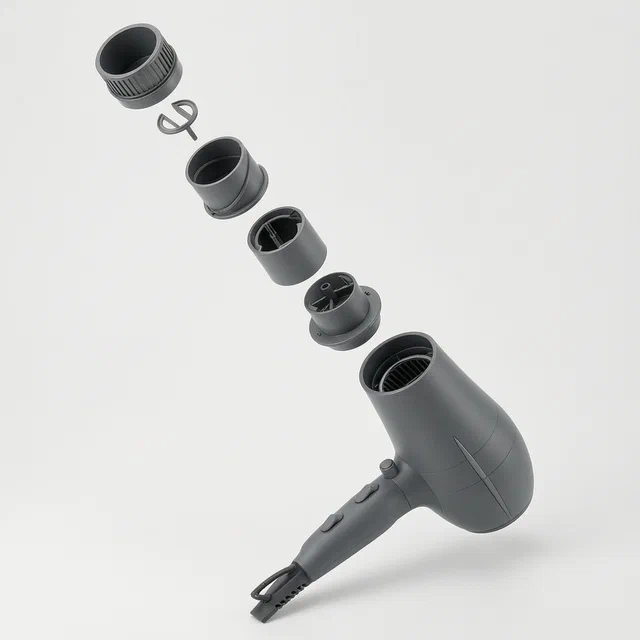
One patent page on IP2M covers a different design route: CN105559311B, a Chinese invention patent recorded as lapsed, changes airflow with a rotating ring, telescopic cylinder and notched discs instead of snap-on nozzles. It is listed at the end of this report; the figures below are category-level.
Market size and growth
Global. Grand View Research values the global hair dryer market at USD 9.5 billion in 2025 and projects USD 9.9 billion in 2026 and USD 17.0 billion by 2033, an 8.0% compound annual growth rate from 2026 to 2033. It puts North America at 33.3% of 2025 revenue, corded dryers at 82.4%, individual consumers at 61.1% and offline channels at 71.4%, and names Asia Pacific as the fastest-growing region. [F2] The public summary does not disclose the full country model.
United States. The U.S. estimate is USD 2.24 billion for 2023, with 5.4% annual growth from 2024 to 2030. [F1] Grand View identifies the United States as the largest country market within North America. [F2] For orientation, 2024 imports of USD 422 million equal about one-fifth of the 2023 market estimate; different years and calibers make the ratio illustrative only. [F1] [F5]
Japan. Fuji Keizai forecasts the Japanese domestic hair dryer market at JPY 71.5 billion in 2025, 68.2% above 2022, after growth of 31.8% in 2023. Products priced at JPY 30,000 or more exceeded JPY 20 billion in 2023 and are expected to account for more than 40% of the market by 2025. [F3] At the 2025 average rate that is about USD 478 million for the whole market and USD 134 million for the premium tier. [F11] Japan imported 8.9 million units worth USD 207 million in 2023, an average of USD 23.20 per unit. [F5]
China. Mainland China’s retail market reached CNY 11.2 billion in 2025, about USD 1.57 billion, with 10% annual growth from 2021 to 2025. High-speed models reached 85% of sales in 2025 and the average selling price fell to about CNY 400, or USD 56. [F4] [F11] The growth path has turned: GfK data cited by Jixin put January–September 2024 retail at CNY 9.2 billion, up 28.4%, [F6] while AVC data cited by Sina show full-year 2024 growth of 10.4% followed by a 10.5% decline in the first half of 2025. [F7] The two sets use different panels and periods and are not additive.
Other import markets. Korea imported 3.7 million units worth USD 96 million in 2023; Brazil imported 5.0 million units worth USD 32 million in 2024; Mexico imported 2.5 million units worth USD 17 million; India imported 7.4 million units worth USD 24 million. [F5] These are import values, not market sizes; India’s low unit value suggests an entry-level mix.
IP2M estimate. Based on Grand View’s 33.3% North American share, the non-North American market would be about USD 6.3 billion in 2025, while NielsenIQ’s narrower measure gives USD 4.6 billion excluding North America and Russia. [F2] [F4] The working range is USD 4.6–6.3 billion outside North America — an orientation figure, not a forecast.
Product segments and who buys
| Segment | What it is | Who buys |
|---|---|---|
| Corded | Mains-powered, full-size body and airflow | Households, salons, hotels |
| Cordless | Battery-powered, smaller airflow, travel-oriented | Travellers, professional touch-ups |
| Individual | Home-use models sold through retail and e-commerce | Mass consumers |
| Professional | Salon-grade durability and airflow | Stylists, salon equipment distributors |
| Premium | High-price models with hair-care features | Affluent buyers in Japan and China |
| Value | Low-price models, now often high-speed | Price-sensitive online buyers |
| Built-in adjustment | Airflow changed by a ring rather than a nozzle | Brands, hotels, attachment-averse users |
Corded dryers took 82.4% of global revenue in 2025, individual consumers 61.1% and offline channels 71.4%. [F2] The premium tier is largest in Japan, where products above JPY 30,000 (about USD 200) are expected to exceed 40% of the market by 2025. [F3] [F11] At the other end, products below CNY 300 (about USD 42) account for close to 80% of China’s online market, and high-speed motors have become the default rather than a premium feature. [F7] [F11]
Channel structure differs. Offline retail still carries most global revenue, [F2] but Chinese brands use livestream and content commerce as the growth channel, with traditional e-commerce still important for search. [F6] In the United States, salon supply sits alongside mass retail; hotels buy through contract channels.
The segment addressed by the patent on this site sits inside the corded, individual and hospitality parts of the market: a dryer that changes airflow by turning a ring instead of clipping on a concentrator or diffuser. Public summaries do not size attachment-free dryers separately, so this is a design position rather than a measured category. Its natural buyers are brands seeking a single-barrel product, hotels that do not want loose parts, and salons that switch airflow often.
Competitive landscape
Grand View Research lists Conair, Spectrum Brands (Remington), Dyson, Koninklijke Philips, Panasonic, Revlon, ghd, Braun, Helen of Troy and Harry Josh Pro Tools among the companies it profiles. [F2] The list spans mass appliance brands, broad consumer-electronics groups, premium technology companies and salon-oriented names. Grand View does not publish company-level shares in its public summary, and this report does not estimate them.
China is the most contested market. Dyson’s 2016 launch reset the premium benchmark, and domestic brands subsequently copied the form factor, then competed on price and motor cost. [F6] The top three brands took 63% of retail value in the period covered by GfK data, while JD.com carried close to 500 brands in 2025. [F6] [F7] AVC data put products below CNY 300 (about USD 42) at close to 80% of the online market, with Feike, Dreame, Laifen, Dyson, Midea, Haier, Gree, Panasonic and Philips all active. [F7] [F11] The result is a market with a concentrated top and a long, price-driven tail.
In Japan, Panasonic and TESCOM appear in Grand View’s global company list, [F2] while Fuji Keizai attributes domestic growth to premium products and hair-care features rather than to a single brand. [F3] The Japanese market rewards demonstrable drying speed, low weight and hair condition, and the JPY 30,000-plus tier (about USD 200) is where that positioning is tested. [F3] [F11]
For a new entrant, the question is not whether another dryer can be made — China’s export base already supplies the world — but whether a mechanical airflow system gives a brand a story that price-led marketplaces cannot copy quickly.
Trends and innovation opportunities
High-speed motors have become commodity. High-speed models reached 85% of China’s 2025 sales, the average price fell to about CNY 400 (USD 56), and Jixin puts brushless motor cost at roughly CNY 20–50 (USD 3–7). [F4] [F6] [F11] Speed alone no longer supports a premium; differentiation has to come from airflow control or hair outcome.
Japan is still premiumising. The Japanese market is forecast 68.2% above its 2022 level, with the JPY 30,000-plus tier (about USD 200) moving from above JPY 20 billion (about USD 134 million) in 2023 to more than 40% of the market by 2025. [F3] [F11] A measurable hair-care benefit can still support a high price, even as China deflates.
China has moved from growth to replacement. After 10.4% growth in 2024, the market fell 10.5% in the first half of 2025, and products below CNY 300 (about USD 42) approached 80% of online sales. [F7] [F11] Growth now comes from replacement, gifting and niche use; a mechanism that removes loose attachments fits travel and hotel use better than another general-purpose dryer.
Portability and cordless designs are the next frontier. Lightweight high-speed models now reach 299 grams, and folding travel formats target hotel and gym use. Cordless full-size dryers remain limited by battery energy and sustained airflow, which is why corded models still hold 82.4% of global revenue. [F2] [F7]
Hair-care ingredients and sensing are converging with airflow. Nano water-ion products gained 2.4 percentage points of China’s high-speed segment in the first half of 2025, and brands are adding sensors, app settings and automatic temperature control. [F7] A mechanical airflow system is complementary: it changes the shape of the stream, while ions and sensors change what the stream carries and how hot it is.
Manufacturing and supply chain
Hair dryers are assembled from injection-moulded housings, a motor and fan, a heater element, a power board and controls. The cost drivers are the motor, heater and assembly labour; the quality drivers are airflow, temperature control, noise, drop resistance and electrical safety. China’s 2024 exports were 174.5 million units worth USD 1.62 billion, an average of USD 9.27 per unit, up from USD 8.49 in 2021. [F5]
Import unit values vary widely: USD 17.60 for the United States, USD 23.20 for Japan, USD 25.90 for Korea, USD 6.30 for Brazil, USD 6.80 for Mexico and USD 3.25 for India. [F5] The gap reflects product mix, packaging, freight and the difference between retail-ready dryers and lower-value items in the same HS line; it is not a margin estimate.
The patented mechanism adds four nested parts at the outlet — cylindrical support, telescopic cylinder, track cylinder with helical openings and rotating ring — plus a fixed disc and a rotating notched disc. That requires multi-cavity tooling with tighter tolerances than a plain nozzle, assembly fixtures that keep the helical tracks aligned, and wear testing on the sliding blocks. It removes the tooling, packaging and inventory cost of separate concentrators and diffusers, which is the trade a brand must evaluate.
Brushless motor cost has fallen to roughly CNY 20–50 (USD 3–7) per unit, which is why high-speed performance spread so quickly and why assembly quality and airflow design now matter more than the motor alone. [F6] [F11] Certification, tooling lead time and voltage and plug variants usually determine the launch schedule.
Compliance and market entry
In the United States, household hair dryers are tested to UL 859, the standard for household electric personal grooming appliances. [F8] Products with digital controls, wireless modules or other electronic circuitry also fall under FCC Part 15 for unintentional radiators, and California’s Proposition 65 warning requirements apply where listed substances are present. [F9] Hair dryers are not food-contact products, so FDA food-contact rules do not apply.
The European Union requires the Low Voltage Directive 2014/35/EU, the EMC Directive 2014/30/EU, RoHS 2011/65/EU and REACH, with CE marking and a technical file. [F10] Japan requires PSE marking under the Electrical Appliances and Materials Safety Act, and its 100 V supply means market-specific heating and motor tuning. China requires CCC marking and testing to GB 4706.1 and GB 4706.15; Korea requires KC marking.
Cordless variants add UN 38.3 for shipping, IEC 62133 for cells and packs, and radio approvals if Bluetooth is fitted. Each route adds test cost and a market-specific variant; a brand selling in the United States, Japan and Europe should budget for three electrical variants and separate certification files.
China’s voluntary T/CHEAA 0022-2023 group standard, issued in 2023 with 31 companies participating, covers drying efficiency, magnetic nozzle retention and hair anti-tangling; its C mark had been licensed to 6 companies and 6 models by March 2026. [F4] It shows Chinese buyers starting to use performance standards as a selection filter.
Commercial paths, risks and open questions
OEM and ODM supply. Supply an established brand or contract manufacturer with a finished mechanism or a complete dryer. The brand carries channel risk; the supplier carries tooling, certification and quality risk. China’s export base already serves this model at scale. [F5]
Private label and e-commerce. Faster to launch with lower tooling ambition, but the price band below CNY 300 (about USD 42) is crowded and one major platform lists close to 500 brands. [F7] [F11] Differentiation must be visible in the listing, not just the bill of materials.
Hospitality and professional channels. Hotels value a dryer that cannot lose its nozzle; salons value fast switching between concentrated and diffused airflow. Both are specification-driven, with longer cycles and stronger durability and safety documentation. The attachment-free design fits hospitality particularly well.
Licensing. The patent record on this site shows CN105559311B lapsed for non-payment, so it no longer provides exclusivity in China. A licensing programme would rest on know-how, tooling and brand, and a manufacturer should still run a freedom-to-operate check.
The main risks are price deflation and slowing demand in China, where the market fell 10.5% in the first half of 2025 and low-price products dominate; concentration at the top, with the top three brands at 63% of retail value; certification across three electrical regimes; and a lapsed patent that lets competitors copy the mechanism unless a new design or utility model is filed. [F6] [F7]
Public sources do not answer whether consumers will pay a premium for attachment-free airflow when a basic nozzle costs little; how often hotels replace room dryers and how they specify them; whether cordless full-size dryers become practical; or how much HS 851631 import value is finished dryers rather than parts. These should be tested before tooling is committed.
Sources
- [F1] Grand View Research, U.S. Hair Dryer Market Size, Share & Trends Analysis Report (public summary), research report, 2024.
- [F2] Grand View Research, Hair Dryer Market Size, Share & Trends Analysis Report (public summary), research report, 2026.
- [F3] Fuji Keizai (富士経済), 美容・健康家電/雑貨の国内市場を調査 (press release No. 24008, in Japanese), research press release, 2024.
- [F4] Xinhua (新华网), 电吹风“C”标志正式发布,引领行业高质量发展新阶段 (in Chinese), national news agency, 2026.
- [F5] United Nations Comtrade Database, HS 851631 hair dryers: China exports and reporter imports, 2021–2024, official customs statistics, 2026.
- [F6] Jixin (极新), 年度重磅爽文:浅谈中国电吹风市场趋势,如此卷的环境下,增量在哪里?机会在哪里? (in Chinese), industry media, 2024.
- [F7] Sina Finance / 百姓家电网, 高速吹风机告别高增长,竞争焦点转向便携、养发与智能 (in Chinese), business media, 2025.
- [F8] UL Standards & Engagement, UL 859 Household Electric Personal Grooming Appliances, safety standard, current.
- [F9] U.S. Electronic Code of Federal Regulations, 47 CFR Part 15 — Radio Frequency Devices, regulation, current.
- [F10] EUR-Lex, Directive 2014/35/EU (Low Voltage Directive) and Directive 2014/30/EU (EMC), regulation, current.
- [F11] Internal Revenue Service, Yearly Average Currency Exchange Rates, official statistics, 2025.