Market & Commercial Opportunity
The U.S. Hair Trimmer Market
Market size, product segments, buyer channels, competition, trends, manufacturing, compliance and the commercial opportunity in U.S. hair clippers and trimmers.
Published November 10, 2026
Executive summary
Hair clippers and trimmers are a large, replacement-driven personal-care category in which cordless units already carry most of the value. Public estimates put the U.S. electric hair clipper and trimmer market at about USD 1.6 billion in 2024, with cordless units around 65% of value, personal use around 70% and household end use around 60%; a narrower measure of U.S. electric shavers and clippers puts the market at USD 682 million. [F1] [F2] [F4]
The category splits by user and by cutting job: home haircutting, beard and body trimming, professional barber and salon work, pet grooming, and travel or touch-up tools. Each has a different blade set, motor duty cycle and price band, and a mechanism that suits a home trimmer rarely survives a barber’s day. [F1] [F2] [F3]
The U.S. grooming market is led by Wahl Clipper, Andis, Conair, BaBylissPRO, Philips Norelco, Remington, Panasonic and Oster. These brands sell separate shaver and trimmer bodies with attachment sets, and the public summaries do not report a dual-head switching model. [F1] [F2] That is the gap a new mechanism has to argue against: an incumbent that already sells the attachments the buyer needs.
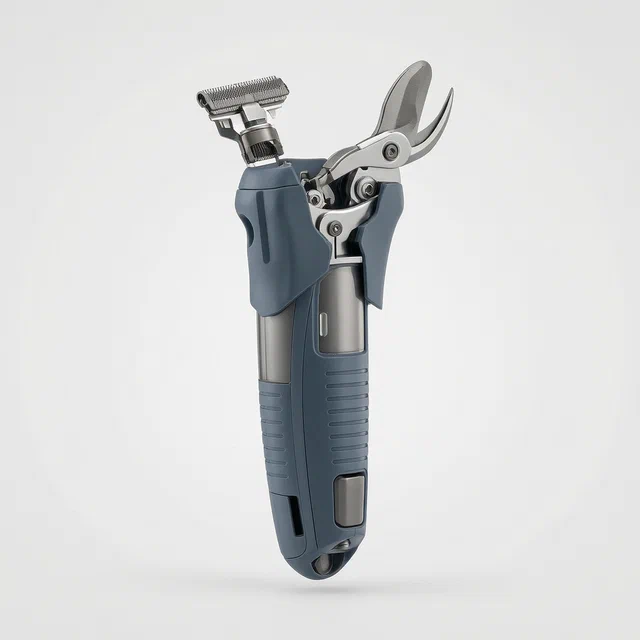
One patent on this site relates to a product sold in this market, a dual-head trimmer. It is listed at the end of this report; the market analysis below is separate from its structure.
1. Market size and growth
U.S. clippers and trimmers. The category is estimated at about USD 1.6 billion in 2024, with cordless units around 65% of value, personal use around 70% and household end use around 60%. [F1] [F2]
Narrower measure. A narrower scope covering electric shavers and hair clippers puts the U.S. market at USD 682 million. The two figures use different definitions and should not be added. [F4]
Segments. No public source in this review gives dollar volumes for barber, beard, body or pet sub-segments, so the segmentation below is a working one rather than measured shares. [F1] [F2]
IP2M estimate. Based on the U.S. category figure, an illustrative 5% share for a switching-head trimmer would imply roughly USD 80 million at retail level. That is orientation arithmetic, not a measured segment, forecast or valuation. [F1]
2. Product segments and who buys
| Segment | Typical product forms | Buyer and channel | What decides the purchase |
|---|---|---|---|
| Home haircutting kit | Clipper with guide combs, corded or cordless | Households through mass retail and e-commerce | Price, guide comb range, ease of use |
| Beard and body trimmer | Compact trimmer, detail head, waterproof body | Households through e-commerce and drug retail | Length control, precision, battery, cleaning |
| Professional barber and salon | Corded or high-duty cordless clipper, replaceable blade sets | Barbers and salons through supply dealers | Motor duty, blade sharpness, service, warranty |
| Pet grooming | Quiet clipper for coats, often with a wider blade | Pet owners and groomers through pet retail | Noise, blade heat, safety |
| Travel and touch-up | Pen-sized or battery trimmer | Households through e-commerce and travel retail | Size, runtime, price |
The published figures cover the whole category, not these rows, and the pet row is described from product types in the channel rather than from a measured volume. [F1] [F3]
Duty cycle separates the rows more than price does. A home trimmer runs for minutes at a time; a barber’s clipper runs for hours and is judged on blade temperature and motor life; a pet clipper is judged on noise and heat because the animal will not hold still. A mechanism that adds a second cutting head has to answer the duty question for whichever row it targets. [F2] [F3]
3. Competitive landscape
Wahl Clipper, Andis, Conair, BaBylissPRO, Philips Norelco, Remington, Panasonic and Oster lead the U.S. market, sold through mass retail, e-commerce, barber supply and salon channels. The sources establish brand presence and channel, not share. [F1] [F2] [F3]
The structure is brand-led and attachment-led. Premium brands win on blade quality, motor duty and the attachment ecosystem; mass brands win on price and bundle size. A new body has to fit that ecosystem or replace it, and a switching mechanism that removes the need for separate bodies is a strong claim only if it does not compromise the cut. [F1] [F2]
4. Trends and innovation opportunities
Trends
Cordless dominance. Cordless units carry most of the value, which pushes design toward battery runtime, charging and weight rather than motor size alone. [F2]
At-home grooming. Personal use accounts for about 70% of the category and household end use about 60%, so the home buyer rather than the professional sets the volume. [F1]
Waterproof and washable. Cleaning convenience has become a mainstream claim, which raises the importance of sealing around the blade and the switch. [F2] [F3]
Attachment ecosystems. Brands sell separate bodies and attachment sets, which means a new mechanism competes with an existing set of combs and heads rather than with one product. [F1] [F2]
Innovation opportunities
The opportunities below are an analyst reading of the segment structure, not a sourced forecast.
- Two cutting heads in one body. A trimmer that switches between a wide clipper head and a detail head removes a second purchase and a second charger. What to prove: the switch locks in both positions, the heads align to the same cutting plane, and the mechanism survives the duty cycle of its target user.
- Blade heat under a long run. A head mount that conducts heat away from the blade extends a barber’s working time. What to prove: blade temperature stays under a measured limit across a full day, and the added mass does not unbalance the trim.
- Washable without a tool. A head that releases and reseats without a tool suits the home buyer who cleans after every use. What to prove: the joint reseals, the spring does not corrode, and the alignment stays true after repeated removal.
- Quiet operation for pets. A head and motor mount that reduce noise and vibration suit the pet channel, where the animal’s reaction decides whether the product is used at all. What to prove: measured noise at the animal’s distance, and blade heat over a full groom.
5. Manufacturing and supply chain
A trimmer is a small electromechanical assembly. The body is injection-molded ABS or polycarbonate, sometimes with a rubberized grip; the motor is a bought-in DC unit; the blade set is stamped and ground stainless steel with a ceramic or steel cutter; the battery is a lithium cell or pack; the switch, charging circuit and LED indicator sit on a small board.
Processes. Injection molding, blade stamping and grinding, motor and battery assembly, board assembly, final assembly, cutting-performance test and packaging. A switching head adds a mechanical interface with its own tolerances and a test step for alignment.
Tooling. Body and head molds are the main tooling cost, followed by blade tooling and assembly jigs. A second head doubles the head tooling but shares the body; the economics depend on whether the buyer values one body with two heads above two bodies.
Cost drivers. Motor grade, blade steel and grinding, battery capacity, mold cavity count, switch and sealing parts, and assembly time. Cordless dominance means the battery and charging circuit are a large share of cost, so a mechanism has to justify itself against that budget.
Quality and testing. Buyers test cutting performance on wet and dry hair, blade heat, runtime, charge cycles, noise, drop and, where claimed, water resistance. A switching head should be tested for alignment and lock retention over repeated changes, not just for the first cut.
No public source in this review breaks down component cost or lead time for trimmers. The manufacturing paragraphs above are manufacturing judgment, to be replaced with supplier quotes before a commercial commitment.
6. Compliance and market entry
FCC Part 15 applies where the unit has a digital control or charging circuit; UN 38.3 testing applies to the lithium cells and to the finished cordless device when it is shipped as dangerous goods; the sharp-point and sharp-edge rules in 16 CFR 1500.48 and 1500.49 matter if a child can reach the blades; and California Proposition 65 warnings apply where a listed chemical may be present. [F5] [F6] [F7]
This review did not identify a product-specific mandatory federal performance standard for trimmer heads beyond those electrical, battery and sharp-edge rules. That is a finding of absence in this review, not a legal conclusion that no standard exists; retailer requirements and voluntary standards can still add scope. [F5] [F7]
The public record shows no U.S. family member for the patent linked to this report. That is an opening rather than a clearance: separate U.S. patents on blade drives, head mounts and trimmer housings may still apply, and a freedom-to-operate review is required before launch.
For a U.S. launch, the practical sequence is: run electrical and radio tests; test the battery and the finished device for transport; run sharp-edge, blade-heat and cutting tests; confirm the child-access question for the blades; review materials against Proposition 65; and keep the records with the product file. A grooming brand already selling into the channel usually owns this process.
7. Commercial paths, risks and open questions
Path 1: OEM for a grooming brand. The brand brings the channel, blade supply and warranty; IP2M supplies the switching-head mechanism and production package. This is the realistic route for a mechanism that needs blade testing.
Path 2: private label for e-commerce. A simplified two-head trimmer sold online competes on price and reviews, and the mechanism becomes the listing’s visible difference.
Path 3: component supply. A head mount or switch can be sold to a trimmer maker as a module, which is the easiest route to a first pilot.
Risks. Blade alignment after switching, heat build-up, battery and charging certification, water ingress where sealed, sharp-edge complaints, and price competition from established grooming brands are the recurring risks. A trimmer that nicks skin ends the brand relationship quickly.
Open questions. The public record does not give U.S. volume for switching-head or professional trimmers, willingness to pay for one body with two heads, or cycle data for the mechanism described on the linked patent page. The grade for any single product would improve with a brand pilot and passing cutting, heat and cycle data, and would fall if the switch cannot hold alignment or if an FTO review finds blocking U.S. claims.
Sources
- [F1] Global Industry Analysts, Electric Hair Clipper and Trimmer – Global Market Trajectory and Analytics, public summary, 2024.
- [F2] Emergen Research, US Electric Hair Clipper and Trimmer Market 2024–2034, public summary, 2025.
- [F3] Grand View Research, Electric Hair Clipper and Trimmer Market 2025–2030, public listing, 2025 (channel only).
- [F4] IndexBox, United States Electric Shavers and Hair Clippers Market, public summary, 2025 (narrow scope).
- [F5] eCFR, 47 CFR Part 15, current.
- [F6] United Nations Economic Commission for Europe, UN Manual of Tests and Criteria, Section 38.3, current.
- [F7] California Office of the Attorney General and eCFR, California Proposition 65 and 16 CFR Part 1500, current.
Related patent categories
Related patents
Product pages for patents that fit this market. Each page covers the mechanism, use cases, customization and patent status.