Market & Commercial Opportunity
The U.S. LED Light Box Sign Market
Market size, product segments, buyer channels, competition, trends, manufacturing, compliance and the commercial opportunity in U.S. LED light box signs for retail display.
Published November 10, 2026
Executive summary
A light box is a retail display decision dressed as a lighting product: the buyer is a chain, a fabricator or a sign company, and what it buys is a graphic that stays lit and can be changed. Public estimates put the global point-of-purchase display market at about USD 12.64 billion in 2024, up 8.4% from 2023 and forecast to grow at roughly 8.1% a year to 2028, with North America the largest region. Electronic advertising signs, which include LED signs, light box signs and neon, were about USD 4.5 billion in 2024, forecast to reach USD 5.78 billion by 2031, and light box signs are roughly 21% of that value. [F1] [F2]
The public display landscape is led by packaging and display groups such as WestRock, Smurfit Kappa, DS Smith and Pratt Industries in point-of-purchase work. Illuminated light-box manufacturing itself is fragmented among sign companies and specialist fixture makers, and no public source ranks it. [F1] [F2]
The demand that fits a quick-change box is the part of retail display where graphics change often: grocery, convenience, pharmacy and fashion chains running frequent promotions. Those buyers pay for labour saving at store level, because changing a graphic on a sealed box is slow and sometimes needs a technician. [F2]
No public source in this review isolates U.S. illuminated light-box volume, price or graphic-change frequency, so this report labels the niche unmeasured wherever it touches it.
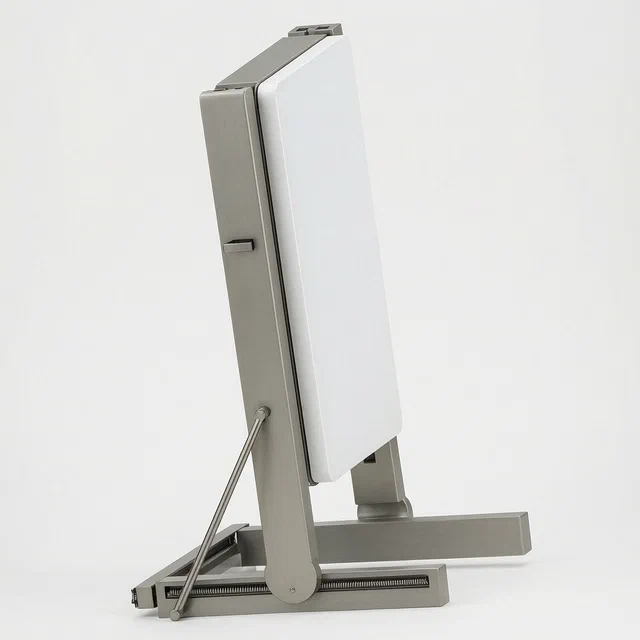
One patent on this site relates to a product sold in this market, an LED light box with a detachable shade and an adjustable frame. It is listed at the end of this report; the market analysis below is separate from its structure.
1. Market size and growth
Point-of-purchase display. About USD 12.64 billion globally in 2024, up 8.4% from 2023, forecast to grow at roughly 8.1% a year to 2028, with North America the largest region. [F1]
Electronic advertising signs. About USD 4.5 billion in 2024, forecast to reach USD 5.78 billion by 2031. The category includes LED signs, light box signs and neon. [F2]
Light box share. Light box signs are roughly 21% of electronic advertising sign value. [F2]
Derived light-box segment. Applying that share to the sign figure gives roughly USD 950 million globally in 2024. It is arithmetic on two published numbers, not a published segment value. [F2]
IP2M estimate. Based on that derived figure, an illustrative 5% share for a quick-change LED box would imply about USD 47 million. It is an orientation figure, not a measured U.S. retail-display niche. [F2] [F3]
2. Product segments and who buys
| Segment | Typical product forms | Buyer and channel | What decides the purchase |
|---|---|---|---|
| Storefront and window sign | Illuminated box on a wall, window or frame | Retail chains through fabricators and sign companies | Brightness, weather rating, graphic change, price |
| In-store promotion box | Counter or wall unit with a changeable graphic | Chains through their fixture suppliers | Change time, graphic cost, appearance |
| Menu and price board | Illuminated board with slots or panels | Restaurants and c-stores through fixture suppliers | Readability, update speed, durability |
| Trade show and event display | Portable illuminated panel | Event and marketing buyers through display houses | Weight, pack-down, setup time |
| Custom fixture | One-off box built into a store fit-out | Fabricators and fit-out contractors | Fit, certification, lead time |
The published figures cover point-of-purchase and sign markets, not these rows and not the United States alone. [F1] [F2]
The buyer in each row is a business, and the decision is a cost-of-change decision. A chain that refreshes promotions weekly measures a box by minutes of store labour, not by lumens; a sign company measures it by whether it can certify, ship and install it. That is why a tool-free graphic change and an adjustable frame matter more here than any lamp specification, provided the certification and shipping cost stay competitive with a printed display. [F1] [F2]
3. Competitive landscape
WestRock, Smurfit Kappa, DS Smith and Pratt Industries lead point-of-purchase display work; illuminated light-box manufacturing is fragmented among sign companies and specialist fixture makers, and no public source ranks it. [F1] [F2]
The structure is fragmented at the product level and concentrated at the buyer level. Individual boxes are made by many small sign and fixture shops, while the buyers are large chains with central specification and central purchasing. A supplier therefore reaches volume through a fabricator that holds a chain contract, or through a chain’s fixture programme. That fragmentation is the opening for a mechanism: a small shop will not develop a release system, and a chain will not buy one from a shop that cannot certify it. [F1] [F2]
4. Trends and innovation opportunities
Trends
Display spending growth. The point-of-purchase display market grew 8.4% in 2024 and is forecast to grow at roughly 8.1% a year to 2028, which keeps new fixtures funded. [F1]
Electronic signage taking share. Electronic advertising signs are forecast to reach USD 5.78 billion by 2031, and digital and illuminated signage keeps displacing printed-only displays where the message changes often. [F2]
Labour at store level. Chains keep looking for fixtures that a store associate can maintain without a technician, because each service call costs more than the graphic it replaces. This is a buying-criteria reading, not a measured trend in the sources. [F2]
Shipping volume. A rigid illuminated box competes on landed cost against a flat-pack printed display, which puts pressure on how the frame packs and how much of the box is air. [F1]
Innovation opportunities
The opportunities below are an analyst reading of the segment structure, not a sourced forecast.
- A shade that releases without tools. A clamp plate and spring that push the clamping bars out let a store associate change a graphic. What to prove: the release works after repeated changes, the shade reseats without rattle, and no live part is reachable when it is open.
- Height and angle adjustment on the fixture. Synchronised screws with a lock let one box serve several mounting heights and sight lines. What to prove: the adjustment holds a heavy shade at any position, and the pair of screws stays in step.
- A frame that packs flat. Shipping volume is the hidden competitor. What to prove: the frame breaks down without tools and survives transport, and assembly at site takes minutes.
- Graphic change without touching the electrics. Every release that also disturbs wiring adds a safety requirement. What to prove: the shade opens onto a graphic area only, with the electrical compartment sealed.
5. Manufacturing and supply chain
An LED light box is a sheet-metal, extrusion and light-engine assembly. The body is folded or extruded aluminium, sometimes with powder coating; the shade is acrylic or polycarbonate, clear or translucent; the light engine is an LED module or strip with a driver; the release parts are stamped steel, spring steel and moulded plastic; the frame is tube or extrusion with screws and belt-driven adjustment.
Processes. Sheet-metal cutting and bending, extrusion cutting, powder coating, acrylic cutting and printing, LED module assembly, wiring, electrical safety testing, packing and, for a chain order, graphic production.
Tooling. Bending dies, extrusions and mould tools carry the tooling cost, with a lower cost for the printed graphic insert. A release mechanism adds stamping tools and a spring specification, which is cheap relative to a new extrusion; that is why a mechanism-led variant can be added to an existing box platform.
Cost drivers. Aluminium and coating, acrylic thickness, LED module quality and driver, certification testing, packaging volume and freight. Freight is a large share for a product that is mostly air and glass, and an adjustable frame that does not pack flat can lose the order before the mechanism is discussed.
Quality and testing. Buyers check brightness uniformity, colour consistency, IP rating where the box is outdoors, electrical safety, mounting strength, drop and packing, and for a quick-change design the release cycle life. A release should be cycled with the graphic in place, because that is how the store will use it.
No public source in this review breaks down component cost or lead time for light boxes. The manufacturing paragraphs above are manufacturing judgment, to be replaced with supplier quotes before a commercial commitment.
6. Compliance and market entry
UL 48 is the end-product safety standard for electric signs and UL 8750 covers the LED driver, modules and control gear inside; FCC Part 15 applies to any digital control or dimmer; California Proposition 65 warnings may apply to housing, coating or cord materials; and installation at height brings mounting-strength and strain-relief requirements into the certification. [F4] [F5] [F6] [F7]
The practical constraint is that a chain will not accept a mains-powered sign without a testing-laboratory mark, and a quick-release shade must not expose live parts when it is open. That combination sets the design: the release has to open onto the graphic area only, with the electrical compartment sealed and the driver accessible separately for service. [F4] [F5]
The public record shows no U.S. family member for the patent linked to this report. That is an opening rather than a clearance: separate U.S. patents on sign boxes, shade mounts and LED sign frames may still apply, and a freedom-to-operate review is required before launch.
For a U.S. launch, the practical sequence is: build to UL 48 and UL 8750 and obtain the evaluation; test mounting strength, drop and packing; cycle the release with graphics in place; confirm IP rating for the intended location; review materials against Proposition 65; and keep the records with the product file. [F4] [F5] [F7] A display fabricator or a chain’s fixture supplier usually owns this process, which is why a licence to a fabricator is the realistic first step.
7. Commercial paths, risks and open questions
Path 1: licence or OEM to a display fabricator. The fabricator holds the chain contract, the certification and the installation crews; IP2M supplies the release mechanism, the adjustable frame and the production package. This is the only route to chain volume.
Path 2: chain fixture programme. A chain that refreshes promotions often can sponsor the tooling for its own fixture and set the change-time requirement, which is the clearest way to prove the benefit.
Path 3: sign company or distributor catalogue. A sign company can carry the box as a catalogue product, which suits a smaller fabricator without a chain relationship.
Risks. Certification cost, a release that exposes live parts or loosens over time, shipping volume against flat-pack printed displays, brightness and IP performance outdoors, and price competition from printed signage are the recurring risks. A shade that rattles after a month ends the chain relationship.
Open questions. The public record does not give U.S. illuminated light-box volume, prices, graphic-change labour cost or certification cost, and there is no cycle data for the mechanism described on the linked patent page. The grade for any single product would improve with a fabricator or chain pilot and passing UL 48 and UL 8750 evaluation, mounting, drop and release-cycle testing at a competitive landed cost, [F4] [F5] and would fall if certification cost or shipping volume makes the box uncompetitive with a printed display or if an FTO review finds blocking U.S. claims.
Sources
- [F1] The Business Research Company, Point of Sale Display Market 2024–2033, public summary, 2024 (market value and growth).
- [F2] QYResearch, Electronic Advertising Signs 2024–2030, public summary, 2024 (sign value, light box share, regional mix).
- [F3] Verified Market Reports, Light Boxes Market to 2032, public summary, 2024 (growth rate only).
- [F4] UL Standards and Engagement, UL 48 – Electric Signs, current.
- [F5] UL Standards and Engagement, UL 8750 – LED Equipment for Use in Lighting Products, current.
- [F6] eCFR, 47 CFR Part 15, current.
- [F7] California Office of the Attorney General, California Proposition 65, current.
Related patent categories
Related patents
Product pages for patents that fit this market. Each page covers the mechanism, use cases, customization and patent status.