Market & Commercial Opportunity
The U.S. Luggage Market
Market size, product segments, buyer channels, competition, trends, manufacturing, compliance and the commercial opportunity in U.S. hard-sided luggage.
Published November 10, 2026
Executive summary
Luggage is a mature, brand-driven category that recovers with travel demand. Public summaries put the U.S. luggage market at about USD 9.89 billion in 2024, reaching about USD 15.46 billion by 2033 at roughly 5.16% a year, and estimate that the United States accounts for about 68.5% of North American luggage demand. A separate global estimate puts the worldwide category at about USD 57.48 billion in 2024 with 5.3% growth to 2034, with the U.S. at about 26.45% of the global total. [F1] [F2]
Those figures cover all luggage, including soft-sided bags, backpacks, duffels and business cases, not hard-sided wheeled cases alone. The public record does not isolate retractable-wheel or cavity-storage designs, so a product plan should treat the category numbers as a ceiling and a direction rather than as a forecast. [F1] [F2]
The category splits by construction and by buyer: commodity hard cases sold on price, premium hardshell sold on brand and warranty, soft-sided and hybrid carry-on, business and laptop cases, and travel sets sold as bundles. Each has a different channel, price point and durability claim.
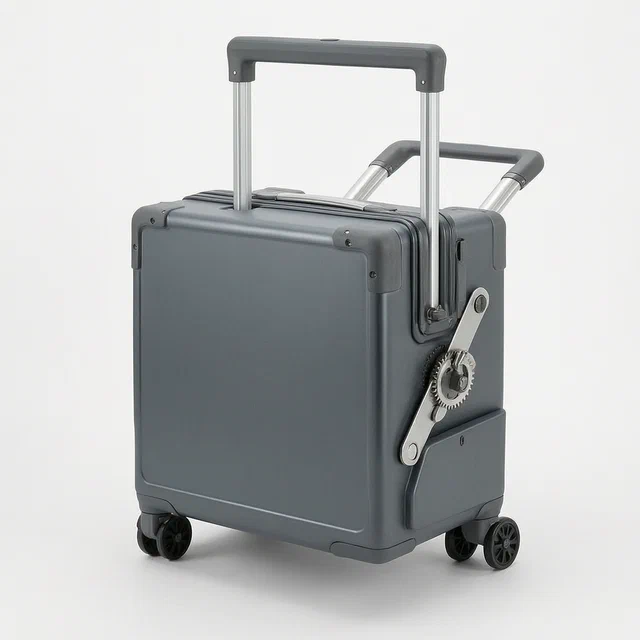
One patent on this site relates to a product sold in this market, a suitcase whose wheels retract into cavities in the case shell on a gear-and-rack drive. It is listed at the end of this report; this report covers the market around it, not its structure.
1. Market size and growth
United States. The U.S. luggage market is estimated at about USD 9.89 billion in 2024, with a projected value of about USD 15.46 billion by 2033 and growth near 5.16% a year. The same source puts the U.S. share of North American luggage demand at about 68.5%. [F1]
Global. A separate estimate sizes the global luggage market at about USD 57.48 billion in 2024, rising to about USD 96.29 billion by 2034 at roughly 5.3% a year, with the United States at about 26.45% of the global total. These two estimates use different scopes and should be read as separate ranges, not added together. [F2]
Hard-sided share. The sources describe hard-sided and soft-sided luggage as distinct product groups and track both, but this review did not find a published hard-sided share for the U.S. category. [F1] [F2]
IP2M estimate. Based on the U.S. category figure, an illustrative 5% share for retractable-wheel or cavity-storage hard cases would imply about USD 500 million at category level. That is orientation arithmetic derived from the published number, not a measured segment, forecast or valuation. [F1]
2. Product segments and who buys
The category is not one product and not one buyer. The table below is a working segmentation built from the product types described in the sources, not a set of measured shares.
| Segment | Typical product forms | Buyer and channel | What decides the purchase |
|---|---|---|---|
| Commodity hard case | Molded hardshell carry-on and checked cases, four fixed wheels | Households through mass retail, discount and marketplaces | Price, capacity, weight, colour |
| Premium hardshell | Polycarbonate and aluminum cases, branded hardware, long warranty | Households and business travellers through brand retail and department stores | Brand, shell strength, wheel and handle quality, warranty |
| Soft-sided and hybrid | Nylon and fabric cases, expandable sections, hybrid hard-back designs | Households through mass retail, e-commerce and travel retail | Flexibility, pockets, weight, price |
| Business and laptop case | Rolling business cases, laptop trolleys, briefcase-and-case hybrids | Professionals through office and electronics channels | Organisation, protection, cabin fit |
| Travel sets and licensed goods | Multi-piece sets, licensed and private-label programs | Households and retailers through mass retail and marketplaces | Set value, brand licence, price |
The published figures cover the whole luggage category, not these rows, and this review did not find segment volumes in the public summaries. [F1] [F2]
Channel decides the product form as much as the market does. A mass-retail case is bought as a set against a shelf price, so a mechanism that adds cost has to add a visible feature; a premium case is bought on brand and warranty, so the mechanism has to survive the brand’s own testing and not just a retail drop test; a business case is bought on cabin fit and organisation, which limits how much internal volume can be given up. [F1] [F2]
3. Competitive landscape
The luggage landscape includes Samsonite, Tumi, Travelpro, Delsey, Away, Rimowa and Briggs & Riley, sold through brand retail, department stores, travel retail, e-commerce and marketplaces. The sources establish brand presence and positioning, not market share. [F1] [F2]
The structure is layered. Samsonite and Tumi cover a wide price range plus premium business travel; Rimowa holds the aluminum and luxury end; Away and other direct brands built their position on design and online distribution; Travelpro, Delsey and Briggs & Riley compete on durability, warranty and crew or frequent-flyer credibility. A new mechanism has to beat a case that already has a warranty process, a testing file and a retail placement, and it has to explain its benefit in a listing photograph. [F1] [F2]
Warranty is the real competitive barrier. Luggage brands compete on how long they will stand behind a wheel, a handle and a zipper, which means a new mechanism is judged by cycle life before it is judged by novelty. [F1] [F2]
4. Trends and innovation opportunities
Trends
Hard-sided share and premiumization. Hard-sided cases and premium brands are tracked as the growth part of the category, and buyers increasingly treat shell material and wheel hardware as the visible quality signal. The sources establish the product split, not a measured hard-sided share. [F1] [F2]
Direct-to-consumer and online-first brands. Online-first brands have changed how luggage is presented: fewer retail SKUs, more photography, reviews as the durability signal. That favours features that photograph clearly and survive a return-rate test. [F1]
Cabin-size pressure. Airlines keep tightening carry-on limits, which pushes design toward shells that fit a sizer and still hold a week of clothing. Any mechanism that consumes internal volume competes directly with packing space. [F1] [F2]
Repairability and parts. Wheels, handles and zippers are the parts that fail, and brands increasingly sell or service replacements. A mechanism whose wear parts can be swapped without scrapping the shell fits that direction. This is a design reading, not a measured trend in the sources.
Innovation opportunities
The opportunities below are an analyst reading of the segment structure, not a sourced forecast. Each one succeeds or fails on a test the buyer can see.
- Wheels that retract into the shell. A case whose wheel assemblies fold into cavities when the handle is stowed presents a cleaner profile, protects the wheels in transit and removes the sizer problem at the gate. What to prove: the cavities do not leak water or collect debris, the drive survives repeated extension under load, and the lost packing volume stays acceptable.
- One motion for handle and wheels. Driving both from the telescopic handle removes a second step for the traveller. What to prove: the lock holds when the case is pulled at an angle, the gears do not strip under a loaded drop, and the assembly stays repairable.
- Repairable wheel modules. A wheel unit that unclips from the cavity without opening the shell suits the warranty model brands already run. What to prove: the joint survives drop testing, the module cannot be lost in transit, and the part cost stays inside the replacement budget.
- Cabin-fit shells. Shells designed to the sizer rather than to a nominal litre count fit the carry-on channel. What to prove: the outer dimensions hold under load, and every feature added sits inside the measured envelope.
5. Manufacturing and supply chain
Hard-sided luggage is a multi-process assembly built around a shell. Shells are thermoformed from polycarbonate, ABS, polypropylene or a blended sheet, or formed from aluminum; frames and handles are aluminum or steel tube; hinges, wheels, trolley tubes, corner guards and locks are bought-in hardware; linings are cut and sewn.
Processes. Sheet extrusion and thermoforming for shells, CNC or press forming for aluminum, tube cutting and bending for trolley frames, injection molding for wheel housings, corner parts and small mechanism components, sewing for linings and internal organisers, and final assembly with riveting and screw fastening.
Tooling. The main cost sits in thermoforming molds for each shell size and colourway, injection molds for wheel housings and mechanism parts, and assembly fixtures. A mechanism that needs cavities molded into the shell changes the shell tool, which is the most expensive kind of change in this category and usually means the mechanism must be designed into the case rather than added to it.
Cost drivers. Shell material and thickness, hardware count, wheel quality, trolley tube grade, lining, packaging and container freight move landed cost more than colour does. Retractable hardware adds parts, adds assembly time and consumes internal volume; it has to pay for itself in shelf differentiation or in the brand’s durability story.
Quality and testing. Luggage is judged by drop, tumble, handle-cycle, wheel-cycle and zipper tests, plus a water-resistance check. A retracting wheel or a linked handle drive should be cycle-tested to the brand’s own target, and the test record should include a loaded case, not just the mechanism.
No public source in this review breaks down component cost or factory lead time for hard-sided luggage. The manufacturing paragraphs above are manufacturing judgment, to be replaced with supplier quotes before a commercial commitment.
6. Compliance and market entry
Luggage sold in the United States is a general consumer product. It is not a children’s product unless it is designed or marketed for children, but CPSIA rules and 16 CFR Part 1500 hazard tests can still apply to children’s luggage and to components; 16 CFR 1303 limits lead in paint and surface coatings; and California Proposition 65 warnings may be required depending on materials and exposure. The exact scope must be confirmed with a test lab and, where relevant, the brand’s compliance team. [F3] [F4] [F5] [F6]
This review did not identify a product-specific mandatory federal performance standard for adult hard-sided luggage. That is a finding of absence in this review, not a legal conclusion that no standard exists; airline size rules, retailer requirements and voluntary standards can still add scope. [F3] [F5]
Separately, the public record shows no U.S. family member for the patent linked to this report. That is an opening rather than a clearance: separate U.S. patents on retractable wheels, telescopic handles, gear drives and luggage frames may still apply, and a freedom-to-operate review is required before launch.
For a U.S. launch, the practical sequence is: confirm whether the product is a children’s product; run drop, tumble, handle and wheel cycle tests to the brand’s target; review coatings and materials against lead and Proposition 65 rules; prepare the compliance and test file the retailer or brand requires; and keep the mechanism’s cycle data with it. A brand already selling into the channel usually owns this process, which is one reason OEM or licence supply is a better first route than a new direct brand.
7. Commercial paths, risks and open questions
Path 1: OEM or licence supply to a luggage brand. The brand brings the listing, warranty, testing and shell tooling; IP2M supplies the mechanism, drawings and production package, or licenses the design for the brand to build. This is the most realistic route for a mechanism that changes the shell tool.
Path 2: component or module supply. A case maker may want the retracting wheel unit or the handle drive as a module that fits an existing shell. This is the lowest-volume, highest-margin route and the easiest to test with one partner, but it only works if the module fits the shell rather than requiring a new cavity.
Path 3: private label for a marketplace seller. A simplified retracting-wheel case sold under a private label is faster to launch but competes on price, and the mechanism becomes a listing feature that has to survive a high return rate.
Risks. Internal volume loss, water and debris ingress into wheel cavities, gear and lock wear under loaded drops, warranty cost, shell tooling cost, freight and tariff exposure, and price competition from cases with fixed wheels are the recurring risks in this category. A warranty claim on a wheel or handle reaches the brand’s reputation faster than almost any other component failure.
Open questions. The public record does not provide U.S. volume for hard-sided or retractable-wheel cases, willingness to pay for a cleaner profile, or cycle-life data for the mechanism described on the linked patent page. The grade for any single product would improve with a committed brand pilot and passing drop and cycle data, and would fall if the mechanism cannot fit the shell tool or if an FTO review finds blocking U.S. claims.
Sources
- [F1] Deep Market Insights, U.S. Luggage Market Size, Share, Trends and Forecast, public summary, 2025 (2024 data).
- [F2] Fact.MR, Luggage Market Size, Share, Trends and Analysis, press release via GlobeNewswire, 2024-01-04.
- [F3] U.S. Consumer Product Safety Commission, CPSIA and general consumer product guidance, current.
- [F4] eCFR, 16 CFR Part 1500 – Hazardous Substances and Articles, current.
- [F5] California Office of the Attorney General, California Proposition 65, current.
- [F6] eCFR, 16 CFR Part 1303 – Ban of Lead-Containing Paint and Certain Consumer Products Bearing Lead-Containing Paint, current.
Related patent categories
Related patents
Product pages for patents that fit this market. Each page covers the mechanism, use cases, customization and patent status.