Market & Commercial Opportunity
The U.S. Pencil Sharpener Market
Market size, product segments, buyer channels, competition, trends, manufacturing, compliance and the commercial opportunity in U.S. electric pencil sharpeners.
Published November 10, 2026
Executive summary
Pencil sharpeners are a slow-growing, price-led school and office category in which most of the shelf is private label. Public estimates put the U.S. pencil-sharpener market at about USD 220.8–224.4 million in 2023–2024 and the global category at USD 828 million in 2024, forecast to reach USD 909 million by 2030. Electric-sharpener estimates range from USD 90 million to USD 2.19 billion depending on scope, so this report uses only the U.S. all-sharpener figure and treats the electric range as unusable. [F1] [F2] [F3]
The category splits by power source and by place of use: manual sharpeners for classrooms and pencil cases, electric sharpeners for classrooms and offices, artist sharpeners for drawing pencils and pastels, and novelty or licensed sharpeners for children. Each has a different mechanism, price band and safety exposure. [F1] [F2] [F4]
Visible brands include Bostitch Office, Staedtler, X-Acto, Prismacolor and Royal, with marketplace brands such as LINKYO and Ohuhu present in electric sharpeners; the summaries list presence but do not rank the segment. [F1] [F2] [F3] Purchases run on the back-to-school cycle, and a large share of the shelf is private label, which means the fight is over a narrow price band. [F1] [F4]
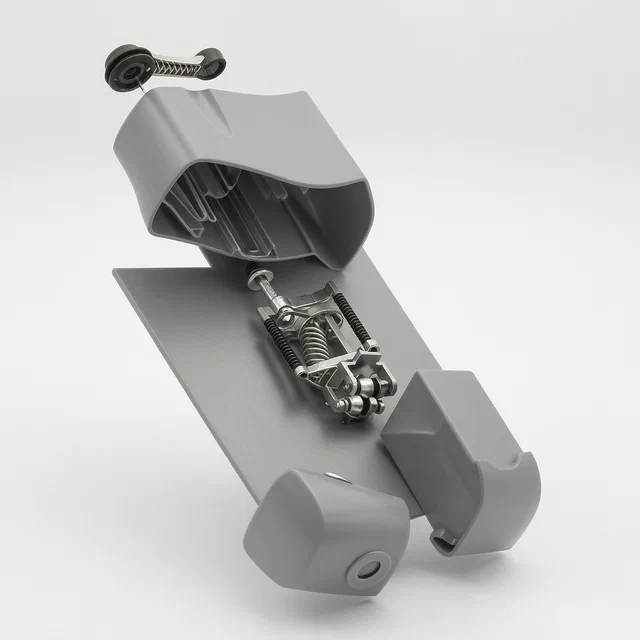
One patent on this site relates to a product sold in this market, an electric pencil sharpener. It is listed at the end of this report; the market analysis below is separate from its structure.
1. Market size and growth
United States. The U.S. pencil-sharpener market is estimated at about USD 220.8–224.4 million in 2023–2024, across two closely spaced estimates. [F1] [F2]
Global. The global category is estimated at about USD 828 million in 2024, forecast to reach about USD 909 million by 2030. [F1]
Electric sharpeners. Public estimates for the electric sub-segment range from about USD 90 million to about USD 2.19 billion depending on scope, a spread too wide to use; this report does not quote a sub-segment number. [F2] [F3]
IP2M estimate. Based on the U.S. category figure, an illustrative 5% share for a mechanism-led electric sharpener would imply roughly USD 11 million at retail level. That is orientation arithmetic, not a measured segment, forecast or valuation. [F1] [F2]
2. Product segments and who buys
| Segment | Typical product forms | Buyer and channel | What decides the purchase |
|---|---|---|---|
| Manual classroom sharpener | Wall or desk-mounted crank sharpener | Schools and districts through education distributors | Durability, replacement cutters, price |
| Electric classroom sharpener | Auto-stop electric unit with a shavings drawer | Schools and offices through education and office distributors | Speed, auto-stop, safety, price |
| Home and office electric | Compact electric unit for a desk | Households and small offices through mass retail and e-commerce | Size, noise, price, ease of emptying |
| Artist sharpener | Adjustable-point sharpener for drawing pencils and pastels | Artists and art students through art stores and e-commerce | Point length, blade quality, lead breakage |
| Novelty and licensed | Shaped or character sharpeners | Families through mass retail and e-commerce | Character, price, safety, pack size |
The published figures cover the whole category, not these rows. [F1] [F2]
Safety separates the rows. A unit sold for school use is likely to be a children’s product, so the cutter and the entry hole are the design constraints; a home-office unit carries less regulatory weight but competes on noise and how easy it is to empty. The same body rarely serves both without changes to the cutter guard and the certification file. [F1] [F4] [F5]
3. Competitive landscape
Bostitch Office, Staedtler, X-Acto, Prismacolor and Royal appear in the category, with LINKYO and Ohuhu among the marketplace brands in electric sharpeners. The sources list presence, not ranking. [F1] [F2] [F3]
The competitive structure is price-led and private-label heavy. Branded products hold the school and art channels through durability and cutter quality; marketplace and private-label products hold the home and novelty shelf through price and pack size. A new mechanism has to justify a price step in a category where the buyer can usually buy a working sharpener for very little, which is why a visible feature such as a point-length setting matters more than a hidden improvement. [F1] [F2] [F4]
4. Trends and innovation opportunities
Trends
Back-to-school seasonality. Purchases cluster around the school year, and the shelf is bought in bulk by families and by institutions, which puts pressure on landed cost and pack design. [F1] [F4]
Private-label share. A large share of the shelf is occupied by private label, which compresses the price band and rewards products that can be re-branded quickly. [F1] [F4]
Auto-stop and safety. Electric units for schools increasingly compete on stopping automatically when the point is reached, which is both a convenience and a safety claim. This is a product-feature reading from the channel, not a measured trend in the sources. [F1] [F2]
Art and hobby use. Adjustable-point sharpeners for drawing pencils and pastels serve a smaller buyer who cares about point shape and lead breakage rather than price. [F2]
Innovation opportunities
The opportunities below are an analyst reading of the segment structure, not a sourced forecast.
- A point setting the user can see. A sharpener that sets a long or short point with a visible, detented adjustment suits artists and drafting users. What to prove: the point repeats across pencils, the cutter does not chip at the setting, and the adjustment survives a school year.
- A cutter guard that cannot be defeated. A guard that keeps fingers out of the entry hole even when the unit is opened suits the school channel, where sharp edges are a compliance issue. What to prove: the guard resists a child’s probing, the cutter is still replaceable, and the unit passes the applicable sharp-edge tests.
- Shavings handling that does not spill. A drawer or chamber that does not release shavings in a school bag or on a desk reduces complaints. What to prove: the lid seals, the drawer opens one-handed, and the unit does not jam when full.
- Quiet operation. Home-office buyers compare noise, and a quieter gear or motor mount is easy to demonstrate in a video. What to prove: measured noise at desk distance without a loss of sharpening speed.
5. Manufacturing and supply chain
An electric pencil sharpener is a small electromechanical product. The housing is injection-molded ABS or polycarbonate; the cutter is hardened steel, often a helical or straight blade on a rotating head; the drive is a small DC motor with a gear train; the auto-stop is a switch or a sensor; the shavings chamber is a molded drawer.
Processes. Injection molding, blade stamping and grinding, motor and gear assembly, board assembly, final assembly, sharpening test and packaging. Manual sharpeners substitute a die-cast or molded body and a single blade for the motor and gear train.
Tooling. Housing, drawer, gear and cutter-holder molds carry the tooling cost; the blade needs its own grinding set-up. A point-setting mechanism adds a detented slider and a new cutter housing, which is a moderate tooling step for a category with thin margins.
Cost drivers. Motor and gear grade, blade steel and grinding, cavity count, switch and sensor, packaging and freight. The price band is narrow, so a mechanism has to remove a part or support a visible retail claim to survive.
Quality and testing. Buyers test point quality, sharpening time, cutter life, jam rate, noise, shavings containment and, for school products, the sharp-edge and small-parts questions. A point-setting mechanism should be cycle-tested for repeatability, not just checked on the first pencil.
No public source in this review breaks down component cost or lead time for pencil sharpeners. The manufacturing paragraphs above are manufacturing judgment, to be replaced with supplier quotes before a commercial commitment.
6. Compliance and market entry
A pencil sharpener sold for school use is commonly a children’s product, so CPSIA lead and phthalate limits, third-party testing and a Children’s Product Certificate are likely to apply; the sharp-point and sharp-edge rules in 16 CFR 1500.48 and 1500.49 cover the cutter and the entry hole; FCC Part 15 applies to any digital control circuit; and California Proposition 65 warnings apply where a listed chemical may be present. [F5] [F6] [F7]
This review did not identify a product-specific mandatory federal performance standard for pencil sharpener mechanisms beyond those children’s-product and electrical rules. That is a finding of absence in this review, not a legal conclusion that no standard exists; state procurement rules, retailer requirements and voluntary standards can still add scope. [F5] [F7]
The public record shows no U.S. family member for the patent linked to this report. That is an opening rather than a clearance: separate U.S. patents on sharpener cutters, auto-stop controls and point adjusters may still apply, and a freedom-to-operate review is required before launch.
For a U.S. launch, the practical sequence is: confirm whether the product is a children’s product; run the applicable third-party tests and prepare the certificate; run sharp-edge, point-quality, jam and noise tests; review materials against Proposition 65; and keep the records with the product file. A school-supply brand or an office-products supplier already selling into the channel usually owns this process.
7. Commercial paths, risks and open questions
Path 1: OEM or private label for a school-supply brand. The brand brings the education channel, the catalogue and the certification file; IP2M supplies the mechanism and production package. This is the realistic route at this price band.
Path 2: private label for marketplace sellers. A simplified electric unit sold online competes on reviews and price, and a visible point setting is the listing’s difference.
Path 3: art and hobby brand. An adjustable-point sharpener sold to artists can carry a higher price and a smaller volume, which suits a first production run.
Risks. Children’s-product certification, sharp-edge and cutter complaints, jams, shavings spills, motor noise, and price competition from private label are the recurring risks. In this category a safety complaint costs more than the margin on a season’s order.
Open questions. The public record does not give U.S. volume for electric or adjustable-point sharpeners, willingness to pay for a point setting, or cycle data for the mechanism described on the linked patent page. The grade for any single product would improve with a school-supply pilot and passing certification and cycle data, and would fall if the mechanism cannot meet the price band or if an FTO review finds blocking U.S. claims.
Sources
- [F1] Research and Markets, Pencil Sharpeners: Global Strategic Business Report 2024–2030, press release, 2024.
- [F2] The Insight Partners, Electric Pencil Sharpener Market Growth, Trends and Demand by 2034, public summary, 2025 (broad definition).
- [F3] Global Growth Insights, Electric Pencil Sharpeners Market Size and Growth 2033, public summary, 2024 (narrow definition).
- [F4] 6Wresearch, North America Pencil Sharpeners Market 2025–2031, public listing, 2025 (channel context).
- [F5] U.S. Consumer Product Safety Commission and eCFR, CPSIA and 16 CFR Part 1500, current.
- [F6] eCFR, 47 CFR Part 15, current.
- [F7] California Office of the Attorney General, California Proposition 65, current.
Related patent categories
Related patents
Product pages for patents that fit this market. Each page covers the mechanism, use cases, customization and patent status.