Executive summary
The U.S. percussion massage gun market is put at roughly USD 138 million in 2025: a North American market of USD 182.1 million, growing to USD 360.39 million by 2033 at 7.88% a year, with the United States at 76.0% of it. [F1] A second source values the global massage gun market at USD 491.5 million in 2025, rising to USD 921.4 million by 2033 at 8.2% a year, with North America at 37.0% and the United States at 84.27% of North America, which implies about USD 153 million for the U.S. [F2] The two U.S. derivations differ because the scopes differ, and this report presents both rather than averaging them.
The category is small next to the trade flow it sits in. U.S. imports under HS 901910, the customs heading for mechano-therapy and massage apparatus, were USD 2.459 billion in 2024, up from USD 2.204 billion in 2023, with China at USD 1.456 billion and Taiwan at USD 494.9 million. [F4] That heading covers all mechano-therapy appliances, not just massage guns, so it is context rather than a market size.
The country picture is broader than the U.S. Europe is put at USD 105.1 million in 2025, or 21.4% of the global market, rising to USD 198.6 million by 2033 at 8.3% a year, with France the fastest-growing country. [F11] China is put at USD 40.3 million in 2025, 8.2% of the global market, rising to USD 83.6 million by 2033 at 9.6%. [F12] Japan is put at USD 31.4 million in 2025, 6.4% of the global market, rising to USD 61.0 million by 2033 at 8.7%. [F13] These country figures come from one databook family, so they are internally consistent rather than independent estimates.
Competition is brand-led. Therabody reports more than 6.5 million Theragun devices sold worldwide, availability in more than 60 countries, and the number-one position in U.S. handheld percussive guns on Circana retail tracking for January–August 2025; the North American market’s top three brands are put at 56% of revenue. [F1] [F3]
The buyer mix is home-first. Home wellness and personal care is 49% of applications, sports recovery 26%, physiotherapy 13%, gyms 8% and clinics 4%, and standard full-size guns are 42% of the market while mini and compact units are 27% and the fastest-growing type. [F1]
The regulatory path is short but claim-sensitive. A consumer massager marketed for general wellness commonly fits FDA Class I, 21 CFR 890.5660, which is exempt from premarket notification subject to the limitations in 21 CFR 890.9; treatment claims can change the classification. [F5] [F6] A connected unit adds FCC Part 15, a battery pack adds UL 2054 or UL 1642, and shipping adds the UN 38.3 test summary. [F7] [F8] [F10] A unit sold in Europe or Japan needs the local electrical, EMC and radio approvals in addition. [F14] [F15]
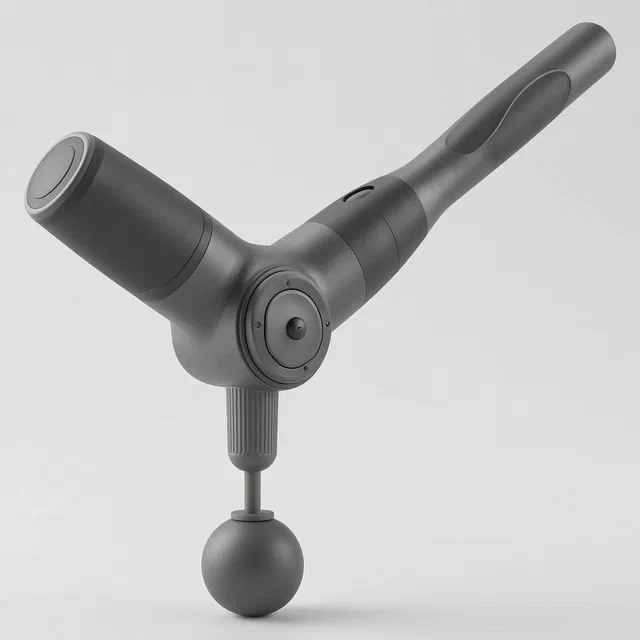
The report covers the U.S., Europe, China and Japan, with import data for other markets where no country estimate is public. One patent on this site relates to a product in this category, a two-handled percussion massager with a rotating output shaft for self-use on the back. It is listed at the end of this report; the market analysis below is separate from its structure.
Market size and growth
North America. The North American percussion massage gun market is estimated at USD 182.1 million in 2025 and projected to reach USD 360.39 million by 2033 at a 7.88% compound annual growth rate. The United States is 76.0% of the regional market, Canada 17.0% and Mexico 7.0%. [F1]
Global. The global massage gun market is valued at USD 491.5 million in 2025, USD 529.4 million in 2026 and USD 921.4 million by 2033, an 8.2% growth rate for 2026–2033. North America is 37.0% of global revenue in 2025 and the United States is 84.27% of North America. [F2]
Europe. Europe generated USD 105.1 million in 2025, USD 113.3 million in 2026 and USD 198.6 million by 2033, an 8.3% compound annual growth rate for 2026–2033. Europe was 21.4% of the global market in 2025, personal and home users were 64.32% of European revenue, and France is projected to grow fastest. [F11]
China. China generated USD 40.3 million in 2025, USD 44.0 million in 2026 and USD 83.6 million by 2033, a 9.6% compound annual growth rate for 2026–2033. China was 8.2% of the global market in 2025 and personal and home users were 65.26% of Chinese revenue. [F12]
Japan. Japan generated USD 31.4 million in 2025, USD 34.0 million in 2026 and USD 61.0 million by 2033, an 8.7% compound annual growth rate for 2026–2033. Japan was 6.4% of the global market in 2025 and personal and home users were 64.65% of Japanese revenue. [F13]
Other import markets. U.S. imports under HS 901910 were USD 2.459 billion in 2024; Germany imported USD 414.8 million, Japan USD 354.2 million, Canada USD 271.6 million and Australia USD 160.1 million in the same year. [F4] China exported USD 4.788 billion under the same heading in 2024. [F4] These are all mechano-therapy and massage apparatus, not massage guns alone, so they show the direction of trade rather than market size.
Why the two U.S. numbers differ. Applying the U.S. share to each source gives about USD 138 million from the North American figure and about USD 153 million from the global figure. [F1] [F2] The difference is about 10%, which points to scope differences — professional devices, mini units, or the value level — rather than to growth, and neither source publishes a reconciliation.
Trade context. U.S. imports under HS 901910 reached USD 2.459 billion in 2024 against USD 2.204 billion in 2023, with China at USD 1.456 billion, Taiwan at USD 494.9 million, Korea at USD 109.0 million, Canada at USD 92.9 million, Hong Kong at USD 67.3 million and Costa Rica at USD 38.2 million. [F4] The heading covers mechano-therapy and massage apparatus generally, so it cannot be read as massage gun revenue.
Brand scale. Therabody reports more than 6.5 million Theragun devices sold worldwide and availability in more than 60 countries, and cites Circana U.S. retail tracking for January–August 2025 for its number-one position in handheld percussive guns. [F3] The unit total is cumulative and the share claim is a ranking, not a published percentage.
IP2M estimate. A new brand taking 5% of the USD 138 million U.S. estimate would hold about USD 6.9 million at the stated value level. [F1] This is an orientation figure, not a forecast.
Product segments and who buys
| Segment | Typical product form | Buyer and channel | What decides the purchase |
|---|---|---|---|
| Standard full-size | Full-size gun with a fixed handle and interchangeable heads | Home users through e-commerce and mass retail | Price, amplitude, noise, battery life |
| Mini and compact | Pocket-size unit with a short stroke | Travel and gift buyers through e-commerce | Size, weight, price, battery |
| Professional-grade | Higher-torque unit for clinics and teams | Physiotherapists, trainers and sports teams | Force, duty cycle, warranty, service |
| Smart and connected | Unit with app, pressure sensor or heat | Tech-adopting home users | App quality, guidance, data privacy |
| Clinical-adjacent | Unit sold with a rehabilitation claim | Clinics and patients | Evidence, claims, reimbursement path |
Home wellness and personal care is 49% of applications, sports recovery and athletic performance 26%, physiotherapy and rehabilitation 13%, fitness centres 8% and professional clinics 4%. [F1] By type, standard guns are 42% of the market, mini and compact 27%, professional-grade 19% and smart and connected 12%. [F1]
The home segment is the largest in every country for which the databook publishes a split: 64.32% of European revenue, 65.26% of Chinese revenue and 64.65% of Japanese revenue in 2025. [F11] [F12] [F13] Medical and rehabilitation users are the fastest-growing end-use segment in all three. [F11] [F12] [F13]
Online is 68.1% of global distribution, with offline the faster-growing channel, which fits a category where buyers compare specifications online and then want to handle the device. [F2] The country channel splits are not published.
Competitive landscape
Therabody holds the number-one position in U.S. handheld percussive guns on Circana retail tracking for January–August 2025, according to the company’s own announcement, and reports more than 6.5 million Theragun devices sold. [F3] The North American top three brands are put at 56% of revenue by one source, which does not name the three. [F1]
The named field includes Therabody, Hyperice, Ekrin Athletics, LifePro, Bob and Brad, RENPHO, HoMedics, Beurer, OPOVE, Achedaway, TimTam, HYDRAGUN, Sharper Image, TOLOCO and Compex, with Sportneer also listed by a second source. [F1] [F2] The sources show presence, not share, beyond the top-three concentration and the brand ranking.
The structure is premium brand at the top and marketplace-led competition below. Premium brands carry clinical partnerships and warranty; marketplace sellers compete on price, colour and review volume. That leaves room for a differentiated mechanism — such as a two-handled format for self-use on the back — but the differentiation has to be demonstrable in use, not just in the listing.
Trends and innovation opportunities
Trends
Compact and mini. Mini and compact units are 27% of the market and the fastest-growing type at 9.2%, which favours smaller motors and lower price points. [F1]
Connected features. Smart and connected units are 12% of the market, and pressure sensing, heat and app guidance are the features being added to justify a premium. [F1]
Home use in every market. Home users are 49% of applications globally and about 64–65% of revenue in Europe, China and Japan, so the buying decision is increasingly made by a consumer rather than a therapist. [F1] [F11] [F12] [F13]
Recovery culture. Sports recovery is 26% of applications and gyms 8%, which keeps the category tied to fitness participation. [F1]
Import-led price pressure. U.S. imports of mechano-therapy apparatus rose 11.6% in value in 2024, with China at 59.2% of the total, while China exported USD 4.788 billion under the same heading, which supports both supply and price competition. [F4]
Innovation opportunities
The opportunities below are an analyst reading of the segment structure, not a sourced forecast.
- Reach the back without a second person. A two-handled format changes the use case from “someone else applies it” to “the user can reach the lower back”; what to prove is leverage, control and safety at the shoulder and spine.
- A rotating head with a locked angle. Adjusting the angle without moving the hands is the mechanism’s claim; what to prove is lock strength, repeatability and vibration at the joint.
- Battery and thermal margin. A higher-torque motor in a compact body needs thermal headroom; what to prove is stall behaviour, surface temperature and cycle life.
- Quiet operation. Noise is a home-use constraint; what to prove is sound pressure at the ear and at arm’s length across speeds.
- Claims-safe guidance. An app that suggests routines without making treatment claims keeps the product in the wellness lane. [F5] [F6]
Manufacturing and supply chain
A percussion massager is a handheld electromechanical device: a brushless or brushed DC motor, a crank or eccentric mechanism that converts rotation into a short reciprocating stroke, a spring or damper, a lithium-ion cell pack, a controller board with an optional Bluetooth module, a moulded housing, a metal or plastic transmission housing, and interchangeable silicone or foam heads.
Processes. Motor and transmission assembly, cell-pack assembly with a protection board, board assembly, housing moulding, anodising or painting, final assembly, calibration, burn-in and packaging.
Tooling. Housing and transmission moulds are the main tooling, followed by head tooling and packaging. The mechanism is the engineering cost: stroke, frequency and amplitude have to be tuned together, and the two-handled format adds a structural joint that a single-handle gun does not have.
Cost drivers. Motor, gearbox and bearings, cell pack and protection board, controller and Bluetooth module, housing material, heads, and assembly labour. The electronics are commodity; the cost sits in the mechanism and in the battery.
Quality and testing. Buyers test stall force, amplitude, frequency, noise, battery runtime and cycle life, surface temperature, drop and vibration at the handle. No public source in this review breaks down component cost or lead time for percussion massagers; the paragraphs above are manufacturing judgment, to be replaced with supplier quotes before a commercial commitment.
Compliance and market entry
A consumer percussion massager marketed for general wellness commonly fits FDA Class I, 21 CFR 890.5660, the therapeutic massager classification, which is exempt from premarket notification procedures subject to the limitations in 21 CFR 890.9; the device still carries general controls, establishment registration and device listing obligations. [F5] [F6] Claims about treating a condition, injury or disease can move the product out of that lane, so the listing copy is a regulatory decision.
A connected unit adds FCC Part 15 for its radio and digital circuitry. [F7] The battery pack is normally tested to UL 2054 or UL 1642, and the appliance to UL 60335-1; a lithium battery shipment needs a UN 38.3 test summary. [F8] [F10] California Proposition 65 applies to the plastics, coatings and electronics in the usual way. [F9]
Outside the United States, the same unit needs CE marking under the Low Voltage and EMC Directives, RoHS and REACH in the EU, and PSE under Japan’s Electrical Appliance and Material Safety Act, with the local radio approval for the Bluetooth module. These are separate from the FCC and UL path and should be planned per market. [F14] [F15]
The largest risk is the claim, not the hardware. A device sold as a recovery tool with general wellness language stays in Class I; a device sold with pain-treatment or rehabilitation language invites a different review. The second risk is the battery: a high-drain cell in a sealed handle needs thermal and fault protection that is documented, not assumed.
The public record shows no U.S. family member for the patent linked to this report. That is an opening rather than a clearance: separate U.S. patents on percussion mechanisms, rotating heads and two-handled housings may still apply, and a freedom-to-operate review is required before launch.
For a launch, the practical sequence is: fix the claim set and confirm the Class I path before designing the packaging; run battery, thermal, stall and cycle testing; complete FCC, CE and PSE testing for each target market; review materials against Proposition 65 and REACH; and prepare the UN 38.3 summary for shipping. A partner already selling into the fitness or wellness channel usually owns this process.
Commercial paths, risks and open questions
Path 1: OEM for a fitness or wellness brand. The brand brings the channel, claims discipline and warranty; IP2M supplies the two-handled mechanism and the production package. This is the realistic route because the regulatory and warranty work is the expensive part.
Path 2: private label for a retailer. A simpler unit without connectivity fits a mass-retail price point in the U.S., Europe or Japan, with the mechanism as the visible difference.
Path 3: professional channel. Clinics, teams and physiotherapists buy on force, duty cycle and service, which supports a higher price and a longer warranty but a slower sales cycle.
Path 4: distribution of a completed unit. The lowest-margin route and the one most exposed to price competition from imported units.
Risks. Claim wording, battery safety, motor and mechanism life, noise, vibration at the handle, returns, counterfeit competition, import price pressure and country-specific approvals are the recurring risks. A battery failure in a handheld device is a safety event, not a warranty claim.
Open questions. The public record does not give a U.S.-only market value on a single definition, a split by mechanism, or field reliability data for two-handled units. The grade for any single product would improve if a partner commits to a wellness claim set, the unit passes battery and cycle testing, and an FTO review finds no blocking U.S. claims; it would fall if the product needs a treatment claim to sell, if the mechanism cannot be made quiet and durable, or if the battery cannot be certified for the intended channel.
Sources
- [F1] HTF Market Intelligence, North America Percussion Massage Gun Market, research report (public summary), 2025.
- [F2] Grand View Research, Massage Gun Market Size, Share & Trends Analysis Report, 2026–2033, research report (public summary), 2026.
- [F3] Therabody, Therabody Surpasses 6.5 Million Theragun Devices Sold (press release citing Circana), company announcement, 2025.
- [F4] United Nations Comtrade Database, HS 901910 mechano-therapy appliances: U.S., German, Japanese, Canadian and Australian imports and China exports 2024, official customs statistics, 2026.
- [F5] U.S. Electronic Code of Federal Regulations, 21 CFR 890.5660 – Therapeutic massager, regulation, current.
- [F6] U.S. Food and Drug Administration, Product classification, product code ISA, device classification database, current.
- [F7] U.S. Federal Communications Commission, 47 CFR Part 15 – Radio Frequency Devices, regulation, current.
- [F8] UL Solutions, UL 2054 – Household and Commercial Batteries, UL 1642 – Lithium Batteries and UL 60335-1 – Household and Similar Electrical Appliances, safety standards, current.
- [F9] California Office of the Attorney General, California Proposition 65, regulation, current.
- [F10] United Nations, Manual of Tests and Criteria, Part III, sub-section 38.3, transport standard, current.
- [F11] Grand View Research, Europe Massage Gun Market Outlook, 2033, research report (public summary), 2026.
- [F12] Grand View Research, China Massage Gun Market Outlook, 2033, research report (public summary), 2026.
- [F13] Grand View Research, Japan Massage Gun Market Outlook, 2033, research report (public summary), 2026.
- [F14] Ministry of Economy, Trade and Industry (Japan), Electrical Appliance and Material Safety Act (DENAN), regulation, current.
- [F15] EUR-Lex, Low Voltage Directive 2014/35/EU, EMC Directive 2014/30/EU, RoHS 2011/65/EU and REACH, regulations, current.