Market & Commercial Opportunity
The U.S. Pet Grooming Market for Vacuum Brush Attachments
Market size, product segments, buyer channels, competition, trends, manufacturing, compliance and the commercial opportunity in U.S. vacuum pet-brush attachments.
Published November 10, 2026
Executive summary
Pet grooming is a large, growing U.S. category, but the part a vacuum brush attachment competes for is much smaller and less well measured. One estimate sizes the U.S. pet grooming products market at USD 5.11 billion in 2024, rising to USD 7.01 billion by 2030 at about 5.4% a year, with online the fastest-growing channel; a second puts the U.S. market at USD 3.7 billion in 2024, inside a global market of USD 14.5 billion forecast to reach USD 21.4 billion by 2030 at 6.7%. [F1] [F2] The two U.S. figures use different definitions and are not additive.
Home pet grooming electrical appliances are a much smaller global segment, estimated at USD 136 million in 2024 and forecast to reach USD 208 million by 2031 at 6.4% a year. [F3] That is the segment an attachment belongs to, and even that figure covers whole appliances rather than tools.
The relevant buyer already owns the expensive part. Pet hair on furniture is a persistent, high-frequency problem, and the people who solve it with a vacuum already have the hose the attachment fits. A brush head that the vacuum sucks through, with a scraper that clears the bristles without the owner touching the hair, fits that habit and demonstrates immediately. [F1] [F3]
The named electrical grooming brands include Dyson, HOMERUN, PETKIT, Neakasa, AIRROBO, oneisall, Afloia and Simple Way, with Bissell and Shark in the broader grooming and vacuum market; the summaries do not rank companies or measure tool attachments. [F1] [F2] [F3]
No public source in this review isolates vacuum pet-brush attachments, their U.S. volume, or the price a vacuum brand pays for a tool, so neither the niche nor the royalty base can be sized from public data.
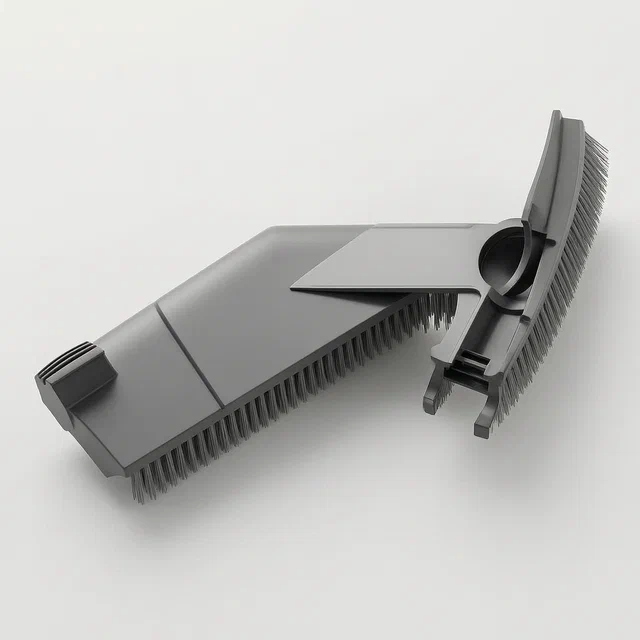
One patent on this site relates to a product sold in this market, a vacuum brush head with a self-clearing scraper. It is listed at the end of this report; the market analysis below is separate from its structure.
1. Market size and growth
U.S. pet grooming products. USD 5.11 billion in 2024, forecast to reach USD 7.01 billion by 2030 at about 5.4% a year, with online the fastest-growing channel. [F1]
Alternative U.S. measure. USD 3.7 billion in 2024, inside a global market of USD 14.5 billion forecast to reach USD 21.4 billion by 2030 at 6.7%. The scope differs from the first figure. [F2]
Home grooming appliances. The global segment is estimated at USD 136 million in 2024, forecast to reach USD 208 million by 2031 at 6.4% a year. [F3]
Vacuum brush attachments. No public source in this review reports them separately, in units, dollars or royalty terms. [F1] [F3]
IP2M estimate. Based on the appliance segment, an illustrative 5% share would imply roughly USD 7 million globally in 2024. It is deliberately narrow, because the product is an attachment rather than an appliance and the real prize is a place on a vacuum brand’s accessory list. [F3]
2. Product segments and who buys
| Segment | Typical product forms | Buyer and channel | What decides the purchase |
|---|---|---|---|
| Vacuum pet tool | Brush or nozzle head that fits a hose | Owners of a compatible vacuum through the vacuum brand and e-commerce | Compatibility, suction loss, hair release, price |
| Grooming appliance | Clipper, dryer or vacuum-and-clipper kit | Pet owners through pet retail and e-commerce | Noise, blade heat, suction, price |
| Manual brush and comb | Slicker, rake, de-shedding tool | Owners through pet retail and mass retail | Bristle type, comfort, price |
| Self-cleaning brush | Manual brush with a retracting bristle plate | Owners through e-commerce | Hair release, size, price |
| Litter and floor tool | Rake, scoop, vacuum floor head | Cat owners through pet retail | Fit for litter, reach, price |
The published figures cover grooming products and appliances, not these rows. [F1] [F2] [F3]
Compatibility is what separates the vacuum row from the rest. A manual brush sells to any owner with a cat; a vacuum attachment sells only to owners of a hose it fits, which is why the natural partner is a vacuum brand with an existing pet line rather than a standalone listing. Inside that row the decision is suction loss and how the hair leaves the tool: an attachment that visibly weakens the vacuum, or that hands the owner a mat of hair to pull off, is returned. [F1] [F3]
3. Competitive landscape
The electrical grooming segment named in public summaries includes Dyson, HOMERUN, PETKIT, Neakasa, AIRROBO, oneisall, Afloia and Simple Way; the broader U.S. grooming market is served by vacuum and pet-care brands such as Bissell and Shark alongside specialist groomers. The sources establish presence, not share, and do not measure tool attachments. [F1] [F2] [F3]
The structure is brand-led at the appliance level and accessory-led beneath it. Appliance brands sell the vacuum and then the tools for it, which makes the accessory list a closed shelf: a third-party head can win only if the brand adopts it or if it is sold as a universal fit with adapters. That is the strategic choice in this category, and it decides the whole commercial plan. [F1] [F3]
4. Trends and innovation opportunities
Trends
Online as the fastest-growing channel. Online is the fastest-growing sales channel for U.S. pet grooming products, which favours products that demonstrate well in video. [F1]
Grooming at home. Home grooming appliances are growing at about 6.4% a year globally, as owners take over tasks that used to go to a groomer. [F3]
De-shedding as a routine. Hair on furniture and floors is a recurring problem rather than a seasonal one, which keeps demand for tools that remove it rather than tools that only brush. This is a reading of use patterns, not a measured trend in the sources. [F1]
Suction-based tools. Owners who already own a pet vacuum or a vacuum with pet tools are the natural first buyer for any attachment, which concentrates demand among a small number of brands. [F3]
Innovation opportunities
The opportunities below are an analyst reading of the segment structure, not a sourced forecast.
- Hair removed without touching it. A scraper that strips the bristles while the suction stream carries the hair away removes the step owners dislike most. What to prove: the scraper clears the full bristle field, hair reaches the canister rather than the head, and the tool does not need opening to clean.
- A head that does not choke the airflow. A brush plate and grid that pass air without strangling suction. What to prove: measured suction loss against the bare hose, and airflow after the head fills with hair.
- One head, several hoses. A fit that covers the common hose diameters through an adapter set. What to prove: the adapter does not leak, does not pull off under suction, and holds fit across the installed base.
- Safe around skin. A moving scraper next to a brush plate is a pinch point. What to prove: fingers and pet skin cannot reach the scraper in motion, and the tool survives a drop on a hard floor.
5. Manufacturing and supply chain
A vacuum brush head is a small plastic and metal assembly. The body and brush plate are moulded ABS or polypropylene, the bristles are nylon or a mixed synthetic, the scraper is stamped steel or moulded plastic, the grid is moulded or stamped, and the suction end is a moulded connector sized to a hose.
Processes. Injection moulding, bristle tufting or insert moulding, stamping, assembly, airflow and function testing, and packaging. A moving scraper adds a guide, a clamping groove and a buckle, which are assembly and tolerance items rather than new processes.
Tooling. Body, plate, grid and connector moulds carry the tooling cost, and a second hose diameter means a second connector mould. That is why an adapter set is often cheaper to tool than a range of dedicated heads.
Cost drivers. Mold cavity count, bristle density and material, scraper and grid parts, assembly labour, packaging and freight. The unit cost of a head is low against the vacuum it fits, which means the buyer’s decision is about suction loss and returns rather than about a few cents of moulding.
Quality and testing. Buyers test airflow and suction loss, hair pickup, scraper clearance, drop, and for pet tools the pinch and skin-contact questions. A self-clearing head should be tested with the hair it is meant to handle, because a scraper that works on a clean bench can jam on a full head.
No public source in this review breaks down component cost or lead time for pet tools. The manufacturing paragraphs above are manufacturing judgment, to be replaced with supplier quotes before a commercial commitment.
6. Compliance and market entry
CPSIA and 16 CFR Part 1500 apply only where a product is designed or marketed for children, but the sharp-point and sharp-edge rules are a useful design reference for a tool with a moving scraper. California Proposition 65 warnings may be needed for plastics, coatings and lubricants, and performance claims such as self-cleaning or hair removal must be substantiated under FTC advertising guidance. [F4] [F5] [F6]
Two constraints matter more than certification. First, airflow: a tool that visibly weakens suction will be returned whatever else it does, so the airflow figure has to be measured and kept. Second, claims: “self-cleaning” and pet-safety statements need test evidence before they go on a listing, and a claim about removing allergens or preventing matting would go beyond what the product can show. [F6]
The public record shows no U.S. family member for the patent linked to this report. That is an opening rather than a clearance: separate U.S. patents on vacuum pet tools, grooming heads and bristle cleaners may still apply, and a freedom-to-operate review is required before launch.
For a U.S. launch, the practical sequence is: fix the hose interfaces and the adapter set; measure suction loss and hair pickup; test the scraper for pinch and jam; run drop and durability tests; review materials against Proposition 65; substantiate every claim; and keep the records with the product file. A vacuum brand with an existing pet line usually owns this process, which is why a licence or OEM route is the realistic one.
7. Commercial paths, risks and open questions
Path 1: OEM or licence to a vacuum brand. The brand owns the hose standard, the accessory list and the warranty; IP2M supplies the head, the scraper mechanism and the production package. This is the route that reaches volume.
Path 2: pet-care brand that sources vacuums. A pet brand buying appliances can add the tool to its own kit, which gives compatibility without competing with a vacuum maker.
Path 3: universal-fit accessory with adapters. A marketplace listing with an adapter set reaches owners across brands, at a lower price and a higher return rate.
Risks. Suction loss, scraper jams, hair trapped in the head, pinch points near skin, hose compatibility, returns on a universal fit, and unsupported claims are the recurring risks. In a category where the buyer already owns a working tool, a head that underperforms the hose is returned rather than kept.
Open questions. The public record does not give the volume, price or royalty basis for vacuum brush attachments, their return rate, or airflow data for the mechanism described on the linked patent page. The grade for any single product would improve with a vacuum-brand pilot and measured suction loss, hair pickup and scraper-cycle data, and would fall if the head chokes airflow, if the scraper jams, or if an FTO review finds blocking U.S. claims.
Sources
- [F1] TechSci Research via Research and Markets, United States Pet Grooming Products Market, By Pet Type, By Product Type, By Sales Channel, By Region, Competition, Forecast & Opportunities, 2020–2030F, 2025.
- [F2] Global Industry Analysts via Research and Markets, Pet Grooming Products – Global Strategic Business Report, 2024.
- [F3] Global Info Research, Global Home-Based Pet Grooming Products Market 2025 by Company, Regions, Type and Application, Forecast to 2031, 2025 (appliance segment).
- [F4] U.S. Consumer Product Safety Commission, Business guidance – CPSIA and 16 CFR Part 1500, current.
- [F5] California Office of the Attorney General, California Proposition 65, current.
- [F6] U.S. Federal Trade Commission, Advertising and Marketing Basics, current.
Related patent categories
Related patents
Product pages for patents that fit this market. Each page covers the mechanism, use cases, customization and patent status.